Car Clicks but Won’t Start: Battery, Starter, or Relay?
A single click with dim dash lights usually points to a weak battery or poor connection; rapid clicks often mean low voltage, while one solid click with bright lights often points to the starter or starter relay. Bad diagnosis burns time and can send you after the wrong part. This guide separates battery, relay, starter, cable, ground, and control-side faults by sound, dash behavior, and simple tests.
What the click pattern means
The click pattern is the quickest clue because it shows whether the fault sits on the power side or the control side of the starting system. Rapid clicking often points to low voltage or high resistance. One loud click can mean the solenoid engages but the starter will not spin. No click at all usually shifts attention to the start-signal circuit.
Single loud click versus rapid clicking
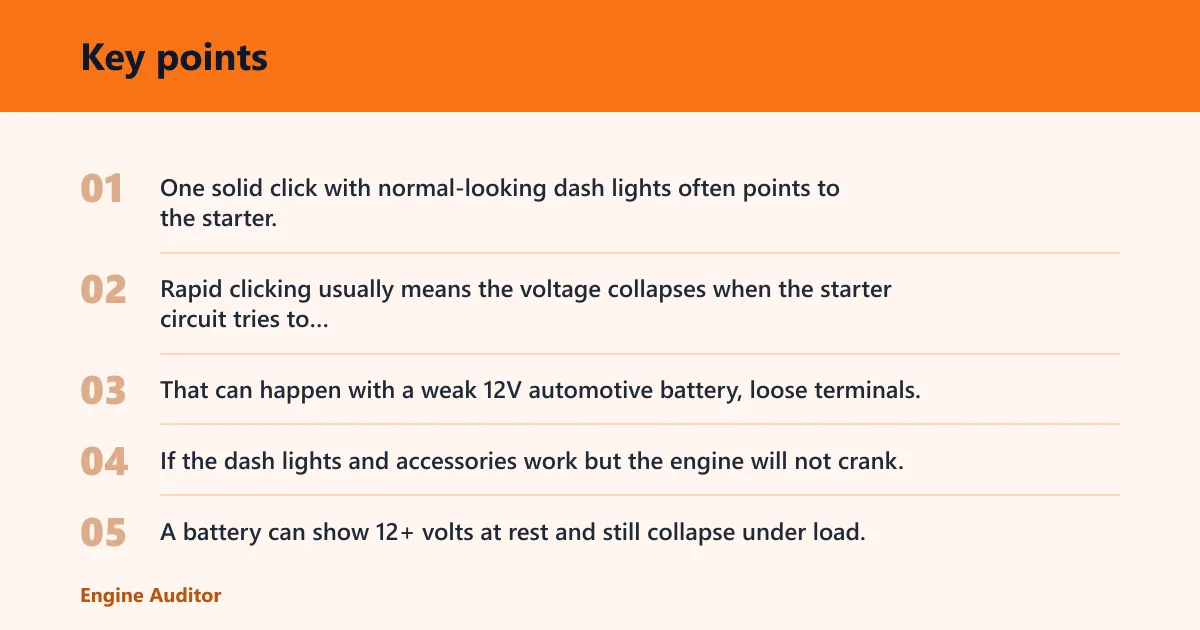
One solid click with normal-looking dash lights often points to the starter, starter solenoid, or a high-resistance cable fault. Rapid clicking usually means the voltage collapses when the starter circuit tries to draw current. That can happen with a weak 12V automotive battery, loose terminals, or hidden corrosion inside a cable.
What no-crank with lights on usually means
If the dash lights and accessories work but the engine will not crank, do not assume the battery is fine. A battery can show 12+ volts at rest and still collapse under load. State-of-charge is not the same as load capacity, and load testing matters more than resting voltage alone.
How dash lights and accessory power change the diagnosis
Bright lights with no crank usually shift suspicion away from gross battery failure and toward the starter circuit, relay, solenoid, neutral safety switch, ignition switch, or immobilizer. Dim lights, slow cranking, or lights that fade hard during a start attempt point back toward battery condition, cable resistance, or poor ground quality.
Click no-start decision table
Use the symptom first, then the first test, then the confirmatory check. That order keeps you from replacing a battery, starter, or relay before you know which side of the circuit failed.
| Symptom | Likely culprit | Quick check | Confirmatory test | What to replace only after confirmation |
|---|---|---|---|---|
| Rapid clicking and dim dash lights | Weak battery or high resistance in cables | Check terminal tightness and note light dimming during crank | Battery load test and voltage-drop test on positive and negative paths | Battery, cable, or terminal only if the test points there |
| One loud click, bright lights, no crank | Starter motor, solenoid, or cable voltage drop | Listen for a single click at key-on start | Measure voltage at the starter during crank; check current draw under crank if available | Starter assembly or starter-side repair after power feed is verified |
| No click, no crank, dash lights work | Relay, ignition switch, start button circuit, or immobilizer | Check for a security light and confirm the key or fob is recognized | Test for start signal at the relay control circuit | Relay, switch, or module only after the control signal is missing |
| Clicks only in Park, starts in Neutral | Neutral safety switch / park-neutral switch | Try Neutral with the brake applied | Inspect switch adjustment and verify start-signal continuity in both ranges | Park-neutral switch or linkage adjustment |
| Starts after a jump, fails again later | Battery with poor load capacity, loose connections, or undercharging alternator | Compare cranking speed on the donor source | Battery load test, alternator output test, and belt check | Battery or charging fault only after load and output tests |
| Single click only when hot | Starter motor wear or solenoid sticking | Try again after a short cool-down | Check voltage at the starter and current draw under crank | Starter assembly if the starter fails hot but power and control are present |
| Intermittent no-response from the key or button | Ignition switch or start button circuit | Watch for dash response and repeat with the wheel in a neutral position if needed | Verify start command output from the switch or button circuit | Switch, button, or related wiring after signal loss is proven |
| Lights work, crank is blocked, security lamp is on | Immobilizer or security system lockout | Check whether the security indicator stays lit or flashes oddly | Try a known-good key or fob and confirm the module recognizes it | Key, fob, or immobilizer diagnosis only after recognition failure is confirmed |
Why the first test matters before any parts replacement
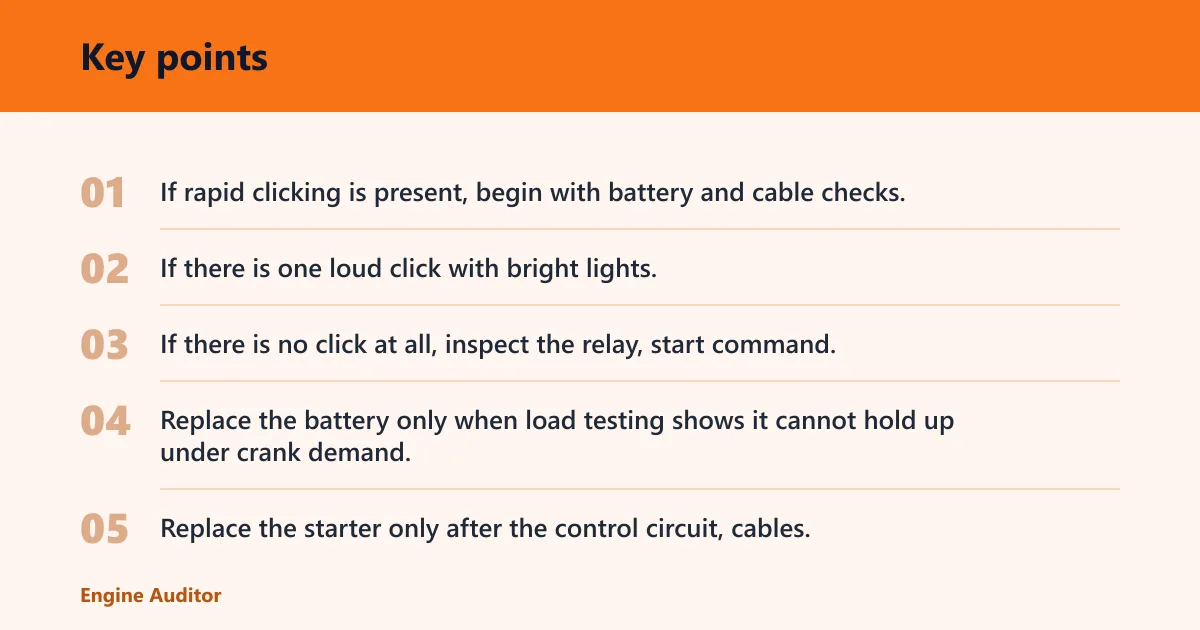
The first test should match the symptom. If rapid clicking is present, begin with battery and cable checks. If there is one loud click with bright lights, move to starter-side voltage and current checks. If there is no click at all, inspect the relay, start command, and security indicators before touching the starter.
What to replace only after confirmation
Replace the battery only when load testing shows it cannot hold up under crank demand. Replace the starter only after the control circuit, cables, and ground path have been verified. Replace the relay only when the relay is not switching correctly and the start command is present. That sequence saves time and cuts guesswork.
Is the battery actually bad?
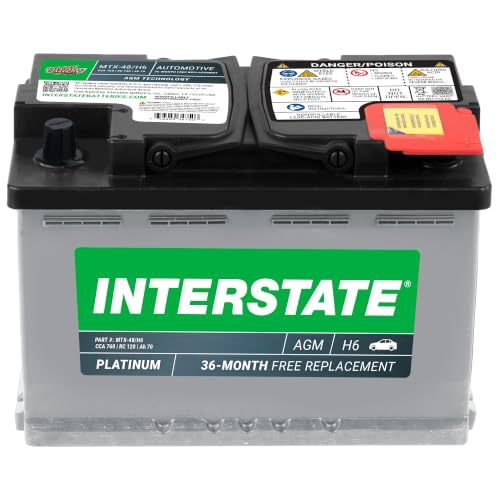
A battery can look normal on a meter and still fail the job. Resting voltage shows state-of-charge, not load capacity. Cold cranking amps, or CCA, describe how much current the battery can deliver during startup. AGM and conventional batteries can behave differently under the same conditions, so battery type matters during diagnosis.
Resting voltage versus load capacity
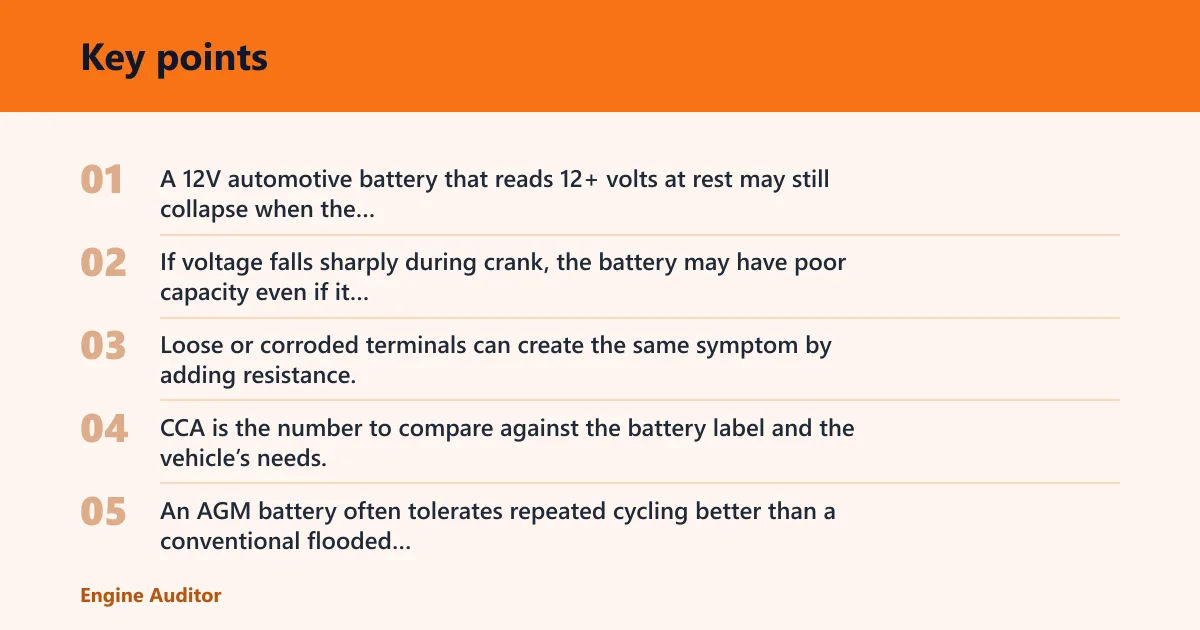
A 12V automotive battery that reads 12+ volts at rest may still collapse when the starter asks for heavy current. That is why a load test matters. If voltage falls sharply during crank, the battery may have poor capacity even if it seems charged. Loose or corroded terminals can create the same symptom by adding resistance.
CCA, AGM, and conventional battery differences
CCA is the number to compare against the battery label and the vehicle’s needs. An AGM battery often tolerates repeated cycling better than a conventional flooded battery, but either one can fail if load capacity drops. The label may still be correct while the battery no longer supports starting current.
How a jump-start result points to battery, cables, or starter
If a jump-start makes the engine crank normally, the fault may be a weak battery, poor cable connection, or high resistance in the ground path. A jump can also mask a starter problem by boosting voltage long enough to spin it. So the result points direction, but it does not prove the battery is the only fault.
Say your sedan clicks rapidly after sitting overnight, then starts immediately with a jump. If the same behavior returns the next morning, the problem may be battery load capacity or undercharging, not just a dead cell. The follow-up should be a load test and charging-system check, not a parts guess.
Can the cables or ground be the fault?
Yes. Battery cables and the engine/body ground strap can stop a good battery from delivering starter current. Loose or corroded connections, including hidden internal corrosion, can create high resistance that mimics a weak battery. Check both the positive and negative paths, not just the visible terminals.
Positive and negative path checks
Inspect the positive cable from battery to starter and the negative cable from battery to body and engine. Tight, clean connections matter at both ends. A corroded clamp, frayed cable end, or loose stud can cause slow cranking, rapid clicking, or one click with no spin.
Hidden corrosion inside battery cables
Cable failure is not always visible at the clamp. Green or white corrosion can travel under the insulation and increase resistance where you cannot see it. Flexing a cable while watching for heat, stiffness, or swelling can reveal trouble, but voltage-drop testing gives a better answer than appearance alone.
Voltage-drop testing on cable and ground circuits
Voltage-drop testing checks how much voltage is lost while the circuit is loaded. That is the right way to find hidden resistance in the positive cable, the negative cable, and the engine/body ground strap. A ground strap problem can mimic a weak battery because the starter still lacks current even though the battery itself may be fine.
Suppose a truck has bright dash lights and one click, but the starter spins only when a remote jump post is used. That pattern often points to a bad engine ground strap or a corroded cable path, because the jump source changes the current route enough to bypass the weak link.
Starter, relay, or solenoid
The starter relay switches the control circuit. The starter solenoid engages the starter drive and often sits on the starter assembly. The starter motor then turns the engine. A fault in any one of those pieces can create the same click-no-crank symptom, so you need the sound pattern plus voltage checks to separate them.
Relay chatter and control-circuit switching
A bad starter relay can make a car click and not start. Rapid clicking or chattering often points to low voltage at the relay coil or a poor control-side connection. Because the relay can fail independently of the starter, a quick voltage check at the relay is worth doing before replacing the starter assembly.
Solenoid click with no crank
What does one loud click usually mean? It often means the solenoid engages but the starter will not spin. On many vehicles the solenoid is part of the starter assembly, so that click can point to an internal starter fault, a sticking solenoid, or a cable issue that prevents current from reaching the motor.
Starter motor wear, current draw, and intermittent failure
Starter motor failure can cause a single click with no start, especially when brushes or bushings are worn. Current draw under crank helps separate a seized or worn starter from a control problem. If voltage reaches the starter but the motor does not turn, the starter is a stronger suspect than the relay.
Why it starts in Neutral
If the car only clicks in Park, the park-neutral switch may be a likely suspect. Trying Neutral is a simple test on automatic transmissions, because a worn or misadjusted switch may block the start command in Park while allowing it in Neutral. Start-signal issues can also come from the ignition switch or start button circuit.
Park-neutral switch diagnosis
Move the selector to Neutral, hold the brake, and try again. If the engine cranks there but not in Park, the switch or shifter linkage may be out of adjustment. That is a control-side fault, not a battery fault, even if the click sounds electrical.
Start signal delivery from ignition switch or start button
An intermittent no-response symptom often points to the ignition switch or start button circuit. The battery can be fine, the starter can be fine, and the engine still will not crank because the start signal never reaches the relay. That is why control-side diagnosis matters when the dash responds but the starter does not.
How immobilizer or security lockout changes the path
An immobilizer or security system can allow lights and accessories while blocking crank. A security light that stays on or flashes oddly is a strong clue. A key or fob that is not recognized can stop cranking even though the battery, relay, and starter are healthy.
Alternator checks after a dead battery
If the battery keeps dying after driving, the alternator moves up the list. Undercharging can leave a battery too low for the next start, and belt tension matters because a slipping belt can reduce output. This is a different complaint from a pure click-no-crank fault, but the two can overlap.
Repeated dead battery after driving
When a vehicle starts after a charge or jump and then dies again after normal driving, the charging system deserves attention. The alternator may not be supplying enough current, or the battery may already be damaged from repeated deep discharge. Both situations can leave you chasing a starting complaint that keeps returning.
Undercharging and belt tension
Check belt condition and tension before blaming the alternator itself. A loose belt can reduce alternator output at idle and low speed. If the battery repeatedly ends up low, verify charging voltage and the belt drive so you do not replace a healthy alternator on a weak mechanical drive.
Ripple testing and what it tells you
Alternator output and ripple testing can confirm whether the charging system is steady. Excess ripple points to a diode or alternator fault that can upset charging quality. That matters when the complaint is repeated battery drain after driving, not just a one-time no-crank event.
Frequently asked questions
Why does my car click but not start even with a good battery?
A battery can read fine at rest and still fail under starter load. If the battery passes a load test, the next suspects are loose terminals, hidden cable corrosion, a bad ground strap, a starter relay issue, or a starter motor that cannot spin even though the solenoid clicks.
Does rapid clicking mean the battery is dead or the starter is bad?
Rapid clicking often points to low voltage or high resistance, so it is not a starter verdict by itself. A weak battery, corroded terminal, bad cable, or poor ground can all cause relay chatter. Confirm with a load test and voltage-drop checks before replacing the starter.
What does one loud click when starting a car usually mean?
One loud click often means the starter solenoid engages but the motor does not turn. That can happen with a worn starter, a sticking solenoid, a cable voltage-drop problem, or a battery that cannot supply enough current under crank. A voltage test at the starter helps separate those cases.
Can a bad starter relay make a car click and not start?
Yes. The relay can fail independently of the starter, and a bad relay can cause rapid clicking, chatter, or no crank at all. Check whether the relay is receiving a proper start signal and whether it is switching power out. Do not replace the starter first if the relay never closes.
How do I tell if the battery cables or grounds are the problem?
Check both terminals for tightness and cleanliness, then inspect the positive cable and the engine/body ground strap for damage or corrosion. Hidden corrosion inside the cable can be missed by eye. A voltage-drop test during crank is the cleanest way to prove a cable or ground fault.
Should I try starting in Neutral if the car only clicks in Park?
Yes. On automatics, trying Neutral is a quick test for a worn or misadjusted park-neutral switch. If it cranks in Neutral but not in Park, the fault is in the shift-range input or linkage, not the battery or starter. That result deserves control-side diagnosis next.
Products related to this article
Sponsored / affiliate links. As an Amazon Associate I earn from qualifying purchases. I may earn additional commission from eligible campaigns.