How to Tell If Your Car Battery Is Dead or Just Cold
A car battery is likely just cold if the dash lights are dim, the starter turns slowly, and it recovers after warming or a jump. It is likely dead if it still will not crank or loses charge again within a short drive. Ignoring that split can leave you stranded, send you after the wrong part, and hide a charging fault. This guide shows the symptom order, simple recovery checks, and what to expect after warming or jump-starting. For quick background, see Cold weather, why cars struggle to start in cold weather, and how to jump-start a car in freezing weather.
What you’ll need

- Measures AC/DC voltage for battery checks
- True RMS with 6000-count resolution
- USB-C rechargeable with built-in worklight
- Multimeter for a voltage check
- Jump starter or jumper cables
- Battery charger or maintainer
- Owner’s manual for the minimum CCA rating
- Gloves and eye protection
Is the battery dead or just cold?
A cold battery can act dead because chemical activity slows in low temperatures, and available cranking power drops as the battery gets colder. Winter often exposes weak batteries first. A rested battery near 12.6 volts is typically healthy, about 12.4 volts suggests a partial charge, and below about 12.2 volts means the battery is substantially discharged. A battery can still show near-normal resting voltage and fail under load, so the crank test matters too. If it starts after warming or charging, the battery may be cold-soaked rather than failed.
Check the starting symptom first
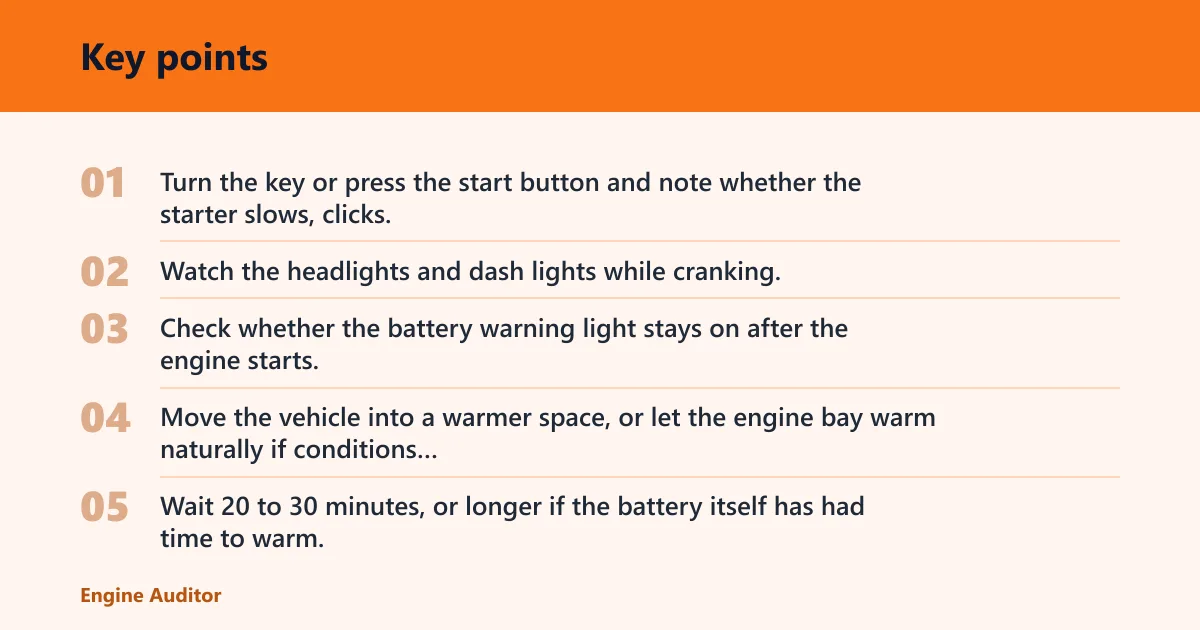
- Turn the key or press the start button and note whether the starter slows, clicks, or stays silent.
- Watch the headlights and dash lights while cranking; bright lights with clicking often point away from a totally flat battery.
- Check whether the battery warning light stays on after the engine starts, because that can mean a charging-system fault.
Warm the battery area and retry
- Move the vehicle into a warmer space, or let the engine bay warm naturally if conditions allow.
- Wait 20 to 30 minutes, or longer if the battery itself has had time to warm, then try again.
- If the engine starts normally after warming, treat the battery as cold-soaked and retest after a full charge.
Look for terminal problems
- Inspect the positive and negative posts for white or green corrosion, looseness, or damaged clamps.
- Clean and tighten the terminals before another start attempt.
- If corrosion keeps returning, plan for terminal service and a battery check, since corroded terminals can mimic a dead battery.
Rule out starter, battery, or charging system
- If the starter barely turns, suspect weak supply, not just temperature.
- If it clicks but the headlights stay bright, inspect connections and the starter circuit next.
- If it starts but dies soon after, check the alternator and charging system before replacing the battery.
Cold-weather battery decision table
Use the voltage and sound pattern together, not separately. A rested battery should read about 12.6 volts; around 12.4 volts usually means partial charge; below about 12.2 volts is discharged. Even with a near-normal resting voltage, a battery may fail when cranked under load. With the engine running, 13.7 to 14.7 volts usually indicates alternator charging. Single click, rapid click, and no click each point to different likely faults, so the table below separates them for faster diagnosis.
| Symptom | Likely cause | Quick test | Next action |
|---|---|---|---|
| Slow crank after an overnight freeze | Cold-soaked battery with reduced cranking power, or a weak battery nearing the end of its life | Warm the vehicle area, then retest after 20 to 30 minutes | charge and retest |
| Clicking with bright headlights | Battery may be weak, but loose terminals or starter draw are also possible | Check terminal tightness and corrosion, then try a jump | check alternator/terminals |
| No-start that improves after warming | Cold-soaked battery, especially if the battery is older or the car sits outside | Warm it, then start again without charging first | charge and retest |
| Jump-start succeeds but the car dies again | Battery may not hold charge, or the alternator is not recharging it | Measure voltage with a multimeter after a short drive | check alternator/terminals |
| Battery light stays on after start | Charging-system fault, not just a battery problem | Check the belt, charging voltage, and terminal condition | check alternator/terminals |
| Swollen or leaking battery case | Internal battery failure | Inspect the case for bulging, cracks, or wet residue | replace battery |
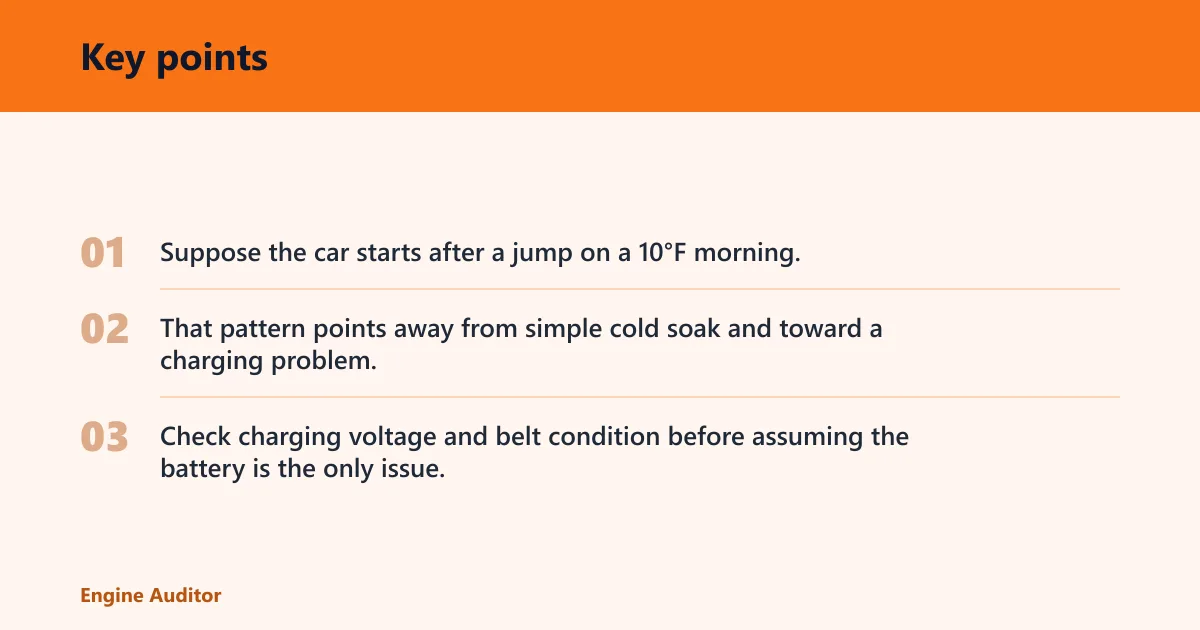
Suppose the car starts after a jump on a 10°F morning, then stalls at the next stoplight and the battery light comes on. That pattern points away from simple cold soak and toward a charging problem, because the alternator should carry the electrical load once the engine is running. Check charging voltage and belt condition before assuming the battery is the only issue.
Can a cold battery be recharged?
Yes, if the battery only went flat from lights, a radio, or a short cold-weather drain, you can often recharge it and start normally again. A jump starter or jumper cables give a temporary boost. They do not repair an internal battery failure, and they should not be used on a cracked or leaking battery. Charging a damaged battery is unsafe and a battery that repeatedly falls below charge may be at end of life.
Use a charger after a weak-start event
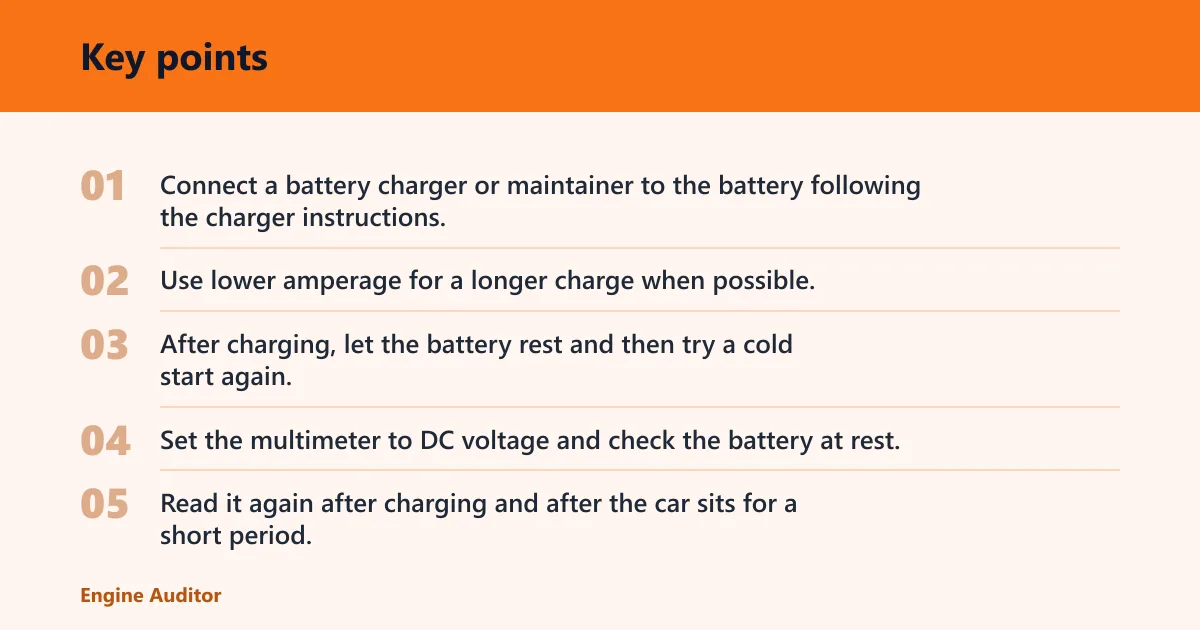
- Connect a battery charger or maintainer to the battery following the charger instructions.
- Use lower amperage for a longer charge when possible, since that is gentler on the battery.
- After charging, let the battery rest and then try a cold start again.
Read the voltage before and after charging
- Set the multimeter to DC voltage and check the battery at rest.
- Read it again after charging and after the car sits for a short period.
- If the voltage drops quickly again, the battery may not hold a charge.
Use a jump only as a test, not a verdict
- Connect jumper cables or a jump starter in the correct order.
- Start the vehicle, then disconnect and observe the next restart.
- If it cranks weakly again after enough driving to recharge more fully, the battery or charging system still needs attention.
A common first-timer mistake is treating one successful jump as proof the battery is healthy. A jump can hide low battery capacity for a few minutes, especially when the starter only needs help overcoming cold oil and reduced battery output. That is why guidance on battery testing emphasizes a rested voltage check and a post-start charging check, not just a single start event.
When should you replace the battery?
Replace it when the case is swollen, cracked, or leaking, when repeated charging does not restore normal cranking, or when the battery is older than about three to five years. Stop-start vehicles often need replacement closer to 3 years. If the battery cannot meet the vehicle’s required CCA, replacement is the safer call. Usable CCA margin matters most in winter, when cold can reduce available cranking performance sharply.
Check age and CCA together
- Read the battery label for its CCA rating.
- Check the owner’s manual for the minimum required CCA.
- Use a replacement battery that meets or exceeds that minimum.
Replace on physical damage
- Inspect the battery case for bulging, cracks, or wet acid residue.
- Do not jump-start a cracked and leaking battery.
- Replace the battery before any further diagnosis if the case is damaged.
Use repeated failure as the cutoff
- Charge the battery fully.
- Retest after warming and again after a normal drive.
- If it still struggles to crank or goes flat again, replace it instead of chasing the same no-start.
How do I tell if my car battery is bad?
A bad battery usually shows repeated failure after charging, a swollen case, or a battery that cannot hold enough charge for a cold start. Age matters too. A battery that is already past three to five years old, or older in a stop-start vehicle, is far more likely to fail in winter than a newer unit. Common diagnostic practice and service manuals both prioritize voltage, load response, and physical condition over appearance alone.
Check the easy clues first
- Look for corrosion on the terminals, loose clamps, or a damaged case.
- Note whether the engine cranks slowly even after a full charge.
- Watch for the battery warning light, which can point to charging-system problems.
Use the CCA rating as a benchmark
- Find the battery’s CCA on its label.
- Compare it with the owner’s manual minimum.
- If the battery is under that minimum, fit one that meets or exceeds it, especially in cold climates.
Cold weather can cut cranking power at 0°F by roughly 40 to 60 percent, which is why battery specialists treat winter complaints as a reserve-capacity problem as much as a voltage problem. A battery with marginal CCA may still read near normal voltage at rest, yet fail under load when the temperature drops.
Common mistakes
Do not assume a jump-start means the battery is fine. Do not ignore corrosion, because corroded terminals can mimic a dead battery and can also keep a good battery from delivering enough current. Do not skip the alternator check if the battery light stays on after start. Do not use a charger as a replacement for a bad battery. Safe handling and correct diagnosis come before replacement.
Prevent repeat no-starts
- Use a battery charger or maintainer on vehicles that sit for long periods.
- Drive long enough for the alternator to replenish what the starter used.
- Replace a battery before winter if it is near the end of its three to five year life.
Frequently asked questions
How do I tell if my car battery is dead or just cold?
A battery that is just cold usually improves after warming, charging, or a jump and then starts normally again. A dead or failing battery keeps losing charge, cranks slowly even after help, or cannot restart after a short drive. A multimeter and a retest after warming give the clearest answer. A rested reading near 12.6 volts is normal; below about 12.2 volts is generally discharged.
How do I tell if my car battery is dying?
A dying battery often gives early warning signs: slower cranking, more dependence on jump-starts, and weak starts after cold nights. If the car starts after a charge but weakens again soon, that points to declining capacity rather than a one-time drain. Check age, terminals, and charging voltage; with the engine running, about 13.7 to 14.7 volts usually indicates the alternator is charging.
How do I tell if my battery is dead?
If the starter will not crank, the battery light or dash behavior is abnormal, and the battery does not recover after charging or jump-starting, it is likely dead or very close to it. Confirm with a multimeter and inspect the case; a cracked or leaking battery should be replaced, not boosted. A no-crank with a single click or repeated rapid clicks can also point to a weak battery or poor connections.
Do car batteries die in the cold?
Cold weather can expose a weak battery and make a good one act weak. It can cut cranking power at 0°F by roughly 40 to 60 percent, so an aging battery may fail only in winter. That is why the same car may start in mild weather and fail overnight in freezing temperatures.
When should you replace the battery instead of trying to jump-start it?
Replace it if the case is swollen or leaking, if the battery keeps failing after charging, or if it is older than about three to five years and no longer meets the owner’s manual CCA minimum. A jump-start is only a short-term aid; it does not fix internal battery failure. If a rested battery is below about 12.2 volts after charging and testing, replacement becomes more likely.
Products related to this article
Sponsored / affiliate links. As an Amazon Associate I earn from qualifying purchases. I may earn additional commission from eligible campaigns.