Best Car Batteries for SUVs and Larger Vehicles: we compared
The best car batteries for SUVs and larger vehicles match the correct group size, meet or exceed factory CCA, provide enough reserve capacity for the electrical load, and use AGM if the vehicle idles, cycles accessories, or has start-stop. Buy the wrong fit and you get slow cranking, repeated no-starts, and shorter battery life. This guide shows how to pick the right battery by fitment, starting power, reserve capacity, AGM versus flooded lead-acid, and real value.
Quick comparison
| Product | Badge | Best for | Price | ||
|---|---|---|---|---|---|
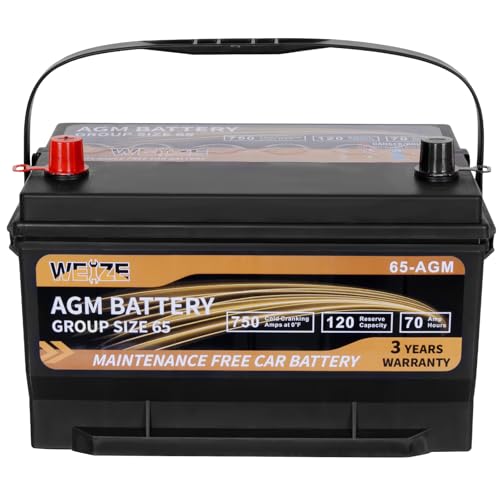 |
Weize Platinum AGM Battery BCI Group 65 Automotive Battery,WEIZE | Also great | 12V 70Ah AGM Group 65, 750 CCA | $160.54
Price as of 7 Oct 2026
|
View |
 |
OPTIMA® Batteries High Performance 75/25 REDTOP® Sealed AGMOPTIMA | Upgrade pick | High performance 12V AGM, 720 CCA, 33.1 lbs | $249.67
Price as of 7 Oct 2026
|
View |
 |
Mighty Max Battery MM-G31M, 12V 110Ah, Group Size 31MMighty Max Battery | Our pick | Group 31M Deep Cycle AGM, 825 CCA, 110Ah | $249.99
Price as of 7 Oct 2026
|
View |
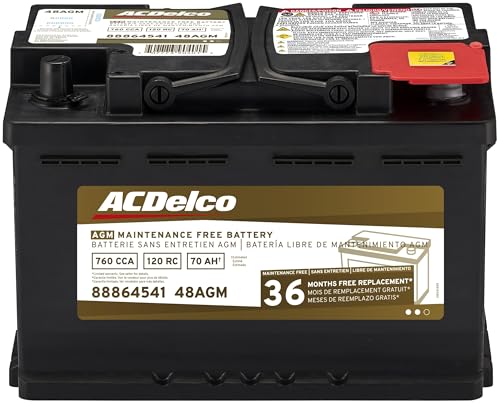 |
ACDelco Gold 48AGM (88864541) 36 Month Warranty AGM BCIACDelco | Budget pick | ACDelco Gold 48AGM Group 48, 36 Month Warranty | $182.99
Price as of 7 Oct 2026
|
View |
For SUVs, the right battery choice starts with tray fit and terminal layout, then moves to the numbers that affect ownership: cold cranking amps, reserve capacity, and battery type. Consumer Reports tests more than 100 individual car batteries every year, and its battery groups include 24/24F, 35, 47, 48, 49, 51R, 65, and 94R.
📊 CR charges and discharges batteries 180 times in a 167º F water bath. Source: 8 Best Car Batteries of 2026, Lab-Tested and Reviewed….
How we chose
The first filter is physical fitment. Battery group size has to match the tray, hold-down, and terminal placement, and CR advises replacing a battery with one from the same group.
The next filter is use case. A compact crossover with a short commute does not need the same reserve capacity or vibration tolerance as a tow rig or three-row SUV with a liftgate, heated seats, and rear entertainment.
We also weighed AGM against lead-acid by ownership pattern. AGM matters more when the battery sees deep cycling, stop-start use, or accessory load. A good flooded lead-acid battery still makes sense when the vehicle is simple and the budget matters.
Finally, we looked at the failure modes that sink SUV batteries in real life: short trips, idle draw, rough roads, and used vehicles that already have the wrong battery installed.

Weize Platinum AGM Battery Group 65: best for value-conscious SUVs
- Reliable performance with 70Ah capacity and 750 CCA.
- Low self-discharge rate compared to flooded batteries.
- Lower risk of acid leaks and spills.
This is the safer value pick for many SUVs that need Group 65 fitment and want AGM behavior without jumping to a premium price tier. It fits drivers who want low upkeep, better leak resistance, and a battery that handles accessory load better than a basic flooded unit.
What stands out is the 70Ah AGM construction and the 750 CCA spec. Based on the spec sheet and owner feedback, that is enough for many SUV duty cycles where the battery must handle longer accessory use, winter starts, and occasional short trips.
The drawback is simple: it is only the right answer if Group 65 is the correct tray and terminal layout for the vehicle. If the SUV calls for another size, the numbers do not matter. Fit comes first.
OPTIMA 75/25 REDTOP sealed AGM battery: best for vibration resistance
- Spiralcell technology delivers more power than flat-plate.
- Fifteen times more resistant to vibration for durability.
- Maintenance-free design for maximum convenience.
This is the stronger pick for truck-based SUVs and drivers who care more about durability than absolute dollar value. Its sealed AGM design and vibration resistance make it a good match for rough roads, towing, and vehicles that see more chassis shake than a suburban crossover.
What stands out is the maintenance-free design and the 720 CCA rating. The spec sheet also points to vibration resistance, which matters when the battery spends its life in a body-on-frame vehicle that gets used hard.
The drawback is cost. It is priced above many flooded batteries, and its value drops if the SUV is a light-duty commuter with no extra electrical load.
Mighty Max MM-G31M: best for heavy accessory load
- Dual-purpose 110Ah capacity for starting and deep discharge.
- Delivers 825 CCA and 1000 MCA for strong starts.
- Up to 700 cycles at 50% depth of discharge.
This is the right style of battery for a large vehicle that acts more like a power station than a commuter. The 110Ah capacity, 825 CCA, and 240 RC make it a fit for builds that run accessories, spend time idling, or need more runtime cushion after the engine is off.
What stands out is the dual-purpose starting and deep-discharge design. That makes sense for expedition-style SUVs, overland builds, or truck-based rigs with auxiliary electronics that can punish a normal starting battery.
The drawback is that a dual-purpose marine AGM is not the automatic choice for every SUV. It can be the wrong tradeoff if the vehicle only needs a standard replacement battery and the tray, hold-down, or terminal layout is less forgiving.
ACDelco Gold 48AGM: best for full-size SUVs with correct Group 48 fit
- High density negative paste improves performance and life.
- Silver Calcium alloy increases cycle life and performance.
- Robust envelope separator prevents shorts and improves circulation.
This is a strong pick when the vehicle calls for Group 48 and the owner wants AGM without moving into specialty territory. It fits many full-size SUVs and crossovers that want dependable starting, decent reserve capacity, and a maintenance-free setup.
What stands out is the battery’s Group 48 format and the construction details aimed at life and cycle performance. Based on the spec sheet, it is the sort of battery that suits a family SUV with steady electrical demand and regular use.
The drawback is that Group 48 is not a universal fit. If the tray, hold-down, or cable reach points to Group 65 or 94R instead, forcing the wrong group is a bad buy no matter how good the battery looks on paper.
Which one should you buy
Budget buyers should start with the correct flooded lead-acid or lower-priced AGM in the exact group size the vehicle calls for. If the SUV is simple, driven often, and not loaded with accessories, paying for the highest CCA number is usually wasted money.
Winter drivers should lean toward an AGM with at least factory-rated starting power and decent reserve capacity. Cold weather is one of the toughest factors facing a car battery, and a battery that starts easily at 0º F is more useful than one that merely looks strong on a label.
Towing, road-trip, and high-electrical-load buyers should favor AGM and reserve capacity over headline CCA. A vehicle with rear entertainment, seat heaters, inverters, or long idle time needs energy storage that can handle the draw after the engine is off.
Older SUVs with simple electrical systems can often make excellent use of a quality lead-acid battery. CR says some less expensive lead-acid batteries score very well, and that matters when the vehicle does not demand deep-discharge tolerance or extra reserve.
Which battery group size do I need for my SUV?
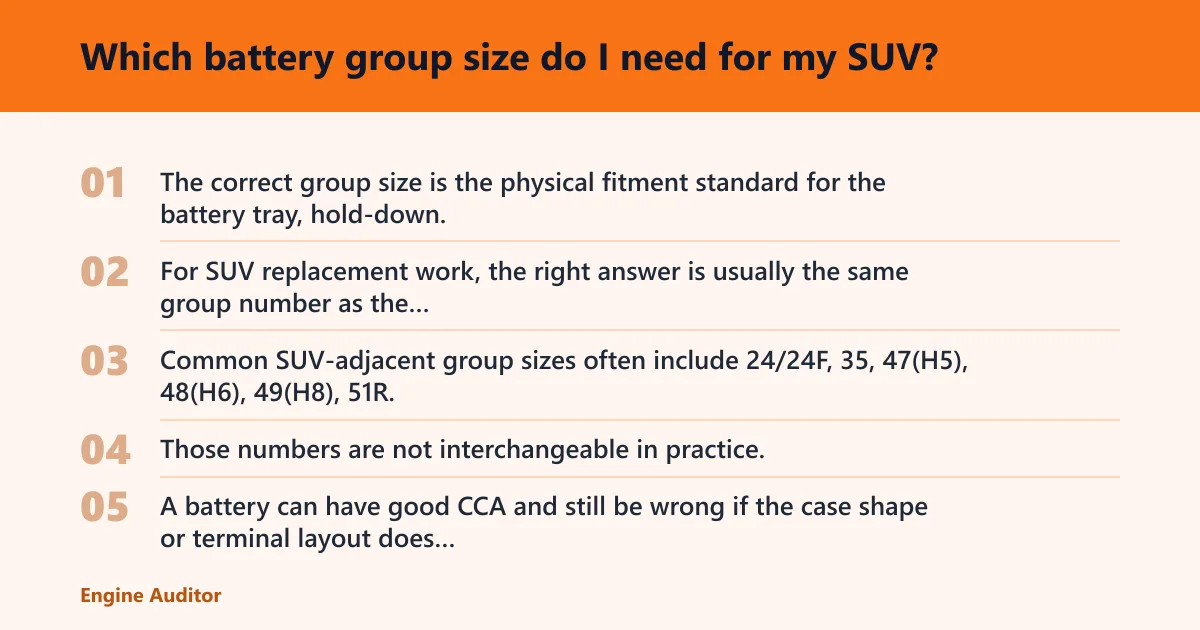
The correct group size is the physical fitment standard for the battery tray, hold-down, terminal placement, and mounting style. For SUV replacement work, the right answer is usually the same group number as the original battery, unless the vehicle has already been altered or the wrong battery was installed by a previous owner.
Common SUV-adjacent group sizes often include 24/24F, 35, 47(H5), 48(H6), 49(H8), 51R, 65, and 94R. Those numbers are not interchangeable in practice. A battery can have good CCA and still be wrong if the case shape or terminal layout does not match the vehicle.
Compact crossover: what to check first
Compact crossovers usually have less tray room and tighter terminal clearances. The first check is the group number on the old battery label and the owner’s manual. After that, confirm terminal orientation and hood clearance before paying for extra CCA you may not be able to use.
Three-row SUV: fitment and accessory load checks
Three-row SUVs often bring more electrical demand: more interior lighting, more convenience features, sometimes rear climate controls, and longer idle periods in school pickup or traffic. In this class, reserve capacity matters more than many shoppers expect. A battery that fits but sags under repeated accessory use is a poor buy.
Truck-based SUV: vibration, tray space, and reserve capacity
Truck-based SUVs add rough-road vibration, towing, and sometimes larger engines. Here, Group 65, 49, or 94R often appears, but the specific vehicle still rules. Vibration resistance and reserve capacity matter more than squeezing in a battery with slightly higher CCA if the case and hold-down are wrong.
AGM or lead-acid: which type fits your SUV?
AGM is the better choice when the SUV sees start-stop use, lots of short trips, long idle periods, or repeated accessory cycling. AGM batteries are known for long service life and deep-discharge tolerance, so they handle stress better when the vehicle is asked to do more than simple starting.
Lead-acid is the smarter buy when the SUV has a straightforward electrical load and the owner wants the lowest sensible replacement cost. A good flooded battery can still score very well, and paying extra for AGM does not help if the vehicle is lightly used and mechanically simple.
When AGM is worth the extra cost
Buy AGM when the SUV has a start-stop system, a high parasitic draw, a reputation for accessory-heavy use, or a history of short-trip driving that never fully recharges the battery. AGM also makes sense for trucks and larger SUVs that spend time on rough surfaces or carry added electrical equipment.
When a good lead-acid battery is the smarter buy
Choose lead-acid when the vehicle is older, used in moderate weather, and driven often enough to stay charged. If the manual calls for a standard flooded battery and the owner does not need extra reserve or deep-cycle tolerance, the lower-cost option is often the better value.
Proof asset: fit and load checklist by SUV segment
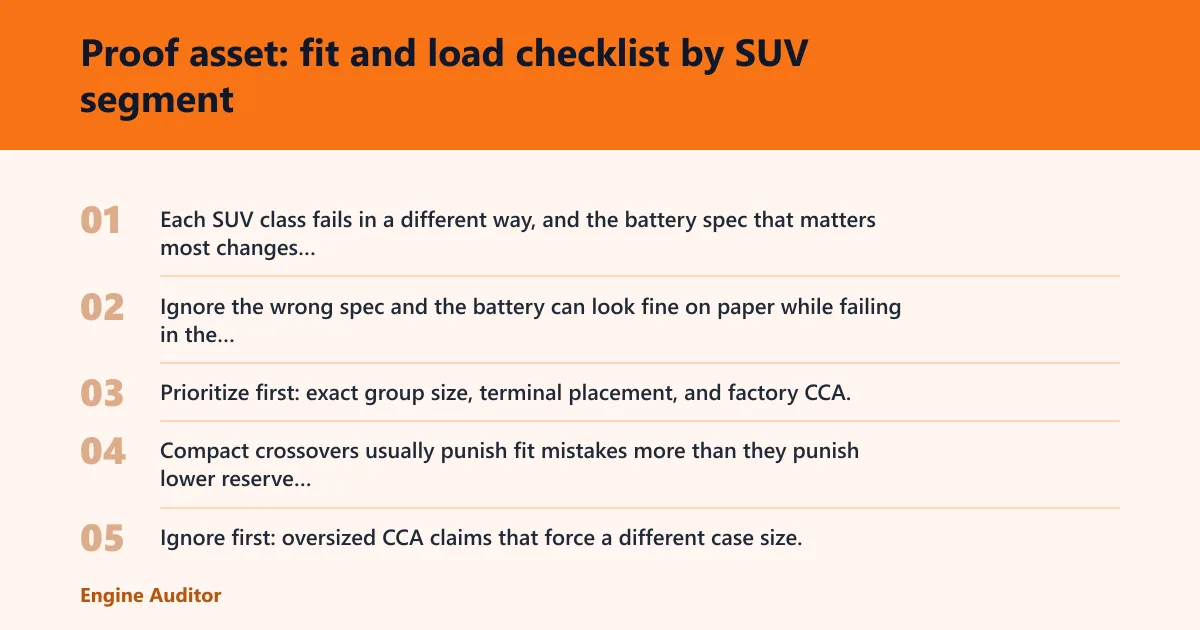
This is the practical part. Each SUV class fails in a different way, and the battery spec that matters most changes with it. Ignore the wrong spec and the battery can look fine on paper while failing in the driveway.
Compact crossover checklist: what spec to prioritize first, what to ignore
Prioritize first: exact group size, terminal placement, and factory CCA. Compact crossovers usually punish fit mistakes more than they punish lower reserve capacity, because the tray is tight and cable reach is limited.
Ignore first: oversized CCA claims that force a different case size, and marketing language about premium construction if the battery does not fit cleanly. A battery that is “better” on paper but wrong in the tray is still the wrong battery.
AGM worth the premium? Usually only if the crossover has start-stop, heavy parasitic draw, or repeated short trips. Otherwise, a quality lead-acid battery is often enough.
Three-row SUV checklist: accessories, reserve capacity, and idle draw
Prioritize first: reserve capacity, then factory CCA, then battery type. Three-row SUVs often spend time powering infotainment, climate fans, and seat features while idling or parked.
Ignore first: chasing the highest CCA number if reserve capacity is weak. High cranking power does little when the vehicle is parked with electronics running.
AGM worth the premium? Yes, more often here than in a compact crossover, especially for families who do lots of short hops, school runs, or road trips with accessories in use.
Truck-based SUV checklist: vibration resistance, towing, and winter starts
Prioritize first: vibration resistance, case fit, and reserve capacity. Truck-based SUVs tend to transmit more road shock, and towing can add both heat and electrical load.
Ignore first: a bargain battery with the right group number but weak build quality. Rough-road use exposes weak internal construction fast.
AGM worth the premium? Usually yes if the vehicle tows, sees winter starts, or carries aftermarket equipment. The extra cost makes sense when the battery has to recover from stress more often.
When to buy AGM instead of lead-acid
Buy AGM when the battery will be cycled often, discharged more deeply than a basic starter battery likes, or exposed to vibration and accessory draw. Buy lead-acid when the vehicle is easy on batteries and the owner wants the lower upfront cost.
How many CCA does an SUV battery need?
An SUV battery needs enough cold cranking amps to start the engine in the weather the vehicle actually sees, not just enough to win a spec-sheet comparison. Higher CCA helps in winter and for larger engines, but CCA alone does not decide whether the battery is right.
The factory rating is the better starting point. In cold weather, battery output drops and engine oil thickens, so the battery has to work harder. That is why a larger SUV or a winter climate often needs a more capable battery, but still within the correct group size.
Why higher CCA helps in winter
Cold weather is one of the toughest factors facing a car battery. A higher CCA battery usually gives more starting margin when temperatures fall and the engine is slow to turn over.
Why CCA alone can pick the wrong battery
CCA says little about reserve capacity, internal build, or whether the battery fits the tray. A high-CCA battery with poor reserve can still leave an SUV stranded after accessory use or short-trip driving. Fit and runtime matter too.
Reserve capacity as the tie-breaker
Reserve capacity becomes the tie-breaker when two batteries have similar starting power. It is the better clue for SUVs with idle draw, road-trip loads, or a charging system that may not keep up during heavy use.
What specs matter most for SUVs with lots of electronics?
Reserve capacity matters most for SUVs with lots of electronics, followed by AGM construction and then CCA. If the vehicle powers rear entertainment, heated seats, cameras, inverters, or long-idle accessories, it needs a battery that can hold up when the engine is not running.
Maintenance-free design matters too, because busy owners do not want water top-offs or extra upkeep. Vibration resistance also matters more in larger vehicles and truck-based SUVs, where road shock can shorten battery life even when the battery is technically the right group.
Reserve capacity for accessory-heavy driving
Reserve capacity tells you how much energy the battery can supply if charging support falls away or accessories run while the engine is off. For SUV ownership, this is one of the most useful ratings because it maps to real use, not just starting strength.
Maintenance-free designs for low-upkeep ownership
Maintenance-free batteries are easier to live with. There are no water top-offs, fewer ownership chores, and less chance that neglect will shorten life. That is a practical win for family vehicles and work vehicles alike.
Vibration resistance for rough-road and truck-based use
Rough roads can damage a battery internally even if the exterior looks fine. A truck-based SUV benefits from stronger internal construction, especially when towing, off-road driving, or heavy curb-to-trail transitions are part of the vehicle’s life.
How do I avoid buying the wrong replacement battery?
Start with the owner’s manual and the battery label, then confirm the tray before purchase. Battery labels show size, type, and terminal placement, and those details matter as much as the rating numbers. Used vehicles may already have the wrong battery installed, so do not assume the current one is correct.
If the label on the old battery does not match the manual, treat that as a warning. The vehicle may have been repaired with whatever battery fit at the time, and a previous owner can leave a bad fit that still starts the engine.
Check the owner’s manual and battery label
The manual is the source of truth for the original group size and minimum ratings. The battery label tells you whether the installed battery is Group 48, 65, 94R, or something else, and whether the terminals sit where your cables expect them to.
Watch for wrong batteries left by previous owners
Used vehicles are a common source of bad battery history. If the current battery is the wrong group, the last owner may have fought fitment, charging, or cable reach problems already. Replace it with the correct group, not just the easiest one to find.
Measure the tray before you buy
Measure the tray length, width, and hold-down clearance if the battery space looks tight. Even a battery with the right group number can vary by terminal orientation or case height. This is a cheap check that prevents an expensive return.
What is the best battery for a truck or full-size SUV?
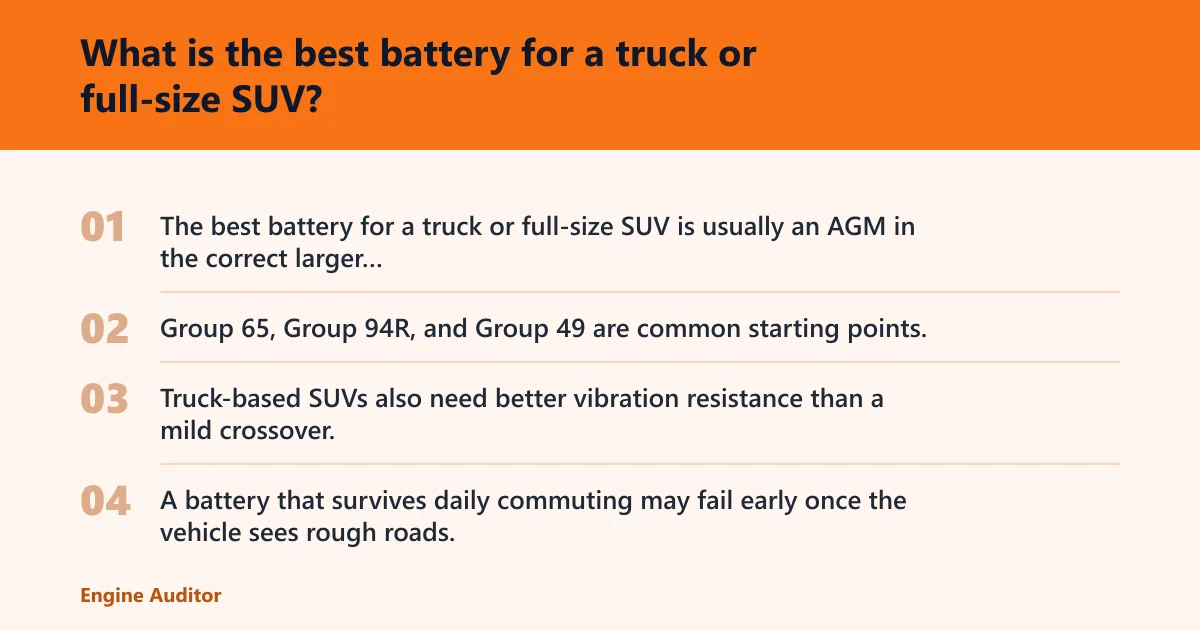
The best battery for a truck or full-size SUV is usually an AGM in the correct larger group size, with enough CCA for winter and enough reserve capacity for towing, idle time, or added electronics. Group 65, Group 94R, and Group 49 are common starting points, but the vehicle manual should decide the exact fit.
Truck-based SUVs also need better vibration resistance than a mild crossover. A battery that survives daily commuting may fail early once the vehicle sees rough roads, trailer work, or frequent engine-off accessory use.
Do I need a maintenance-free battery for my SUV?
Most SUV owners should choose maintenance-free. It cuts upkeep, removes water-top-off chores, and reduces the chance of simple neglect shortening battery life. For a family vehicle or work vehicle, that convenience matters more than many shoppers expect.
The main exception is a specialized setup where the owner already knows the battery type and service routine. For almost everyone replacing an SUV battery, maintenance-free is the practical default.
Frequently asked questions
What is the best car battery for an SUV?
The best SUV battery is the correct group size with factory-level starting power, enough reserve capacity for your accessories, and AGM if the vehicle has start-stop, short-trip use, or a heavy electrical load. Fit comes first. A strong battery in the wrong case is still the wrong purchase.
How do I know if my SUV needs Group 34, 48, or 65?
Check the owner’s manual and the label on the battery already in the vehicle. Then verify tray dimensions and terminal placement. If the current battery came from a previous owner, do not assume it is correct. Group numbers are not interchangeable just because the posts line up.
Is AGM better than lead-acid for larger vehicles?
Often yes, but not always. AGM is better for larger vehicles that cycle accessories, idle often, tow, or see stop-start use because it handles deeper discharge and repeated cycling better. A quality lead-acid battery can still be the smarter value when the vehicle is simple and lightly loaded.
How many cold cranking amps does an SUV battery need?
An SUV needs at least the factory-rated CCA, and often more if it sees harsh winters or a larger engine. But CCA is only one part of the choice. If reserve capacity and fit are weak, the battery can still disappoint even with a high starting number.
What battery specs matter most for SUVs with lots of electronics?
Reserve capacity matters most, followed by AGM construction and then CCA. Electronics-heavy SUVs can draw power while parked or idling, so the battery needs runtime cushion, not just strong starting power. Maintenance-free design and vibration resistance also matter when the vehicle is used hard.
Do I need a maintenance-free battery for my SUV?
For most owners, yes. A maintenance-free battery reduces upkeep and helps prevent avoidable failures from low fluid or neglect. It is especially useful in family SUVs, commuting vehicles, and trucks that already demand enough attention elsewhere.
Products related to this article
Sponsored / affiliate links. As an Amazon Associate I earn from qualifying purchases. I may earn additional commission from eligible campaigns.