5 Best lithium car batteries for cars (2026): research shows
For most everyday petrol cars, a lithium 12V replacement is still impractical. It tends to make more sense if the car calls for an AGM-compatible system, the battery will live in hot conditions, or saving weight is worth paying roughly 2 to 4 times more. Get the fitment wrong and you can trigger charging faults, shorten battery life, or waste money on a battery the car will not charge correctly. This guide breaks down where lithium 12V batteries work, where they do not, and what compatibility checks matter before you buy.
Quick comparison
| Product | Badge | Best for | Price | ||
|---|---|---|---|---|---|
 |
12V 50Ah Trolling Motor LiFePO4 Battery,5000+ Deep CycleBtrPower | Also great | 12V 50Ah · 11 lbs · LiFePO4 | $109.99
Price as of 12 Oct 2026
|
View |
 |
Lithium Car Cranking Battery, GROUP 47 12V Lithium StartingForgetyo | Our pick | Group 47 · 800 CCA · H5 | $234.99
Price as of 12 Oct 2026
|
View |
 |
Renogy 12V 100Ah Bluetooth Self-Heating Lithium LiFePO4Renogy | Upgrade pick | 12V 100Ah · Self-heating · Bluetooth | $559.99
Price as of 12 Oct 2026
|
View |
 |
Victron Energy Battery Management System, Smart BMS CLVictron Energy | Pair with it | Victron Smart BMS CL 12-100 | View | |
 |
NOCO GENIUS5 5A 6/12V Smart Battery Charger, TrickleNOCO | Pair with it | 5A Smart Charger · 6/12V | $69.87
Price as of 12 Oct 2026
|
View |
This comparison only helps if you begin with fitment, charging profile, and use case. A lithium battery that looks strong on paper can still be a poor choice if the car expects a different voltage window or a different charging strategy.
For most mainstream drivers, AGM or EFB still fits better. Lithium starts to make sense when the car is sensitive to weight, spends time on accessory loads, or already uses a battery strategy that can support lithium properly.
📊 traditional lead-acid batteries in Malaysia typically last between 1 to 2 years. Source: Lithium-Ion Car Batteries in Malaysia |.
How we chose
The main filter is fitment. Battery group size, terminal layout, and hold-down style have to match before chemistry matters.
Next comes charging-system compatibility. A battery that wants one profile while the alternator and regulator deliver another can age badly or fault out.
Climate matters too. Hot-weather use and cold starts put different limits on the battery and its control electronics.
Finally, cost per year matters more than sticker price. A battery that costs more up front can still make sense if the vehicle genuinely benefits from its use pattern and service life.

12V 50Ah Trolling Motor LiFePO4 Battery, 5000+ Deep Cycle lithium Battery: best for light accessory loads
This BtrPower LiFePO4 battery is best for drivers who need a 12V lithium battery for accessory-heavy or deep-cycle use, not a normal petrol-car starter role. The listed 12V 50Ah format, 11 lbs weight, and built-in 50A BMS protection make it more relevant to auxiliary power than to cold-cranking duty.
What stands out is the deep-cycle angle. The 5000+ deep cycle claim and built-in protection suit loads that draw power for long periods, such as camping accessories or support systems.
The drawback is obvious for road-car buyers: this is not presented as a Group 47, H5, H6, or H7 drop-in starting battery. If your car needs a conventional starter battery with known CCA and reserve capacity, this is the wrong shape of solution.
Lithium Car Cranking Battery, GROUP 47 12V Lithium Starting Battery with 800CCA LiFePO4 Automotive Batteries Size H5 For Car Start-Stop High Performance: best for lithium-compatible start-stop cars
Forgetyo’s Group 47 lithium starting battery is the closest fit here for a mainstream car that truly needs lithium, because it is built around the starting role and lists Group 47 size compatibility. The 800 CCA figure makes it more credible for crank-duty than a generic deep-cycle pack.
Its strong point is the fitment story: Group 47 and H5 compatibility matter because battery size comes first. The 60-month manufacturer warranty also suggests the maker expects longer service than a basic flooded lead-acid unit.
The drawback is that 800 CCA does not remove charging-system limits. A car with a mismatched alternator profile, poor cold-weather behaviour, or a start-stop strategy that expects AGM or EFB may still be a poor candidate.
Renogy 12V 100Ah Bluetooth Self-Heating Lithium LiFePO4 Deep Cycle Battery: best for cold-weather auxiliary use
Renogy’s 12V 100Ah LiFePO4 battery is best for auxiliary or off-grid support where cold-weather behaviour matters. The self-heating feature, IP67 protection, and Bluetooth monitoring make it more useful in controlled systems than as a simple drop-in starter battery for a petrol car.
Its advantage is temperature management. Self-heating helps in cold climates, and Bluetooth monitoring gives visibility into battery condition, which matters when lithium is being asked to do real work for long periods.
The drawback is size and purpose. A 100Ah deep-cycle battery is not the same decision as replacing a normal H6 or H7 starter battery, and the price moves it further away from mainstream-road-car practicality.
Victron Energy Battery Management System, Smart BMS CL 12-100: best for custom lithium systems
Victron’s Smart BMS CL 12-100 is for builders who need lithium management rather than a simple battery swap. It is relevant when a LiFePO4 system needs cell-level monitoring, protection, and remote control functions.
The main advantage is the protection logic. A proper BMS helps manage overcharge, over-discharge, short-circuit risk, and temperature-related control, which are the functions lithium systems depend on.
The drawback is that it is not a battery and not a universal fix. A normal petrol car owner usually wants a self-contained replacement battery, not a component that still requires system design and wiring discipline.
NOCO GENIUS5 5A 6/12V Smart Battery Charger, Trickle Charger & Maintainer: best for maintenance and recovery
NOCO’s GENIUS5 is the sensible pick for owners who need a charger or maintainer that can support lithium-ion on 6V and 12V systems. The thermal sensor and low-voltage recovery claim make it useful as a support tool, not as a battery replacement.
Its strength is practicality. A smart charger is often the missing piece when a battery is stored for long periods or needs regular maintenance, especially in mixed-fleet garages.
The drawback is that it cannot solve a bad fitment decision. If the car’s alternator profile, battery group size, or start-stop strategy is wrong for lithium, a charger will not make the installation correct.
Which one should you buy
Start with the vehicle, not the chemistry. If the car is a normal petrol model with a simple charging system, AGM, EFB, or even lead-acid usually remains the more practical choice.
Choose lithium only when the battery location, heat load, accessory demand, or weight target justifies the extra cost and the car’s charging system is compatible. In a start-stop vehicle, the battery strategy matters even more because frequent restart events and deeper cycling place different demands on the battery.
Say your car uses a Group 47 battery space, runs hot in summer traffic, and has heavy accessory use. A lithium option can make sense if the charging system is suitable and the battery is explicitly built for the job. Suppose the car is a cold-climate daily driver with short trips and no AGM-compatible charging profile. Lead-acid or EFB usually remains the safer buy.
Are lithium car batteries practical for a normal car yet?
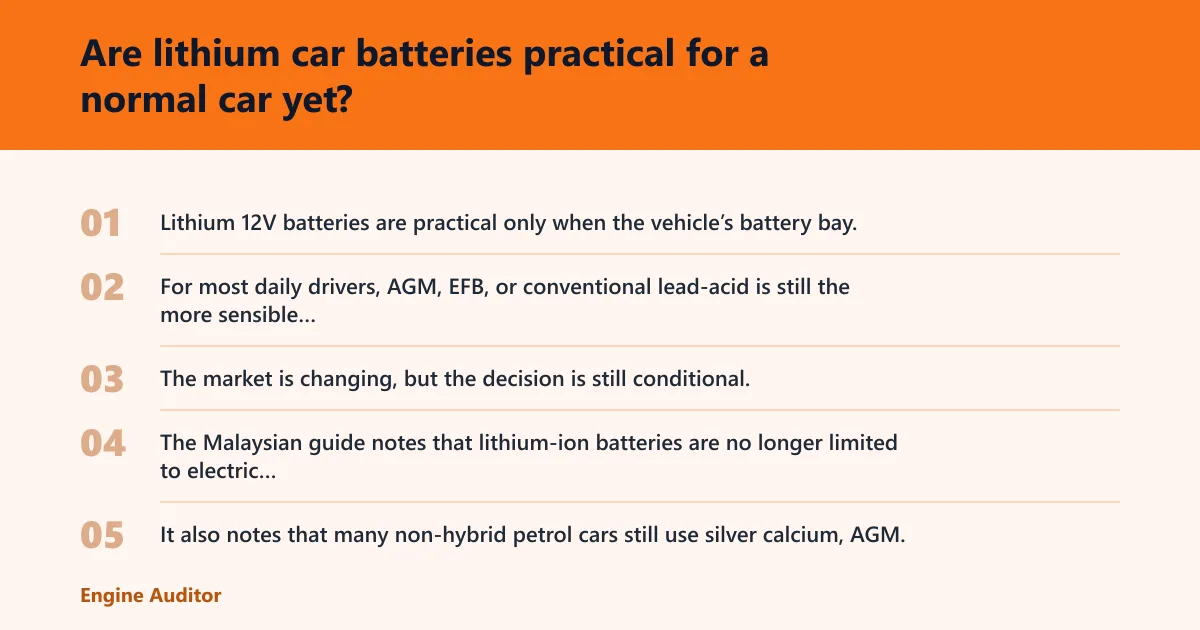
For a normal petrol car, usually no. Lithium 12V batteries are practical only when the vehicle’s battery bay, charging profile, and use pattern match what lithium expects. For most daily drivers, AGM, EFB, or conventional lead-acid is still the more sensible fit because it is easier to match and cheaper per year.
The market is changing, but the decision is still conditional. The Malaysian guide notes that lithium-ion batteries are no longer limited to electric vehicles, yet it also says they require advanced battery management systems and remain significantly more expensive than conventional batteries. It also notes that many non-hybrid petrol cars still use silver calcium, AGM, or EFB as more practical choices.
The practical question is not whether lithium is advanced. It is whether your car can use it without charging faults, cold-start trouble, or avoidable replacement cost. If the answer is no, the new chemistry adds little value.
LiFePO4 automotive battery versus broader lithium-ion car battery
LiFePO4 automotive batteries are the more common lithium choice for 12V replacement work because they are built around a nominal 12.8V system and often include a built-in BMS. They are better suited to deep-cycle use than many starter-focused batteries, and they are the relevant lithium type for most aftermarket 12V discussions.
Broader lithium-ion car batteries are a wider category. They are lighter than lead-acid, but they generally depend on more advanced battery management and appear more often in EVs, hybrids, and auxiliary systems than in simple petrol-car swaps.
What 12.8V nominal voltage means in practice
Nominal 12.8V tells you the battery is designed to live in the same general 12V automotive space as lead-acid, but the operating behaviour is different. A lithium pack can hold voltage differently under load and during charging, so matching the car’s electrical expectations matters more than the label alone.
That is why “12V” is not enough as a decision rule. The alternator, regulator, and vehicle electronics still need to tolerate the battery’s chemistry and charging window.
Why a built-in BMS is required
A battery management system is not optional overhead. It is the control layer that helps prevent overcharge, over-discharge, short-circuit damage, and temperature abuse.
Without that control, a lithium battery can be misused far more easily than a basic flooded battery. For a 12V replacement, the BMS is part of the product’s job, not a luxury feature.
LiFePO4 automotive battery: best for weight-sensitive and deep-cycle use
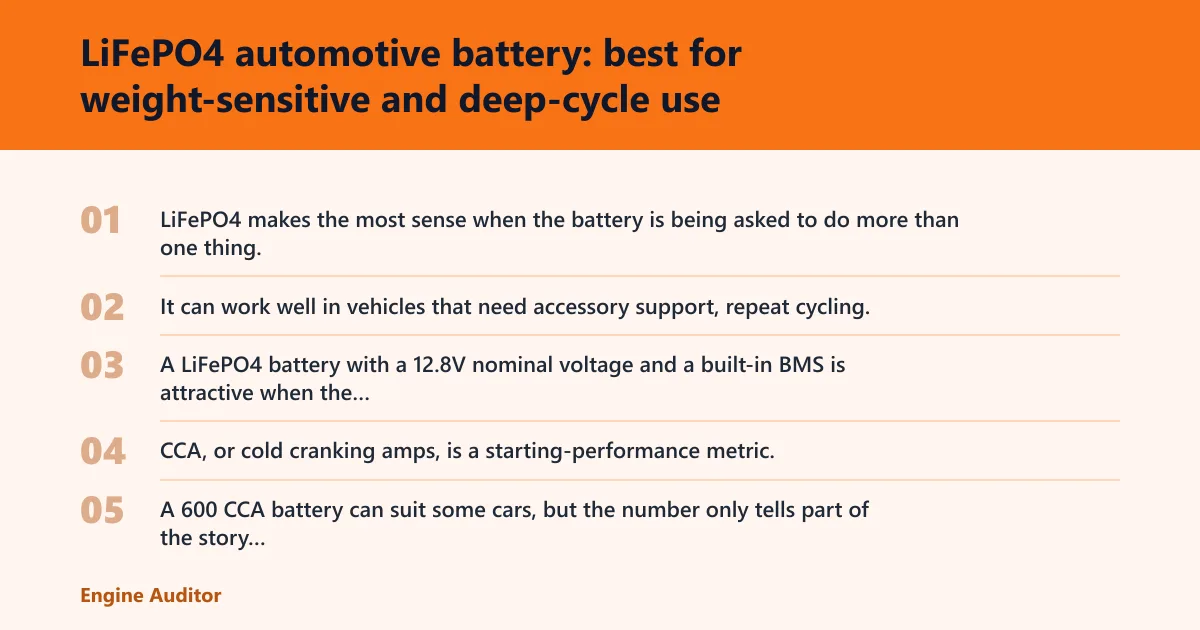
LiFePO4 makes the most sense when the battery is being asked to do more than one thing. It can work well in vehicles that need accessory support, repeat cycling, or a lighter battery package, provided the charging system is a good match.
The key is to judge it by use case. A LiFePO4 battery with a 12.8V nominal voltage and a built-in BMS is attractive when the car spends time idling accessories, cycling more often, or carrying a battery that is physically hard to reach.
600 CCA and what it tells you
CCA, or cold cranking amps, is a starting-performance metric. A 600 CCA battery can suit some cars, but the number only tells part of the story because it says little about reserve capacity, charging compatibility, or low-temperature behaviour.
The featured Group 47 LiFePO4 battery is rated at 600 CCA and has a 60-month warranty. That combination may appeal to buyers who want a lithium starter battery, but CCA alone does not make it suitable for every petrol car.
100 RC and accessory-load use
Reserve capacity measures backup runtime. A battery with 100 RC is more relevant when the vehicle runs accessory loads, short trips, or stop-and-go use that can leave less time for replenishment.
RC matters because a battery that starts the engine well may still disappoint when the vehicle spends time powering electronics with the engine off. That is why reserve capacity can matter as much as CCA in some daily-driver cases.
Where LiFePO4 works best and where it does not
It works best in vehicles that are already battery-sensitive, use a compatible charging strategy, or benefit from deep-cycle behaviour. It does not suit a car with unknown alternator settings, harsh winter starts, or a battery bay that cannot support the right group size.
A common first-timer mistake is buying for the chemistry and ignoring the battery tray. A Group 47 battery that does not match the tray, hold-down, or terminal position is the wrong battery, no matter how good the spec sheet looks.
Lithium-ion car battery: best for premium, hybrid, or auxiliary roles
Broader lithium-ion car batteries are usually better viewed as specialized system parts than as universal replacements. They appear more often in hybrids, EVs, and auxiliary applications where battery management, packaging, and charging logic are designed around lithium from the start.
For normal petrol cars, that makes them a poor default choice. The chemistry can be excellent in the right system, but the vehicle has to be built, or at least configured, to accept it.
Advanced BMS needs
The Malaysian guide is blunt on this point: lithium-ion batteries require advanced battery management systems. That is because lithium cells need tighter control over charging and protection than many conventional 12V replacements.
If the system is missing that control, the battery may not age well, and the vehicle may not charge it correctly. This is one reason lithium-ion is still uncommon as a straight swap in ordinary petrol cars.
Where lithium-ion appears in vehicles
It appears in EVs, hybrids, and some auxiliary applications where the charging system is part of the design. In those cases, the car and battery are built to work together.
That is very different from dropping a lithium pack into a car designed around lead-acid charging assumptions. The fit may look right, but the system logic may not be.
How practical is lithium for a normal petrol car?
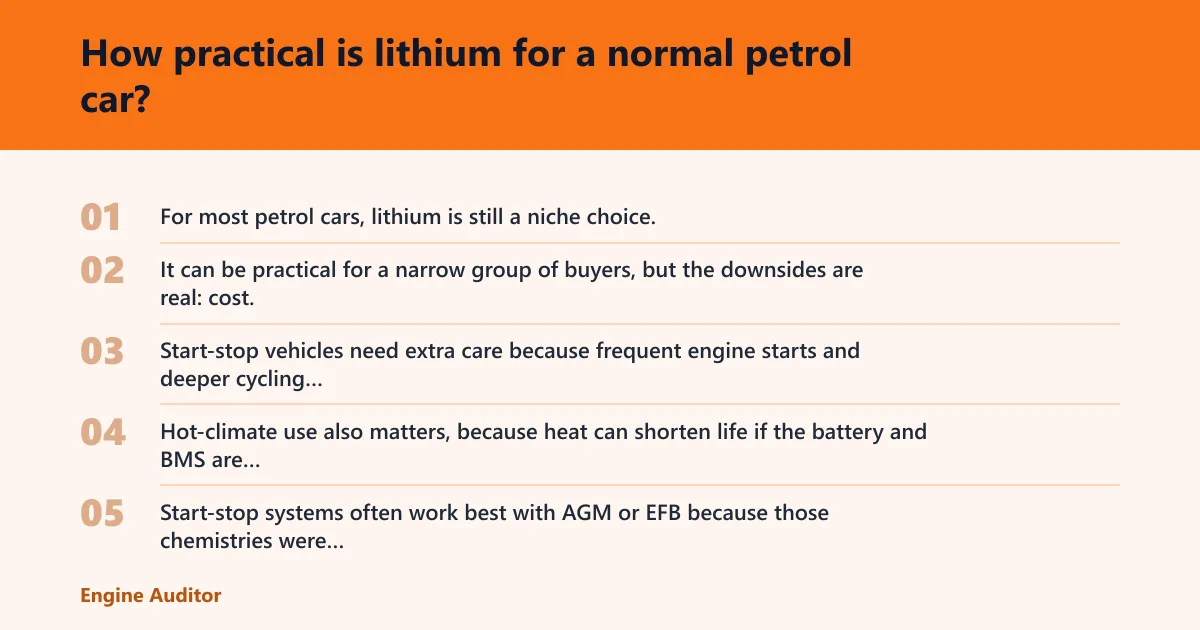
For most petrol cars, lithium is still a niche choice. It can be practical for a narrow group of buyers, but the downsides are real: cost, charging-system sensitivity, cold-weather limits, and the risk of buying the wrong size or chemistry for the vehicle.
Start-stop vehicles need extra care because frequent engine starts and deeper cycling put more strain on the battery. Hot-climate use also matters, because heat can shorten life if the battery and BMS are not designed for thermal management.
Start-stop vehicle battery compatibility
Start-stop systems often work best with AGM or EFB because those chemistries were designed for frequent starts and deeper cycling in conventional vehicle architectures. Some lithium batteries are built for this duty, but the charging strategy must be compatible.
If the car expects a certain voltage profile, a lithium battery can confuse the control logic or underperform. That is why “start-stop capable” on a listing is not enough; the alternator and battery strategy still need to match.
Hot-climate use and thermal limits
Lithium batteries can be attractive in hot climates, but only if the product has suitable thermal management and the installation environment is not abusive. Heat exposure can reduce lifetime, and a battery that lacks proper temperature control may age faster in summer traffic.
The practical advice is simple: if the battery sits in a hot engine bay or under-hood area, check whether the design is intended for that environment. A good BMS helps, but it is not a cure for an unsuitable installation.
Cold-weather and storage failure cases
Cold weather is a common failure case for the wrong lithium setup. Some packs need help before charging in low temperatures, and a battery that sits discharged for long periods can be harmed by low-voltage storage risk.
That is why a maintainer like the NOCO GENIUS5 can be useful, but only as part of a correct setup. It supports the battery; it does not correct the chemistry choice.
Decision matrix: which chemistry should you buy?
Use this matrix to separate “sounds advanced” from “fits the job.” Score lithium suitability from 1 to 5 for each factor: vehicle type, climate, charging system, daily mileage, and budget. Then compare the total to the recommended chemistry.
| Scenario | Vehicle type | Climate | Charging system | Daily mileage | Budget | Lithium suitability | Recommended chemistry |
|---|---|---|---|---|---|---|---|
| Typical petrol sedan | Normal starter battery | Mild | Unknown or standard | Short to medium | Value-focused | 1/5 | Lead-acid or EFB |
| Start-stop hatchback | Frequent restart duty | Mild to warm | AGM/EFB compatible | Medium | Moderate | 3/5 | AGM, or lithium only if approved |
| Hot-climate SUV | High accessory demand | Hot | Stable, verified profile | Medium to long | Flex budget | 4/5 | LiFePO4 if fitment and BMS align |
| Hybrid or auxiliary system | Designed around battery control | Varies | Advanced management present | Varies | Higher budget | 5/5 | Li-ion or LiFePO4 system-specific |
| Cold-region commuter | Daily cold starts | Cold | Conventional | Short trips | Value-focused | 1/5 | AGM or lead-acid with correct CCA |
Weight savings matter most in motorsport, some performance builds, and vehicles where battery mass sits high or far forward. In a normal road car, the handling gain is usually too small to justify the cost unless the rest of the system already supports lithium.
Cost per year is the real number to compare. The Malaysian guide says lead-acid batteries there typically last 1 to 2 years, while Li-ion batteries can last two to three times longer under the right conditions. Even so, the guide also says lithium-ion is significantly more expensive, so the math only works when the car actually benefits from the chemistry.
- Check battery group size first: H5, H6, H7, or Group 47 must match the tray, hold-down, and terminal layout.
- Confirm the charging system is compatible with the battery chemistry and voltage profile.
- Match the battery to the duty cycle: starting, stop-start, or deep-cycle accessory use.
- Check climate exposure, especially heat soak and cold-start conditions.
- Compare cost per year, not just the purchase price.
What are the downsides of a lithium car battery in a petrol car?
The main downsides are mismatch risk, higher purchase cost, and more demanding compatibility checks. A lithium battery that works in one petrol car can be wrong for another if the alternator profile, thermal conditions, or battery group size do not line up.
There is also a practical downside in everyday use: the battery often needs more attention to system compatibility than AGM or lead-acid. That matters because many drivers want a direct replacement, not a battery project.
Do lithium car batteries work with start-stop systems?
They can, but only when the vehicle and battery are designed for that duty. Start-stop systems need a battery that tolerates frequent engine starts and repeated cycling, and the charging system has to be compatible with the lithium battery’s profile.
In many cars, AGM or EFB still remains the cleaner choice. Lithium is worth considering only when the car explicitly supports it or the battery maker specifies the exact start-stop application.
How much does a lithium car battery cost compared with AGM or lead-acid?
Lithium 12V batteries usually cost far more up front than AGM or lead-acid units, and the gap can be large enough to matter on a normal car. The useful comparison is cost per year, not sticker price, because a longer service life only helps if the battery is actually suited to the vehicle.
In a basic petrol car, AGM or EFB often wins on total cost because it is cheaper, simpler to fit, and easier to charge correctly. Lithium only pulls ahead when the car’s use case is one of the narrow scenarios where its strengths are needed.
Will a lithium car battery fit my car’s battery group size?
Only if the physical dimensions and terminal layout match your car’s battery group size. H5, H6, H7, and Group 47 are not interchangeable by chemistry alone, and the tray and hold-down hardware still have to accept the battery.
Fitment comes before performance. A battery that does not fit properly can create cable strain, poor clamping, or installation issues even if its specs look excellent on paper.
Do lithium car batteries need a special charger or battery management system?
Yes, in many cases they do. A lithium battery should have a built-in BMS, and the charging system or external charger should suit lithium charging requirements. The BMS handles overcharge protection, over-discharge protection, short-circuit protection, and temperature control.
If the car will be stored or maintained off-vehicle, a smart charger that supports the chemistry is useful. That said, a charger cannot fix an incompatible alternator or a battery that is wrong for the car.
Are lithium car batteries safe in hot climates?
They can be, but only when the battery has proper thermal control and the installation environment is suitable. Hot-climate battery use needs more care than a simple swap, because heat can reduce life and increase stress on the battery and BMS.
If the battery lives near the engine bay or in a poorly ventilated location, check the maker’s temperature limits and control features. A well-managed LiFePO4 battery is more believable here than a generic lithium pack with vague claims.
How long do lithium car batteries last in real-world use?
Under the right conditions, lithium batteries can last longer than conventional batteries, but that depends heavily on fitment, charging, temperature, and storage habits. The Malaysian guide states that Li-ion batteries can last two to three times longer than traditional lead-acid batteries under the right conditions.
That said, real-world use is exactly where bad matches fail. A mismatched alternator, a cold climate, or long storage at low voltage can erase the advantage quickly, which is why the battery has to be chosen for the car, not for the spec sheet.
Bottom line: lithium 12V batteries are practical today for specific vehicles and specific use patterns, not for most everyday petrol cars. If your car needs a true starter battery and you do not have a clear fitment and charging-system match, AGM or EFB is still the safer purchase.
Products related to this article
Sponsored / affiliate links. As an Amazon Associate I earn from qualifying purchases. I may earn additional commission from eligible campaigns.
 T.E.T LITHIUM 51R Lithium Car Battery | Group 51R LiFePO4 Automotive Starter Battery | 12.8V 28Ah 840CCA | Built-in BMS | 2-Year Warranty
 SEFEPODER 12V 20Ah Lithium LiFePO4 Deep Cycle Battery, 4000 Cycles Rechargeable Battery for Lighting, Power Wheel, Fish Finder with and More Built-in 40A BMS(Screw Terminal)