Best Car Batteries for Ford Vehicles (2026): research shows
For most Ford replacements, start with the exact OEM group size on the old battery label, then match or exceed its CCA, reserve capacity, and battery type; many gas models use H5, H6, or H7, and start-stop Fords often use AGM batteries. A wrong group size or weak CCA can trigger no-starts, warning lights, short battery life, and charging-system complaints. This guide maps common Ford models to the right group size, technology, and spec targets by use case.
Quick picks
Top pick: AGM for F-150, Super Duty, and other high-load Ford trucks, because it handles vibration, accessory load, and frequent starts better than flooded batteries. Best value: flooded lead-acid for older non-start-stop Ford sedans and crossovers. Best start-stop match: EFB for Ford models that left the factory with mild start-stop and did not call for AGM.
- Truck and tow use: AGM, with reserve capacity treated as seriously as CCA.
- Older non-start-stop Ford: flooded lead-acid, if the OE setup was flooded.
- Mild start-stop Ford: EFB only when the vehicle was built for it.
- Cold climate: choose the same group size and a CCA rating that meets or exceeds the factory spec.
📊 The Ford guide says Explorer, Edge, Bronco, and Escape with start-stop often use Group 48/H6. Source: Best Car Battery for Ford.
Quick comparison
| Product | Badge | Best for | Price | ||
|---|---|---|---|---|---|
 |
Weize Platinum AGM Battery BCI Group 24F AutomotiveWEIZE | Upgrade pick | 710 CCA, 120 RC, AGM | $179.99
Price as of 10 Oct 2026
|
View |
 |
DB Electrical Starter for Ford Truck Ranger 2.3L 2001-2011DB Electrical | Pair with it | Ford Ranger 2.3L starter | $82.38
Price as of 10 Oct 2026
|
View |
 |
OPTIMA® Batteries High Performance D34/78 YELLOWTOP® SealedOPTIMA | Also great | 750 CCA, 120 RC, AGM | $309.99
Price as of 10 Oct 2026
|
View |
Ford fitment starts with the tray, terminal placement, and OE battery type, not with brand names. Consumer Reports says battery size varies by make, model, year, and engine size, and that batteries are defined by physical size, type, terminal placement, and mounting style.

How we chose
We compared batteries and fitment rules by four criteria: group size, OE technology match, cold-start performance, and reserve capacity for accessory load. Consumer Reports tests more than 100 individual car batteries every year, charges and discharges batteries 180 times in testing, and checks both 167º F heat and 0º F cold performance. (consumerreports.org)
For Ford owners, that matters more than generic “best battery” claims. A battery can have good specs on paper and still be wrong if the group number, terminal layout, or mounting style does not match the vehicle.
What battery size does my Ford need?
Start with the owner’s manual and the label on the old battery. The right Ford battery matches the tray, cable reach, and terminal placement, then meets the factory spec for CCA and reserve capacity. Common Ford groups include 94R, 48/H6, and 96R.
Use the group code, not guesswork
Battery group size is a BCI fitment code. It tells you the physical dimensions, terminal location, and mounting style. Consumer Reports advises replacing a battery with the same group so it fits the tray and leads, which matters on Ford vehicles with tight hold-downs and specific cable routing.
- Check the old battery label for the group code.
- Confirm terminal layout and hold-down style.
- Match or exceed the factory CCA.
- Prefer equal or higher reserve capacity if you tow, idle, or run accessories.
Common Ford group sizes
Many Ford trucks and larger SUVs use Group 94R or Group 65. Explorer, Edge, Bronco, and Escape with start-stop often use Group 48/H6. Some applications use Group 96R, so the tray and cable layout still need to be verified before ordering.
AGM vs flooded vs EFB: what Ford owners should buy
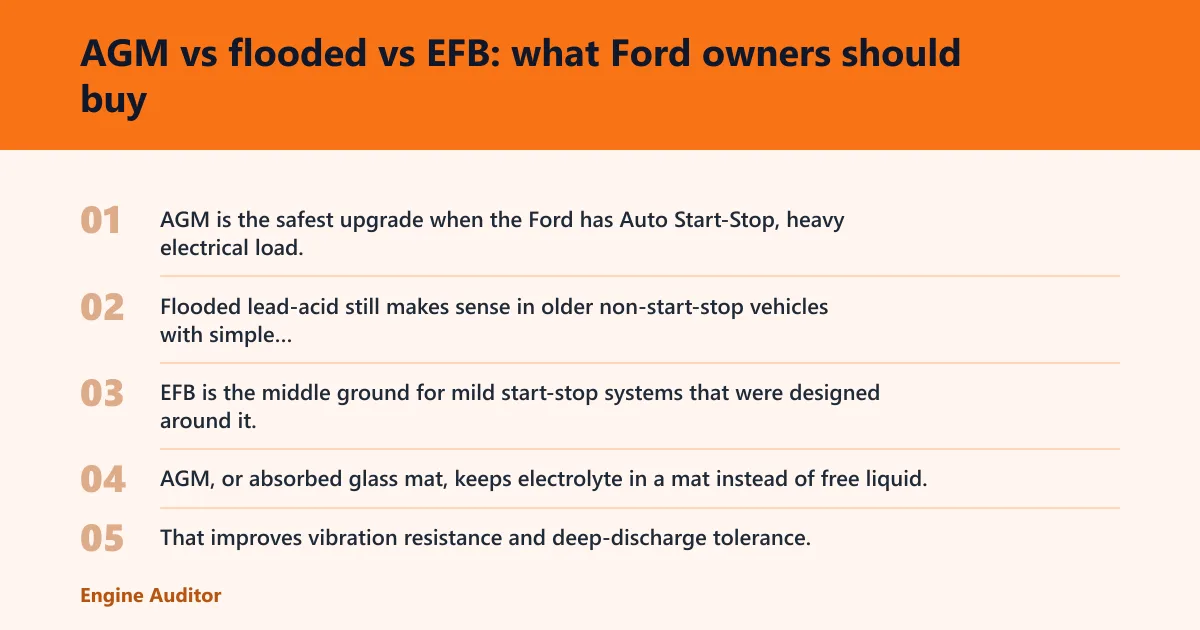
AGM is the safest upgrade when the Ford has Auto Start-Stop, heavy electrical load, or rough-duty use. Flooded lead-acid still makes sense in older non-start-stop vehicles with simple electrical demands. EFB is the middle ground for mild start-stop systems that were designed around it.
AGM battery
AGM, or absorbed glass mat, keeps electrolyte in a mat instead of free liquid. That improves vibration resistance and deep-discharge tolerance, which is why AGM shows up often in trucks and start-stop vehicles. Consumer Reports says many top-scoring batteries use AGM technology.
Flooded lead-acid battery
Flooded lead-acid uses traditional liquid electrolyte. It usually costs less, but it also has lower vibration resistance and less cycling tolerance than AGM or EFB. For an older Ford without start-stop and without heavy accessory use, it can still be the correct fit.
EFB battery
EFB, or enhanced flooded battery, sits between standard flooded and AGM. It is built for better cycling than regular flooded and is commonly used in mild start-stop applications. It is not a blanket replacement for AGM, and it should only be used when the OE system allows it.
Why Auto Start-Stop changes the decision
Start-stop systems restart the engine many times in city driving, and that repeated cycling is hard on standard flooded batteries. If the truck or SUV came with AGM, downgrading can shorten battery life and may create charging complaints. The Ford guide specifically says not to downgrade an AGM-equipped truck or SUV to a normal flooded battery.
A common first-timer mistake is treating every Ford battery as interchangeable. A 48/H6 AGM from a start-stop Escape is not the same decision as a flooded Group 65 in an older Fusion, even if both physically look “close enough.”
Best battery for F-150, Super Duty, and Bronco
Ford trucks and heavier SUVs usually favor AGM because they carry more electrical load, see more vibration, and often sit with accessories running. The Ford guide says F-150 and Super Duty often use Group 94R or Group 65, and that AGM is a strong fit for high-electronics builds and short-trip city driving.
Towing and accessory load
For towing, idle-heavy work, trailer-brake use, and add-on lights or audio, reserve capacity matters as much as CCA. A higher RC helps the battery support electrical load if the charging system is not keeping up at idle. That is one reason AGM is common in truck use cases.
Dual-battery diesel caution
Some diesel trucks use dual batteries. In that setup, replacement should be matched as a pair in size, type, and age when possible. Mixing a fresh battery with a weak one can shorten service life and complicate charging balance, especially under cold-start or tow-use conditions.
Best battery for Explorer, Escape, Edge, Fusion, and Mustang
Crossovers and sedans need fitment checks just as much as trucks do. Explorer, Edge, Bronco, and Escape with start-stop often use Group 48/H6, while Fusion and Mustang fitment depends on trim, engine, and terminal layout. The right answer is the OE battery code, not the badge on the hood.
Start-stop Ford SUVs
If the Explorer or Escape left the factory with start-stop, the OE battery type matters. EFB can be acceptable only when the vehicle was designed for it. If the original battery was AGM, keep AGM. That reduces the risk of premature wear and weak restarts.
Mustang fitment checks
Mustang batteries can vary by engine and package, so tray space and terminal placement need to be checked before ordering. Do not buy by CCA alone. A battery that misses the group code can fit poorly, strain cables, or create hold-down issues.
Ford battery fitment table by model and use case
This table is a fitment guide, not a universal parts list. Confirm the battery label, tray size, and OE code before you buy, because battery size varies by make, model, year, and engine size.
| Ford model and use case | Common group size | OE tech | Minimum CCA target | Reserve capacity priority | Upgrade/downgrade warnings |
|---|---|---|---|---|---|
| F-150, towing or accessory-heavy use | 94R or 65 | AGM | Meet or exceed factory spec | High | Do not drop to flooded if OE was AGM; match tray and cable layout exactly. |
| Super Duty, idle-heavy or diesel use | 94R or 65 | AGM | Meet or exceed factory spec | High | Check for dual-battery setups and replace as a matched pair when required. |
| Explorer with auto start-stop | 48/H6 | AGM or EFB | Meet or exceed factory spec | Medium to high | Do not assume EFB is acceptable if the OE battery was AGM. |
| Escape with auto start-stop | 48/H6 | AGM or EFB | Meet or exceed factory spec | Medium to high | Downgrading from AGM can shorten life and hurt restart performance. |
| Edge with start-stop or short-trip commuting | 48/H6 | AGM or EFB | Meet or exceed factory spec | Medium | Short trips favor AGM when electrical loads are high. |
| Bronco with accessories or cold-weather use | 48/H6 or 94R | AGM | Meet or exceed factory spec | High | Verify tray and terminal placement; off-road vibration favors AGM. |
| Fusion, non-start-stop daily driver | 48/H6 or 96R | Flooded or AGM, depending on OE | Meet or exceed factory spec | Medium | Use the OE type first; do not install AGM if the charging system was not set up for it. |
| Mustang, engine-specific fitment | 48/H6 or 94R | Flooded or AGM, depending on OE | Meet or exceed factory spec | Medium | Check tray dimensions and terminal orientation before ordering. |
Weize Platinum AGM Battery BCI Group 24F: best for Ford drivers who want a high-CCA AGM
This is a fit-first AGM pick for drivers who need strong cold-start output and decent reserve capacity. Based on the spec sheet and the stated 710 CCA and 120 RC, it makes sense for Ford owners who are comparing AGM options for accessory load, short trips, or cold weather.
What stands out is the low self-discharge rate and the 36-month warranty. The drawback is simple: Group 24F is not a universal Ford fit, so you still have to verify tray dimensions, terminal placement, and the OE group number before considering it.
OPTIMA YellowTop D34/78: best for Ford drivers with vibration and accessory demand
This AGM battery is aimed at drivers who want strong vibration resistance and a higher-output spec sheet. The listed 750 CCA and 120 RC make it a plausible fit for Ford trucks or SUVs with accessory load, but only when the group size and terminal layout match the vehicle.
Its main advantage is the SpiralCell design and the maintenance-free AGM construction. The drawback is price; at $309.99, it is a premium option, and the D34/78 format still has to fit the tray and cable setup in the Ford you are servicing.
Which one should you buy?
Choose AGM if your Ford has Auto Start-Stop, heavy electrical load, or frequent short trips. Choose EFB only if the OE system was designed for it. Choose flooded lead-acid only if the vehicle calls for it and the duty cycle is light. In cold climates, prioritize CCA; for towing or accessories, prioritize reserve capacity.
Budget-driven choice
If your Ford is older, non-start-stop, and lightly loaded, flooded lead-acid is usually the lowest-cost correct fit. If the vehicle is a start-stop model or sees winter city use, that lower price can become false economy if the battery cycles poorly or shortens charging-system margin.
Use-case-driven choice
For commuting with many restarts, AGM is the safest default. For a mild start-stop Ford that was factory-built around EFB, stay with EFB unless the owner’s manual allows AGM as an approved replacement. For trucks and tow rigs, reserve capacity should not be treated as optional.
Suppose a Bronco owner sees a Group 48/H6 label on the old battery and uses the vehicle for short trips, snow, and roof-mounted accessories. The correct move is to stay with the right group, keep the OE technology type, and choose a battery with factory-level or better CCA and RC.
How important is CCA for cold starts in Ford vehicles?
CCA matters a lot in cold weather because it measures cold-start performance. A Ford battery should meet or exceed the factory CCA spec, especially in freezing climates where oil thickens and the starter needs more current. More CCA is not useful if the group size or charging system compatibility is wrong.
In warm climates, CCA still matters, but reserve capacity and heat tolerance become more important for durability. Consumer Reports tests battery performance at 0º F and also simulates under-hood heat with a 167º F water bath, which is a reminder that Ford batteries must handle both extremes.
What is the best battery for short trips and city driving in a Ford?
AGM is usually the best choice for short trips and city driving because repeated starts and incomplete recharge cycles are hard on standard flooded batteries. The Ford guide recommends AGM for high-electronics builds and short-trip city driving, which is a good fit for modern F-150s, Explorers, and other load-heavy models.
If the Ford was factory-equipped with EFB, that can be a reasonable middle-ground option. If the original battery was AGM, do not step down to flooded just to save money, because that often shortens service life in stop-and-go use.
How do I know if my Ford battery is the right group number?
The battery is the right group number if it matches the tray, terminal placement, and hold-down hardware, and if the vehicle starts without cable strain or fitment issues. Check the old battery label and the owner’s manual, then confirm that the replacement matches the same BCI group code.
If the battery is close but not exact, do not force it. Consumer Reports advises replacing a battery with the same group so it fits the tray and leads. That is especially important on Ford vehicles that use 94R, 48/H6, or 96R in specific layouts.
Frequently asked questions
What battery size does my Ford need?
Most Ford replacements should match the group size on the old battery label or the owner’s manual. Common families include 94R, 48/H6, and 96R, but fitment still depends on the exact model, engine, tray space, and terminal placement. Always match the physical code first.
Is AGM better than flooded for my Ford?
AGM is better when your Ford has start-stop, lots of accessories, towing use, or frequent short trips. Flooded lead-acid still makes sense for older non-start-stop vehicles with simpler electrical demands and lighter cycling. The right answer depends on the OE battery type, not just the price tag.
Which battery is best for an F-150?
For many F-150 setups, AGM is the best fit because trucks often use 94R or 65 sizes and carry higher electrical and vibration load. If the truck tows, idles, or runs accessories, look for strong reserve capacity as well as factory-level or better CCA.
What battery should I buy for an Explorer with auto start-stop?
Buy the same technology the Explorer was built with, which is often AGM or EFB in start-stop trims. If the OE battery was AGM, keep AGM. If the system was designed around EFB, use EFB only if the manual and label support that choice.
Can I downgrade from AGM to a regular battery in my Ford?
Usually no, especially on trucks or SUVs that came with AGM from the factory. Downgrading can shorten battery life and create restart or charging complaints. The Ford guide specifically says not to downgrade an AGM-equipped truck or SUV to a normal flooded battery.
Which battery group fits a Mustang?
Mustang fitment depends on engine and package, so the group number is not one-size-fits-all. Common possibilities include 48/H6 or 94R, but you need to confirm tray dimensions and terminal layout before buying. The old battery label is the fastest check.
Products related to this article
Sponsored / affiliate links. As an Amazon Associate I earn from qualifying purchases. I may earn additional commission from eligible campaigns.