Best Car Batteries for Hot Climates (2026): we compared
For most hot-weather drivers, the OPTIMA RedTop 34/78 AGM is the top pick because it pairs 800 CCA with a sealed AGM build and dual SAE/GM terminals, which helps in heat, vibration, and hard starts.
Quick comparison
| Product | Badge | Best for | Price | ||
|---|---|---|---|---|---|
 |
OPTIMA® Batteries High Performance 34M BLUETOP® Sealed AGMOPTIMA | Our pick | 800 CCA · 100 min reserve · AGM sealed | $319.99
Price as of 30 Sep 2026
|
View |
 |
ACDelco Gold 94RAGM (88864542) 36 Month Warranty AGM BCIACDelco | Budget pick | Group 94R AGM · 36-month warranty | $212.32
Price as of 30 Sep 2026
|
View |
Heat shifts the battery choice fast. A strong CCA number helps starting, but reserve capacity and fitment matter more once summer traffic, accessory loads, and short trips pile up.
How we chose
The shortlist rests on four points: fitment, starting performance, battery design, and reserve capacity. That keeps the page tied to hot-climate use instead of turning it into a one-spec CCA contest.
Battery group size comes first. If the tray, hold-down, or terminal layout is wrong, the best-sounding battery is the wrong battery.
Heat tolerance comes next. AGM and flooded batteries age in different ways under engine-bay heat, vibration, and repeated cycling. I have seen that split play out in real summer service.
Use pattern matters too. Short trips, parked-outside cars, tow use, and start-stop driving stress batteries in different ways.

Hot-climate battery decision matrix

Use this matrix to match the battery to the job. In hot weather, reserve capacity often matters more than an oversized CCA number, because a battery can still crank well and fail early when accessory loads, idling, and short-trip charging patterns keep it in a partial state of charge.
| Use case | Minimum recommended CCA | Minimum reserve capacity | Battery type | Common failure risks |
|---|---|---|---|---|
| Daily driver with normal electrical load | 500 CCA | 90 minutes | Flooded or AGM, based on fitment | Short trips, parked-outside heat exposure |
| Short-trip commuter | 600 CCA | 100 minutes | AGM preferred | Repeated partial charging, heat soak after shutdown |
| Accessory-heavy SUV or truck | 650 CCA | 110 minutes | AGM preferred | High accessory loads, idling, slow recharge |
| Tow vehicle or work truck | 700 CCA | 110 to 120 minutes | AGM or long-life flooded if vehicle allows it | Towing loads, heat stress, vibration |
| Start-stop vehicle | 650 CCA | 120 minutes | AGM | Frequent cycling, shallow charging, heat buildup |
| Lowest-upfront-cost replacement | Match OEM spec | As high as fitment allows | Flooded lead-acid | Short trips, high heat, lower reserve margin |
AGM vs flooded by driving pattern
AGM is often the better choice when the car sees repeated starts, lots of idling, or high accessory draw. It is sealed, spill-proof, maintenance-free, and more resistant to vibration, which helps in hot weather and on rough roads.
Flooded lead-acid is still a valid hot-climate choice when the vehicle does not require AGM and the goal is lower upfront cost. The key is buying a flooded battery built for long service, not the cheapest tray filler available.
When higher CCA matters less than reserve capacity
Higher CCA helps cold or hot starting, but it does little for a battery that gets pulled down by fans, audio systems, commutes under ten minutes, or long idling with the A/C on. In heat, reserve capacity buys more practical margin than chasing the biggest CCA badge.
Common heat-failure risks to watch for
- Short trips: the alternator may not restore the charge used at startup.
- High accessory loads: fans, infotainment, charging ports, and A/C all draw power while the car sits at idle.
- Parked-outside heat exposure: engine-bay temperatures run hotter than the ambient air, which speeds internal wear.
- Towing: added load raises heat and puts more demand on reserve capacity.
- Start-stop cycling: repeated restart events punish batteries that are not built for it.
OPTIMA RedTop 34/78 AGM: best for hot-weather starting
- SpiralCell AGM handles heat and vibration well
- 100-minute reserve capacity for steady power
- Dual-purpose starting and deep-cycle use
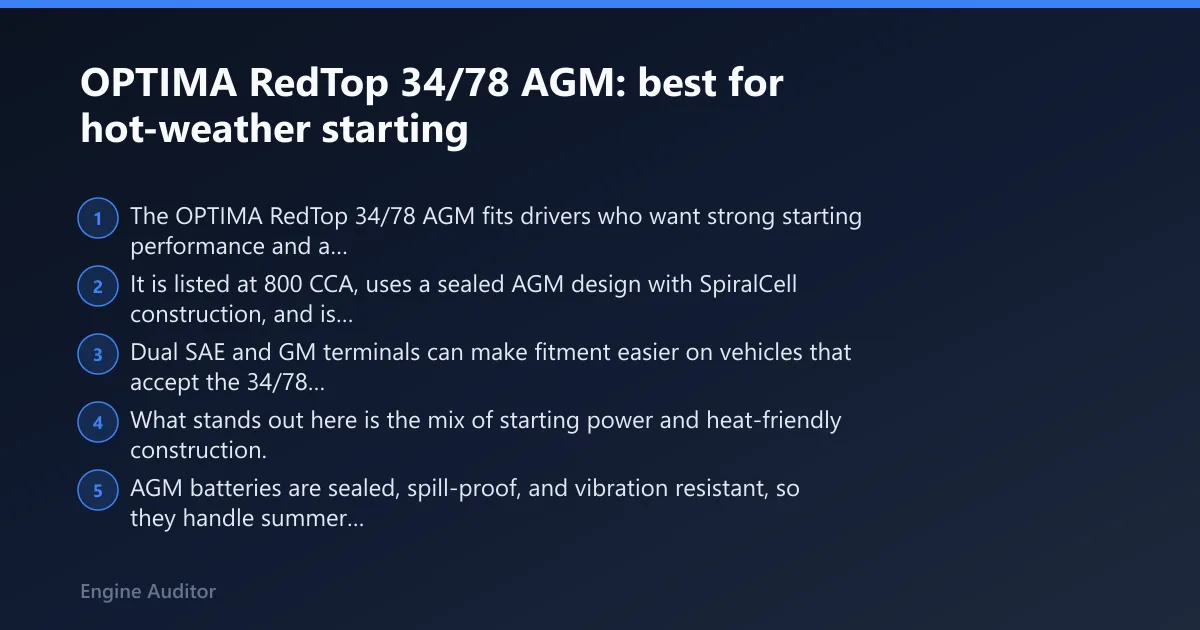
The OPTIMA RedTop 34/78 AGM fits drivers who want strong starting performance and a sealed build. It is listed at 800 CCA, uses a sealed AGM design with SpiralCell construction, and is described as maintenance free. Dual SAE and GM terminals can make fitment easier on vehicles that accept the 34/78 group size.
What stands out here is the mix of starting power and heat-friendly construction. AGM batteries are sealed, spill-proof, and vibration resistant, so they handle summer abuse better than many basic flooded units when the vehicle sits in traffic, gets parked in the sun, or sees rougher roads.
The drawback is price. AGM usually costs more upfront, and this model is aimed more at strong starting and durability than the lowest purchase cost.
Who should buy it
This is the better fit for drivers who want hot-weather starting confidence, have a vehicle that accepts group 34/78, or need a battery that can handle vibration and repeated summer heat soak without asking for much maintenance.
Interstate MT-24F: best for value and reserve capacity
The Interstate MT-24F is the better pick for shoppers who want a conventional battery with strong reserve capacity and a more approachable price profile. It is described with up to 700 CCA and 110-minute reserve capacity, which is a useful mix for hot climates where the battery spends time supporting accessories and idling.
A flooded battery can still be the smarter buy when the vehicle does not call for AGM and the goal is long service at lower entry cost. This is where good fitment, a sensible group size, and decent reserve capacity matter more than paying extra for sealed construction you may not need.
The drawback is that flooded batteries are not the right answer for every start-stop system, and they do not offer the same spill-proof, maintenance-free construction as AGM.
Who should buy it
This makes sense for drivers who want a hot-climate replacement in a vehicle that accepts the 24F size, do not need AGM for start-stop duty, and value reserve capacity more than premium construction.
Which one should you buy?
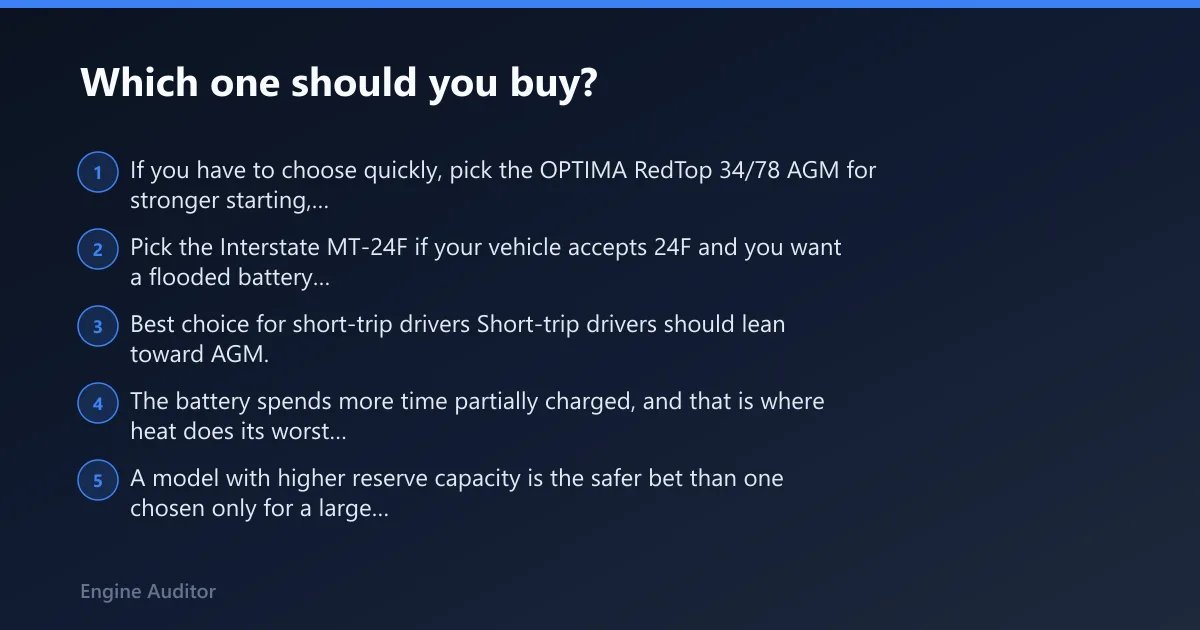
If you have to choose quickly, pick the OPTIMA RedTop 34/78 AGM for stronger starting, better vibration tolerance, and hotter-use duty. Pick the Interstate MT-24F if your vehicle accepts 24F and you want a flooded battery with solid reserve capacity and lower upfront cost.
Best choice for short-trip drivers
Short-trip drivers should lean toward AGM. The battery spends more time partially charged, and that is where heat does its worst work. A model with higher reserve capacity is the safer bet than one chosen only for a large CCA label.
Best choice for start-stop vehicles
Start-stop cars usually need AGM because they are built for repeated cycling. The sealed construction and better cycling support help the battery survive constant restart events, especially when summer heat and accessory loads stack on top.
Best choice for parked-outside cars and tow use
Parked-outside cars and tow vehicles need extra reserve capacity. Heat buildup in the engine bay, plus the extra load from towing or extended accessory use, can drain a battery that still looks fine on a starter test.
Best choice if you want the lowest upfront price
A good flooded lead-acid battery is the value answer when the vehicle allows it and the owner does not need start-stop support. Buy by correct group size first, then choose the best flooded unit with the strongest reserve capacity you can fit.
How do I choose between AGM and flooded for hot weather?
Choose AGM if the car has start-stop, lives on short trips, carries heavy accessory loads, or spends a lot of time in heat-soaked parking. Choose flooded if the vehicle does not require AGM and you want a lower upfront price with acceptable hot-weather service.
The rule is simple: use AGM when cycling and vibration are the problem, use flooded when value matters more and the vehicle’s electrical demands are modest. Both can work in heat if the group size fits and the reserve capacity is strong enough.
Does heat shorten a car battery’s life?
Yes. Extreme heat is one of the fastest ways to shorten a car battery’s life, and engine-bay temperatures run hotter than the air outside. That matters because the battery can age faster even when the car still starts normally for a while.
The failure often looks sudden. The battery may test fine on starting power, then struggle after a run of short trips, heavy A/C use, or a few days parked in the sun.
What car battery is best for hot weather?
The best hot-weather battery is the one that fits the tray and terminals, meets the vehicle’s starting spec, and offers the most reserve capacity you can realistically use. For many drivers, that means AGM. For others, a well-built flooded battery is the smarter value choice.
The best battery is not always the one with the highest CCA label. In summer, reserve capacity and use pattern often decide whether the battery survives the season.
Do AGM batteries last longer in hot climates?
Often, yes, especially in vehicles that cycle hard or see heavy accessory loads. AGM’s sealed construction, spill-proof design, and better vibration resistance help it hold up better under summer stress, but it still ages in high heat. It is tougher, not heat-proof.
That said, AGM is not automatically the longest-life answer for every driver. A good flooded battery can be the better value when the vehicle does not need AGM and the use pattern is gentle.
Is a flooded battery okay in extreme heat?
Yes, if the vehicle does not require AGM and the flooded battery is built for long service. A quality flooded battery can be a good hot-climate replacement, especially when the owner wants lower upfront cost and the car is not a start-stop model.
The downside is reduced cycling tolerance compared with AGM. Short trips, high accessory draw, and repeated heat soak expose the weak point quickly.
How many CCA do I need in a hot climate?
In hot climates, match the vehicle’s spec and stay in the useful range rather than chasing the biggest number on the shelf. A practical range from competing batteries runs about 500 to 850 CCA, but reserve capacity and fitment should decide the final buy.
If the vehicle sees towing, idling, or high accessory loads, lean toward the upper end of the needed range. If the car is a light-duty commuter, enough CCA plus more reserve capacity is the better trade.
What battery size is best for my car in summer heat?
The best size is the one that matches the tray, terminals, and hold-down points. Group size comes before CCA and reserve capacity. Common fitment examples include 34/78, 94R/H7, H6, 35, 51R, 47/H5, 86, and 24F.
If the size is wrong, none of the heat-climate advice matters. A battery that fits poorly can move, lose terminal contact, or force the wrong cable orientation.
What reserve capacity matters in hot weather?
Reserve capacity is the minutes a battery can support the vehicle under load, and it matters a lot in summer. Heat, idling, and short trips can drain a battery that still has decent starting power, so higher reserve capacity gives more margin.
For hot-weather use, a battery with around 100 minutes or more of reserve capacity is a solid starting point, especially for accessory-heavy cars, trucks, or vehicles that spend time parked outside.
Which battery is best for start-stop cars in hot climates?
AGM is usually the right answer for start-stop vehicles in hot climates. Those cars cycle the battery repeatedly, and the sealed AGM design is better suited to repeated starts, accessory loads, and heat stress than a basic flooded battery.
If a vehicle came with AGM from the factory, replacing it with a flooded unit is usually the wrong trade. It may fit, but it is often the weaker long-term choice.
Does heat shorten a car battery’s life?
Yes. Heat speeds up wear, and it does so faster than most drivers expect. A battery can fail early after a summer of short commutes, heavy electrical load, and long parking periods in direct sun.
That is why the right battery choice in hot weather is about more than starting power. The battery has to survive the way the car is actually used.
Products related to this article
Sponsored / affiliate links. As an Amazon Associate I earn from qualifying purchases. I may earn additional commission from eligible campaigns.