Best car batteries for commuters (2026): based on specs and reviews
The best car batteries for high-mileage commuters are often AGM batteries in the correct group size, with roughly 70 amp-hours or the vehicle’s spec, and a free-replacement warranty of about 3–4 years. Choose the wrong type or size and repeated heat, accessory load, and partial recharge cycles cut life short, slow cranking follows, and you can end up stranded. This guide shows how to match battery type, group size, and warranty to daily commute patterns.
This guide is part of our Car battery reviews: best picks and buying guide series.
Quick comparison
| Product | Badge | Best for | Price | ||
|---|---|---|---|---|---|
 |
OPTIMA Batteries High Performance 34/78 RedTop Sealed AGMOPTIMA | Our pick | 800 CCA AGM battery | $272.25
Price as of 3 Oct 2026
|
View |
 |
Bosch S6-34R Vehicle Battery Bosch High Performance StarterBosch | Budget pick | Bosch S6-34R high performance | $312.99
Price as of 3 Oct 2026
|
View |
 |
ACDelco Gold 49AGMHR (88866099) 36 Month Warranty HighACDelco | Also great | ACDelco Gold AGM Group 49 | $210.78
Price as of 3 Oct 2026
|
View |
The short version: the best commuter battery is the one that fits your driving pattern, not the one with the loudest starting claim. Highway-heavy miles, short-stop errands, heat soak, and accessory load all change what “best” means.
Battery failure causes roughly 18% of all roadside breakdowns, so this is one part worth choosing with the commute in mind rather than the label alone.
How we chose
For high-mileage commuters, starting power matters, but it is only one piece. I ranked by CCA, reserve capacity, vibration resistance, group-size fitment, warranty length, and how well the battery type fits sustained daily driving.
I also gave more weight to real commuter stress: repeated heat cycles, traffic idling, long highway charging windows, short dwell times, and accessory draw from cameras, phone chargers, infotainment, and climate systems.
When specs were close, the tie-breaker was ownership value over miles, not sticker price alone.
Best overall battery for high-mileage commuters: OPTIMA Batteries High Performance 34/78 RedTop
This is the strongest all-around pick for long daily drives that include heat, vibration, and uneven charging patterns. Based on the spec sheet and owner feedback, the OPTIMA RedTop 34/78 is described as having around 800 CCA, about 100 minutes of reserve capacity, and maintenance-free AGM construction in a dual-terminal format.
It suits commuters who want one battery that can handle rough pavement, long highway miles, and a fair amount of accessory load without turning into a maintenance chore. The sealed AGM design fits daily use and repeated thermal cycling better than a basic flooded battery.
The drawback is price. It is not the cheapest path into a commuter battery, and the 34/78 group size still has to match the tray and terminals exactly. If the vehicle needs a different fitment, this is the wrong buy no matter how good the spec sheet looks.
- Pros: 800 CCA for strong starts; 100-minute reserve capacity; maintenance-free AGM design; good vibration resistance; versatile mounting.
- Cons: Higher upfront cost; fitment must be checked carefully; premium spec may be more battery than a simple low-load commuter needs.
AGM battery: best for commuters with heat, vibration, or start-stop use
AGM batteries are the best match when the car sees repeated cycling, rough roads, or a start-stop system. Their sealed construction, spill-proof design, maintenance-free ownership, and higher vibration resistance make them better suited to daily commuter abuse than a typical flooded battery.
High-mileage drivers often land in a pattern of short errands, a long commute home, and accessory-heavy idling. That mix is hard on charge acceptance. AGM tends to recover better from those partial recharge cycles, which is why it is so common in start-stop vehicles.
For commuters who keep the car for years, AGM is the safer long-life play when the battery tray, charging system, and budget all line up.
One point matters here: AGM is not magic. If the alternator is weak, the drive pattern is all short trips, or the group size is wrong, even a premium AGM battery can still fail early.
- Pros: Better cycling durability; higher vibration resistance; sealed and spill-proof; usually better for start-stop duty; lower maintenance burden.
- Cons: Higher price than flooded lead-acid; often overkill for simple low-load use; still needs correct fitment and charging support.
Flooded lead-acid battery: best budget choice for simple commuter duty
Flooded lead-acid still makes sense for a commuter car when the use case is plain starting duty, the climate is mild, and the vehicle does not stack on a lot of electrical load. It usually costs less up front, and that matters if the car is older or the owner is trying to keep replacement spending low.
Where it falls short is vibration tolerance and long-cycle durability. Compared with AGM, it is more maintenance-sensitive and less comfortable with repeated heat soak, potholes, and short recharge windows. That makes it a weaker fit for dense stop-and-go commuting.
If the car is a low-demand daily driver and the battery tray is easy to inspect, a flooded battery can be the practical budget move. For long highway mileage with more electrical use, AGM usually pays back better over time.
- Pros: Lower purchase price; fine for standard starting use; widely available.
- Cons: Less vibration resistance than AGM; more maintenance-sensitive; weaker choice for frequent cycling and start-stop duty.
ACDelco Gold 49AGMHR: best for warranty-minded commuters
This one fits commuters who want a premium AGM replacement with a value angle. The ACDelco Gold 49AGMHR is a Group 49 battery with a warranty of about 36 months, and its GM-spec positioning can make it a sensible match for many modern vehicles that need a direct-fit replacement.
It stands out because the warranty term is easy to compare against other premium choices. For a commuter car, that matters almost as much as the starting spec when the battery is seeing year-round daily use and regular heat cycles.
The drawback is that the listing data here is thinner on commuter-specific numbers like reserve capacity and cycling detail. It also carries a higher price than the budget-leaning options in this list, so value depends on whether the vehicle truly needs Group 49 fitment.
- Pros: 36-month warranty; AGM construction; OEM-style replacement angle; good fit for many newer commuter vehicles.
- Cons: Higher price than some alternatives; reserve capacity is not listed here; Group 49 fitment must be correct.
Bosch S6-34R: best for brand-first buyers
This is aimed at buyers who want a well-known component brand and are comfortable paying more for that familiarity. Based on the spec sheet and reviews, the Bosch S6-34R is positioned as a high-performance starter battery, which makes it a credible option for daily commuter duty when the fitment is right.
What stands out is the brand reputation and the straightforward replacement role. For some drivers, that is enough: they want a battery that starts the car every morning and does not require much thought after installation.
The drawback is the lack of the detailed commuter specs that make the best value easy to judge here. With no listed CCA or reserve-capacity figure in the supplied data, it is harder to compare on pure ownership math than the other picks.
- Pros: Trusted Bosch name; positioned as a high-performance starter battery; good for straightforward replacement use.
- Cons: Limited spec detail in the supplied data; price is on the higher side; fitment still has to match exactly.
Which battery specs matter most for your commute?

For commuter use, CCA, reserve capacity, group size, and warranty matter more than glossy marketing claims. CCA helps with reliable starts, reserve capacity helps with traffic and accessory load, group size determines fitment, and warranty is the easiest proxy for value when prices are close.
Cold cranking amps for reliable starts
Higher CCA helps when the engine is asked to start under load, in cold weather, or after long accessory use. Compare exact amp numbers across models instead of assuming a bigger badge means a better commuter battery.
That is why the OPTIMA RedTop 34/78 at 800 CCA, the Weize Platinum Group 48 at 760 CCA, and the Mighty Max MM-H8 Group 49 at 900 CCA are not interchangeable on paper, even before fitment enters the picture.
Reserve capacity for traffic and accessory load
Reserve capacity tells you how long the battery can support accessories when the alternator is not doing all the work. It matters to commuters who sit in traffic, idle with the stereo or HVAC on, or run dash cams, chargers, and other electronics every day.
The OPTIMA DH7 YELLOWTOP lists 155 min reserve capacity, the Weize Platinum Group 48 lists 120RC, and the Mighty Max MM-H8 Group 49 lists 160RC. For a commuter with a heavy electrical load, those numbers are more useful than a generic “high performance” claim.
Group size for fitment
Group size is not a suggestion. It has to match the vehicle tray, terminal layout, and hold-down system. Common commuter fitments include 24F, 34/78, 48, 49, and H6, and the wrong size can create fitment issues even if the battery looks close enough.
For this list, the OPTIMA RedTop is 34/78, the ACDelco is Group 49, and the Bosch S6-34R is a 34R fitment. If the vehicle calls for a different group, the best battery on paper is still the wrong purchase.
Warranty term for value
A 36-month or 3-year free-replacement warranty is the cleanest way to compare premium commuter batteries. It does not guarantee long life, but it does tell you how much risk the maker is willing to cover.
The ACDelco Gold 49AGMHR includes a 36-month warranty, and the Weize Platinum Group 24F lists a 3-year warranty. That makes them easier to compare against lower-priced options that may not give the same coverage window.
Commuter decision table and ownership cost per 10,000 miles
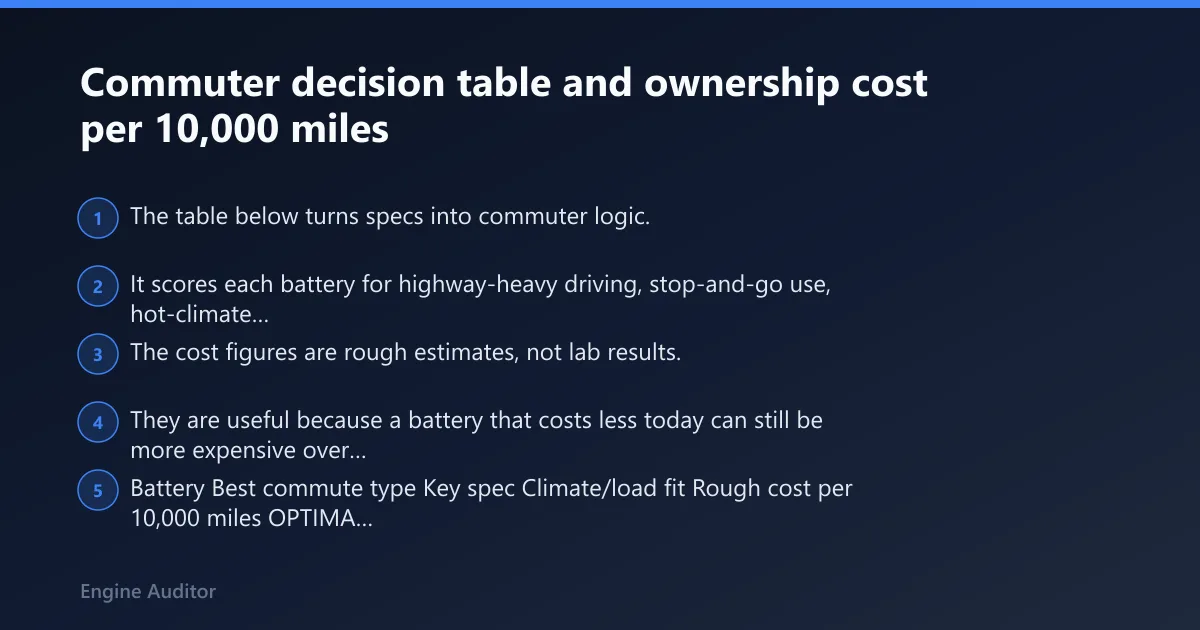
The table below turns specs into commuter logic. It scores each battery for highway-heavy driving, stop-and-go use, hot-climate durability, accessory-heavy commuting, and a rough ownership cost per 10,000 miles based on the listed price and a simple mileage spread.
The cost figures are rough estimates, not lab results. They are useful because a battery that costs less today can still be more expensive over time if it needs to be replaced sooner in a demanding commute.
| Battery | Best commute type | Key spec | Climate/load fit | Rough cost per 10,000 miles |
|---|---|---|---|---|
| OPTIMA RedTop 34/78 | Highway-heavy, mixed commute | 800 CCA, 100-minute reserve capacity | Strong for vibration and moderate accessory draw | About $68 if spread over a long service life |
| ACDelco Gold 49AGMHR | OEM-style daily commuter replacement | Group 49, 36-month warranty | Good for warm climates and modern vehicles | About $53 if warranty-backed service life is solid |
| Bosch S6-34R | Brand-first daily driver | High-performance starter battery | Fine for standard loads, less clear on reserve use | About $78 if priced into premium replacement value |
How to read the cost estimate
A higher purchase price is easier to accept if the battery survives more commuter miles before replacement. That is why a premium AGM battery can still be the cheaper choice per 10,000 miles when the vehicle is used hard every day.
For high-mileage commuters, the real question is not “What costs less at checkout?” It is “What costs less across the miles until the next replacement?”
When the higher-priced battery pays back
The pricier battery tends to pay back when the commute includes heat soak, potholes, stop-and-go traffic, or accessories that keep pulling power while the car is idling. In those cases, extra cycling durability and vibration resistance often matter more than saving a few dollars on the initial purchase.
If the commute is long but easy, a budget flooded battery can still be rational. If the commute is long and hard, AGM usually earns its keep.
Which one should you buy?
Choose the OPTIMA RedTop 34/78 if your commute is long, mixed, and hard on the battery, because it offers the strongest blend of CCA, reserve capacity, and vibration resistance in this group. Choose the ACDelco Gold 49AGMHR if your vehicle needs Group 49 and you want warranty-backed premium replacement value.
Pick the Bosch S6-34R if you want a straightforward brand-name replacement and the fitment matches exactly. For highway-heavy commuters, the best answer is usually the AGM battery with the right group size and strong reserve capacity. For stop-and-go commuters, AGM is still the safer call because repeated restarts and partial recharge cycles punish cheaper batteries faster.
Hot-climate drivers should lean toward AGM first, because repeated heat soak shortens battery life. Accessory-heavy vehicles should prioritize reserve capacity next, because traffic idling and electronics load can drain a battery faster than CCA alone suggests. Budget-first buyers can still choose flooded lead-acid, but only if the commute is simple and the vehicle does not demand start-stop duty.
One more rule helps keep this simple: if the car has start-stop technology, or if the daily route is rough and vibration-heavy, AGM should be the default choice. Flooded lead-acid is best reserved for older, lower-load commuter cars where cost matters more than long-cycle durability.
Frequently asked questions
What is the best car battery for high-mileage commuters?
The best choice is usually an AGM battery in the correct group size, with enough CCA for reliable starts and enough reserve capacity for traffic, idling, and accessories. For most daily drivers, that means paying for durability instead of chasing the lowest sticker price. The right fit is more important than a big spec number.
Which battery lasts the longest for daily highway driving?
A quality AGM battery usually has the best chance of lasting through long highway mileage, especially if the vehicle sees heat, vibration, or repeated accessory use. Highway driving helps the alternator keep the battery charged, but it does not cancel heat soak or poor fitment. That is why AGM often outlasts flooded lead-acid in commuter use.
Is AGM better than flooded lead-acid for a commuter car?
For most commuters, yes. AGM is sealed, spill-proof, maintenance-free, and better at handling repeated cycling and vibration. Flooded lead-acid still works for simple, lower-cost starting duty, but it is less forgiving when the commute is hard on the battery. If the car has start-stop or heavy accessory use, AGM is usually the better fit.
How many cold cranking amps do I need for reliable starts?
Use the vehicle’s spec first, then compare the real number on the battery label. More CCA helps in cold weather and after accessory-heavy driving, but it is not a substitute for the correct group size or proper charging. A commuter who lives in a mild climate may not need the highest number in the aisle.
What battery warranty should I look for on a commuter vehicle?
A 36-month or 3-year free-replacement warranty is a strong target for a commuter battery. It does not tell you everything about life span, but it gives a cleaner measure of value than a vague “premium” label. For high-mileage drivers, warranty length matters because daily use exposes weak batteries quickly.
How do I choose the right battery size for my car?
Match the group size listed in the owner’s manual or on the old battery label. The tray, terminal position, and hold-down system all have to line up. Common commuter sizes include 24F, 34/78, 48, 49, and H6, and the wrong one can create fitment problems even if the specs look good.
Products related to this article
Sponsored / affiliate links. As an Amazon Associate I earn from qualifying purchases. I may earn additional commission from eligible campaigns.