Hybrid Car Battery vs Regular Car Battery: What’s Different?
A hybrid car typically uses two batteries: a high-voltage traction battery for propulsion and a 12-volt battery for accessories and startup, while a regular car usually relies on a 12-volt starter battery for starting and electronics. Mixing them up leads to wrong diagnostics, wasted repair money, and a no-start that gets blamed on the wrong part. This guide compares job, voltage, chemistry, size, charging method, and failure symptoms so you can tell which battery is failing.
| Factor | Hybrid Car Battery | Regular Car Battery | Winner |
|---|---|---|---|
| Primary job | Uses a high-voltage traction battery for propulsion, while a separate 12-volt battery runs accessories and startup logic. | Relies on one 12-volt starter battery to start the engine and power electronics. | Hybrid Car Battery |
| Voltage | Traction battery is high-voltage; the 12-volt system is separate. | 12 volts. | Tie |
| Charging method | Regular hybrids recharge through regenerative braking and engine operation; PHEVs can also be charged from an external power source. | Charged by the engine-driven charging system. | Hybrid Car Battery |
| Chemistry | Traction pack is NiMH in many earlier hybrids and lithium-ion in many newer hybrids and PHEVs; the 12-volt auxiliary battery may be lead-acid or AGM. | Usually lead-acid; sometimes AGM. | Regular Car Battery |
| Size / packaging | Traction batteries are much larger and more complex because they store far more usable energy; PHEVs carry a larger battery than HEVs. | Smaller starter battery built for brief, high-current starting. | Regular Car Battery |
| Lifespan | NiMH hybrid packs are often described as lasting around eight to ten years; some lithium-ion hybrid packs are engineered to last 10 years or more under favorable conditions. | Lead-acid typically lasts around three to five years in many vehicles. | Hybrid Car Battery |
| Maintenance / diagnostics | Diagnosis often needs hybrid-specific testing; a weak 12-volt battery can mimic a larger problem and prevent READY mode. | Common starter-battery service; diagnosis is more straightforward. | Regular Car Battery |
| Performance when failing | A traction battery problem usually shows reduced electric assist, warning lights, weaker fuel economy, or limited drive mode changes; a weak 12-volt battery can stop the car from waking up. | A dead battery causes no crank or slow crank, dim lights, and dead electronics. | Tie |
| Can the car still run if this battery fails? | A traction battery may still allow READY in the short term if the 12-volt system is healthy, but the car may enter reduced-power mode or limit EV operation; if the 12-volt battery fails, the car may not wake up or enter READY. | If the battery is dead or too weak, the car will not crank the starter. | Hybrid Car Battery |
| Best-fit use | Supports hybrid driving, electric assist, regenerative braking capture, and, in PHEVs, some electric-only driving. | Best for starting the engine and powering electronics in a conventional car. | Tie |
| Replacement cost | Higher replacement cost. | Usually lower replacement cost. | Regular Car Battery |
What does each battery do?
The traction battery in a hybrid moves the car. The 12-volt battery wakes the electronics, powers lights and accessories, and lets the car boot up. In a regular car, the 12-volt battery does both startup and accessory work, so one weak battery can affect everything at once. NHTSA notes that hybrid and electric vehicles rely on both a high-voltage propulsion system and a separate low-voltage system for controls and accessories (Nhtsa).
Hybrid traction battery
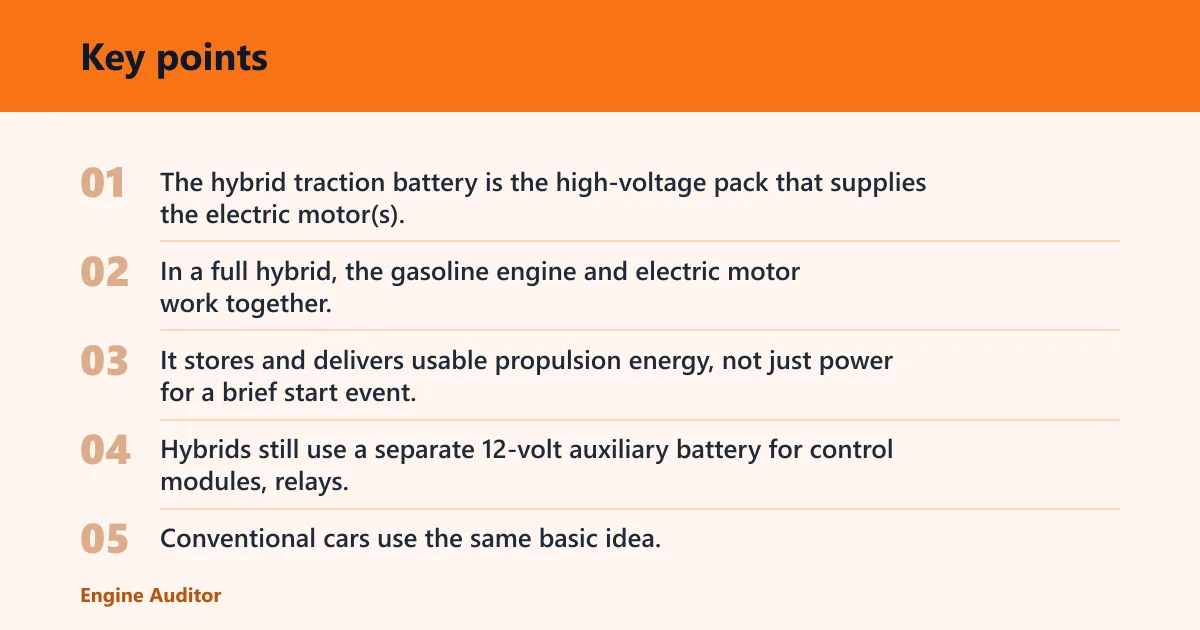
The hybrid traction battery is the high-voltage pack that supplies the electric motor(s). In a full hybrid, the gasoline engine and electric motor work together, and the battery is replenished while driving. It stores and delivers usable propulsion energy, not just power for a brief start event.
12-volt auxiliary battery
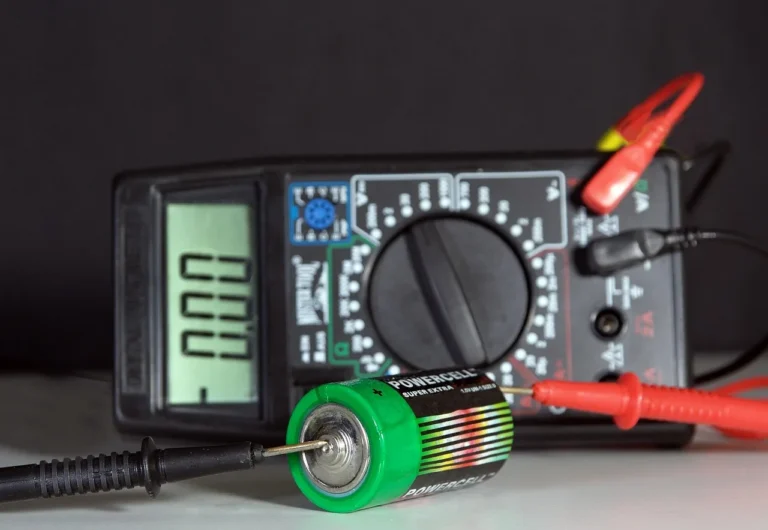
Hybrids still use a separate 12-volt auxiliary battery for control modules, relays, lights, locks, and boot-up logic. Conventional cars use the same basic idea, but their 12-volt battery also has to crank the engine directly. That is why a hybrid can have a healthy traction battery and still refuse to enter READY mode if the auxiliary battery is weak.
What powers the starter, lights, and control modules
In a regular car, the 12-volt battery must spin the starter motor and keep the electronics alive during starting. In a hybrid, the high-voltage pack does not do that job; the 12-volt battery is the gatekeeper for the computers and contactors that allow the system to start. If the 12-volt side is weak, the symptom can look worse than the fault really is.
Why are hybrid batteries so much larger?
Hybrid traction batteries store far more usable energy than a starter battery, so they need more cells and more packaging. Many standard hybrids use packs around 1 kWh, which is enough for propulsion support and regen capture rather than long electric-only travel; that is still only a small fraction of a full EV battery. Because pack size and usable capacity vary by model, that figure is best treated as a typical benchmark rather than a hard rule. A Car and Driver overview explains the basic size gap between hybrid packs and EV packs (Caranddriver).
Voltage and capacity differences
A 12-volt battery is built for brief, high-current starting and for electronics when the engine is off. A hybrid traction battery works at much higher voltage and higher capacity because it has to move the vehicle with electric assist, capture energy, and feed that energy back into drive events. That is why the pack is physically larger and more complex.
How packaging changes between HEVs and PHEVs
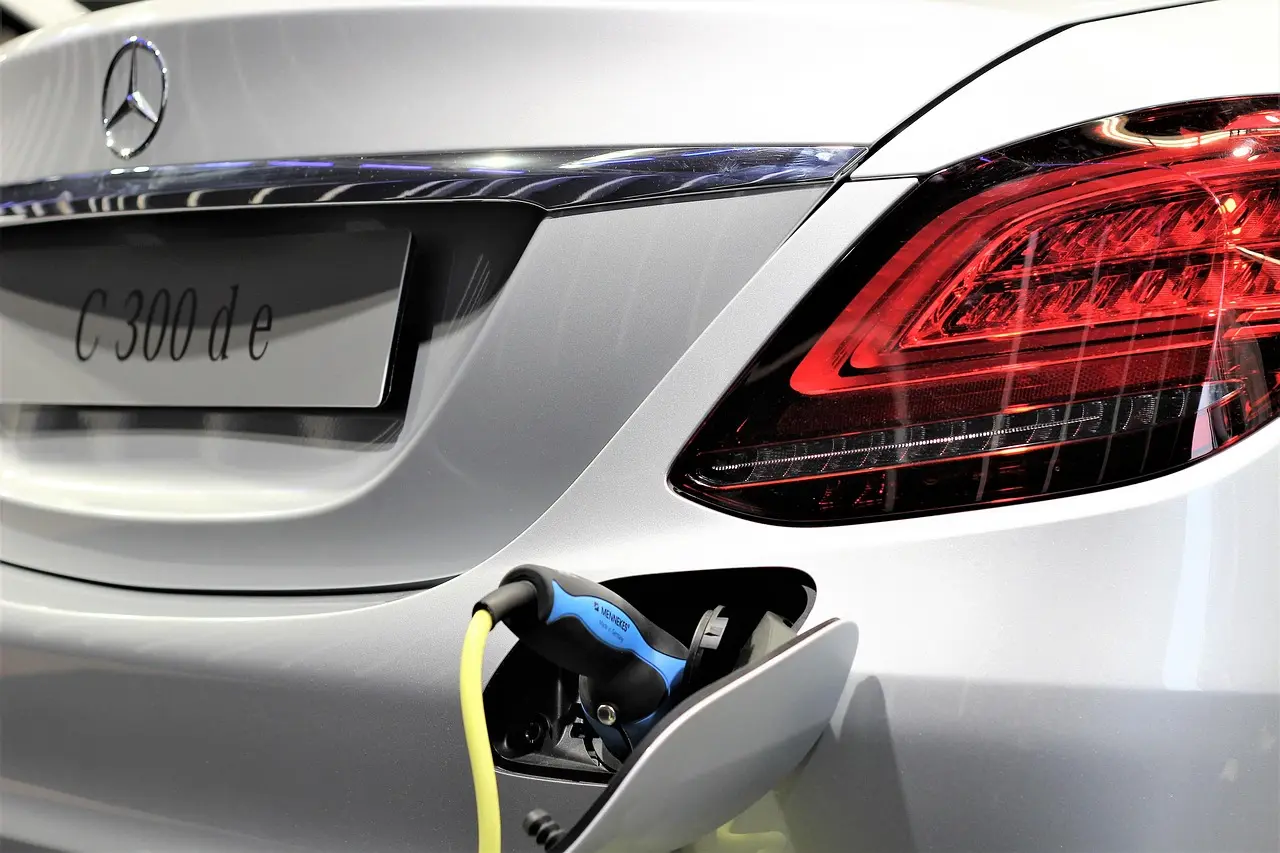
A full hybrid, or HEV, does not need external charging and keeps the battery smaller than a plug-in design. A plug-in hybrid electric vehicle, or PHEV, carries a larger battery, can be charged from an external power source, and can travel on electric power for roughly 20 to 60 miles depending on the model before switching to hybrid operation; actual range varies by trim, battery size, driving conditions, and temperature (Motortrend). That extra size changes both packaging and repair cost.
Picture a compact sedan with a weak 12-volt battery. The dash stays dark, the doors may not respond normally, and the car never reaches READY even though the traction pack could still be healthy. The fault looks like a dead hybrid battery from the outside, but the real problem is the small auxiliary battery.
How do they charge and recharge?
Regular hybrids generally do not need to be plugged in. They recharge the traction battery while driving through regenerative braking and engine operation. PHEVs are different because they can be connected to an external power source, so they can use grid power before the system falls back to hybrid operation.
Regenerative braking
Regenerative braking stores energy in the battery for immediate reuse. It captures kinetic energy during deceleration and feeds it back into the pack instead of wasting all of it as heat. Traditional brakes still matter, though; regenerative braking does not replace them.
Engine charging in full hybrids
In a full hybrid, the gasoline engine can help replenish the traction battery while driving. That is one reason these systems are often described as self-charging. The car does not need external charging, and the battery is managed in a narrow operating window to support efficiency and drivability.
External charging in plug-in hybrids
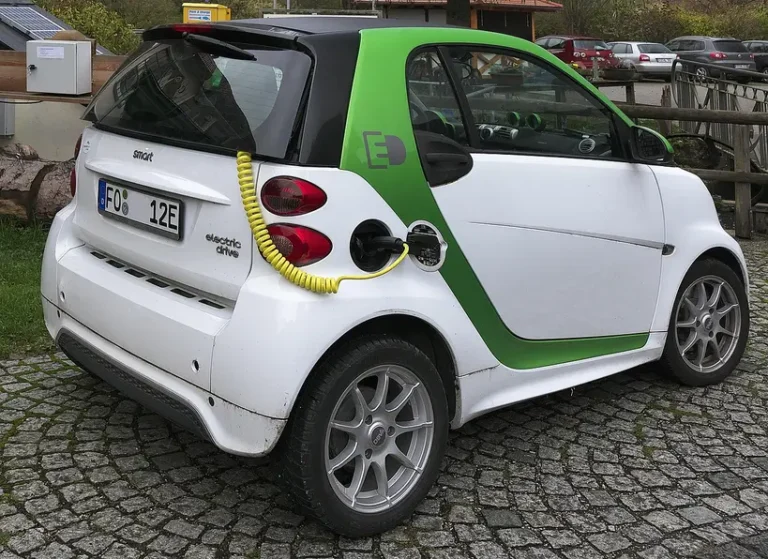
PHEVs can be plugged in, which changes daily use and repair expectations. Because the battery is larger, the system can cover more short trips on electricity alone before the engine takes over. That extra battery capacity also shifts the ownership question from “Will it start?” to “How much electric-only driving is left?”
What battery types are used in hybrid cars?

Hybrids use more than one battery type, and the chemistry depends on which battery you mean. The traction pack may be NiMH or lithium-ion, while the 12-volt auxiliary battery may still be lead-acid or AGM. That split is the part many comparisons leave out.
Nickel-metal hydride in many older hybrids
NiMH batteries are common in earlier hybrids and are known for durability. They are used in many Toyota-style hybrid systems and are often described as lasting around eight to ten years, though real-world lifespan depends heavily on heat, usage patterns, and maintenance history. Their long service life made them a practical choice before lithium-ion became more common.
Lithium-ion in many newer hybrids and PHEVs
Lithium-ion batteries are common in PHEVs and EVs, and they are also used in some newer hybrids. They have a good power-to-weight ratio and low self-discharge, which helps with packaging and stored energy retention. Manufacturer coverage and design life vary, but some lithium-ion hybrid packs are engineered to last 10 years or more under favorable conditions.
Lead-acid and AGM in 12-volt systems
Lead-acid is still common in standard starter batteries, and many hybrids also use lead-acid or AGM for the 12-volt system. Lead-acid typically lasts around three to five years in many vehicles, but climate, short-trip use, and parasitic draw can shorten that. That is why a hybrid’s small battery can age sooner than the traction pack.
What fails first when the car won’t start?
The first failure is often the 12-volt battery, not the traction battery. A dead auxiliary battery can stop the computers from waking up, which makes the car look completely dead. A failing traction battery more often shows warning lights, reduced assist, or drivability changes rather than a simple no-wake condition.
Dead 12-volt battery symptoms
Common signs include no dash lights, weak interior lights, slow locks, clicking relays, or a car that will not enter READY. In a regular car, the same kind of failure usually means no crank or slow crank. Either way, the 12-volt battery can fail independently of the larger battery system.
Hybrid traction battery warning signs
A traction battery problem usually affects drive behavior first. You may see warning messages, reduced electric assist, poorer fuel economy, or frequent engine running. The car may still start because the 12-volt system is healthy enough to wake the electronics, but the propulsion battery is no longer performing well.
Suppose a PHEV still drives for a few miles on electric power, then shifts to the engine sooner than usual and throws a hybrid warning light. That points toward the high-voltage battery or its controls. If the dash never wakes up at all, the smaller 12-volt battery is the first place to look.
Why a bad auxiliary battery can make a hybrid seem dead
Hybrids depend on the 12-volt battery to close contactors and bring the control system online. When that battery is weak, the high-voltage pack may never be connected, so a healthy traction battery stays inaccessible. That is why jump-starting a hybrid can sometimes restore normal operation without touching the traction pack itself.
Quick symptom-to-battery checklist
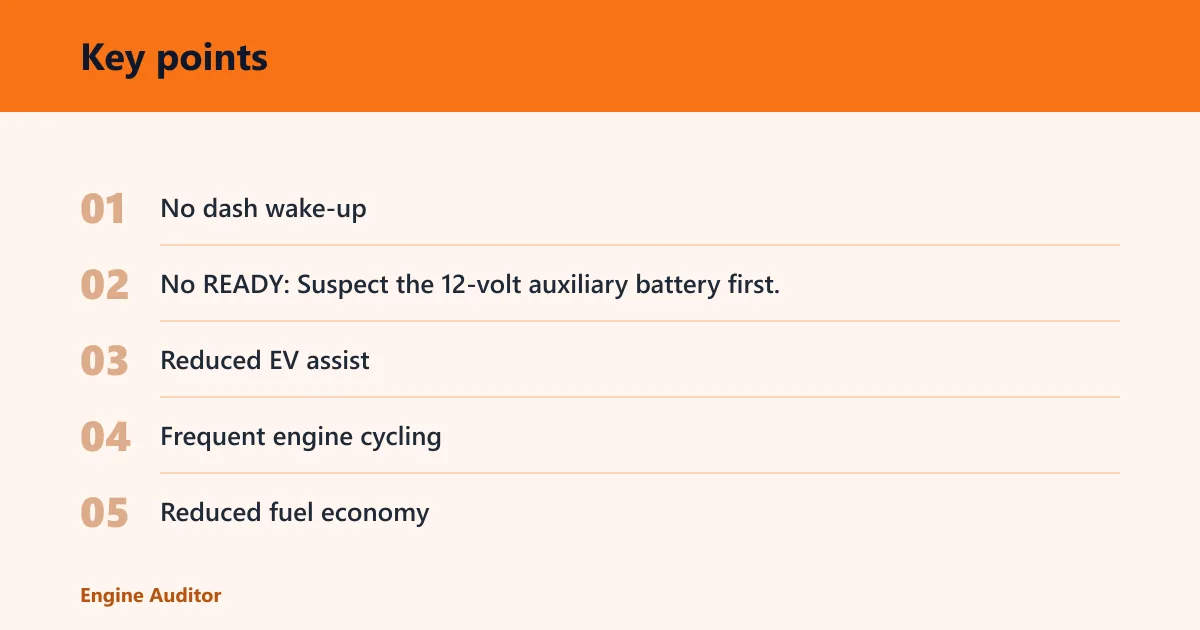
- No dash wake-up: Start with the 12-volt battery, its connections, and any parasitic draw concerns.
- No READY: Suspect the 12-volt auxiliary battery first, then scan for hybrid system faults if power is present but the car will not initialize.
- Reduced EV assist: Look at the traction battery, battery management system, or related hybrid control codes.
- Frequent engine cycling: Check whether the traction battery is holding charge or whether the hybrid system is compensating for weak pack performance.
- Reduced fuel economy: Consider traction battery degradation, sensor issues, tire pressure, or a hybrid system that is leaning on the engine more than usual.
- Warning lights: Read codes before replacing anything; hybrid warning lamps can point to the battery, inverter, cooling system, or control electronics.
- Check whether the dash, locks, and interior lights respond.
- If the car will not wake up, test the 12-volt battery first.
- If the car enters READY but shows hybrid warnings, inspect the traction battery system.
- Use the symptom pattern to avoid replacing the wrong battery.
Choose Hybrid Car Battery if… / Choose Regular Car Battery if…
Choose Hybrid Car Battery if you need propulsion support, electric assist, or a pack that is recharged while driving. Choose Regular Car Battery if you are servicing a conventional gas car that starts with a 12-volt starter battery and has no traction pack. The right pick follows the vehicle’s powertrain, not the label on the battery case.
Choose hybrid car battery if…
Choose it if your vehicle is a full hybrid or PHEV, if the symptom is reduced electric assist or hybrid warnings, or if the question is about the high-voltage pack that moves the car. Choose it if the battery needs to be recharged through regenerative braking, engine operation, or external charging in a PHEV. Choose it if the repair is likely to be complex and more expensive.
Choose regular car battery if…
Choose it if the car is a conventional gas vehicle that relies on a single 12-volt starter battery. Choose it if the symptom is no crank, weak lights, or a dead electrical system with no hybrid architecture involved. Choose it if you are replacing a standard starter battery and want a simpler, lower-cost repair path.
Frequently asked questions
What is the difference between a hybrid car battery and a regular car battery?
A hybrid car battery usually means the high-voltage traction pack that powers the electric motor(s). A regular car battery is a 12-volt starter battery that cranks the engine and runs electronics. Hybrids also have a separate 12-volt auxiliary battery, so the two systems should not be confused.
Do hybrid cars use a different 12-volt battery than regular cars?
Often, yes in packaging and sometimes in type, but not in principle. Hybrids use a 12-volt auxiliary battery for accessories and control electronics, and it may be lead-acid or AGM depending on the vehicle. The job is similar to a regular car battery, but the failure symptoms can feel different.
Why are hybrid batteries so much larger than regular car batteries?
Hybrid traction batteries are much larger because they store and deliver energy for propulsion, not just starting. They support the electric motor(s), absorb energy from regenerative braking, and help the vehicle operate efficiently. A standard hybrid battery is usually no larger than 1 kWh in many standard hybrids, which is still built for a very different job.
Can a hybrid car run if the 12-volt battery dies?
Not reliably. A weak or dead 12-volt battery can prevent the car from waking up, closing contactors, or entering READY mode even if the traction battery is healthy. Some hybrids may respond to a jump start, but the small battery still has to be fixed before normal operation is dependable.
How long does a hybrid car battery last compared with a regular car battery?
Hybrid traction batteries often last longer than a standard lead-acid starter battery, but lifespan depends on the vehicle, climate, and use pattern. Hybrid battery warranties are often stated at 8 years or 100,000 miles in many U.S. markets, and longer in some emissions states or on certain EV/hybrid components; some manufacturers quote 10 years or 150,000 miles or more for specific models. NiMH batteries are often described as lasting around eight to ten years, lithium-ion packs can last 10 years or more in favorable conditions, and lead-acid batteries typically last around three to five years.
Is a hybrid battery rechargeable without plugging in?
Yes, in a regular hybrid. Traditional hybrids are self-charging and do not need plugging in because regenerative braking and engine operation replenish the battery while driving. PHEVs are different because they can also be charged from an external power source, which gives them electric-only range before hybrid operation resumes.
What parts of a hybrid use the high-voltage battery versus the 12-volt battery?
The high-voltage battery powers the electric motor(s) and supports propulsion. The 12-volt battery runs accessories, control modules, relays, lighting, locks, and the boot-up sequence that brings the hybrid system online. If the car will not wake up, the 12-volt side is often the first diagnostic target.
Products related to this article
Sponsored / affiliate links. As an Amazon Associate I earn from qualifying purchases. I may earn additional commission from eligible campaigns.