Car battery reviews for towing and heavy accessories
For towing and heavy accessories, start with the highest-CCA AGM battery that fits your tray, with reserve capacity above about 120 minutes if possible. That setup gives stronger starts, longer accessory runtime, and better vibration tolerance than standard flooded lead-acid. In cold weather, put CCA first.
Quick picks for towing and heavy accessories
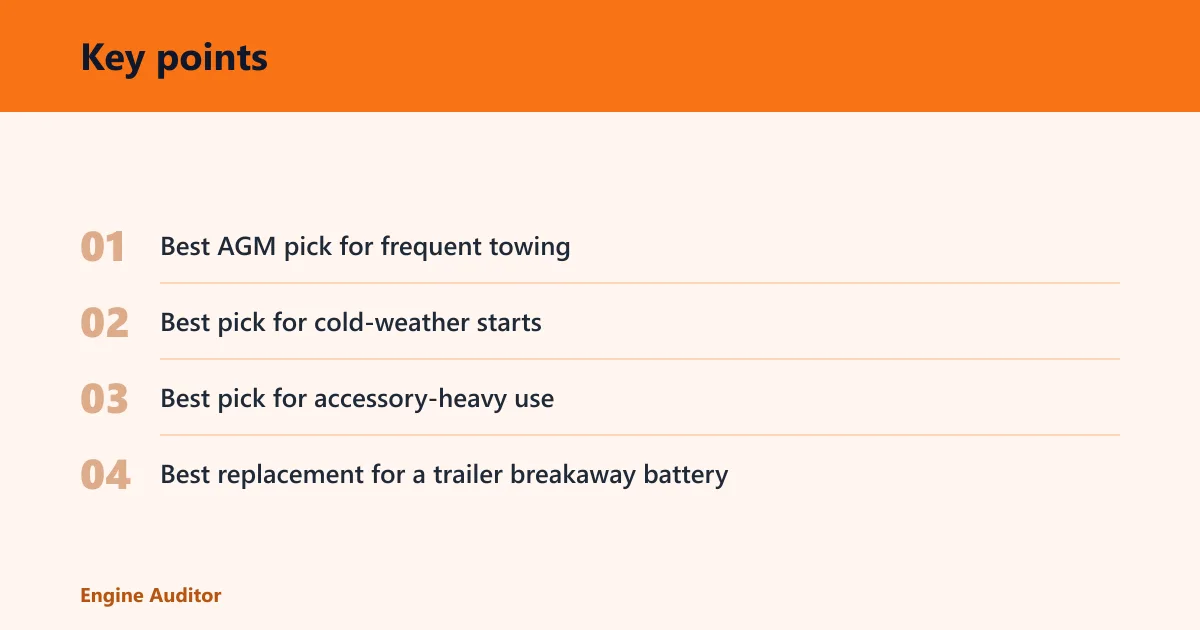
- Best AGM pick for frequent towing: 1AUTODEPOT Group 49, with 900 CCA and 160 minutes reserve capacity.
- Best pick for cold-weather starts: OPTIMA RedTop 34/78, listed with 800 CCA and up to 15 times more vibration resistance.
- Best pick for accessory-heavy use: UPLUS Group 48 AGM, rated at 760 CCA and 120 RC.
- Best replacement for a trailer breakaway battery: Mighty Max 12V 5AH SLA battery.
Say your SUV tows a camper on weekends and runs a brake controller plus dash accessories. A battery with 720 CCA may start the engine, but 120 RC or more matters when those loads stay on after shutdown. AGM is the better fit there.
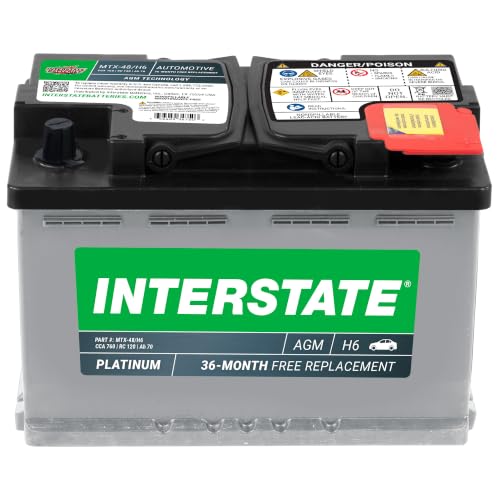
📊 The ACDelco Gold 94RAGM is presented as a maintenance-free AGM battery. Source: 8 Best Car Batteries for Towing in 2026.
What battery is best for towing?
The best towing battery matches three jobs: starting the engine, supporting accessory runtime, and handling vibration on rough roads. For most truck and SUV owners, AGM is the better default because it is sealed, spill-proof, and maintenance-free, while flooded lead-acid is mainly the backup choice when fitment or budget limits the pick.
Why towing changes the battery job
Towing adds electrical load and more demand on the battery. Trailer brake controllers, in-cab electronics, winch use, short-trip recovery, and cold starts all pull from the same reserve. Towing packages can include larger batteries and/or alternators for that reason.
A tow vehicle can start fine at idle and still struggle after a stop at a fuel station with the trailer connected. The battery must deliver a hard crank, then recover quickly once the alternator is online.
The three specs that matter most
CCA tells you how much starting power the battery can deliver in cold conditions. Reserve capacity tells you how long it can support accessory loads when the alternator is not carrying everything. Group size tells you whether it actually fits the tray and hold-down.
When AGM makes more sense than flooded lead-acid
AGM makes more sense when the vehicle tows often, sits between trips, runs short hops, or sees rough roads. Its sealed construction reduces spill risk, and its vibration resistance helps in trucks and SUVs that shake more than commuter cars.
AGM vs flooded lead-acid for towing
AGM is usually better than flooded lead-acid for towing because it is sealed, maintenance-free, and better at handling vibration. Flooded batteries still work as a budget baseline, but they are less durable in vibration-heavy use and less forgiving when accessory loads stack up.
Sealed, spill-proof construction
An AGM car battery uses absorbed electrolyte, so it is sealed and spill-proof. That matters in tow vehicles that see angle changes, rough roads, or hard braking. It also reduces maintenance because there is no routine water check.
Maintenance-free operation
Maintenance-free operation is more than convenience. It helps when the battery sits under a cover, deep in a truck bay, or in a hard-to-access tray. A sealed AGM format is simpler to live with than a flooded battery that needs more attention.
Vibration resistance on rough roads
Vibration resistance matters more in towing than many buyers expect. The OPTIMA RedTop claims up to 15 times more vibration resistance. Other AGM batteries are commonly marketed around 3 times versus standard batteries. Those claims matter because tow vehicles spend time on broken pavement, gravel, and jobsite routes.
Where flooded batteries still fit
Flooded lead-acid still fits when the vehicle is lightly loaded, the budget is tight, and the battery tray and charging profile are designed for that style. It remains the standard comparison point, but it is not the better choice for vibration-heavy towing use.
How many CCA do you need?
For towing, CCA should be high enough to crank the engine reliably after a cold soak or accessory drain. A practical floor for many gas tow vehicles is around 680 to 720 CCA, while heavier setups often do better at 750 to 900 CCA. Diesel and cold-weather use should bias higher.
CCA targets for light towing
For light towing in mild weather, a battery around 680 to 720 CCA can be adequate if the vehicle is otherwise healthy and the tray fit is correct. The HQST H5 Group 47 AGM is listed with 680 CCA, and the OPTIMA 35 REDTOP is listed with 720 CCA.
CCA targets for cold climates
Cold weather raises the bar because engine oil thickens and cranking demand climbs. In that case, a battery around 760 CCA or higher is a smarter target, and 800 CCA gives more margin. The OPTIMA RedTop 34/78 is listed with 800 CCA.
CCA targets for diesel or accessory-heavy setups
Diesel tow vehicles and accessory-heavy builds often benefit from 750 to 900 CCA, especially when the truck idles, makes short trips, or powers extra loads before shutdown. The Autocessking Group 65 AGM is rated at 750 CCA, the UPLUS Group 48 AGM at 760 CCA, and the 1AUTODEPOT Group 49 at 900 CCA.
How to read CCA without overbuying
Do not buy CCA alone. A battery with very high starting power but weak reserve capacity may still disappoint if the trailer brake controller, cab electronics, or camping gear runs after shutdown. Match CCA to climate and engine size, then check reserve capacity and fitment.
Does towing require a battery with higher reserve capacity?
Yes. Towing often benefits from higher reserve capacity because brake controllers, trailer electronics, and in-cab devices can keep drawing power after the engine is off. If the vehicle makes short trips or sits with the trailer connected, RC matters almost as much as CCA.
Reserve capacity for brake controllers and electronics
Reserve capacity is the battery’s accessory-runtime metric. It helps when the truck or SUV powers trailer brake controllers, lighting modules, infotainment, and charging ports. A battery with 120 RC is a better fit than a low-RC battery for that kind of use.
Reserve capacity for winches and camping loads
Winches and campsite accessories can drain a battery quickly. For that use, 120 RC is a reasonable floor, and 160 minutes is better when the vehicle may run lights, a fridge, or other loads while parked. The 1AUTODEPOT Group 49 is listed with 160 minutes reserve capacity.
When RC matters more than peak CCA
RC matters more than peak CCA when the concern is post-shutdown runtime rather than a single start event. A battery with moderate CCA and higher RC often serves towing better than a battery with high CCA and short runtime.
Towing battery decision table by use case
This table turns towing demands into battery targets. Use the minimum CCA as a floor, not a wish list, and treat reserve capacity as the accessory runtime target. Group size and terminal layout still have to match the vehicle.
| Use case | Minimum CCA | Recommended RC | Group-size examples | AGM or breakaway battery? |
|---|---|---|---|---|
| Daily driver with occasional towing | 680 | 100+ | 35, 47/H5 | AGM preferred |
| Frequent trailer towing | 720 | 120+ | 34/78, 48/H6, 65 | AGM recommended |
| Cold-weather tow vehicle | 800 | 120+ | 34/78, 49, 94R | AGM strongly preferred |
| Accessory-heavy truck or SUV | 750 | 160 | 48/H6, 49, 65 | AGM preferred |
| Trailer breakaway battery replacement | 12V 5Ah SLA format | Not the same metric | Breakaway kit-specific fit | Yes, use a trailer breakaway battery |
What battery fits my truck or SUV for towing?
The right battery must fit the tray, hold-down, and terminal layout before it fits your towing plan. Group size handles physical dimensions, while terminal style determines whether the cables reach cleanly. Dual-terminal options can help when a vehicle uses SAE and GM layouts across trim levels.
Common group sizes: 34/78, 35, 47/H5, 48/H6, 49, 65, and 94R
Those group sizes cover many truck and SUV fitments. A Group 47/H5 often suits smaller batteries, while 48/H6, 49, 65, and 94R appear in larger tow vehicles or higher-load setups. The right one is the one that matches the tray and clamp.
Dual-terminal flexibility: SAE and GM options
Dual-terminal flexibility helps when a vehicle or accessory harness uses different post styles. SAE and GM terminal options reduce adapter clutter and make cable routing cleaner. That matters on trucks with aftermarket wiring, brake controllers, or auxiliary power leads.
Start-stop vehicle fitment and AGM compatibility
Start-stop tow vehicles usually need AGM-specific compatibility because the battery sees more cycles than a conventional starting battery. H5/47, H6/48, and 65 are common fitment examples. If the vehicle is start-stop equipped, AGM is the safer match.
Are spiral AGM batteries better for rough roads and towing?
Spiral AGM batteries can be a strong choice for rough roads because the design is built around vibration resistance. For towing, that matters if the truck spends time on broken pavement, washboard roads, or jobsite routes. Fitment, CCA, and RC still matter more than shape alone.
Do not assume spiral construction solves every towing problem. A spiral AGM still needs the right group size, terminal layout, and reserve capacity. If the vehicle demands a specific tray or post arrangement, fitment comes first.
What battery do I need for a trailer breakaway kit?
A trailer breakaway kit needs a dedicated 12V 5Ah sealed lead-acid replacement battery. That battery is not the same thing as a truck starter battery. It exists to power the breakaway system long enough to engage the trailer brakes if the trailer separates from the tow vehicle.
Replacement compatibility
The Mighty Max 12V 5AH SLA battery is positioned for breakaway kit replacement. Check the breakaway enclosure dimensions and connector style before ordering. A trailer breakaway battery must match the kit, not the truck battery tray.
What to check before buying
Verify voltage, amp-hour rating, terminal type, and physical size. If the kit calls for 12V 5Ah sealed lead-acid, do not substitute a random automotive battery. A mismatch can leave the safety system unusable.
Must-have
These are the pieces that affect whether the battery actually works in a towing setup. Start with the battery itself, then secure it correctly and size the cables for the current it needs to carry.
 Pair with it
Dorman · Universal base clamp for battery hold-down
Pair with it
Dorman · Universal base clamp for battery hold-down
- Reduces battery movement to extend lifespan
- Direct OEM replacement for many vehicles
- Simple bolt-on installation
Drawback: Fit varies by vehicle—check compatibility
$10.90
Price as of 13 Oct 2026
View on Amazon →
As an Amazon Associate we earn from qualifying purchases. Prices and availability are accurate as of the date shown and are subject to change.
- Reduces battery movement to extend lifespan
- Direct OEM replacement for many vehicles
- Simple bolt-on installation
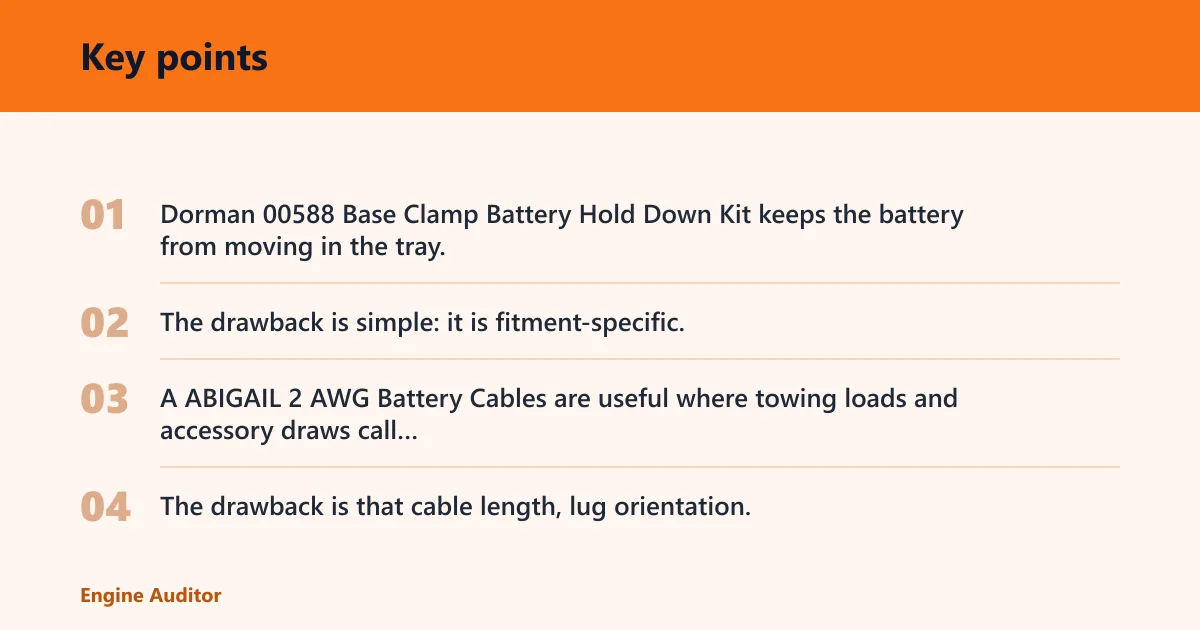
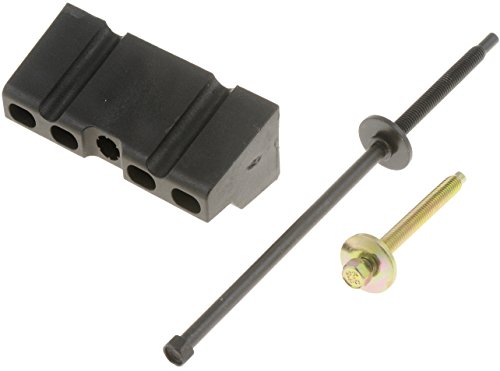
Dorman 00588 Base Clamp Battery Hold Down Kit keeps the battery from moving in the tray, which matters in towing because vibration shortens battery life. The drawback is simple: it is fitment-specific, so you still need the right tray dimensions and OEM-style mounting points.
 Upgrade pick
A ABIGAIL · 5FT 2 AWG pure copper marine-grade cables
Upgrade pick
A ABIGAIL · 5FT 2 AWG pure copper marine-grade cables
- Thick copper core for low voltage drop
- Corrosion-resistant tinned lugs for longevity
- Flexible PVC jacket for durability
Drawback: Longer lengths may require extra routing
$44.99
Price as of 13 Oct 2026
View on Amazon →
As an Amazon Associate we earn from qualifying purchases. Prices and availability are accurate as of the date shown and are subject to change.
- Thick copper core for low voltage drop
- Corrosion-resistant tinned lugs for longevity
- Flexible PVC jacket for durability
A ABIGAIL 2 AWG Battery Cables are useful where towing loads and accessory draws call for low voltage drop and better cable quality. The drawback is that cable length, lug orientation, and routing still need to match the vehicle, so this is not a universal fix.
Nice-to-have
These options help when the towing battery has to do more than crank the engine. They are useful for accessory-heavy setups, but they are not stand-ins for correct group size or proper charging control.
 Our pick
ExpertPower · 200Ah AGM deep-cycle for solar/RV systems
Our pick
ExpertPower · 200Ah AGM deep-cycle for solar/RV systems
- High vibration resistance for mobile use
- Low-maintenance sealed lead-acid design
- Long cycle life for frequent deep discharges
Drawback: Bulky size requires secure mounting
$399.00
Price as of 13 Oct 2026
View on Amazon →
As an Amazon Associate we earn from qualifying purchases. Prices and availability are accurate as of the date shown and are subject to change.
- High vibration resistance for mobile use
- Low-maintenance sealed lead-acid design
- Long cycle life for frequent deep discharges
ExpertPower EXP200 12V 200Ah Deep Cycle Solar Battery fits a deep-cycle, mobile-power role better than a starter role. Its low-maintenance sealed lead-acid design and vibration resistance suit frequent discharges, but it is oversized for most under-hood towing-battery jobs and is not the right answer for engine starting.
 Budget pick
KGIOO · 12V 7Ah LiFePO4 for toys & small power tools
Budget pick
KGIOO · 12V 7Ah LiFePO4 for toys & small power tools
- Lightweight lithium design for portable use
- Built-in BMS for safe charging/discharging
- Expandable for higher-voltage setups
Drawback: Limited capacity for heavy-duty towing
$19.90
Price as of 13 Oct 2026
View on Amazon →
As an Amazon Associate we earn from qualifying purchases. Prices and availability are accurate as of the date shown and are subject to change.
- Lightweight lithium design for portable use
- Built-in BMS for safe charging/discharging
- Expandable for higher-voltage setups
KGIOO 12V 7Ah Lithium LiFePO4 Battery is a portable auxiliary battery for small loads, not a primary tow-vehicle starter. The drawback is that its 7Ah capacity is far too small for mainstream starting or trailer accessory duty, even though the built-in BMS is useful in the right low-power application.
Consumables and spares
These are the replacement items that keep towing systems working after wear, damage, or a swap. One belongs to the trailer safety system, and the others support a cleaner battery installation.
Mighty Max 12V 5AH SLA battery is the right kind of spare for a trailer breakaway kit. The drawback is that it is a small sealed lead-acid unit with a narrow job, so it should not be mistaken for a vehicle starter battery or a general accessory battery.
Budget setups
If you are building a towing setup on a tighter budget, spend first on the correct battery type and fitment, then on the hardware that keeps the battery secure and the cables efficient. Prices below are the listed product prices only.
| Setup | Suggested parts | Listed price | Best use |
|---|---|---|---|
| Starter | Dorman base clamp hold-down kit | $10.90 | Secure a correctly sized battery in the tray |
| Mid | A ABIGAIL 2 AWG battery cables | $44.99 | Improve current delivery for towing accessories |
| Serious | ExpertPower EXP200 12V 200Ah Deep Cycle Solar Battery | $399.00 | Accessory-heavy mobile power, not starter use |
How to choose the right group size and terminals
Start with the vehicle manual or the existing battery label. Then match group size, terminal layout, and hold-down style before comparing CCA and reserve capacity. A battery that misses the tray dimensions is the wrong battery, even if the specs look attractive.
Step 1: confirm fitment
- Read the current battery label for group size, terminal type, and polarity.
- Measure the tray if the label is gone or the battery has been changed before.
- Check whether the vehicle uses 34/78, 35, 47/H5, 48/H6, 49, 65, or 94R.
- Confirm that the hold-down and cable reach match the replacement battery.
Step 2: match the electrical demand
If the vehicle tows in cold weather, pick higher CCA. If it powers brake controllers or camping electronics, prioritize RC as well. If the route is rough, favor AGM for its vibration resistance and sealed, spill-proof construction.
Step 3: check the charging profile
Start-stop vehicles should stay with AGM-compatible fitments such as H5/47, H6/48, or 65. A battery that cannot tolerate frequent cycling will wear faster in a stop-start tow vehicle, even if the CCA number looks strong.
Step 4: separate starter needs from accessory runtime
A tow battery does two jobs, but not with the same spec. CCA solves the crank, while RC solves the lights, brake controller, and other loads that stay alive after shutdown. Buy for both.
Step 5: favor sealed construction for most towing
For most towing use, AGM is the better pick because it is maintenance-free, spill-proof, and better suited to vibration. Flooded lead-acid still has a place, but usually only when the vehicle was designed around it and the use is light.
Frequently asked questions
What car battery is best for towing and heavy accessories?
The best battery is usually a high-CCA AGM with at least 120 minutes of reserve capacity, sized to the vehicle’s tray and terminal layout. For frequent towing, cold weather, or accessory-heavy use, AGM gives better vibration resistance and less maintenance than flooded lead-acid.
Is AGM better than flooded lead-acid for towing?
Yes, for most towing use AGM is the better choice. It is sealed, spill-proof, maintenance-free, and more resistant to vibration. Flooded batteries remain a baseline option, but they are less durable on rough roads and less suited to accessory-heavy towing.
How many CCA do I need for a tow vehicle?
Many tow vehicles do well around 720 to 800 CCA, while diesel, cold-weather, or heavily accessorized setups may justify 900 CCA. The right number depends on climate, engine size, and how often the battery must recover after accessory use.
How do I choose a battery for stop-start tow vehicles?
Choose an AGM battery that matches the original group size and terminal layout, then verify it is approved or compatible with the vehicle’s stop-start system. Stop-start adds cycle load, so AGM’s higher cycle tolerance is usually the safer fit.
Products related to this article
Sponsored / affiliate links. As an Amazon Associate I earn from qualifying purchases. I may earn additional commission from eligible campaigns.