Best car batteries for city driving (2026): we compared
For short trips and city driving, I’d start with an AGM battery that has at least 20% more reserve capacity than stock and the highest cold-cranking amps that fits your tray. Cheap flooded batteries usually fail early from chronic undercharging, restart cycling, and accessory drain. This guide compares the best battery types and picks for stop-and-go use, plus the specs that matter most.
Quick comparison
| Product | Badge | Best for | Price | ||
|---|---|---|---|---|---|
 |
Go Power GP-AGM-224-6V 6 Volt 224 Amp AGM Deep Cycle BatteryGo Power | Upgrade pick | 6V 224Ah deep-cycle AGM battery | $319.99
Price as of 2 Oct 2026
|
View |
 |
TalentCell 12V 6Ah LiFePO4 Battery Pack, Ultra Long LifeTalentcell | Budget pick | 12V 6Ah LiFePO4 battery for accessories | $35.99
Price as of 2 Oct 2026
|
View |
 |
Weize Platinum AGM Battery BCI Group 24F AutomotiveWEIZE | Our pick | 12V 710CCA AGM battery for city driving | $179.99
Price as of 2 Oct 2026
|
View |
AGM is the safest default for short-hop drivers because it handles partial charge better and tolerates repeated starts. Flooded lead-acid still makes sense in simple, low-load cars where budget matters more than cycling endurance.
How we chose
I judged these picks against the failure mode short trips create: undercharging, repeated restarts, and accessory drain. I prioritized sealed AGM construction, fitment options, stated CCA, reserve capacity, and whether the battery is built for start-and-stop use.
I also looked at vehicle type and electrical load. A plain commuter with no extra electronics needs a different battery than a car with dash cams, heated seats, remote start, and long parking periods.
Fitment stayed front and center. Group size has to match tray length and terminal layout before any other spec matters.

AGM batteries: best for repeated short trips
AGM is the safest pick for most city drivers because sealed construction resists vibration, recovers charge faster than a basic flooded battery, and handles repeated starts better. It is the right default when your car sees short hops, stop-and-go traffic, or steady accessory use.
Who should buy AGM
Choose AGM if the car sits through short commutes, idling, school runs, delivery routes, or frequent errands that never give the alternator much time to refill the battery. It is especially sensible when the vehicle has heated seats, infotainment kept on during waits, dash cams, remote start, or repeated restart events.
AGM is also the better call for drivers who want less mess and fewer maintenance checks. The sealed design keeps electrolyte handling out of the picture.
Fitment notes: H5, H6, H7, Group 47, Group 48
Common AGM fitments can include H5, H6, H7, Group 47, and Group 48. The right group size must match tray length, hold-down style, and terminal position, or the battery will be the wrong fit even if the specs look good.
Group 47 is often sold as H5. Group 48 is often sold as H6. Those labels are close cousins, not interchangeable guesses.
When AGM is worth the extra cost
AGM earns its price when short-trip undercharging is routine, when the car is started several times a day, or when accessory load is high enough that the battery is asked to do more than just crank the engine. For these vehicles, the higher cycle life matters more than the sticker price.
It is also a strong choice for cold weather. Weak starts tend to show up first when the battery is partly charged and temperatures drop.
Weize Platinum AGM Group 24F: best for high-CCA city starts
This fits drivers who want a sealed AGM battery with strong starting performance and a clear short-trip bias. Based on the spec sheet and owner feedback, its 710 CCA and roughly 120 RC appear suited to city use where the battery may not fully recharge between errands.
The honest drawback is fitment. Group 24F only helps if your tray, hold-down, and terminals are made for that size. If your car wants H5, H6, or H7, this is not the automatic answer.
Go Power GP-AGM-224-6V: best for series-built off-grid use
This battery is more relevant to deep-cycle applications than to a normal commuter car. Based on the spec sheet, it is a sealed 6V AGM option for owners who need flexible voltage expansion in paired setups rather than a standard automotive replacement.
The drawback is simple: it is not a drop-in answer for most cars. Drivers looking for a city-driving battery should treat it as a specialty product, not a general short-trip fix.
TalentCell 12V 6Ah LiFePO4: best for accessory backup
This is a compact auxiliary-style battery for low-draw gear, not a main starter battery. It fits a different problem: keeping small electronics or secondary devices running when a vehicle battery is not the right source.
The drawback is that its 6Ah size is far too small for cranking a car engine. It can be useful for accessories, but it does not solve short-trip starting stress by itself.
Flooded lead-acid: best for low-load, lower-cost replacements
Flooded lead-acid is still acceptable when the car is simple, the commute is short but not accessory-heavy, and the owner wants the lower upfront cost. In a basic vehicle with modest electrical demand, it can do the job if charging habits are decent and winter is mild.
Where flooded batteries still make sense
Use flooded lead-acid when the car has no start-stop system, no big parking loads, and no stack of electronics running while the engine is off. It remains a fair choice for a low-load commuter that sees short trips but not constant restart cycling.
If the battery location is easy to service and the owner is comfortable checking it periodically, flooded can still be practical. Simplicity is its main advantage.
Maintenance and partial-charge limits
The weak point is partial-charge tolerance. Short drives can leave the battery not fully recharged, and flooded lead-acid suffers when that becomes a habit. The result is sulfation, weak starts, and a shorter useful life.
It also tolerates repeated deep partial states less gracefully than AGM. That matters in city use, where the engine may run less than the accessories do.
When to skip flooded and move to AGM
Skip flooded if the car has repeated restarts, heavy accessory use, cold winters, or signs of chronic undercharging. If the battery has to cope with dash cams, heated seats, phone charging, infotainment, and parking loads, AGM is usually the better buy.
Once the vehicle starts acting like a rolling electrical hub, the lower-cost battery tends to become the expensive one.
Do you need a start-stop battery?
If your car has a start-stop system, yes, it usually needs a battery built for repeated engine restarts and higher cycle life. In those vehicles, a normal battery can work for a while and then fail early because the system asks for more cycling than a basic design was built to handle.
How start-stop systems change battery choice
Start-stop vehicles spend more time restarting than older cars do. That means the battery must accept repeated discharge and recharge events without falling apart early, which is why AGM or an auxiliary battery is often used.
City traffic makes that pressure worse. Every red light becomes another cycle.
Auxiliary battery examples such as AUX14
Some start-stop vehicles use an auxiliary battery to support accessories and secondary loads. AUX14 is a common example of that format, and it should be treated as a system component rather than a generic replacement.
If the auxiliary battery is weak, the main battery may look guilty even when the fault is shared across the system.
Why city traffic can punish the wrong battery
Short commutes, long idle periods, and repeated restarts are hard on any battery that cannot return to a full charge. The issue is not city driving by itself; it is city driving plus undercharging plus load.
That combination can make a decent battery look bad in a hurry.
Short-trip battery decision table
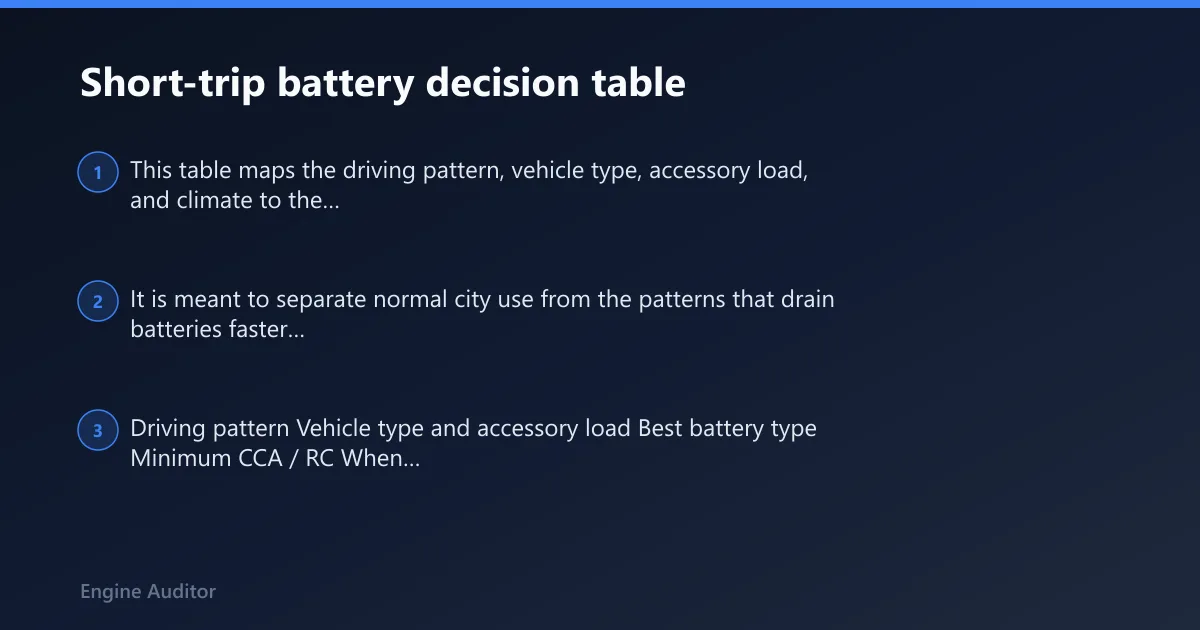
This table maps the driving pattern, vehicle type, accessory load, and climate to the battery type, minimum CCA range, and when a portable jump starter becomes smart backup. It is meant to separate normal city use from the patterns that drain batteries faster than they recharge.
| Driving pattern | Vehicle type and accessory load | Best battery type | Minimum CCA / RC | When to add a jump starter |
|---|---|---|---|---|
| 2 to 5 mile errands, many starts, winter mornings | Non-start-stop car, dash cam, infotainment, heated seats | AGM, Group 47/H5 or Group 48/H6 | About 680 to 720 CCA, at least 120 RC | Add one if the car sits overnight often or start reliability has already slipped |
| Short commute, no start-stop, modest accessories | Basic commuter, low parking load | Flooded lead-acid if budget is tight; AGM if cold weather is common | About 570 to 650 CCA | Add one if winter cranking is already weak |
| Stop-and-go traffic, frequent idle time | Start-stop vehicle, moderate to heavy electrical load | Start-stop AGM or system-correct auxiliary battery such as AUX14 | About 680 to 720 CCA, strong reserve capacity | Add one if the car has a history of battery warnings or accessory brownouts |
| Long parking gaps between short drives | Any vehicle with remote start, phone charging, or security loads | AGM with higher reserve capacity than stock | At least 120 RC, with CCA matched to the vehicle spec | Add one if the battery routinely drops after sitting two to four days |
| Mild climate, one daily short trip, low accessories | Simple commuter, no start-stop | Flooded lead-acid acceptable | Match the OEM spec closely | Add one as cheap insurance if the car is parked outside overnight |
Which one should you buy?
For most drivers, the best answer is the AGM option that matches the tray and gives the most reserve capacity you can fit. If the vehicle is simple and the electrical load is light, a flooded battery can still be enough. If the car has start-stop, use the battery type the system expects.
Pick by budget
If cost is the main constraint, choose flooded lead-acid only for a low-load car with no start-stop system. It is the cheapest way to get back on the road, but it is not the best answer for repeated short hops with heavy accessory use.
If you can spend more, AGM is the smarter long-term buy because short trips punish batteries that hate partial charge.
Pick by climate
Cold weather pushes the choice toward AGM and higher CCA. That is where weak-start complaints show up first, especially when the battery never gets fully recharged between trips.
In mild weather, flooded batteries have more room to survive, but only if the load is light and the car is not sitting for long stretches.
Pick by vehicle type and load
For a non-start-stop commuter with a few electronics, a Group 47/H5 or Group 48/H6 AGM is a strong fit if the tray allows it. For a start-stop car, the correct system battery matters more than generic battery quality.
If the car uses an auxiliary battery, treat that component separately. AUX14-style parts are not interchangeable with the main starter battery.
What CCA and reserve capacity mean in practice
CCA is the starting power rating. It matters when the engine turns slowly, the oil is thick, or winter mornings make weak starts more obvious. For short-trip use, the useful range commonly discussed is around 570 to 720 CCA.
Reserve capacity matters because short drives can leave the battery not fully recharged. A battery with stronger RC gives you more buffer when the alternator never gets enough time to refill the tank.
How to avoid buying the wrong size
Check the tray, the hold-down, and the terminal layout before ordering. Group size is a physical fitment standard, not a marketing term, and the wrong case dimensions turn a good battery into a return.
H5/Group 47, H6/Group 48, H7, and AUX14 should be treated as specific fitment targets, not general suggestions.
How do I keep my battery charged if I only drive short distances?
The best fix is to reduce how often the battery sits below full charge. Short drives can leave the battery not fully recharged, so the goal is to give it longer runs occasionally, cut unnecessary accessory drain, and keep a jump starter in the car for backup.
- Take the car on a longer drive once a week if possible.
- Limit parking loads such as dash cams, accessory chargers, and interior lights left on too long.
- Use a battery maintainer if the car sits for days at a time.
- Check for corrosion, loose terminals, and a weak charging system before blaming the battery.
- Carry a portable jump starter if the car lives on short trips and overnight parking.
Failure checklist: undercharging or a worn-out battery?
If the car starts normally after a longer drive but struggles after several short trips, undercharging is the likely pattern. If the battery also fails after a full charge, the case may be wear-out instead.
Repeated jump starts, dim lights after parking, and accessories acting sluggish point toward chronic low state of charge. Cranking that stays weak even after recovery usually points to a battery at the end of its life.
Why a portable jump starter belongs in the trunk
A portable jump starter is practical backup for city drivers because it turns a dead-battery problem into a manageable delay instead of a tow. Peak amps matter, but so do safety protections and clamp quality.
It will not fix a bad battery. It does buy time when short trips and accessory drain have left the battery too low to start the car.
Frequently asked questions
What is the best car battery for short trips?
For most cars, AGM is the best choice for short trips because it tolerates partial charge better, handles repeated starts well, and usually fits city driving patterns better than a basic flooded battery. If the car has start-stop, choose the battery type the system requires.
Does stop-and-go driving drain a car battery?
Yes. Stop-and-go driving drains a battery when the engine spends too much time restarting and too little time recharging. Short drives can leave the battery not fully recharged, and accessory loads make the problem worse by using power while the alternator has little time to recover it.
Should I get AGM or lead-acid for city driving?
Get AGM if the car sees frequent short trips, cold starts, heavier accessories, or repeated restarts. Choose flooded lead-acid only when the car is simple, the load is light, and you want the lower upfront cost more than extra cycling tolerance.
How many CCA do I need for short trips?
Use the vehicle’s required starting spec as the floor, then favor the higher end of the practical range when city use is hard on the battery. For short-trip cars, a range around 570 to 720 CCA is commonly useful, with the exact choice depending on climate and engine size.
Will a normal battery fail faster in city driving?
Often, yes. A normal flooded battery can fail faster in city driving because it spends more time partially charged, sees more restart events, and may also be feeding accessories during idle. That pattern is much harder on the battery than steady highway use.
Do I need a start-stop battery for short commutes?
If the vehicle has a start-stop system, yes, because the battery must support repeated engine restarts and higher cycle life. If the car does not have start-stop, a good AGM may still be the right answer, but a dedicated start-stop battery is not automatically required.
Products related to this article
Sponsored / affiliate links. As an Amazon Associate I earn from qualifying purchases. I may earn additional commission from eligible campaigns.