Car Has Power but Won’t Crank: What to Inspect First
Start with the symptom pattern: if the dash lights stay bright and you hear only a click or silence, inspect the battery terminals for corrosion and looseness, verify the brake or clutch switch, and check the starter relay before blaming the starter. Skipping that order burns time and money on parts that were never the fault. This guide gives the fastest no-crank inspection sequence, with cheap checks first and the next test at each branch.
No-crank decision table
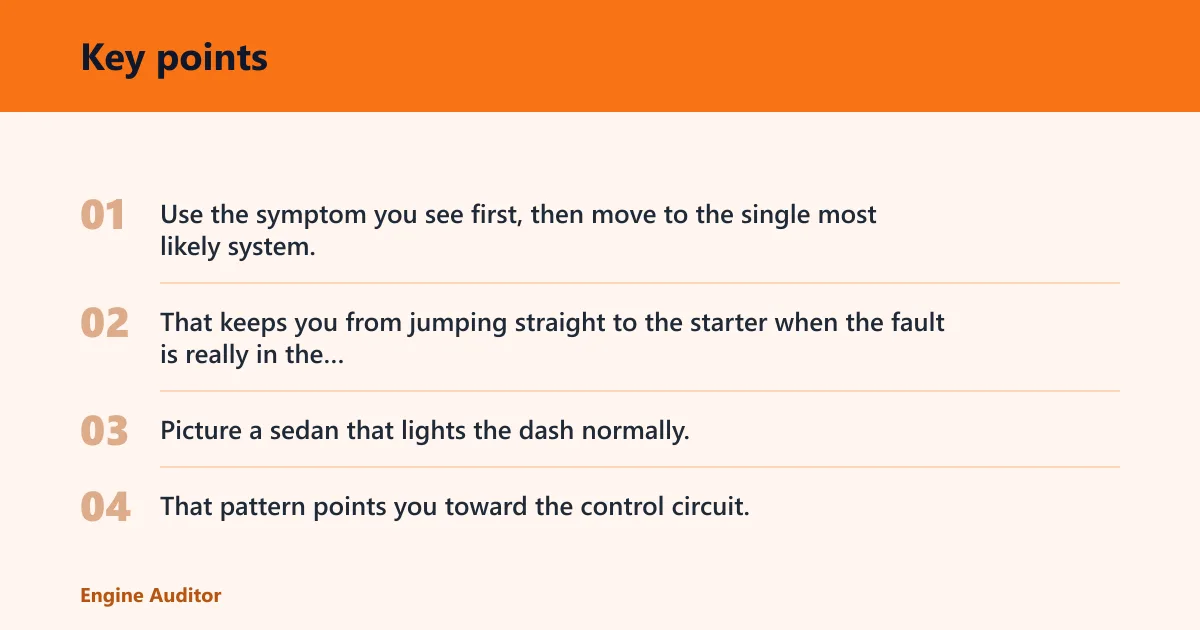


Use the symptom you see first, then move to the single most likely system. That keeps you from jumping straight to the starter when the fault is really in the battery, cables, relay, or park/neutral circuit.
| Symptom pattern | Most likely system | Single best first check |
|---|---|---|
| Bright lights/no crank | Starter control circuit, relay, or starter motor | Listen for a click, then check the starter relay in the under-hood fuse box |
| No lights/no click | Battery, battery cables, or main power path | Measure battery voltage and inspect terminal tightness and corrosion |
| One click | Starter relay, starter solenoid, or high-resistance cable/ground | Check battery voltage and cable connections before any part swap |
| Rapid clicking | Weak battery or poor cable connection | Test resting battery voltage and inspect both terminals for corrosion |
| Starts in Neutral only | Neutral safety switch or shift linkage | Try Park and Neutral, then inspect the shift range circuit |
Picture a sedan that lights the dash normally, then gives a single hard click when you turn the key. That pattern points you toward the control circuit, not a fuel problem and not a cranks-but-won’t-start issue.
What should I check first when my car won’t crank?
First, confirm you truly have a no-crank condition, meaning the engine does not spin at all. Then start with battery state, terminal condition, and clamp tightness, because those checks are cheap, visible, and often enough to explain silence, a click, or rapid clicking.
Confirm no-crank, not crank-no-start
A no-crank fault means the starter is not turning the engine. That is different from a cranks-but-won’t-start problem, where the engine spins but fuel, air, or spark is missing. The two diagnoses follow different paths.
Start with the battery and terminals
A fully charged battery is about 12.6V at rest. A weak battery is around 12.2V. Under 12.0V usually indicates trouble. If the battery sits low and the terminals are corroded or loose, the car may have power for lights and accessories but still refuse to crank.
Use a multimeter for a quick voltage read
Set a multimeter to DC volts and measure across the battery posts, not the cable clamps. That reading tells you whether the battery itself is weak before you dig deeper into fuses, relays, or the starter motor.
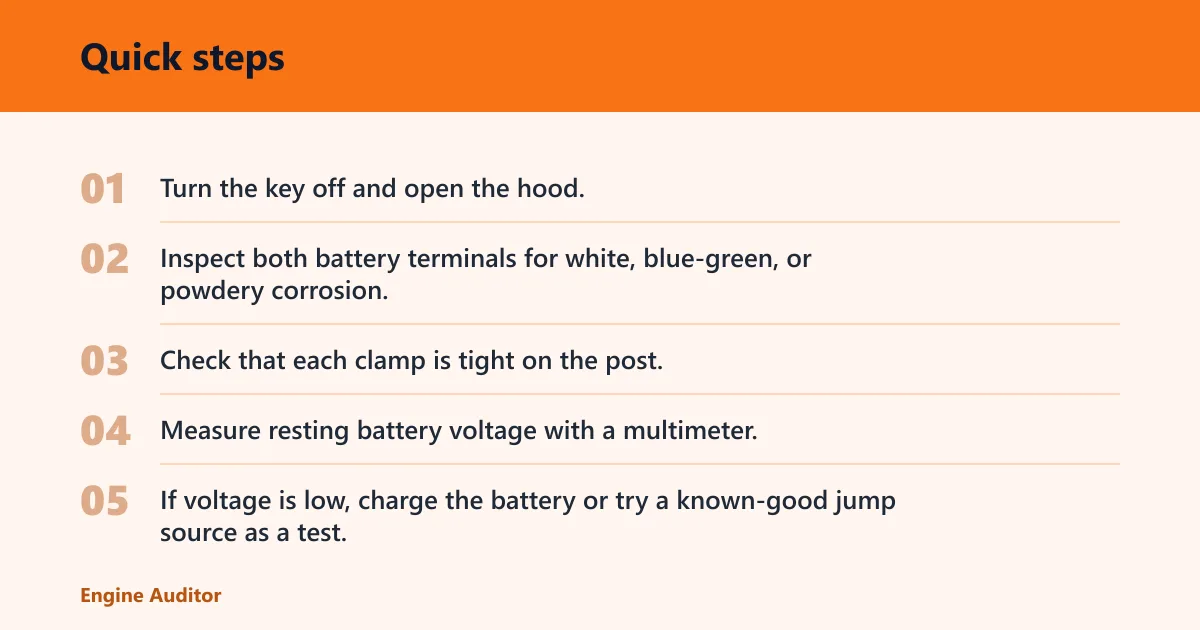
- Turn the key off and open the hood.
- Inspect both battery terminals for white, blue-green, or powdery corrosion.
- Check that each clamp is tight on the post.
- Measure resting battery voltage with a multimeter.
- If voltage is low, charge the battery or try a known-good jump source as a test, then repeat the crank attempt.
Why the battery may still fail
A battery can seem “alive” because the dome light, radio, and dash still work. That does not mean it can supply the current needed to spin the starter motor. Voltage at rest, corrosion, and clamp tightness matter because the starter needs far more current than accessories do.
Resting voltage clues
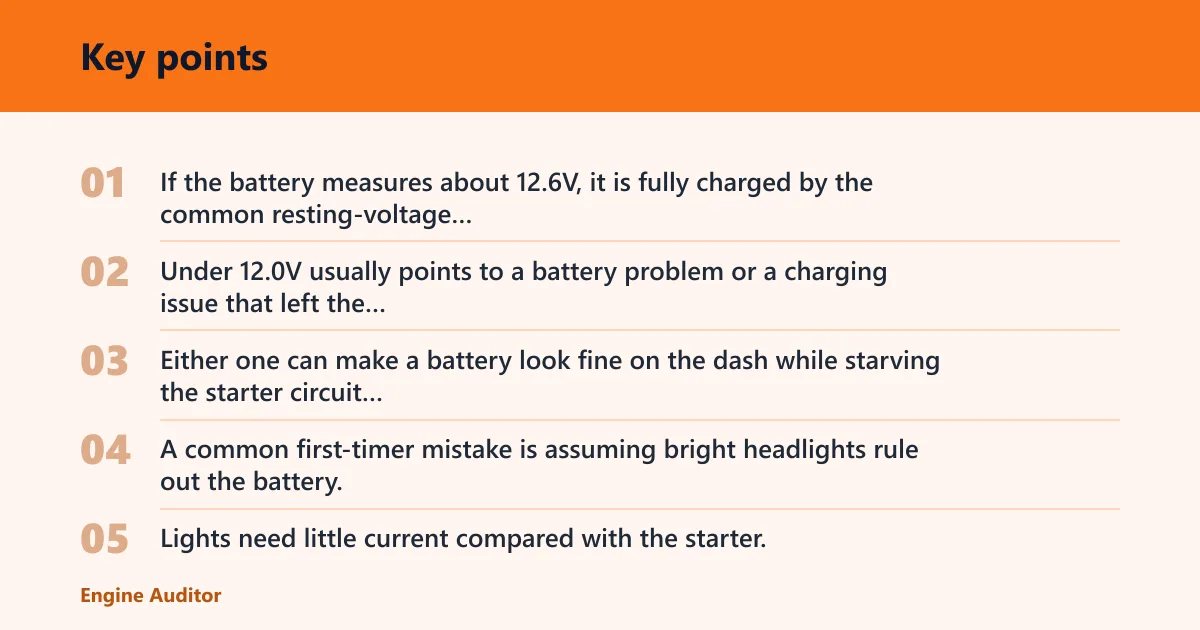
If the battery measures about 12.6V, it is fully charged by the common resting-voltage standard. Around 12.2V is weak. Under 12.0V usually points to a battery problem or a charging issue that left the battery too low to crank.
Corrosion and clamp tightness
Terminal corrosion adds resistance. A loose clamp does the same thing. Either one can make a battery look fine on the dash while starving the starter circuit at the moment the key is turned.
A common first-timer mistake is assuming bright headlights rule out the battery. They do not. Lights need little current compared with the starter, so a battery can run accessories and still fail under crank load.
When a jump start is useful
A jump start is a quick test, not the whole diagnosis. If the engine cranks normally with a jump and then goes right back to no-crank later, the battery, terminals, cables, or charging system still need attention. A jump start does not prove the starter is good.
Battery cables and grounds
Battery power has a path in both directions. The positive cable feeds the under-hood fuse box and starter circuit. The negative cable returns through body ground and an engine block ground strap. High resistance anywhere in that path can mimic a dead starter.
Positive cable path
Inspect the positive cable from the battery to the under-hood fuse box and onward to the starter feed. Look for swollen insulation, burnt ends, loose lugs, or hidden corrosion where the cable joins a terminal.
Negative cable and body ground
Check the negative cable where it bolts to the body. A weak body ground can cause dim lights, flickering lights, or a hard no-crank. If the dash flickers while you try to start, suspect resistance in the ground path before blaming the starter.
Engine block ground strap
Do not skip the engine block strap. The starter pulls current through the engine’s ground path, and a missing or corroded strap can stop cranking even when the battery and relay are fine. This is one of the most missed checks in driveway diagnosis.
Suppose the dash stays bright, you hear one click, and the battery tests around 12.6V at rest. That combination makes a bad cable connection or ground strap more likely than a dead battery.
Is the starter relay at fault?
Yes, it can be. The starter relay sits in the no-crank control circuit and can fail even when accessories work. On many vehicles, it is checked in the under-hood fuse box, but you need the fuse legend to identify the right cavity before you touch anything.
Where to find it
Look in the under-hood fuse box first. Some vehicles also route related power through interior fuse panels. Match the relay and fuse names to the fuse legend so you do not pull the wrong part.
What relay failure looks like
A failed relay often gives a bright dash with no crank, or a single click without starter engagement. It can also be intermittent. The car may start one time, then refuse the next time after sitting, which makes relay faults easy to confuse with battery problems.
Which fuses to inspect first?
Inspect the starter-related fuses, ignition fuse, and ECU-related circuits named in the legend. Do not treat every fuse as equally relevant. The starter control circuit includes battery, cables, grounds, fuses, relays, ignition switch, neutral safety switch, and starter/solenoid, so you need the correct fuse map for the vehicle.
Does Park and Neutral matter?
Yes. Trying Neutral as well as Park is a key check for no-crank diagnosis. If the car starts in Neutral but not Park, the neutral safety switch or shift linkage is a likely suspect. That clue is useful, but it is not proof by itself.
Neutral safety switch clue
The neutral safety switch prevents cranking unless the transmission is in Park or Neutral. A car that starts in Neutral only often points to an out-of-adjustment switch, worn shifter linkage, or a related circuit fault.
Park versus Neutral test
Hold the brake, move the shifter firmly to Park, and try to start. Then try Neutral. If the engine cranks in one position and not the other, record that result before you move on. It helps separate a selector issue from a battery or starter fault.
When shift linkage can mislead you
If the lever feels normal but the range switch is slightly out of adjustment, the car may not recognize Park correctly. That can produce a no-crank complaint that looks electrical from the driver’s seat.
Starter motor checks
The starter motor spins the engine by engaging the flywheel. It can fail mechanically or electrically. Before replacement, check for voltage-drop clues and control-signal behavior so you know whether the fault is inside the starter or upstream in the relay, switch, or cables.
Mechanical versus electrical failure
Mechanical failure may show as a click with no spin, grinding, or a starter that works only sometimes. Electrical failure may show as a healthy battery and good cables but no response at the starter terminal or solenoid trigger wire.
Voltage-drop clues
Voltage-drop style clues matter because resistance hides in places that still look clean. Dim headlights while cranking, flickering dash lights, or a dramatic drop in lamp brightness can point to cable or ground resistance instead of a bad starter motor.
Control-signal checks before replacement
Check whether the starter is receiving the command signal when the key is turned. If the control signal is present and the power and ground paths are sound, the starter itself becomes a stronger suspect. If the signal is missing, the fault is farther upstream.
A bad ground can cause multiple kinds of no-crank symptoms, including silence, clicking, and light dimming. That is why grounds deserve the same attention as the battery itself.
What does one click but no crank usually mean?
One solid click often means the starter relay or starter solenoid is moving, but the starter motor is not turning the engine. That can happen with a weak battery, a bad cable, a poor ground, or an internal starter fault. Do not replace the starter on the click alone.
Rapid clicking usually leans toward low battery voltage or a bad connection. The relay keeps trying to pull in, then drops out, which creates the chatter sound you hear from the key or under-hood fuse box.
How do I test the starter circuit without replacing parts?
Use symptom order, voltage checks, and simple control-path tests first. That sequence lets you isolate battery, cable, relay, neutral-safety, and starter issues without guessing. If the battery, terminals, and grounds check out, move to the relay and then the starter circuit itself.
- Confirm the symptom pattern: silence, one click, rapid clicking, or bright lights with no crank.
- Measure resting battery voltage.
- Inspect terminals, positive cable, negative cable, and engine ground strap.
- Try Park and Neutral.
- Check starter-related fuses using the fuse legend.
- Check the starter relay in the under-hood fuse box.
- Only then move toward starter control-signal and voltage-drop testing.
Say your SUV sits overnight, then gives rapid clicking the next morning and the dash lights flicker. That is a classic sign to inspect battery state and cable resistance first, not to order a starter immediately.
When should I stop DIY diagnosis and call a mechanic?
Stop when the car keeps refusing to crank after battery, terminal, cable, relay, and Park/Neutral checks, or when you find burnt cable ends, heavy corrosion, or an intermittent fault you cannot make happen twice. Call for help sooner if starter-circuit testing becomes uncertain or unsafe.
Frequently asked questions
Why does my car have power but won’t crank?
Accessories can work with less current than the starter needs. A car may have dash lights, radio power, and even bright headlights while still failing to crank because of a weak battery, poor cable connection, bad ground, failed relay, neutral safety issue, or starter fault.
What voltage should a car battery have before starting?
A fully charged battery is about 12.6V at rest. Around 12.2V is weak, and under 12.0V usually indicates trouble. That resting reading is a useful first filter before you spend time on relays, grounds, or the starter motor.
Can a bad ground cause a car to have power but not crank?
Yes. A bad ground can create several no-crank symptoms, including silence, clicking, dim lights, and flicker. Check the negative battery cable, body ground point, and engine block strap. A clean-looking ground can still have high resistance under load.
Should a car crank in Park and Neutral?
Yes, it should crank in Park or Neutral on most automatic transmissions. If it starts in Neutral only, the neutral safety switch or shift linkage is a likely clue. Test both positions, but do not use that result as the only proof of failure.
Which fuses matter for a no-crank problem?
Focus on starter-related fuses, ignition power, and ECU-related circuits listed in the fuse legend. Check the under-hood fuse box first, then the interior panel if the legend points there. Do not assume every fuse near the starter relay is part of the same circuit.
Products related to this article
Sponsored / affiliate links. As an Amazon Associate I earn from qualifying purchases. I may earn additional commission from eligible campaigns.