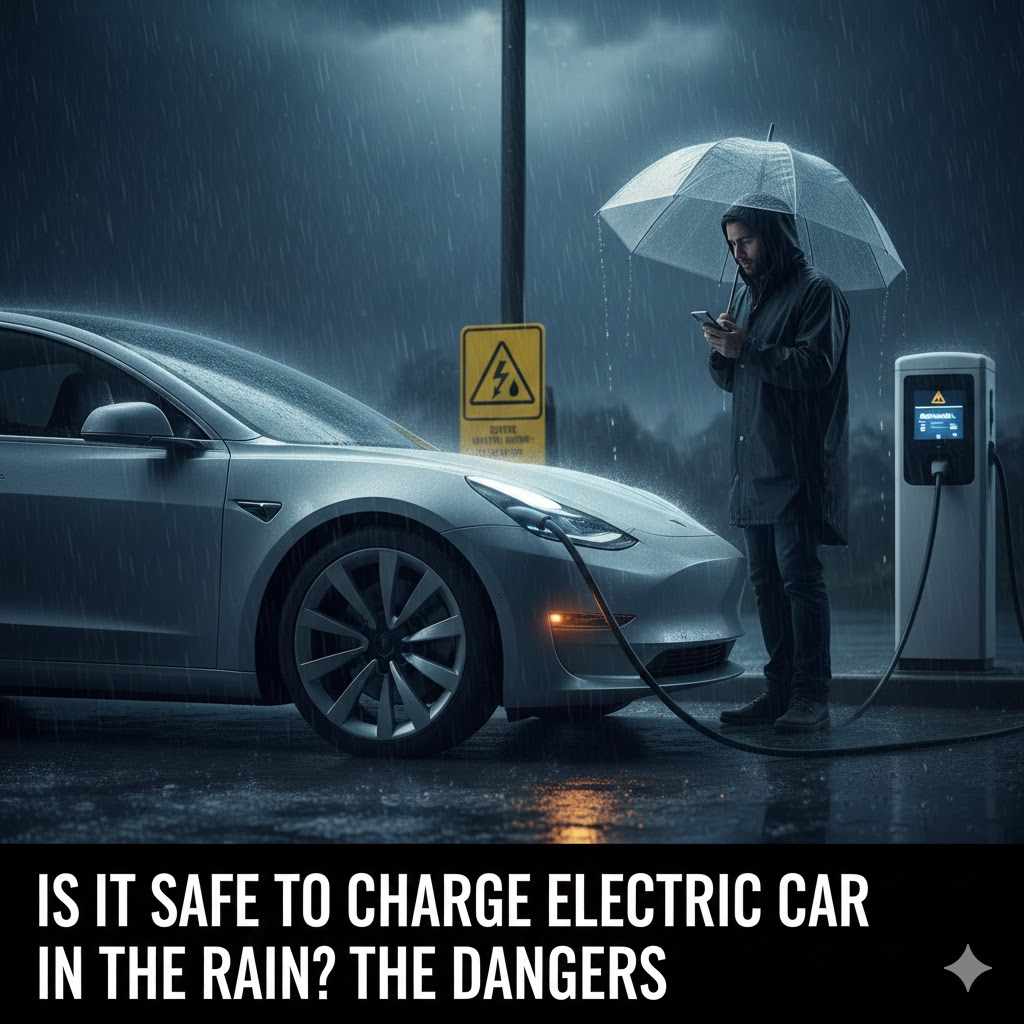
Is It Safe To Charge Electric Car In The Rain? The Dangers
Yes, it is completely safe to charge your electric car in the rain. EV charging systems are designed with multiple layers of safety features, including weatherproof connectors and automatic shut-offs, to protect you from electric shock. As long as you use manufacturer-approved equipment that isn’t damaged, you can charge your car worry-free, rain or shine.
Worried about charging your new electric car when the weather turns bad? You’re not alone. The idea of mixing high-voltage electricity with rain can sound scary. It’s natural to wonder if you’re putting yourself or your car at risk. But here’s the good news: car makers and charging companies have already thought about this.
They built many safety features right into your car and the charger to handle wet conditions. In this guide, I’ll walk you through exactly how these systems keep you safe. We’ll cover the simple checks you can do for peace of mind and the few situations you should watch out for. You’ll soon see that charging in the rain is just as routine as charging on a sunny day.
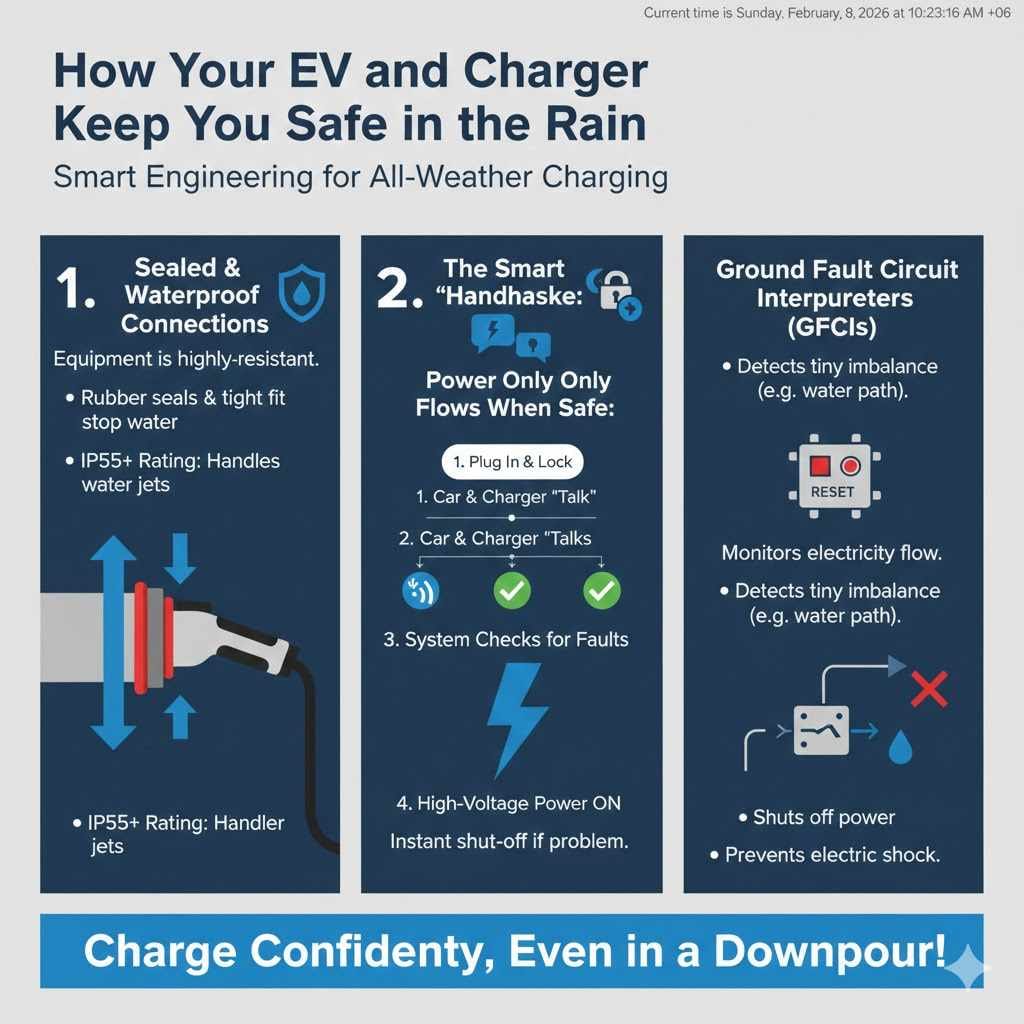
How Your EV and Charger Keep You Safe in the Rain
You can feel confident charging your car in a downpour because of smart engineering. It’s not just a simple plug and socket; it’s a sophisticated system designed from the ground up to prevent accidents, especially in wet weather. Let’s look at the key features that make it so safe.

visnfa
visnfa 15W Magsafe Car Mount Charger, Faster…
- 15W Wireless Car Charger: Simply place it on the car charger mount, and it will automatically align and lock for stable and effici…
- Double Locking, Vacuum Pressure: This phone mount for car redefines the sturdiness of automotive accessories with its "double lock…
- Super Strong Magnetism, Ultimate Stability: The car phone holder mount features an upgraded N56 neodymium magnet with a magnetic f…
As an Amazon Associate I earn from qualifying purchases.
1. Sealed and Waterproof Connections
The first line of defense is the equipment itself. Both the charging handle (the part you hold) and your car’s charging port are built to be highly water-resistant. They have rubber seals and tight-fitting designs that stop rain from getting to the electrical contacts inside.
Engineers use a system called the Ingress Protection (IP) rating to measure how well something is protected against solids and liquids. Most EV charging connectors have a rating like IP55 or higher when connected. This means they can handle water jets from any direction. Some are even rated higher, making them virtually weatherproof.
2. The Smart “Handshake” Before Power Flows
Did you know that the charging cable isn’t “live” with high voltage when you’re holding it? Power only starts flowing after a series of checks. Think of it as a secret handshake between your car and the charger:
- You plug the connector securely into your car’s port. You’ll often hear a “click” as it locks in place.
- The charger and the car start communicating. They send low-voltage signals to each other to confirm a solid, safe connection.
- The system checks for any problems, like poor insulation or ground faults.
- Only after everything checks out does the charger start sending high-voltage power to charge your battery.
If the connection is ever broken or a fault is detected, the power shuts off instantly, long before you could be in any danger.
3. Ground Fault Circuit Interrupters (GFCIs)
This is one of the most important safety features. A GFCI is a smart device that constantly monitors the flow of electricity. It measures the amount of power going into a circuit and the amount coming back out. If it detects even a tiny imbalance—which could mean electricity is leaking out and going where it shouldn’t, like through water—it shuts off the power in a fraction of a second. This is much faster than a standard circuit breaker and is designed specifically to prevent electric shock.
Most home chargers (Level 2) have GFCIs built-in, and electrical codes require them for the outlets used for Level 1 charging. Public charging stations also have this protection, providing a powerful safety net.
Real Dangers to Watch For (And How to Avoid Them)
While the charging system is incredibly safe, no system is perfect if the equipment is misused or damaged. The real dangers don’t come from the rain itself, but from a few specific situations you should be aware of. Luckily, they are all easy to spot and avoid.
Damaged Charging Equipment
The most common risk comes from using damaged gear. Always take a few seconds to inspect your equipment before you plug in, whether at home or at a public station.
- Frayed or Cracked Cables: The thick outer casing of the charging cable protects the electrical wires inside. If you see deep cuts, cracks, or exposed wires, do not use that charger. The insulation is compromised, and water could get in.
- Cracked Plugs or Handles: The plastic housing on the plug handle protects the internal connections. If it’s cracked or broken, it’s no longer weatherproof. Report a damaged public charger to the station operator.
- Damaged Car Port: Check your car’s charging port for any visible damage. If the plastic is broken or pins look bent, have it inspected by a qualified mechanic before charging.
Charging in Flooded or Submerged Areas
This is a critical rule: never attempt to charge your electric car in standing water. While the connectors are water-resistant, they are not designed to be submerged. Charging in a flooded area is extremely dangerous.
If the charging station, the cable, or your car’s port is in a deep puddle or submerged in floodwater, do not go near it. Standing water can conduct electricity and create a serious shock hazard. It can also cause catastrophic damage to the charging station and your vehicle’s high-voltage battery system. For more information on flood safety, resources from government agencies like Ready.gov provide essential guidance.
Severe Thunderstorms and Lightning
Can you charge your EV during a thunderstorm? Yes, the car and charger will be fine. However, there is a very small risk associated with lightning. A nearby lightning strike can cause a massive power surge on the electrical grid. This surge can travel through the charging station and potentially damage your car’s sensitive electronics, including the onboard charger and battery management system.
The risk is low, but the potential repair costs are high. It’s like using a laptop or expensive TV during a bad storm—it’s probably fine, but it’s wise to unplug it. If there is active lightning nearby, it is safest to wait for the storm to pass before starting or ending a charging session.
Your Step-by-Step Guide to Charging Safely in the Rain
Feeling more confident? Great! Now let’s put it all together. Here is a simple, step-by-step checklist to follow every time you need to charge in the rain. This will become second nature in no time.
- Quickly Inspect Your Gear: Before you do anything, take 5 seconds to look at the charging cable and the connector. Do you see any exposed wires or cracks in the plastic handle? Check your car’s port too. If everything looks good, you’re ready to go. If not, find another charger.
- Check Your Surroundings: Glance at the ground. Are you standing in a giant puddle? If so, try to find a drier spot. Your shoes and the tires provide plenty of insulation, but it’s always best practice to avoid standing water.
- Keep the Connector as Dry as Possible: An umbrella is your best friend here. Shield the connector and your car’s port from the heaviest rain as you plug in. If the connector is a little wet, give it a gentle shake to remove any excess water droplets before you plug it in. The seals will do the rest of the work.
- Plug In and Listen for the “Click”: Push the connector firmly into your car’s port until you hear and feel it lock into place. This click confirms that the physical connection is secure and the weatherproof seals are engaged. The car and charger will now do their safety handshake.
- Confirm Charging Has Started: Look at your car’s dashboard, the indicator light on the port, or the charging station’s screen to confirm that the charging session has started normally. This tells you that all safety checks have passed.
- Unplugging Is Just as Easy: When you’re done charging, use your umbrella again if needed. Press the release button on the handle, pull it straight out, and close your car’s port cover. Place the charging cable back in its holder so it stays clean and off the wet ground.
Home Charging vs. Public Charging in the Rain
The basic safety principles are the same everywhere, but there are slight differences between charging at home and using a public station. Understanding these can help you stay safe in any scenario.
| Feature | Home Charging (Level 1 & Level 2) | Public Charging (Level 2 & DC Fast Charging) |
|---|---|---|
| Equipment Condition | You are responsible for maintaining your equipment. You know its history and condition. Regular checks are up to you. | Maintained by a network operator. Equipment is used by many people and may see more wear and tear. Always inspect it before use. |
| Weather Exposure | Often done in a garage or carport, protected from the worst weather. If outdoors, ensure your outlet and charger are rated for outdoor use. | Almost always outdoors and fully exposed to the elements. These stations are built to be very durable and weatherproof. |
| Electrical Protection | Safety relies on your home’s wiring. Ensure your Level 1 outlet has a GFCI and your Level 2 charger was installed by a certified electrician. | Commercial-grade installations with multiple, robust safety systems, including GFCIs and advanced monitoring. They are inspected regularly. |
| Main Safety Tip | Never use a standard indoor extension cord for outdoor charging. Only use a heavy-duty extension cord specifically rated for EV charging, and only if absolutely necessary. | If you find a damaged charger, don’t use it. Report the damage to the operator (there’s usually a phone number on the station) so they can fix it. |
What About Different Types of Chargers?
Your safety is assured no matter the charging speed, but how you handle them can vary slightly. Here’s a quick breakdown.
Level 1 Charging (Standard 120V Outlet)
This is when you plug your car into a regular wall outlet using the mobile charger that came with your vehicle. This is the scenario that requires the most attention in the rain.
- Use a Weather-Resistant Outdoor Outlet: The outlet should have a protective cover that keeps water out, even when a plug is inserted.
- Confirm GFCI Protection: The outlet must be protected by a GFCI. Modern homes have this on all outdoor and garage outlets, but you can check for a “TEST” and “RESET” button on the outlet itself.
- Avoid Extension Cords: Standard household extension cords are not safe for charging an EV. They can overheat and are not weatherproof. If you must use one, it needs to be a heavy-duty cord specifically rated for the high, continuous power draw of an EV.
Level 2 Charging (240V Home or Public)
These are the most common chargers you’ll find at home (installed in a garage) and in public places like shopping centers. They are much more robust than Level 1 setups. The equipment is designed for outdoor use, and the hardwired connection is more secure and weatherproof. The safety checks are all automatic, so you just need to inspect for physical damage before plugging in.
DC Fast Charging (DCFC)
These are the high-power chargers you find along highways for long-distance travel. They are the safest and most rugged of all. The cables are thick and heavily insulated, the connectors are industrial-grade, and the entire unit is permanently installed and regularly maintained. These systems have extensive self-diagnostic and safety features. You can use a DC fast charger in the rain with a very high degree of confidence.
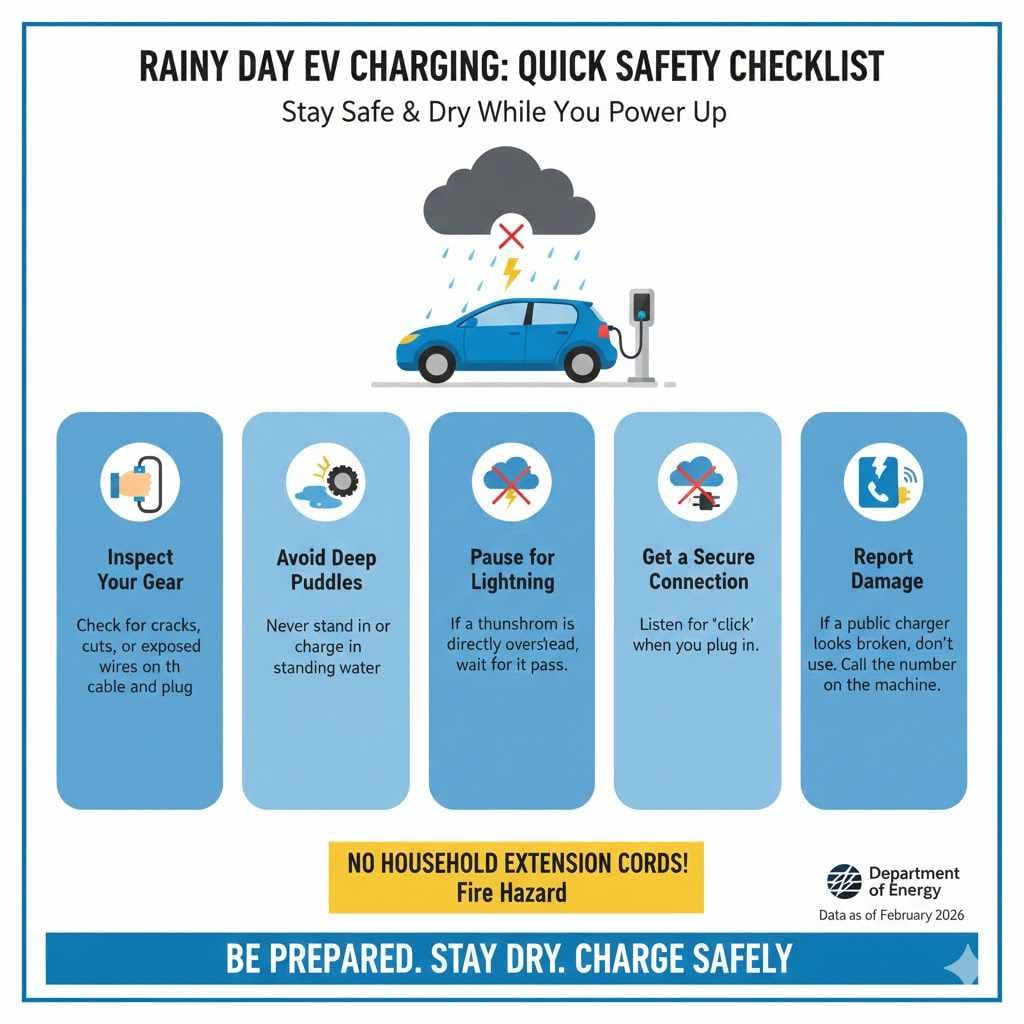
Quick Safety Checklist for Rainy Day Charging
Keep these key points in mind, and you’ll always be safe:
- Inspect Your Gear First: Look for cracks, cuts, or exposed wires on the cable and plug.
- Avoid Deep Puddles: Never stand in or charge in standing water.
- Pause for Lightning: If a thunderstorm is directly overhead, wait for it to pass.
- Get a Secure Connection: Listen for the “click” when you plug in.
- Report Damage: If a public charger looks broken, don’t use it. Call the number on the machine to report it.
- No Household Extension Cords: They are a fire hazard and not meant for EV charging.
Frequently Asked Questions (FAQ)
Can an electric car electrocute you in the rain?
No, it is extremely unlikely. Electric cars and chargers are designed with multiple layers of safety, including sealed connections, insulation, and ground fault detectors (GFCIs) that shut off power in milliseconds if a leak is detected. You are not in danger of electrocution while charging in the rain.
What happens if water gets into my car’s charging port?
Your car’s charging port is designed with drainage holes to let water escape. Furthermore, the electrical pins are not live until a secure, locked connection is made with the charger. Even if some moisture is present, the system’s safety protocols will prevent charging from starting until a safe connection is confirmed.
Can I use a regular extension cord to charge my EV in the rain?
No, you should never use a standard indoor or outdoor household extension cord for charging your car. They are not rated for the sustained high power that EVs draw and can overheat, creating a fire risk. They are also not sufficiently weatherproof for this purpose.
Is it safe to touch the charging handle when it’s wet?
Yes, it is safe. The handle is made of durable, insulating plastic. The electrical contacts inside are protected from touch, and no power flows through the cable until it is securely locked into your car. Simply shake off any excess water before plugging it in.
Do I need to cover my charger in the rain?
No, you do not need to cover a properly installed outdoor charger (like a Level 2 wallbox) or a public charging station. They are specifically built and rated to withstand direct exposure to rain, snow, and heat.
Is it safe to take my EV through a car wash?
Absolutely! Taking an electric car through a car wash is perfectly safe. Just like a gasoline-powered car, all the high-voltage components, including the battery and charging port, are completely sealed against high-pressure water jets.
What is an IP rating and why does it matter?
An IP (Ingress Protection) rating is a standard used to define how well an electrical enclosure is sealed against dirt and moisture. It has two numbers: the first for solids (like dust) and the second for liquids (like water). A higher number means better protection. For EV chargers, a rating like IP55 means it’s protected from dust and can withstand water jets, making it safe for outdoor use.
Conclusion: Charge with Confidence, Rain or Shine
The thought of mixing electricity and water can be unnerving, but when it comes to your electric car, you can rest easy. Decades of engineering and rigorous safety testing have gone into making sure that charging your vehicle—even in a heavy downpour—is a safe and simple task. The combination of weatherproof designs, smart communication protocols, and instant-shutoff safety features works together to protect you and your car.
By following a few simple habits, like giving your equipment a quick visual check and avoiding deep puddles, you can handle any rainy day charging situation like a pro. So the next time the clouds roll in and your battery is low, don’t hesitate. You have the knowledge and the technology on your side to charge safely and confidently, no matter what the weather brings.
Related pick: Check today's price on Amazon