How to Tell If an Engine Is Overheating From Part Failure
If an engine overheats only at idle or in traffic, inspect the cooling fan, fan relay, or low coolant; if it overheats mainly at highway speed, inspect a thermostat stuck shut or a restricted radiator. Miss the pattern, and you can warp the head and damage the gasket in minutes. Match the symptom to the part, then make the first safe check before opening anything.
What the temperature gauge is telling you


A temperature gauge climbing into the red means stop driving. Pull over, switch the engine off, and let it cool for 30+ minutes before checking anything. The gauge matters most as a pattern marker, because a sudden red-zone jump, a slow creep, a steady rise at idle, or a spike after service point to different faults.
Do not treat the gauge as the fault itself. A sensor fault can lie, but the engine still needs to be treated as hot until proved otherwise. A true overheat is about heat load and coolant flow, not just the needle position.
If the needle moved into the red while the car was climbing a hill, the first suspect differs from a car that only climbs hot in a driveway. That timing narrows the path before you touch a cap, hose, or drain plug.
Engine overheating diagnostic matrix
This cold-engine matrix turns symptom timing into the most likely failed part. Start with the safe first check listed in the same row, then move to the next step only after the engine has cooled.
| Symptom pattern | Most likely failed part | Safe first check | Next escalation step |
|---|---|---|---|
| Traffic-only overheating, but temperature drops once speed rises | Radiator fan, fan relay, fuse, or fan sensor | With the engine cool, inspect coolant level and then confirm whether the fan runs when the engine warms up | Check relay, fuse, wiring, and fan motor output |
| Highway-only overheating, while idle or low-speed driving seems normal | Thermostat stuck closed or radiator restriction | Check cold coolant level and look for external radiator blockage or bent fins | Test thermostat operation and evaluate radiator flow or replacement |
| Immediate overheating from a cold start | Thermostat stuck closed, severe coolant-flow block, or belt-driven water pump fault | Verify the radiator and reservoir levels are correct when cold | Inspect belt condition, water pump seepage, and thermostat operation |
| Gradual temperature creep with coolant loss | Cooling system leak, weak radiator cap, or slow head gasket leak | Look for wet trails, crust, or dried residue around hoses, seams, and the water pump weep hole | Perform a pressure test if no visible leak is found |
| Random gauge spikes after coolant service | Air pocket, low fill, cap issue, or sensor/connector disturbance | Recheck cold fill level and confirm the bleed procedure was completed | Bleed the system again and verify post-service air removal before chasing parts |
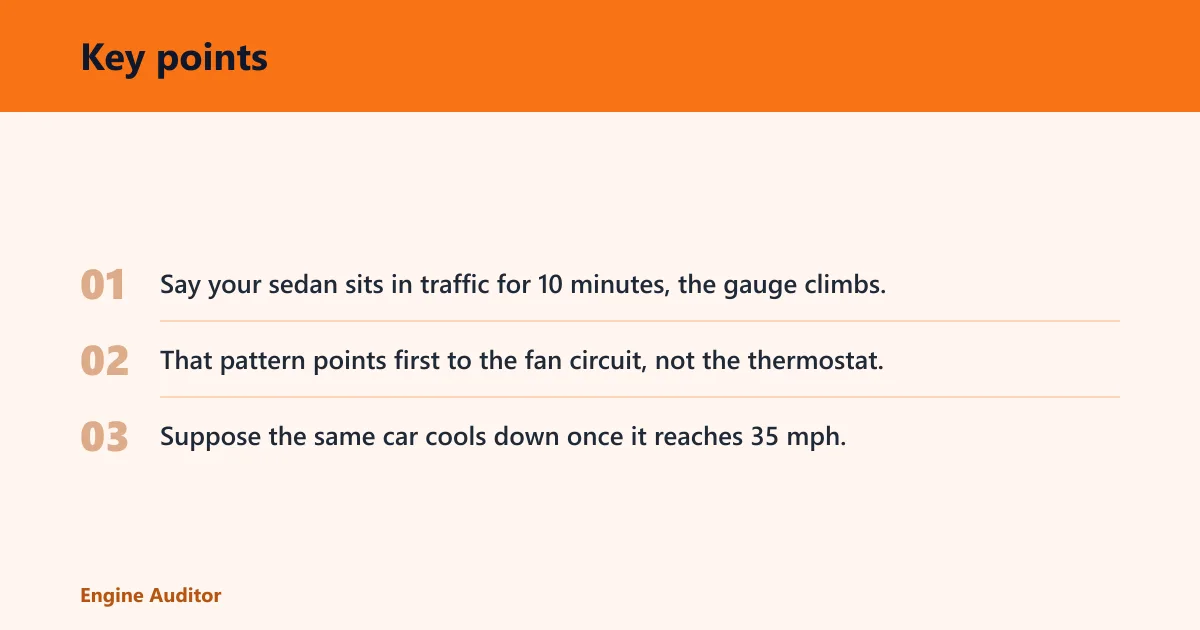
Say your sedan sits in traffic for 10 minutes, the gauge climbs, and the fan never comes on. That pattern points first to the fan circuit, not the thermostat. Suppose the same car cools down once it reaches 35 mph; road speed is covering for missing airflow, which is why idle conditions expose the fault.
Could it be a thermostat?
Yes. If an engine overheats fast from a cold start, a thermostat stuck closed is one of the first parts to inspect. It blocks coolant flow to the radiator, so heat builds before the system can shed it. That pattern tells you more than the thermostat’s price, because the symptom timing does the diagnosis work.
Stuck-closed symptoms from a cold start
A stuck-closed thermostat often makes the upper radiator hose stay cool far longer than it should while the engine gets hot. The gauge can climb quickly, the heater may blow weak or cool air, and the radiator may stay cooler than expected because coolant is not reaching it.
If the engine is already overheating within a short drive after a true cold start, do not assume the coolant is low and stop there. A thermostat problem, a blocked radiator, or a belt-driven water pump issue can all create that same fast rise.
What makes the thermostat the first suspect in fast overheating
A thermostat is a cheap part, but the temperature pattern makes it a strong diagnostic clue. When an engine overheats quickly from cold and then behaves the same on a repeat start, the thermostat rises toward the top of the list because it controls when coolant reaches the radiator.
That does not make it the only possible fault. A badly restricted radiator or a failed water pump can mimic it, so confirm coolant level, belt condition, and visible circulation clues before replacing parts at random.
Why does it overheat in traffic?
Traffic-only overheating usually points to a cooling fan problem because airflow replacement matters most when vehicle speed is low. On the highway, ram air helps the radiator, so a weak fan can hide until the car idles. That is why stop-and-go heat often points away from road-speed airflow and toward the fan circuit.
Radiator fan, fuse, relay, and sensor checks
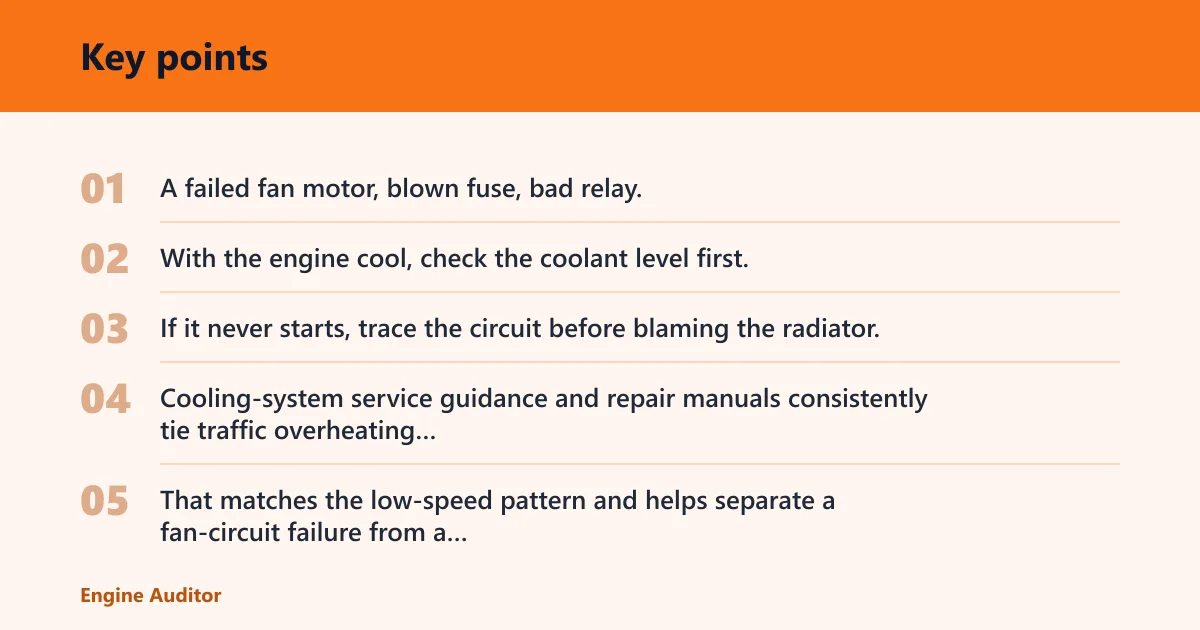
A failed fan motor, blown fuse, bad relay, or faulty temperature sensor can keep the fan from running when the engine needs it most. With the engine cool, check the coolant level first, then watch whether the fan starts as the engine warms up. If it never starts, trace the circuit before blaming the radiator.
Cooling-system service guidance and repair manuals consistently tie traffic overheating to fan operation, relay control, and sensor input. That matches the low-speed pattern and helps separate a fan-circuit failure from a thermostat complaint.
How idle overheating points away from road-speed airflow
If the temperature drops the moment the car starts moving, airflow is probably the missing piece. That does not prove the fan is the only fault, but it tells you to start there. A blocked radiator can still matter at idle, yet a dead fan is the sharper fit when heat appears mainly at a stoplight.
A common first-timer mistake is replacing a thermostat when the car only overheats at long red lights. That can miss the real issue: the fan circuit may be dead, or the fan may run late because of a relay or sensor fault.
Can coolant still be full and the engine overheat?
Yes. A water pump can fail with full coolant still present, because coolant volume and coolant circulation are different problems. A bad pump may move too little fluid, especially if the impeller is damaged, the bearing is noisy, or the pump is weeping at the shaft. Belt-driven setups add another failure point.
Water pump failures with full coolant present
A failed water pump can cause overheating even with full coolant. Clues include bearing noise, seepage at the weep hole, or a loose, slipping, or broken serpentine belt on engines that drive the pump from the belt. Those signs point to circulation failure, not just a low-fluid problem.
If the pump is belt-driven, a worn serpentine belt can stop coolant circulation even when the pump itself is not seized. That makes belt condition part of the cooling diagnosis, not just a driveability check.
Radiator restriction, belt slip, and cap pressure loss
A blocked radiator can come from internal sediment, external debris, bent fins, or stop-leak residue. The symptom split matters: highway-speed overheating suggests poor heat exchange at load, while traffic-only overheating more often points to lost airflow. A restricted core can act up in both places, but not always in the same way.
A weak radiator cap can lower system pressure and the boiling point, which may create steam pockets and hot spots. Cap guidance from cooling-system component literature treats pressure control as part of normal operation, so a bad cap can make the engine run hotter without any obvious leak on the ground.
What leak signs point to cooling system failure?
Low coolant from a leak is a primary cause of overheating. Check the reservoir and, if safe and accessible, the radiator only when the engine is cold. Visible wet trails, crust, or dried residue can help point to hoses, radiator seams, the water pump weep hole, or the heater core.
Hoses, radiator seams, water pump weep hole, and heater core
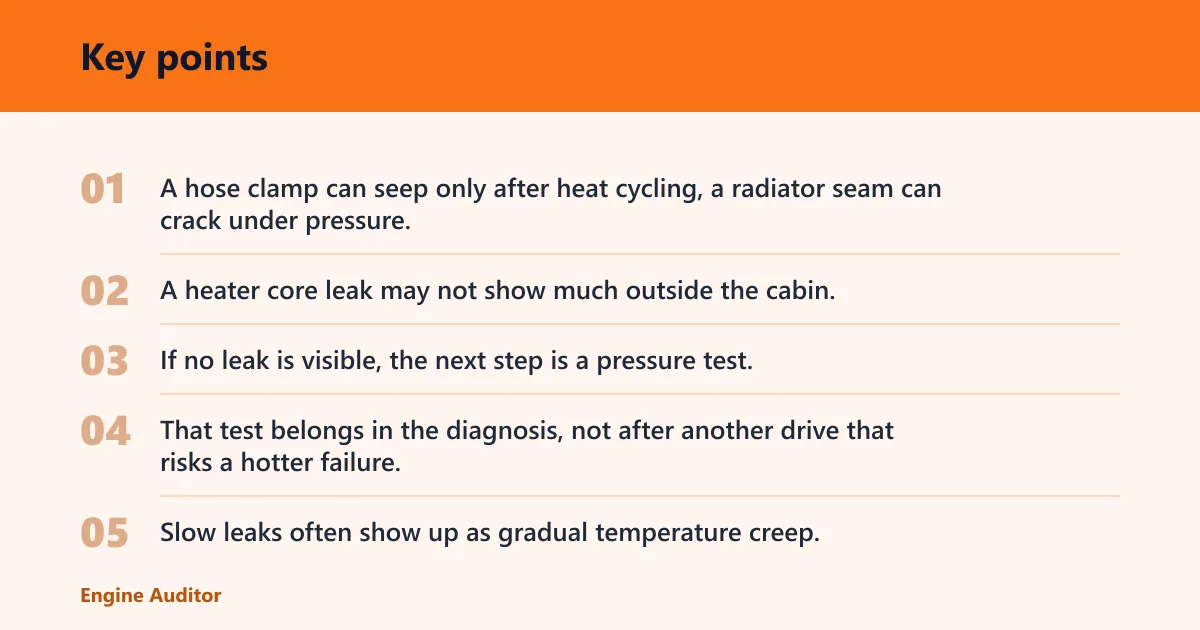
Cooling system leaks often start small. A hose clamp can seep only after heat cycling, a radiator seam can crack under pressure, and a water pump weep hole can leave a trace before a full drip appears. A heater core leak may not show much outside the cabin, so weak cabin heat or a leaking heater core can matter.
If no leak is visible, the next step is a pressure test. That test belongs in the diagnosis, not after another drive that risks a hotter failure. Slow leaks often show up as gradual temperature creep, especially once the coolant level falls enough to expose air to the pump.
When to move from visual checks to a pressure test
Use visual checks first when the engine is cold. If the level is low and no outside leak is obvious, a pressure test is the next step because it can force hidden leaks to show themselves. That is better than guessing at a thermostat or water pump before the leak is found.
Another useful clue is repeated top-ups with no puddle. That often means the leak is slow, external, or evaporating on hot parts, and a pressure test is the cleanest way to move forward.
Is it a head gasket or a bad sensor?
A blown head gasket can be both a cause and a result of overheating. It may let combustion gas enter the coolant, which pushes coolant out of the system and creates repeat overheating. Signs can include milky oil, coolant contamination, or unexplained pressure in the cooling system, but a bad sensor can still mislead the gauge.
Combustion gas in coolant, milky oil, and contamination clues
Look for oil that looks milky or coolant that appears contaminated with oil residue. Those are serious clues, especially if the engine keeps overheating after the coolant level has been corrected. Repeated overheating also makes later repairs more expensive because it can warp the cylinder head and damage the gasket further.
If bubbles appear in the reservoir very quickly after start-up, that can point toward combustion gas in the coolant. Do not jump straight to that conclusion from one symptom alone, though. A weak cap, trapped air, or a poor bleed after service can imitate part of the picture.
Separating sensor or gauge glitches from real overheating
Random gauge spikes after coolant service often come from an air pocket, low fill, cap issue, or disturbed sensor connector. That is different from a steady heat rise under load. If the gauge jumps but the heater output, hose temperatures, and overflow level do not agree, the problem may be in the sensor circuit rather than the engine itself.
Still, a red-zone gauge call should be treated as real until the engine cools and the system is checked. The warning is about risk, not certainty.
What part of the engine most often causes overheating?
Low coolant from a leak is the most likely cause. After that, the most common pattern-based suspects are a thermostat stuck closed, a failed water pump, a radiator fan that does not run, and a blocked radiator. The right answer depends more on when the overheating happens than on the part name itself.
What should you check first when the temperature gauge goes into the red?
Pull over, switch the engine off, and let it cool 30+ minutes. Then check the coolant level only when the engine is cold, along with obvious leaks, fan operation, and belt condition if the pump is belt-driven. Do not open the radiator cap hot.
Frequently asked questions
How can you tell if an engine is overheating because of a bad part?
Look at when it overheats, not just that it overheats. Traffic-only heat points to the fan circuit, highway-only heat points to a thermostat or radiator restriction, and immediate cold-start overheating points strongly to a thermostat stuck closed or another coolant-flow problem. A bad part usually leaves a repeatable pattern.
How do I know if my thermostat is stuck closed?
A stuck-closed thermostat often causes fast overheating from a cold start. The upper radiator hose may stay cool while the engine temperature rises quickly, and the radiator may not warm normally. That pattern fits blocked coolant flow to the radiator better than a simple low-coolant complaint.
Can a bad water pump cause overheating even with coolant full?
Yes. A water pump can fail to circulate coolant even when the system is full. Bearing noise, seepage at the weep hole, or a slipping serpentine belt are common clues. On belt-driven systems, belt slip can mimic pump failure because circulation drops even though coolant volume looks normal.
Why does my car overheat in traffic but not on the highway?
Traffic-only overheating usually means the car needs fan-driven airflow that is missing at idle or low speed. Highway speed hides that fault because outside air still moves through the radiator. That pattern makes the fan motor, relay, fuse, and sensor the first checks, not the thermostat.
What does a blown head gasket look like when an engine overheats?
A blown head gasket can show combustion gas in the coolant, milky oil, or coolant contamination. It can also cause repeated overheating after the system has been refilled. Because overheating can create head-gasket damage too, treat the gasket as a serious possibility after repeated heat events rather than the default first guess.
Can a radiator fan failure cause overheating at idle?
Yes. A dead fan, bad relay, blown fuse, or faulty sensor can cause idle or traffic overheating because airflow drops when vehicle speed is low. If the temperature drops once you start moving, that is a strong sign the fan circuit deserves first attention.
Should I open the radiator cap when the engine is hot?
No. Do not open the cooling system when hot. Pressure can flash coolant and steam out of the cap path and cause severe burns. Wait until the engine has cooled, then check the reservoir and radiator level only if the design allows safe access.
Products related to this article
Sponsored / affiliate links. As an Amazon Associate I earn from qualifying purchases. I may earn additional commission from eligible campaigns.