Horsepower vs Torque in Engine Performance Explained
Torque is rotational force; horsepower is the rate that force does work. Torque shapes launch and towing, while horsepower matters more for higher-speed acceleration and top-end pull. Read them wrong, and you can buy a vehicle that feels weak at highway merges or disappoints under load. This guide explains both numbers, how they feel in real driving, and how to compare spec sheets correctly.
| Decision factor | What Is Horsepower | Torque in Engine Performance | Winner |
|---|---|---|---|
| Launch feel from a stop | Shows up after rpm climbs | Strong low-rpm twist moves the vehicle sooner | Torque |
| Highway passing and top-end pull | Better predictor of sustained acceleration at speed | Important, but less complete on its own | Horsepower |
| Towing and hill climbing | Helps keep speed as road speed rises | Better fit for starting a load and holding grades | Torque |
| Spec-sheet clarity for beginners | Easy to compare, but often misunderstood | Also easy to compare, but needs gearing context | Tie |
| Best single number for performance feel | Captures work over time across rpm | Captures twisting force, but not the whole speed story | Horsepower |
What is horsepower vs torque in engine performance?
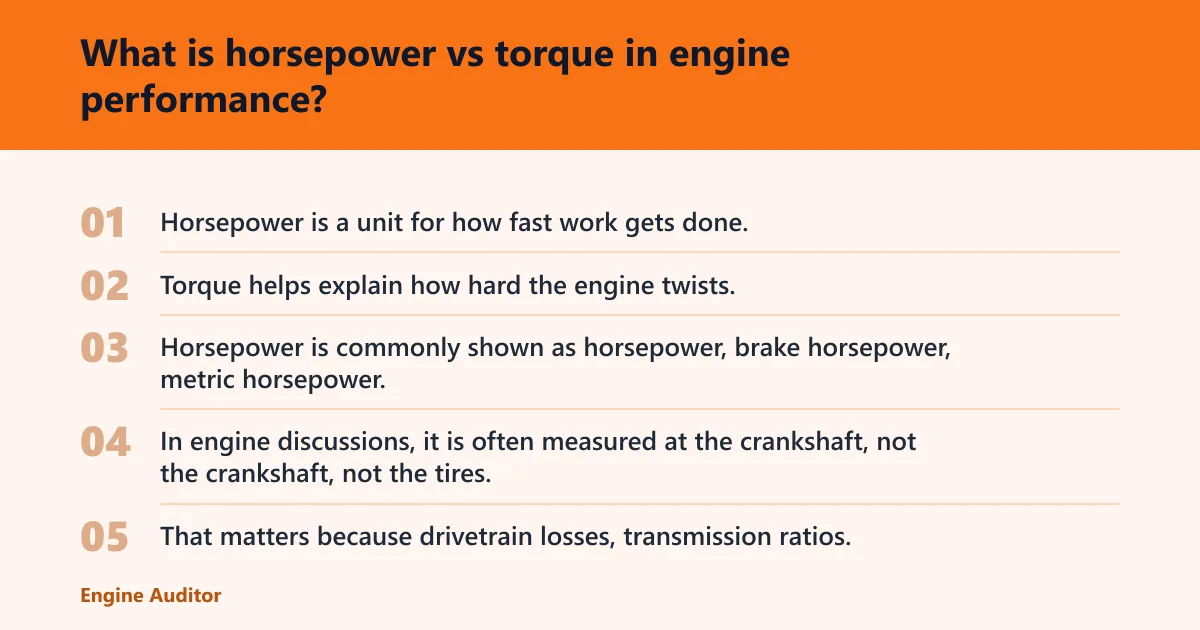
Horsepower is a unit for how fast work gets done, while torque is rotational force at the crankshaft. They are linked, not interchangeable. Torque helps explain how hard the engine twists; horsepower helps explain how quickly that twist turns into useful work as rpm rises.
Horsepower is about work over time
Horsepower is commonly shown as horsepower, brake horsepower, metric horsepower, or kilowatt. In engine discussions, it is often measured at the crankshaft, not the tires. That matters because drivetrain losses, transmission ratios, and wheel size all change what reaches the road.
Torque is the twisting input
Torque is described as force multiplied by distance in automotive contexts. It is commonly shown in pound-feet, foot-pounds, or Newton meters. One foot-pound is equal to 0.73756 newton meters, which matters when you compare spec sheets from different markets. (thedrive.com)
How they work together
Horsepower and torque help determine a car’s speed and acceleration, but they do different jobs. A high torque figure can make a vehicle feel eager off the line, while horsepower becomes more important as engine speed rises and the vehicle needs to keep pulling harder at higher road speeds.
📊 Horsepower and torque are linked through the formula Power (Hp) = Torque (ft-lbs) x RPM / 5252. Source: Dieselhub.
How does torque affect acceleration, towing, and hill climbs?

Torque affects the first part of motion, especially when engine speed is low and the vehicle is pulling against weight or grade. More low-rpm torque usually means a stronger launch, easier trailer takeoff, and less strain on steep climbs, especially when gearing multiplies that twist at the wheels.
Why launch feel comes from low-rpm torque
From a stop, the engine does not have much time or speed to build. If useful torque arrives early, the vehicle feels ready sooner, even before the tachometer climbs. That is why two vehicles with similar peak horsepower can feel very different in city traffic.
Why towing depends on torque plus gearing
Towing is not about peak torque alone. The transmission and axle ratios change how much of that engine torque reaches the wheels, and the right gear can keep the engine in its power band under load. A strong torque curve at usable rpm is usually more helpful than a single peak number.
Why grades expose weak torque delivery
On a hill, the vehicle needs enough wheel torque to maintain speed without constant downshifts. If the engine’s torque drops sharply outside a narrow rpm range, the transmission must hunt for gears. A flatter curve tends to feel calmer on long climbs.
Suppose a compact SUV has good peak horsepower but relatively modest torque at lower rpm. It may feel fine on open roads, yet hesitate when starting up a steep driveway with passengers and luggage. The number on the brochure did not say that part.
How does horsepower relate to rpm?
Horsepower is calculated from torque and rpm, so it rises as engine speed rises when torque holds steady. That is why peak horsepower usually arrives after peak torque. The engine needs rpm, not just force, to make more power as vehicle speed builds.
Why the rpm band matters
The power band is the rpm range between peak torque and peak power. That range tells you where the engine feels strongest for passing, merging, and climbing. A broad band usually means less gear hunting and more predictable acceleration.
Why peak horsepower comes later
As rpm rises, each combustion event happens more often per minute. If torque does not fall too fast, horsepower climbs with it. This is why a sporty engine can feel modest at low rpm but pull much harder once it is spinning in its sweet spot.
Why gear choice changes the feel
Gearing lets the engine stay in the rpm range where horsepower is strongest. A shorter gear ratio multiplies wheel torque and improves punch, while a taller ratio lowers engine speed on the highway and can calm noise and fuel use. The same engine can feel lively or lazy depending on the ratios behind it.
Why do horsepower and torque cross at 5,252 rpm?
Horsepower and torque are linked through the formula Power (Hp) = Torque (ft-lbs) x RPM / 5252. Because of that math, the two curves cross at 5,252 rpm on many gasoline engine charts. The metric version uses a constant around 9550 with kilowatts in the horsepower-torque formula, using the same relationship in different units.
Why the crossover point appears on charts
If torque and rpm are plotted together, horsepower will match torque at the rpm implied by the formula. For imperial units, that point is 5,252 rpm. On a dyno graph, the crossing is a math result, not a special mechanical event in the engine.
Why metric charts look different
In metric units, power is often shown in kilowatts, and torque in newton meters. The same relationship is commonly written with 9550 in the formula. That is why an imported spec sheet may look unfamiliar even when the engine behavior is easy to understand.
What do spec-sheet units like lb-ft, Nm, HP, BHP, and kW mean?
Those labels are different ways of reporting the same basic engine outputs. Torque can appear as lb-ft, ft-lbs, or Nm, while power can appear as HP, brake horsepower, metric horsepower, or kW. The numbers only make sense when you know which unit system is being used.
Common torque units on car spec sheets
Torque can be shown in pound-feet, foot-pounds, or Newton meters. Some sheets shorten Newton meters as NM, though the standard symbol is N·m. Conversions matter because a number that looks larger in one unit may not be larger after conversion.
What brake horsepower means
Brake horsepower is a common power rating term outside the U.S. It refers to engine output before drivetrain losses, which is why it is often discussed at the crankshaft rather than the wheels. Different testing context can change the number slightly, so the label matters as much as the figure.
Why kilowatts matter in some markets
Kilowatt is the metric unit for power, and many countries list engine output that way instead of horsepower. If you compare a kW figure to an HP figure without converting, the spec sheet becomes misleading. Always check whether the listing is power or torque, then verify the unit.
What does a dyno measure on a car?
A dynamometer measures torque and speed, then uses those inputs to plot horsepower across the rpm range. It does more than report a peak number. The graph shows where the engine pulls hardest, where the curve flattens, and where power starts to fall off.
Why the curve matters more than the peak
A single peak can hide a narrow band of usable output. Two engines may show similar maximum horsepower, yet one may feel stronger in normal driving because it holds torque over a wider rpm range. That is the difference a dyno graph makes visible.
How to read a dyno without getting fooled
Look at where torque starts, where it peaks, and how quickly it drops. Then compare the horsepower rise and the rpm range where it stays strong. A broad, flat curve usually delivers easier drivability than a sharp spike with a quick falloff.
Picture two sedans with the same horsepower rating. One makes its torque low and carries it through midrange rpm; the other peaks late and only feels urgent near redline. Around town, the first can feel quicker even though the brochure numbers look similar.
Spec sheet decoder: how to read horsepower, torque, rpm, and gearing
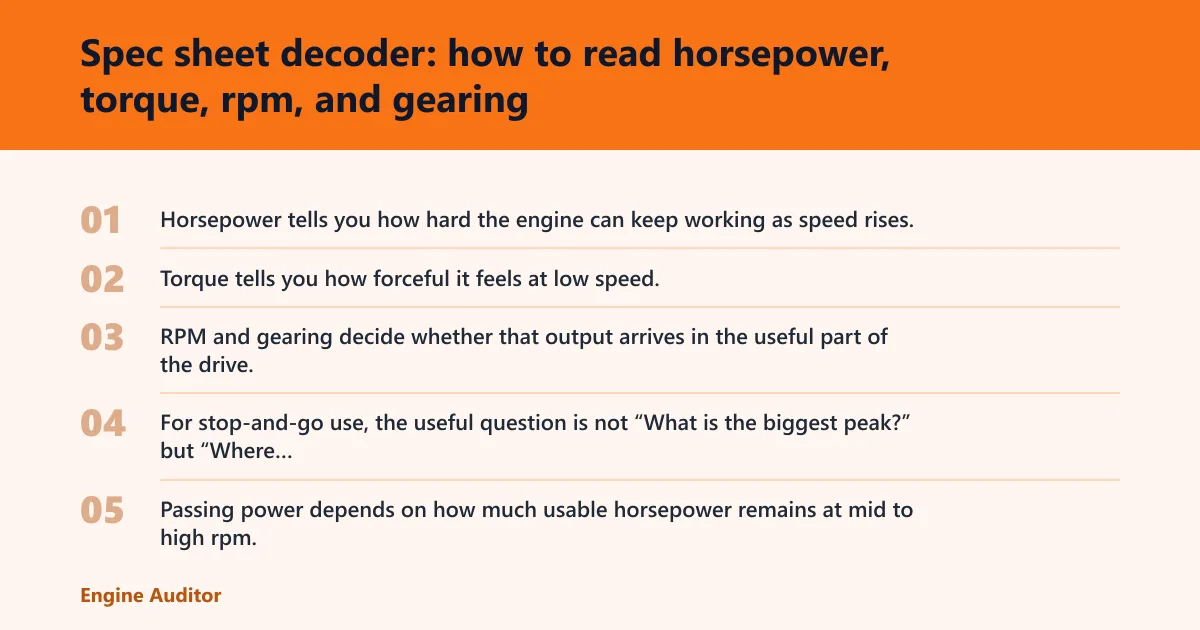
Use the numbers together, not one at a time. Horsepower tells you how hard the engine can keep working as speed rises. Torque tells you how forceful it feels at low speed. RPM and gearing decide whether that output arrives in the useful part of the drive.
| Use case | What to look for on the sheet | What it feels like on the road | Practical read |
|---|---|---|---|
| City driving | Useful torque at low to mid rpm; automatic gearing that keeps shifts calm | Easy pull from stops, fewer downshifts, less strain in traffic | Torque plus gearing matters most |
| Highway passing | Broad power band and strong horsepower in the midrange | Quick merge and passing without waiting for a big downshift | Horsepower matters more here |
| Towing and hauling | Strong low-rpm torque, conservative gearing, and stable cooling strategy | Better start-up on grades, calmer holding speed, less gear hunting | Torque is the first filter |
| Performance driving | Horsepower that stays strong through the rev range and gearing that keeps rpm in the band | Harder pull as speed rises, stronger acceleration after the launch | Horsepower plus power band win |
City driving
For stop-and-go use, the useful question is not “What is the biggest peak?” but “Where does the engine make easy torque?” A vehicle with healthy low-rpm torque and sensible gearing feels less busy and more responsive in traffic.
Highway passing
Passing power depends on how much usable horsepower remains at mid to high rpm. If the engine only makes its best numbers near redline, it may need more downshifts before it can pull hard. That delay is what many buyers notice as hesitation.
Towing and hauling
Should you care more about torque when towing? Yes, but only when torque is paired with gearing and enough horsepower to hold speed once the load is moving. The practical rule is simple: if the vehicle must start heavy loads on grades or climb long hills, prioritize low-rpm torque and a transmission that can keep the engine in its power band.
Performance driving
For spirited driving, horsepower often tells the more useful story because it reflects how hard the engine can keep accelerating as speed rises. Still, a flat torque curve and the right gearing can make a car feel much stronger than a peak figure suggests. That is why track and street impressions often diverge from brochure comparisons.
What is brake horsepower?
Brake horsepower is a power rating term commonly used by countries outside the U.S. It is measured at the crankshaft in many engine discussions and may include a different testing context than wheel output. The label matters because the same engine can be described differently depending on the measuring method.
Why the label matters on imports
When a spec sheet says BHP or bhp, it is still a power figure, but not necessarily one that matches a U.S. HP listing line for line. That is why direct comparison requires the same unit, the same measurement basis, and the same engine speed context.
Why do diesel engines usually have more torque than horsepower?
Diesel engines often produce more than double the torque than horsepower because they are tuned to make strong low-rpm twist rather than high-rpm peak power. That gives them a strong start under load and steady pull at lower engine speeds, even if the horsepower number looks smaller.
Why diesel feels different from gasoline
Diesel engines usually work in a lower rpm range, so they prioritize force where towing and hauling need it most. That is why the torque figure often stands out more than horsepower on a diesel spec sheet. The power delivery feels calm, not frantic.
Why electric motors feel different again
Electric motors deliver near-instant torque across a wide rpm range, so they can feel quick without a traditional rev climb. That makes them different from both gasoline and diesel engines. The launch can feel urgent, while the top-end story depends on the motor’s power curve and gearing.
Is horsepower or torque more important?
Neither number wins in every case, because they describe different parts of the same performance story. Torque is especially important for launch, towing, and climbing. Horsepower matters more for sustained acceleration, passing at speed, and higher-road-speed pull. The better number depends on how the vehicle will be used.
Use case rules that actually help
- Choose torque first if you need easy starts with a load, frequent hills, or trailer use.
- Choose horsepower first if you care about merging, passing, or strong pull at higher speed.
- Check rpm where peak torque and peak horsepower arrive.
- Check gearing, because it changes what the wheels receive.
- Compare the shape of the torque curve, not only the peak.
Verdict
Choose horsepower if your main concern is highway passing, sustained acceleration, or a vehicle that keeps pulling as speed rises. Choose torque if you care more about launch feel, towing, hauling, or climbing grades with less downshifting. For most buyers, the right answer is not the bigger peak number; it is the engine, rpm range, and gearing that match the drive you actually do.
Frequently asked questions
What is horsepower vs torque in engine performance?
Horsepower is a measure of power, or how quickly work is done. Torque is twisting force at the crankshaft. Torque shapes launch and towing, while horsepower better describes sustained acceleration at speed. They are linked mathematically, but they do not feel the same on the road.
Is horsepower or torque more important?
It depends on the task. Torque matters more for starting a load, climbing hills, and towing. Horsepower matters more for higher-speed acceleration and strong pull after the vehicle is already moving. A good spec sheet should be read as a package, not as one winning number.
How does torque affect acceleration?
Higher usable torque, especially at low rpm, helps the vehicle move off the line with less delay. Gearing multiplies that effect at the wheels. If torque falls off quickly outside a narrow rpm range, acceleration can feel weaker than the peak figure suggests.
How does horsepower relate to rpm?
Horsepower rises as rpm rises if torque holds steady, because the engine is doing useful work more often each minute. That is why peak horsepower usually appears after peak torque. The rpm band where horsepower stays strong is a major clue to passing performance.
Why do horsepower and torque cross at 5,252 rpm?
Because of the formula Power (Hp) = Torque (ft-lbs) x RPM / 5252. At 5,252 rpm, the math makes the two values equal on an imperial-unit chart. It is a calculation point, not a special mechanical threshold in the engine.
What does a dyno measure on a car?
A dynamometer measures torque and speed, then uses those readings to plot horsepower across rpm. The result is a curve, not only a peak figure. That curve helps you see where the engine pulls hard, where it tapers, and how broad the power band is.
Products related to this article
Sponsored / affiliate links. As an Amazon Associate I earn from qualifying purchases. I may earn additional commission from eligible campaigns.