Vehicle Types for DMV Forms: How to Identify Yours Correctly
Match the DMV vehicle type to the title, registration, and door-jamb certification label. If they conflict, use the official record your state DMV treats as primary, not the marketing name. Choosing the wrong class can trigger rejected forms, wrong fees, or a later title correction. This guide shows which document to read first, how VIN decoding helps, and how common DMV labels map to cars, trucks, SUVs, vans, motorcycles, trailers, and RVs. (See NHTSA VIN Decoder; state DMV title and registration instructions vary by form and jurisdiction.)
What does vehicle type mean on DMV forms?

On DMV forms, vehicle type usually means the body style or an administrative vehicle class, not the trim or package. A form may ask for sedan, truck, van, motorcycle, or a class code such as passenger vehicle or commercial vehicle, and the exact wording can vary by state. That difference matters because a title may use one term, a registration card another, and a form a third. (See state DMV instructions for title/registration coding and body-type fields; examples below.)
What you should look for first
Start with the exact label on the form. If it asks for body type, use the closest exterior shape. If it asks for class, use the government category on your title or registration. Do not substitute the model name, because “Explorer,” “Civic,” or “F-150” can hide different classifications. NHTSA’s VIN Decoder can help confirm make, model, and body style, but it does not override a state record. (NHTSA VIN Decoder; DMV title and registration instructions.)
Why state wording varies
Some DMVs separate body type from use type. Others combine them into one field. A passenger van may appear as a van in one state and a passenger vehicle in another. That is why the document order matters more than guessing from the vehicle’s appearance. State forms may also use abbreviations such as “P,” “PC,” “TK,” “TRK,” “VAN,” or “SUV,” but the meaning depends on the agency’s glossary and instructions. (Examples: Texas DMV title/registration guidance; California DMV registration forms; New York DMV form instructions.)
What you’ll need
- Vehicle title
- Registration card
- VIN from the dashboard or driver-side door jamb
- Certification label on the door jamb or pillar
- The DMV form itself, so you can match its exact wording
Step 1: Check the title first
The title is usually the best starting point because many states list vehicle class or body type there. Read the field carefully for terms such as sedan, pickup, van, passenger car, or truck, and note any branded or special classification that could affect how the DMV wants it entered. When a title and form use different wording, the title often gives the clearest official baseline for the vehicle’s administrative description. (See state title instructions and title application glossaries.)
Read the exact field name
If the title says body type, use that value unless the form clearly asks for a different class. If the title shows a branded record, salvage status, or special use category, keep that in mind. Those labels can matter more than the visible shape when fees or eligibility are involved. A title may describe the same vehicle differently from a registration card, so the field label matters as much as the word itself.
Step 2: Compare the registration card
The registration card often shows a body type abbreviation or vehicle class code when the title is missing. It may not match insurance wording, so do not copy the language from the insurance card. Use the registration only as a substitute source, then compare it with the title if both are available. Registration cards can also carry shorthand class codes that are not obvious unless you compare them to the agency’s form instructions or legend. (Examples: DMV registration card codes and abbreviations vary by state.)
Match abbreviations, not marketing names
Common short forms include P/C for passenger car, TK for truck, VAN for van, and SUV or UT for utility vehicle in some states. Those codes are administrative shorthand. They help when the form has limited space, but they still need to match the state record rather than a brochure term. State agencies often define abbreviations differently: one form may use “PC” for passenger car while another uses “PAS” or “P”; one may use “TK” while another spells out truck. (Examples below.)
Step 3: Decode the VIN and label
The VIN is a 17-character identifier that can help confirm year, make, model, body style, and engine. You can find it on the dashboard near the windshield, the driver-side door jamb, the title, and the registration. Use it as confirmation, then check the certification label for GVWR and related specs. (Nhtsa)
Use the certification label for weight-based categories
The certification label usually sits on the door jamb or pillar and lists GVWR, the manufacturer’s stated weight limit. Some DMVs use that number to separate passenger and commercial categories, often for trucks, vans, and converted vehicles. If the form asks for a class that depends on weight, GVWR matters. On certain forms, the class can also depend on whether the vehicle was built as a passenger vehicle, cargo vehicle, or multi-purpose vehicle before conversion.
Do not stop at the VIN alone
A VIN lookup can confirm a body style, but it does not always settle the DMV category. Conversions, upfits, and state-specific rules can change the administrative answer. If the VIN says one thing and the title or label says another, use the recorded state documents first and the VIN second. The safest result is the one that aligns with the title, registration, and the state’s published instructions for the specific form.
Vehicle type checklist
| Priority | Source | What to read | How to use it |
|---|---|---|---|
| 1 | Title | Body type, class, branded status | Use as the first match for the DMV form |
| 2 | Registration card | Abbreviations or class codes | Use if the title is unavailable or unclear |
| 3 | VIN and certification label | Body style, model details, GVWR | Use to confirm or resolve edge cases |
Closest-match rule for form wording
If the form uses different wording than your records, choose the closest administrative match, not the closest sales label. A pickup with an enclosed utility shell is still usually a pickup if the title and registration say truck. A van converted to camper use may need a camper or motorhome class if the state record says so. When a form gives only one field, match the official record that best fits the agency’s definitions rather than the vehicle’s current appearance.
Edge-case notes
- Pickup trucks: open cargo bed, but some states classify by weight or use.
- SUVs: often filed as utility vehicles or passenger vehicles, depending on the state.
- Vans: cargo, passenger, and minivan labels can lead to different form answers.
- Conversions: rebuilt interiors, camper kits, and lift packages can change the administrative class.
What if the records disagree?
If the title, registration, and VIN decode do not match, follow the state record your DMV treats as primary, then document the mismatch. Do not guess when the category changes fees, taxes, title class, or eligibility. If the form is strict, the safest documented answer is the one backed by the strongest state record. The key is to separate three different questions: what the vehicle is built as, how the state classifies it, and how the current form wants it entered.
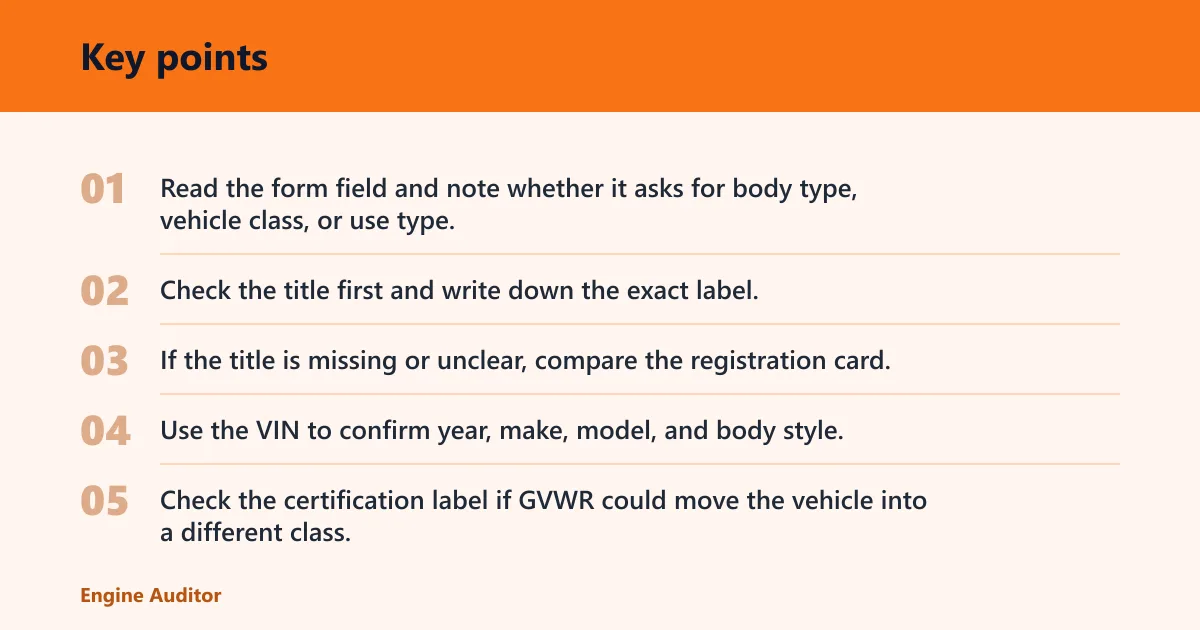
Vehicle types flowchart
- Read the form field and note whether it asks for body type, vehicle class, or use type.
- Check the title first and write down the exact label.
- If the title is missing or unclear, compare the registration card.
- Use the VIN to confirm year, make, model, and body style.
- Check the certification label if GVWR could move the vehicle into a different class.
- If the records still conflict, contact the DMV before filing.
When to stop and ask
Contact the DMV if the form affects fees, commercial status, emissions rules, or eligibility for plates or registration. That matters especially for lifted trucks, imported vehicles, electric vans, and custom-built vehicles. A written answer from the DMV is better than a correction notice later. State instructions commonly direct applicants to verify uncertain classifications before submitting, especially when the vehicle may fall into a passenger, commercial, or reconstructed category.
Two common examples
Say your registration says “SUV,” but the title says “WAGON.” Use the title first, then check the VIN for body style and the DMV form for whether it wants a body type or a class code. The body shape may look crossover-like, but the state record controls the answer. If the form distinguishes between body type and use type, “wagon” can be the right title answer even when the registration shorthand looks more like an SUV category.
Suppose your cargo van has a camper bed and cabinets added after purchase. The VIN still identifies the base vehicle, but the certification label and state title may point to a commercial van or a converted recreational class. In that case, the converted use can matter more than the original body shell. Some states require the updated use to be reflected on the title or registration before the form can be completed consistently.
Can you use the VIN to confirm it?
Yes, the VIN can confirm vehicle details, including body style, but it should be used as confirmation rather than the only source. A 17-character VIN can decode year, make, model, and often body style, yet state records and the certification label still decide the DMV answer when classification rules differ. The VIN is strongest as a verification tool when the title or registration is missing, incomplete, or inconsistent. (NHTSA VIN Decoder.)
What the VIN can and cannot settle
The VIN helps when the title is missing or the registration is unclear. It can also identify imported vehicles and unusual builds. It cannot always resolve converted vans, commercial upfits, or state-specific class rules, because those depend on how the vehicle is titled and how your DMV groups it. Use the VIN to narrow the field, then confirm against the DMV’s own terminology and the vehicle’s certification label if GVWR matters.
Common mistakes
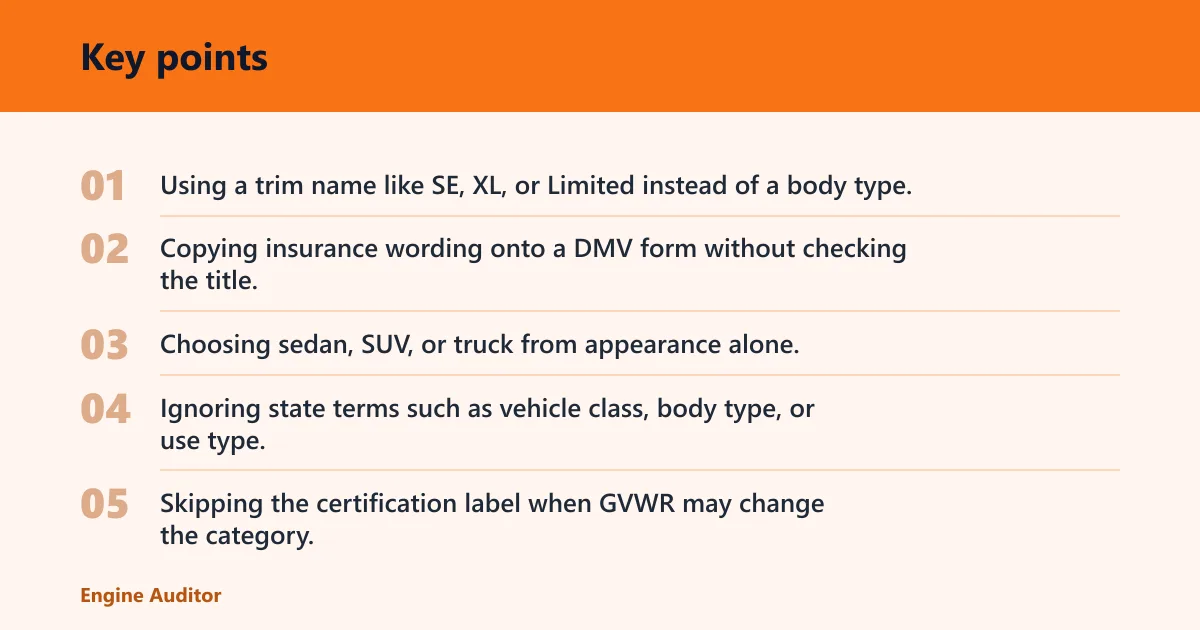
- Using a trim name like SE, XL, or Limited instead of a body type.
- Copying insurance wording onto a DMV form without checking the title.
- Choosing sedan, SUV, or truck from appearance alone.
- Ignoring state terms such as vehicle class, body type, or use type.
- Skipping the certification label when GVWR may change the category.
- Assuming an electric vehicle gets the same label everywhere.
Body-style labels that usually fit best
| DMV form term | Closest answer | Notes for edge cases |
|---|---|---|
| Sedan | Sedan | Usually a four-door passenger car with a separate trunk |
| Coupe | Coupe | Often two doors, but some states use it loosely |
| Hatchback | Hatchback | Rear liftgate area replaces a separate trunk |
| Wagon | Wagon | Can be labeled as a utility vehicle in some records |
| SUV | SUV or utility vehicle | Use the title or registration if the state prefers class codes |
| Pickup | Pickup truck | Check GVWR and use if the form separates commercial trucks |
| Van | Van | Passenger van, cargo van, and minivan may file differently |
| Convertible | Convertible | Use only if the roof design is the recorded body style |
Decision matrix for form terms, verification, abbreviations, and edge cases
| Form term | What it usually means | Where to verify it | Common abbreviations | Edge-case notes |
|---|---|---|---|---|
| Body type | Exterior shape or configuration | Title, registration, VIN decoder, certification label | BT, BODY, TYPE | Use the current state record for conversions, not the sales name |
| Vehicle class | Administrative category used by the state | Title, registration card, DMV form instructions | CL, CLASS, VC | Can differ from body type for trucks, vans, and commercial vehicles |
| Use type | How the vehicle is used for registration purposes | Registration card, title branding, agency instructions | USE, UTL, COM | May shift with business use, passenger use, or conversion status |
| Passenger vehicle | Noncommercial vehicle designed mainly for people | Title, registration, GVWR on certification label | P, PC, PAS | Passenger vans and some SUVs may still be coded differently by state |
| Commercial vehicle | Vehicle classified for business or weight-based purposes | Registration card, certification label, title notes | COM, COMM, CV | Weight, cargo setup, and business use can change the answer |
| Truck / pickup | Open-bed truck or a truck-class vehicle | Title, registration, GVWR, VIN decode | TK, TRK, PU | Pickup shells, toppers, and utility beds may not change the class |
| Van | Cargo, passenger, or minivan configuration | Title, registration, VIN body style, certification label | VAN, VN | Cargo vans and passenger vans may be treated differently |
| SUV / utility vehicle | Sport utility or multipurpose vehicle | Title, registration, VIN body style | SUV, UT, UTL | Some states use wagon, utility vehicle, or passenger vehicle instead |
Frequently asked questions
How do I identify my vehicle type for DMV forms?
Check the title first, then the registration card, then the VIN and certification label. Use body style when the form asks for shape, and vehicle class when it asks for an administrative category. If the records disagree, follow the state document the DMV treats as primary. That approach matches the way most agencies define form answers and avoids relying on the vehicle’s nickname or trim package.
What vehicle type should I put on a title application?
Enter the exact class or body type shown on your title if the form allows it. If the title is missing, use the registration card, then confirm with the VIN and the certification label. Do not use trim names, package names, or insurance wording. If the application has limited choices, pick the nearest official match from the state record rather than the closest sales description.
What does vehicle type mean on a registration form?
On a registration form, vehicle type usually means the class code or body style the DMV uses for filing. That may be passenger car, truck, van, SUV, motorcycle, trailer, or a similar group. The exact label depends on state wording and weight rules. Some states also distinguish body type from use type, so the same vehicle may be coded differently depending on the field.
Where can I find the vehicle type on my title or VIN lookup?
The title may list body type, class, or a branded description near the vehicle details section. A VIN lookup can confirm year, make, model, and body style if the decoder supports that level of detail. For weight-based classes, check the certification label for GVWR too. When those sources disagree, the state title or registration record usually carries more weight than the decoder.
What if the DMV form asks for a body type and I am not sure?
Use the closest body-style match from the title or registration, then confirm with the VIN. If the form offers limited choices, pick the closest administrative match only when the state record is clear. If fees or eligibility change, call the DMV before submitting. Form instructions often expect applicants to choose the nearest official category, not a guess based on appearance.
What should I enter if my vehicle is converted or custom-built?
Use the current state record, not the original factory description alone. Conversions, camper builds, lifted trucks, and imported vehicles may need a different class from the base VIN decode. If the title has not been updated, ask the DMV what proof it wants before you file. A converted vehicle may need the title, registration, and certification label to agree before the form can be accepted.
Sources
- NHTSA VIN Decoder: https://www.nhtsa.gov/vin-decoder
- State DMV title and registration instructions and glossaries for vehicle type, class, and body style fields
- Examples of state form instructions that distinguish body type, class, and abbreviations: Texas DMV title/registration guidance; California DMV registration forms and instructions; New York DMV registration and title forms
Products related to this article
Sponsored / affiliate links. As an Amazon Associate I earn from qualifying purchases. I may earn additional commission from eligible campaigns.