Check Engine Light Flashing: What to Do Right Away
If the check engine light is flashing, stop driving if the engine is shaking, misfiring hard, or the temperature is rising; otherwise, drive only a short distance at low load to a repair shop, and tow it if the misfire is severe. Ignoring it can overheat the catalytic converter, damage the engine, and turn a small fault into a repair bill fast. This guide gives you a yes/no triage path using symptoms and common code patterns.
Flashing versus solid engine lights: urgency and risk
A flashing check engine light, also called the MIL, is an active warning. It is not the same as a solid light, and on many vehicles it points to a misfire severe enough to risk catalytic converter damage. On many vehicles, that means a live misfire warning that can damage the catalytic converter immediately.
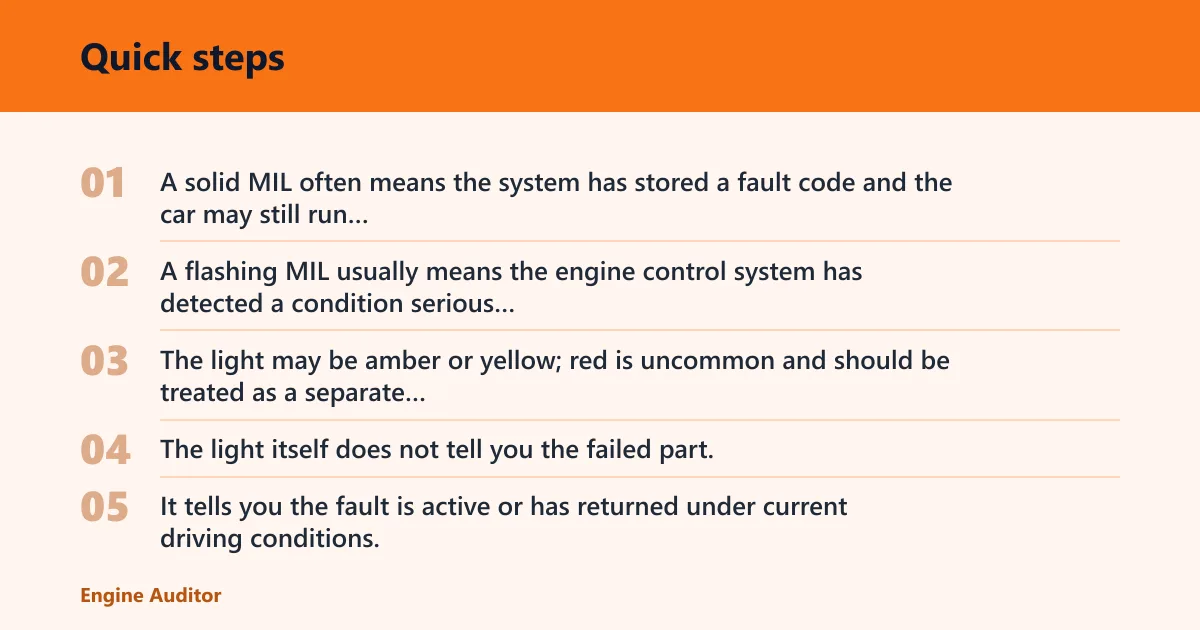
The key difference is urgency. A solid MIL often means the system has stored a fault code and the car may still run normally. A flashing MIL usually means the engine control system has detected a condition serious enough to call for load reduction or a stop. The light may be amber or yellow; red is uncommon and should be treated as a separate warning if a vehicle uses it.
The light itself does not tell you the failed part. It tells you the fault is active or has returned under current driving conditions. A scan tool or code reader helps you separate a stored DTC from a live problem and can point to a cylinder or fuel condition pattern, but it does not replace symptom checks.
What to do in the first minute
Lift off the throttle at once and cut engine load immediately. That means easing out of hard acceleration, skipping hills if you can, and avoiding speed that makes the engine shake more. If the light is flashing and the car runs rough, pull over safely as soon as you can do so.
If you smell raw fuel, see smoke, or notice strong shaking, stop the vehicle and shut it down. A flashing amber light plus rough running is an emergency because unburned fuel can overheat the catalytic converter while you keep driving. The safer move is to arrange a tow rather than keep forcing the engine to work.
Picture a four-cylinder sedan climbing a long grade when the light starts flashing and the engine begins bucking at the same time. The best next step is not to “see if it clears.” Back off, get off the road if possible, and avoid any more load until the fault is addressed.
Flashing CEL triage table
| Symptom pattern | Likely risk level | Immediate action | Do not do |
|---|---|---|---|
| Flashing only, engine feels normal | Medium to high; active fault still matters | Reduce load at once and head for a scan or repair only if the car stays smooth | Hard acceleration |
| Flashing plus shaking or rough idle | High; misfire may be severe | Pull over safely and prepare to stop driving | Hill climbing |
| Flashing plus fuel smell | High; unburned fuel may be entering the exhaust | Stop driving and arrange a tow if the smell is strong or persistent | Hard acceleration |
| Flashing plus smoke | High to severe | Stop as soon as it is safe, shut the engine off, and call for help | Code clearing without repair |
| Flashing then solid | Medium; the fault may still be active or may return under load | Get the car scanned this week, sooner if symptoms return | Hard acceleration |
| Flashing with P0300, P0301-P0308, or P0171/P0174 codes | High; misfire or lean condition pattern needs diagnosis | Reduce load, read codes, and decide between limp or tow based on running quality | Hill climbing |
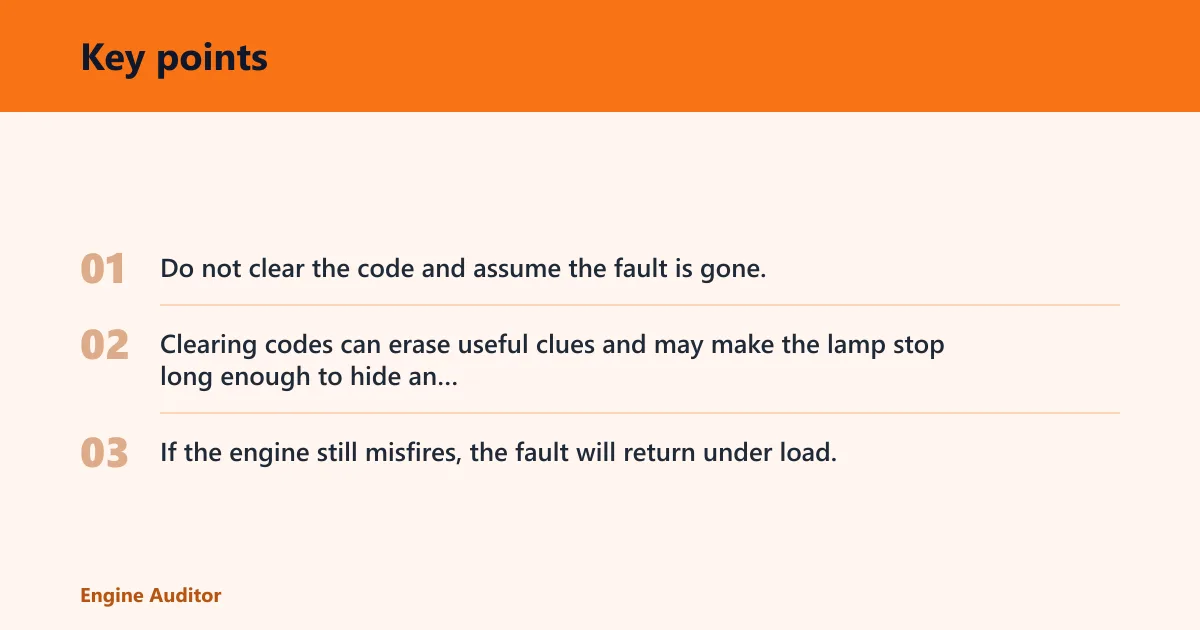
Do not clear the code and assume the fault is gone. Clearing codes can erase useful clues and may make the lamp stop long enough to hide an active problem. If the engine still misfires, the fault will return under load, and the damage risk remains.
Can you keep driving with it flashing?

Sometimes a careful limp to a nearby shop is acceptable, but only if the engine runs smoothly enough to avoid shaking, fuel smell, smoke, or rising temperature. Keep throttle input light and avoid high speed, long grades, and any demand that makes the misfire worse. If the car bucks, stalls, or smells strongly of fuel, stop and tow it.
Engine load matters because throttle position, road speed, and hill climbing can make the fault damage faster. A misfire that feels tolerable at idle can get worse under load, and the same light may flash more persistently when the engine is asked to work harder. That is why a “drive it gently” answer is too vague by itself.
Suppose a V6 sedan flashes the MIL at idle after a cold start, then smooths out as long as the driver avoids a steep hill. A short, low-load trip to a shop may be reasonable. If the same car begins shaking on the on-ramp, the safe choice changes to a tow.
When a careful limp may be acceptable
A careful limp is only for a car that still runs predictably, with no heavy shaking, smoke, strong fuel smell, or temperature rise. Keep the route short, avoid traffic that forces repeated acceleration, and keep rpm and throttle low. If the lamp begins flashing again more often, pull over and stop.
When towing is the safer choice
Tow service is the right call when the engine misfires hard, the car shakes at idle, fuel odor is obvious, smoke appears, or the vehicle barely holds speed. It is also the safer choice when the driver cannot keep load low, such as on a steep route or in stop-and-go traffic that keeps triggering the fault.
What codes point to the cause?
OBD-II codes help narrow the fault, especially when the light is flashing. P0300 means random misfires across multiple cylinders. P0301 through P0308 point to a cylinder-specific misfire. P0171 or P0174 alongside a misfire code suggests a lean condition, which can starve the engine of the mixture it needs to run cleanly.
A scan tool or code reader can tell you which code is stored and whether the problem is centered on one cylinder or spread across several. That is useful because a single-cylinder misfire often points toward one spark plug, one coil, or one injector, while a random pattern pushes you toward a broader fuel or air problem.
The scan tool cannot tell you the failed part by itself. A cylinder-specific code is a clue, not a verdict. The code tells you where to focus, but you still need symptom checks and, for many faults, component testing before replacing parts.
How to read the pattern
- P0300: random misfires across more than one cylinder; think fuel, air, or a fault that moves around.
- P0301-P0308: one cylinder is misfiring more than the others; think spark plug, ignition coil, injector, compression, or wiring on that cylinder.
- P0171/P0174 plus a misfire code: lean condition along with misfire; think vacuum leak, weak fuel supply, dirty injectors, or another fuel delivery issue.
Common causes behind the flash
Spark plugs are one of the most common causes. Wear-related failure can weaken spark and set off a misfire, especially under load. If one plug is tired, the whole set is often replaced together because a mixed old-and-new set can make diagnosis messy and leave you with uneven ignition performance.
Ignition coils are another common cause. They deliver spark to the plug, and when one coil weakens, the engine can misfire even if the plug looks acceptable. That is why a car can keep flashing after a plug change if the coil was the real fault all along.
Fuel injectors can also trigger a flashing CEL. A dirty or broken injector can cut fuel delivery to one cylinder or make the mixture unstable enough to misfire. Related fuel delivery problems can create the same result, including a lean condition that shows up with P0171 or P0174.
A common first-timer mistake is to replace parts in a hurry because the car idles “almost normally.” A misfire that comes and goes under throttle may still be hard on the converter. The better move is to match the symptom pattern to the code pattern before buying parts.
Does restarting the engine help?
Restarting the engine may change the symptom, but it does not fix the fault. A misfire can pause after a restart, then return when load, temperature, or speed changes. If the light stops flashing and goes solid, that still does not mean the problem is gone; it should be addressed this week.
Do not treat a calmer restart as clearance to drive normally. A flashing light that turns solid may mean the active fault has eased for now, but the stored code still matters. If the engine is rough, smells of fuel, or runs hot, keep the car off the road until it is checked.
What damage can happen if you keep driving?
Unburned fuel can enter the exhaust and overheat the catalytic converter. That part can be damaged to the point that replacement is needed, and converter damage can become permanent if the misfire keeps dumping fuel into it.
The risk rises with load. Hard acceleration, speed, and hill climbing increase cylinder demand and can make the misfire worse, which pushes more raw fuel into the exhaust. The problem can appear quickly once the engine is under strain.
Do not keep testing the car by driving farther.
What should I do right away if my check engine light starts flashing?
Lift off the throttle, reduce load, and look for a safe place to stop. If the engine shakes, smells of fuel, smokes, or the temperature rises, shut it down and arrange a tow. If it stays smooth, keep the trip short and low-load until you can get a scan.
Can I keep driving with a flashing check engine light?
Only in a limited, low-load way if the engine is still smooth and there is no fuel smell, smoke, shaking, or temperature rise. If any of those symptoms appear, stop driving. The flashing light signals an active fault, and load can turn a repairable issue into converter damage fast.
What does a flashing check engine light usually mean?
Most often, it means active misfiring. It can also appear with other urgent engine-control faults, so it should not be treated as a normal warning. The important point is that the fault is happening now, not just stored in memory from an earlier drive cycle.
Is a flashing check engine light the same as a solid one?
No. A flashing light is more urgent than a solid one because it points to an active problem that can damage the catalytic converter right away. A solid light usually means a stored fault that still needs diagnosis, but it is usually less urgent than a live flashing warning.
What are the most common causes of a flashing check engine light?
Spark plugs, ignition coils, and fuel injectors are common causes. Fuel delivery issues and lean conditions can also trigger a flashing MIL.
How do I tell if I need to tow the car or can limp to a shop?
Tow it if the engine shakes hard, smells of fuel, smokes, stalls, or gets hotter as you drive. A limp may be acceptable only when the car stays smooth and the route is short and low-load. If the fault worsens with throttle, speed, or hills, tow service is the safer call.
Will restarting the car make the flashing check engine light go away?
It may change the symptom for a moment, but it does not repair the fault. If the light stops flashing and goes solid, the problem can still be present and should be addressed this week. A restart is not a fix, and it should not be used to justify normal driving.
What damage can happen if I keep driving with a flashing check engine light?
The main risk is catalytic converter damage from unburned fuel and heat. That damage can become permanent, and continued driving can also worsen the original misfire or fuel problem. The harder the engine works, the more likely the fault is to do expensive harm fast.
Products related to this article
Sponsored / affiliate links. As an Amazon Associate I earn from qualifying purchases. I may earn additional commission from eligible campaigns.
 OBD2 Scanner Diagnostic Tool - Check Engine Light Code Scanner Tool with Reset, DTC, Data Stream, I/M Readiness, Car & Truck Scan Tool for All Vehicles Since 1996, escaner automotriz
 OBD2 Scanner Diagnostic Tool - Check Engine Light Code Reader, Reset Function, Data Stream, I/M Readiness, Full Features, Modes 6 & 8, for All 1996+ Vehicles, Automotriz Scanner