Vehicle Types for Registration: What Documents Usually Ask for
For most registrations, bring proof of identity, ownership, insurance, and a title or bill of sale; add odometer, lien, emissions, VIN, or import papers only when your state or purchase type requires them. Missing one document can mean a rejected application, a return trip, and extra fees. This guide maps the papers to gather for new purchases, private sales, gifts, inherited vehicles, out-of-state moves, and states that require extra checks.
What you’ll need
- Vehicle title or Manufacturer’s Certificate of Origin for a new vehicle
- Bill of sale for a private-party purchase when your state asks for it
- Government-issued ID such as a driver’s license, state ID, or passport where allowed
- Proof of insurance that meets your state minimum coverage
- Proof of residency when your state requires it, such as a utility bill or lease
- VIN verification if your state requires it, especially for an out-of-state vehicle
- Inspection certificate if your state requires safety inspection, emissions, or smog testing
- Registration application form from your DMV
- Payment for registration fees and taxes
Vehicle registration document matrix
| Vehicle scenario | Usually required documents | Sometimes required documents | Common rejection triggers |
|---|---|---|---|
| Dealer purchase | MCO for a new vehicle or title for a used vehicle, proof of insurance, government ID, application form, payment | Odometer disclosure, residency proof, inspection certificate, VIN verification | Missing MCO or title, VIN mismatch, insurance that does not meet state minimum coverage |
| Private-party purchase | Signed title, bill of sale, proof of insurance, government ID, application form, payment | Odometer disclosure, title transfer forms, residency proof, inspection certificate, VIN verification | Unsigned title, seller name or VIN mismatch, missing bill of sale when tax must be calculated |
| Out-of-state transfer | Current registration, title, proof of insurance, government ID, application form, payment | VIN verification, residency proof, inspection certificate, emissions or smog test, import papers | Title does not match the vehicle, VIN does not match, missing current registration, failed inspection |
| Leased vehicle | Lease agreement, title or lender paperwork from the leasing company, proof of insurance, government ID, application form, payment | Residency proof, VIN verification, inspection certificate, power of attorney | Missing leasing company authorization, insurance that does not list required coverage, lien information that is incomplete |
| Lost-title case | Replacement title application, proof of identity, proof of insurance, application form, payment | Bill of sale, lien release, VIN verification, residency proof | No replacement title request, ownership history cannot be verified, lienholder record is unresolved |
What documents do I usually need to register a vehicle?
Start with proof of ownership, proof of identity, proof of insurance, the state application form, and payment for fees and taxes. Most states require proof of ownership before registration, and many states ask for identity, residency, and a state-specific application form at the same counter visit.
Start with the core papers
Your ownership paper is usually the title for a used vehicle or the MCO for a new one. The title should match the VIN, and the original copy is usually required. Insurance generally needs to meet state minimum requirements, and the DMV may accept a card or declarations page in printed or digital form.
Add state-specific verification
Many states ask for proof of residency or address, and some require VIN verification before they issue plates. If the vehicle is from another state, bring the current registration too. Odometer disclosure may be required for some vehicles, especially at transfer.
Check the DMV payment method
Fees and taxes are due at submission in many places. Sales tax or use tax may apply, and some DMVs accept card or money order only. Bring enough to cover the filing fee, title fee, and any tax amount your state calculates from the sale paperwork.
How do the documents change by vehicle scenario?
The exact stack changes with how the vehicle was acquired. New purchases usually lean on the MCO, private sales lean on the signed title and bill of sale, and leased vehicles add lender or lessor paperwork. Out-of-state transfers and lost-title cases need extra verification before the DMV will issue a plate.
New vehicle with MCO
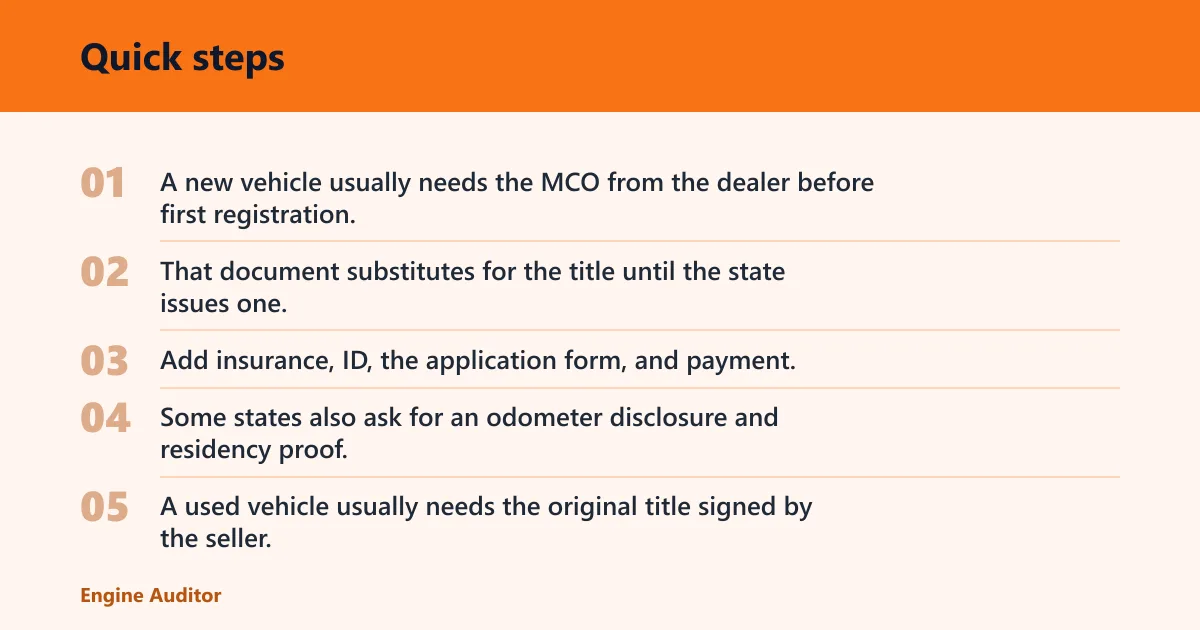
A new vehicle usually needs the MCO from the dealer before first registration. That document substitutes for the title until the state issues one. Add insurance, ID, the application form, and payment. Some states also ask for an odometer disclosure and residency proof.
Used vehicle with title
A used vehicle usually needs the original title signed by the seller, though requirements can vary by state. The name on the title should match the seller, and the VIN should match the car. A bill of sale often helps with tax calculation and price proof, especially in private-party purchases.
Vehicle with a lienholder
If a lender or leasing company still has an interest in the vehicle, the title may show the lienholder. Bring any payoff or lien release paperwork if ownership has changed. A missing lien release is a common reason a DMV will hold the application instead of issuing a plate.
What extra checks does your state require?
Some states require additional checks, such as emissions or safety testing, before registration can move forward. VIN verification is required in some states, safety inspection certificates are required in about 15 states, and emissions or smog testing is separate from a safety check. Do not treat those as the same requirement.
VIN verification
VIN verification confirms that the number on the vehicle matches the title or ownership paper. It is common for out-of-state vehicles and may also apply to rebuilt or otherwise flagged records. A mismatch usually stops the registration until the paperwork is corrected.
Safety inspection
A safety inspection checks items such as brakes, lights, and tires under your state’s rule set. If your state requires it, complete it before the DMV visit unless the DMV tells you otherwise. Bring the certificate, not just the repair invoice.
Emissions or smog test
An emissions or smog test is a separate requirement from a safety inspection. Some states want both, some want only one, and some want neither. Bring the test result if your county or state requires it, and check whether it has a short validity window.
Common mistakes
The most common failures are easy to spot after the fact. The problem is usually a missing original paper, a mismatch between the vehicle and the document, or a state-specific proof that was left at home.
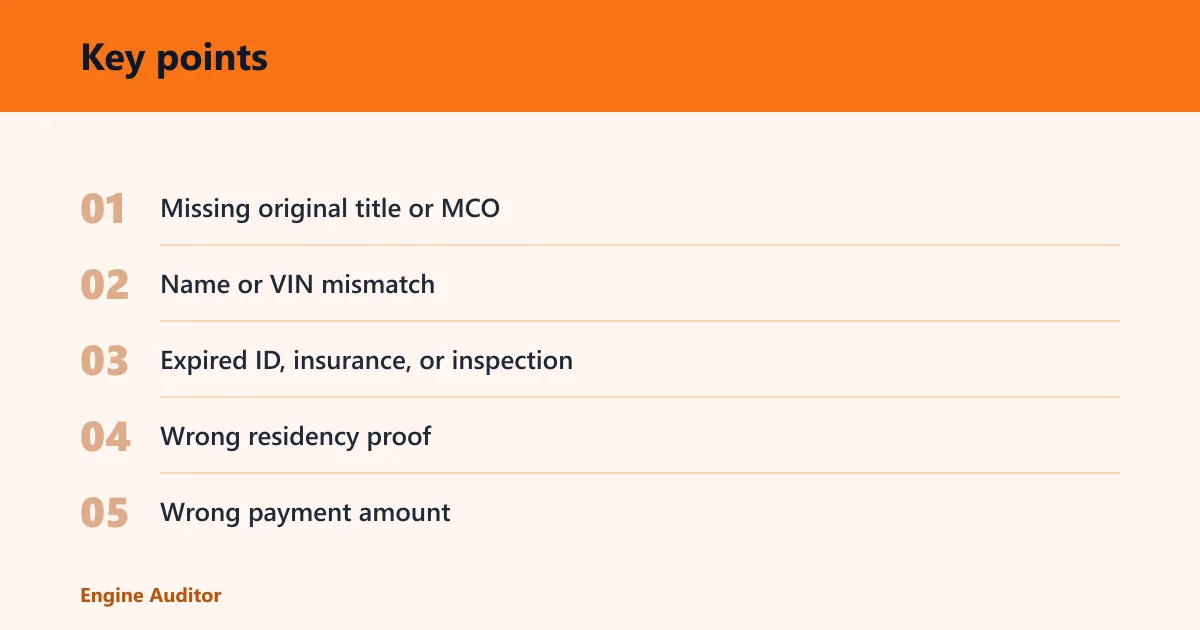
- Missing original title or MCO: A copy may not be enough when the DMV wants the original ownership paper.
- Name or VIN mismatch: Check that the title, bill of sale, and vehicle all show the same VIN and owner name.
- Expired ID, insurance, or inspection: Each must be current or within the state’s allowed window.
- Wrong residency proof: Some states want a recent utility bill, lease, mortgage statement, or bank statement within a set date window.
- Wrong payment amount: Fees and taxes can change with sales or use tax, so confirm the total before you submit.
Say your dealer hands you an MCO for a new sedan, but the insurance card lists a different garage address than your ID. The DMV may pause the file until the identity and residency papers line up with the application.
Suppose you buy a pickup from a private seller and the title is signed, but the county requires an emissions test. You still need the test result before registration, even though the title transfer itself is complete.
- Match the vehicle source to the document set in the matrix.
- Collect the ownership paper first: title, MCO, or replacement title paperwork.
- Add identity, insurance, residency, and any transfer forms your state asks for.
- Check whether your state needs VIN verification, safety inspection, or emissions testing.
- Confirm the VIN, seller name, and odometer details on every form.
- Bring payment for fees and taxes, plus a second payment method if your DMV limits card use.
Prevention is simple: verify every paper against the VIN and your state DMV checklist before you visit. That one review catches most counter rejections.
Frequently asked questions
Do I need the title or bill of sale to register a car?
The title is usually the key ownership paper. A bill of sale often helps with private-party transfers and tax calculation, but it usually does not replace the title by itself. If the title is unavailable, use the replacement-title process your DMV lists before you submit the registration.
What proof of insurance do DMVs usually ask for?
Most DMVs want proof that meets the state minimum coverage. An insurance card or declarations page is commonly accepted, and some states accept a digital copy. The policy should be active on the registration date, not scheduled to start later.
Do I need proof of residency for vehicle registration?
Many states ask for it, but not all. Typical documents include a utility bill, lease, mortgage statement, or bank statement. The date window varies by state, so check whether the document must be recent and whether the name and address must match your ID.
What if my state requires an inspection or emissions test?
Complete the required test before your DMV visit unless the office gives a different order. Safety inspection and emissions or smog test are separate checks. Bring the certificate or printed result, because a repair receipt usually does not stand in for the official test record.
Can I register a vehicle without the title?
Sometimes, but only through your state’s replacement-title or bonded-title process. A bill of sale alone usually is not enough for standard registration. If the title is lost, contact the DMV first and ask what ownership proof, identity papers, and lien release documents it wants.
What documents are needed for a dealer purchase versus a private sale?
A dealer purchase usually centers on the MCO for a new vehicle or the dealer-assigned title for a used one. A private sale usually needs a signed title and often a bill of sale. Both still need ID, insurance, application forms, and fees at submission.
What should I bring for an out-of-state vehicle registration?
Bring the current registration, the title, proof of insurance, ID, and payment. Many states also want VIN verification, proof of residency, and sometimes an emissions or safety certificate. Out-of-state transfers often face the most document checks, so verify every item before you go.
Products related to this article
Sponsored / affiliate links. As an Amazon Associate I earn from qualifying purchases. I may earn additional commission from eligible campaigns.