Vehicle body style vs vehicle type: what’s different?
Body style is the vehicle’s shape, roofline, door count, and cargo access. Vehicle type is the wider shopper bucket, usually built around size, use, or market role. Use this rule: shape first, category second. Mixing them up leads to bad filter results, wrong comparisons, and spec-sheet confusion. The rest of this guide shows where body styles and vehicle types overlap, where they do not, and how to sort them before comparing models.
This guide is part of our Vehicle types guide: body styles and categories series.
| Decision factor | Vehicle body style | Vehicle type: what’s the difference? | Winner |
|---|---|---|---|
| What it describes | Shape, roofline, door count, and cargo access layout | Broader shopper bucket that may combine size, use case, and market positioning | Vehicle body style |
| How precise it is for shopping | Usually more exact for comparing cabin access, rear cargo opening, and parking fit | Useful for narrowing a search, but often wider and fuzzier | Vehicle body style |
| How well it handles fuzzy models | Better at spotting liftbacks, wagon-like SUVs, and coupe-SUV shapes | More likely to blur those models into a broad segment label | Vehicle body style |
| Best use case | Buyers comparing seating position, cargo loading, and door access | Buyers sorting by broader needs such as compact, luxury, sports, or off-road intent | Tie |
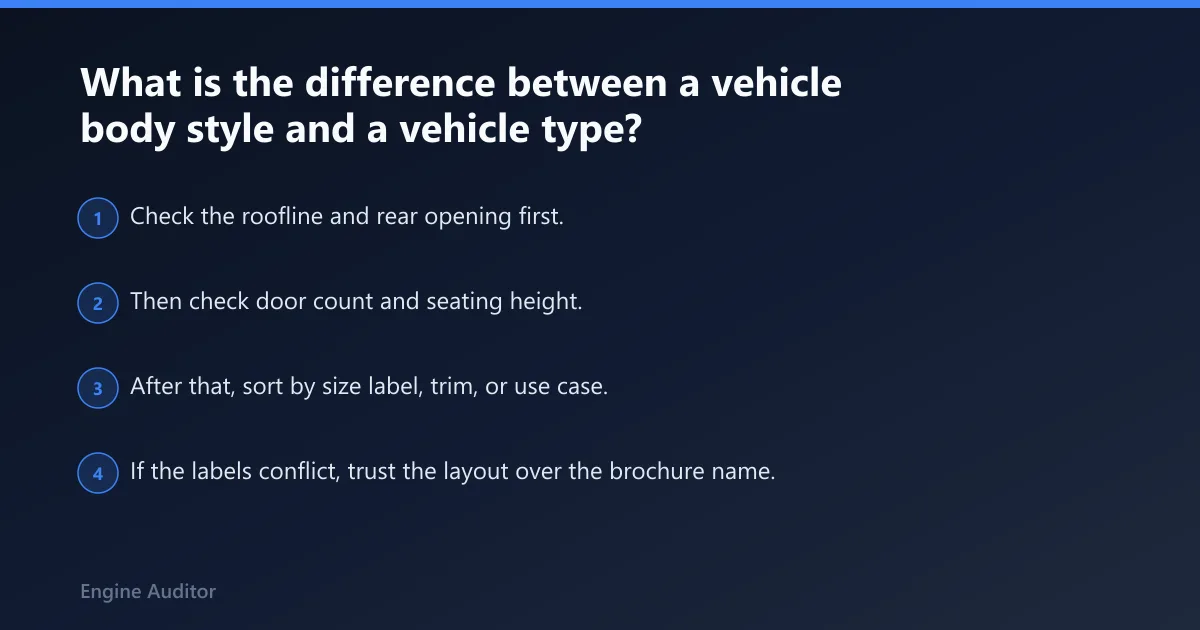
What is the difference between a vehicle body style and a vehicle type?
Body style is the visible layout: sedan, hatchback, wagon, coupe, SUV, van, or pickup. Vehicle type is the larger shopping bucket used to group vehicles by use, size, or market role. A sedan can be compact, mid-size, or full-size; those size labels sit beside body style, not inside it.
Why the two labels get mixed up
Retail sites and manufacturer brochures often use the terms loosely because shoppers search by familiar words. A site may call a compact crossover an SUV, while another lists the same model as a crossover or wagon-based utility vehicle. ISO 3833-1977 is the international standard for road vehicle types, terms and definitions, but showroom language is often less strict. (en.wikipedia.org)
Car and Driver says body style describes a vehicle’s size, shape, and characteristics, and it separates vehicles into eight primary body styles. That shopper-friendly approach works because it tracks what people can see and use: how you enter, where the cargo goes, and whether the rear opening is a trunk lid or a liftgate. (caranddriver.com)
The quick rule buyers can use first
Use this shortcut: if you are asking “What does it look like and how is it packaged?”, you are asking about body style. If you are asking “What shopping segment does it fall into?”, you are usually asking about vehicle type. That rule keeps model pages, filter menus, and sales language from turning into a naming dispute.
- Check the roofline and rear opening first.
- Then check door count and seating height.
- After that, sort by size label, trim, or use case.
- If the labels conflict, trust the layout over the brochure name.
What are the main vehicle body styles in the U.S.?
The main body styles shoppers often run into are sedan, hatchback, coupe, wagon, SUV, van, and pickup. Each one is defined more by shape and access than by brand or price. The size labels compact, subcompact, mid-size, and full-size are separate descriptors that can apply within several body styles.
Sedan, hatchback, coupe, wagon, SUV, van, and pickup
Sedans usually have four doors and a three-box design. Hatchbacks use a rear liftgate instead of a separate trunk lid, which makes cargo loading easier. Coupes often have two doors and a lower, sportier roofline. Wagons keep a long roof and a rear cargo opening, while pickups use an open bed. Vans prioritize people and cargo space, and SUVs sit higher with more ground clearance.
Body style matters most when two vehicles share a class but not the same shape. A hatchback and a sedan may both be compact cars, yet the hatchback will usually accept bulkier cargo more easily through the larger rear opening. A wagon and an SUV may both look cargo-friendly, but the wagon usually carries a lower load floor.
Where compact, mid-size, and full-size fit in
Those labels describe scale, not shape. A compact sedan and a compact SUV are different body styles with different packaging; a mid-size sedan and a full-size sedan are the same body style with different interior and exterior proportions. That is why shoppers should not treat size labels as body-style labels.
Car and Driver notes that mid-size sedans trade some driving enjoyment for more rear seat and cargo space. Full-size sedans emphasize a comfortable ride and rear seat space. Those are shopping traits, not separate body styles.
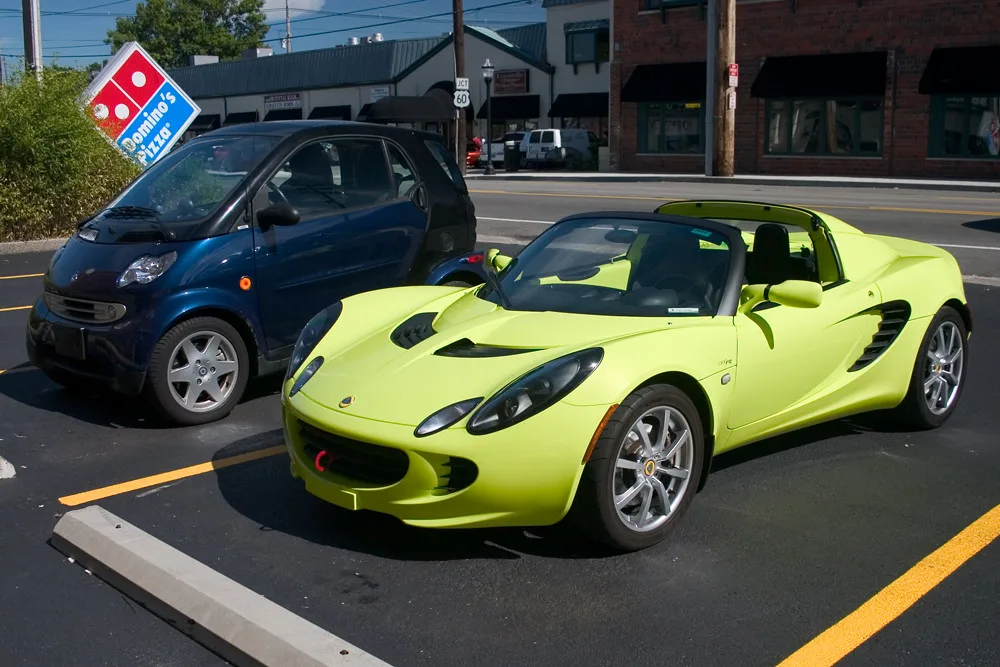
Is an SUV a body style or a vehicle type?
An SUV can be both, depending on context. In everyday retail use, it is a body style because it describes a taller, higher-riding shape with a cabin and cargo area behind the front row. In broader shopping language, it also works as a vehicle type because buyers use it to group compact, mid-size, luxury, and off-road-oriented models together.
Why the answer changes with context
When a sales site says “SUV,” it may mean a body shape, a market segment, or both. That is why the label alone is not enough. A tall wagon-like crossover may be sold as an SUV even though its structure is closer to a car-based wagon than to an old-style truck-based utility vehicle.
SUVs are described as the most popular vehicle type in the United States, and they often provide generous space in the cabin and cargo area. That popularity makes the term do too much work. It can point to a body shape, a shopper segment, or a trim family depending on who is using it.
Where subcompact, compact, and mid-size SUV fit
Subcompact SUVs are the smallest SUV breed. Compact SUVs sit one step up and are often the model class most likely to be cross-shopped against wagons. Mid-size SUVs generally trade some parking ease for more row-to-row space and cargo volume. These labels say more about scale than about whether a vehicle is a true truck-based SUV or a car-based crossover.
How do sedans, hatchbacks, wagons, and coupes differ?
They differ mainly by roofline, rear access, and door count. Sedans usually have four doors and a trunk separated from the cabin. Hatchbacks and wagons use a liftgate or rear hatch for cargo access. Coupes usually have two doors and a lower, more sloped profile.
What does three-box design mean on a car?
Three-box design means the body is visually divided into three sections: engine compartment, passenger compartment, and cargo compartment. That is the classic sedan shape. It is easy to spot because the hood, cabin, and trunk read as separate volumes rather than one continuous roofline.
That design matters because it changes loading, rear visibility, and how the car looks from the side. A sedan’s isolated trunk usually gives a cleaner separation between passengers and cargo. A hatchback or wagon blends those spaces more directly, which is why it often feels more practical for bulky items.
Liftgate access versus trunk access
A hatchback opens with the rear glass and cargo door together, so tall items can fit through a larger opening. A sedan’s trunk opening is often smaller and lower. That difference matters more than badge names when someone carries strollers, sports gear, or boxes.
Wagons extend the roofline farther back than sedans, which adds cargo room without raising the roof as much as many SUVs do. Coupes go the other direction, trading some rear-seat and cargo practicality for a lower, sleeker shape. When shoppers debate these labels, the real issue is usually access, not taxonomy.
Why do some vehicles fit more than one category?
Many vehicles sit in the overlap because manufacturers blend platforms and marketing terms. A liftback sedan can look like a sedan from the side but use a hatch-like rear opening. A crossover can be sold as an SUV even when it rides on a car platform. That is why the same model may appear under different filters.
Crossover SUV versus traditional SUV
A crossover SUV is a wagon-like SUV form, and it is commonly confused with a traditional SUV. A crossover often uses a car-based structure, which can help reduce weight and improve road manners. The traditional SUV often has a more truck-like feel and higher, more upright proportions.
Car and Driver describes compact SUVs as effectively modern-day station wagons. That is a useful reminder that the crossover label grew out of wagon logic: useful cargo room, higher seating position, and easier daily access without the bulk of a large truck-based utility vehicle.
Liftback sedans, coupe-SUVs, and sedan-based crossovers
Liftback sedans blur the line between sedan and hatchback because the rear glass and trunk opening move together. Coupe-SUVs borrow the sloping roofline of a coupe but the ride height and proportions of an SUV. Sedan-based crossovers start with sedan architecture and then add height, body cladding, and a higher seating position.
That is why marketing names can mislead shoppers. A vehicle may be sold as an SUV for image reasons even if the load floor, cabin shape, and rear opening behave more like a hatchback or wagon. The label tells a story; the body tells the truth.
How should you choose the label that matters most when shopping?
Start with use case, then sort by body style, then use size labels if needed. If cargo loading matters most, body style is the first filter. If parking, garage clearance, or child-seat access matters most, dimensions and door access matter more than the badge on the window sticker. If you are comparing trims within one model, vehicle type or size class may be the better filter.
When body style matters more than size labels
Body style matters most when the shape changes how the vehicle works. A hatchback versus a sedan is a real choice for cargo access. A wagon versus an SUV changes load height and roofline. A pickup versus an SUV changes the cargo-carrying method entirely because the bed is open and separate from the cabin.
When size or trim category matters more than body style
If the shopper already knows the body style, size labels become the next useful sorter. Compact, mid-size, and full-size tell you about parking ease, rear legroom, and cargo volume. They help when comparing two sedans or two SUVs, but they are poor substitutes for body style when the shape and access layout differ.
Shopping factors that actually change the decision
Insurance, child-seat access, and cargo loading are often more important than the name on the segment chart. A tall seat can make buckling a child easier. A low trunk lip can make loading heavy bags easier. A shorter vehicle can simplify tight parking. Those are practical effects of body style, not marketing labels.
Vehicle classification matrix: model examples and where they get fuzzy
This matrix maps common models to both labels so shoppers can see where body style and vehicle type align, and where they do not. The ambiguous column matters because that is where shopping filters usually fail. When one site says sedan and another says liftback or fastback, the layout still decides the real-world use case.
| Model example | Body style | Vehicle type | Door count | Cargo access | Seating height | Where it becomes ambiguous |
|---|---|---|---|---|---|---|
| Toyota Camry | Sedan | Mid-size car | 4 | Trunk lid | Low | Usually clear; some trims can look sportier, but the layout stays sedan |
| Honda Civic Hatchback | Hatchback | Compact car | 4 or 5 depending on rear-door count treatment | Rear liftgate | Low | Often cross-shopped against sedans because the footprint is similar |
| Subaru Outback | Wagon-like crossover | Mid-size utility vehicle | 4 | Liftgate | Moderate | Commonly mistaken for an SUV, but the shape tracks wagon logic |
| Honda CR-V | Crossover SUV | Compact SUV | 4 | Liftgate | Higher | Called an SUV in retail language, though its structure is crossover-based |
| Ford Bronco | SUV | Off-road SUV | 2 or 4 | Rear door or liftgate depending on configuration | High | Closer to a classic utility shape; trim and door count change the label feel |
| Toyota Tacoma | Pickup truck | Light-duty truck | 2 or 4 | Open bed | Moderate to high | Not an SUV; this is a separate body style with a separate cargo layout |
| Volkswagen Arteon | Liftback sedan | Mid-size car | 4 | Hatch-style rear opening | Low | Looks like a sedan, opens like a hatchback |
| BMW X6 | Coupe-SUV | Luxury SUV | 4 | Liftgate | Higher | Uses SUV hardware with a coupe-like roofline, so shoppers may disagree on the label |
How to use the matrix when filters disagree
If one filter says sedan and another says hatchback, use the rear opening as the tie-breaker. If one source says SUV and another says crossover, check the roofline, floor height, and cargo setup. If the vehicle has a bed, it is a pickup, even if the brochure tries to dress it up with utility language.
Verdict: Vehicle body style or vehicle type: what’s the difference?
Choose Vehicle body style if you are comparing seating position, cargo loading, and door access, or if you are checking the roofline and rear opening first for fit, access, and bulkier cargo.
Choose vehicle type: what’s the difference if you are sorting by broader needs such as compact, luxury, sports, or off-road intent, or narrowing a search by size, use, or market role.
Frequently asked questions
What is the difference between a vehicle body style and a vehicle type?
Body style is the shape and packaging of the vehicle: sedan, hatchback, wagon, coupe, SUV, van, or pickup. Vehicle type is the broader shopping bucket used to group vehicles by use, size, or market role. Body style is usually the better answer when the question is about layout.
Is an SUV a body style or a vehicle type?
An SUV can be either, depending on context. In retail language it often acts like a body style because it describes a high-riding shape with liftgate cargo access. In shopping language it also works as a type because buyers use it to group subcompact, compact, and mid-size models together.
Are crossover and SUV the same thing?
No, but they overlap a lot. A crossover is usually a wagon-like SUV form with car-based architecture, while “SUV” is the broader term shoppers use for tall utility vehicles. Many dealerships and websites collapse the two labels, which is why the same model may appear under both.
How do sedans, hatchbacks, wagons, and coupes differ by body style?
Sedans use a three-box design with four doors and a separate trunk. Hatchbacks use a rear liftgate and usually give easier cargo access. Wagons stretch the roofline rearward for more cargo room, and coupes usually have two doors with a lower, sportier roofline.
What does three-box design mean on a car?
Three-box design means the car is visually divided into engine, passenger, and cargo sections. It is the classic sedan layout. The hood, cabin, and trunk read as three distinct shapes rather than one continuous body, which is why sedans look different from hatchbacks and wagons.
How should I choose between body style labels when shopping?
Start with the job the vehicle must do. If cargo access matters, compare hatchbacks, wagons, and SUVs by rear opening and load height. If child-seat access matters, compare door count and seat height. If parking matters, compare exterior length and turning feel before worrying about the name.
What are the main body styles used in the U.S.?
The main U.S. body styles shoppers see are sedan, hatchback, coupe, wagon, SUV, van, and pickup. Those labels tell you about shape and access first. Compact, mid-size, full-size, and subcompact are size labels that sit beside the body style rather than replacing it.
Products related to this article
Sponsored / affiliate links. As an Amazon Associate I earn from qualifying purchases. I may earn additional commission from eligible campaigns.
 LINKSWELL Radio for Dodge RAM 2019-2022 New Body Style 1500/2500/3500
 Headlight Restoration Kit,Headlight Cleaner for All Vehicle Types (4.23 oz)
 Swing‑Away 2 Inch Hitch Adapter, Heavy‑Duty 120 Degree Pivot, 260 Lbs Load Capacity, Hitch Mount Bike Rack Extension for Standard 2" Receiver, Fits Most 2‑inch Hitch Racks