Vehicle Types for Towing: Choose the Right One
Choose the tow vehicle that fits trailer geometry and load behavior, not the highest tow rating alone: long-wheelbase pickups, vans, and some SUVs fit stable, heavy trailers; shorter vehicles fit lighter, compact loads. Pick poorly and you invite sway, weak braking, overloaded axles, and a hitch pushed past its limit. This guide explains how body style, wheelbase, hitch class, trailer type, and load distribution shape the right choice for trailers, RVs, and work loads.
Choose by trailer behavior
Start with how the trailer rides on the road. A tall travel trailer, a long boat trailer, and a low equipment trailer push on the tow vehicle in different ways, so the same tow rating can lead to very different results in real use.
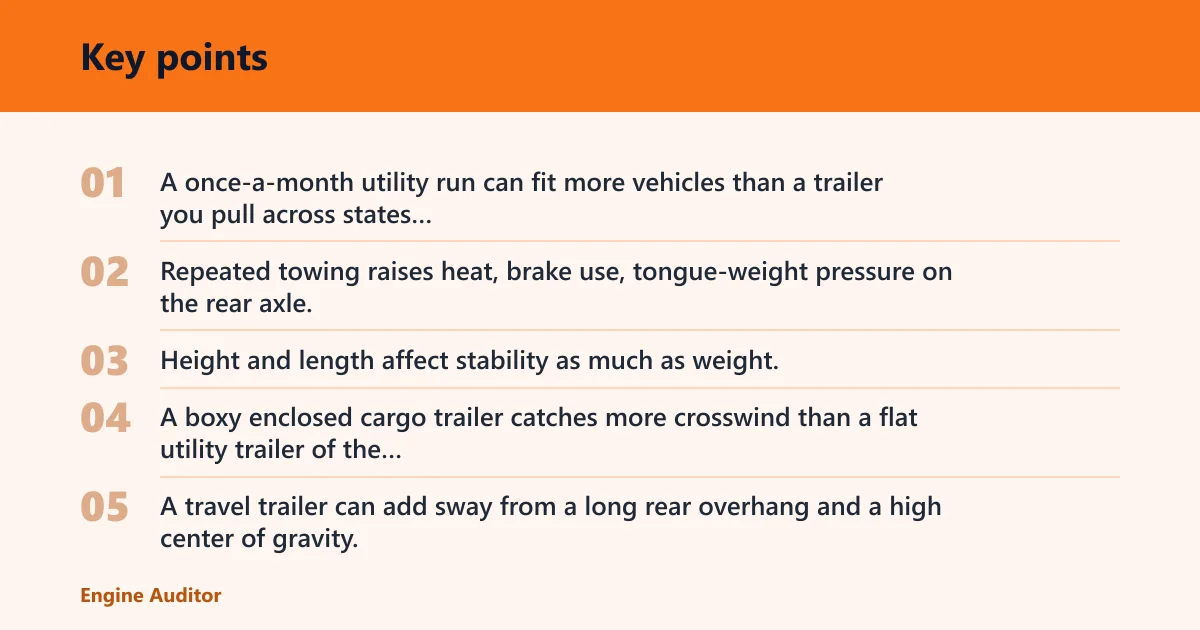
Frequency matters too. A once-a-month utility run can fit more vehicles than a trailer you pull across states every week. Repeated towing raises heat, brake use, tongue-weight pressure on the rear axle, and the value of a stable wheelbase.
Why trailer shape changes the match
Height and length affect stability as much as weight. A boxy enclosed cargo trailer catches more crosswind than a flat utility trailer of the same mass. A travel trailer can add sway from a long rear overhang and a high center of gravity. A fifth wheel or gooseneck places more load in the truck bed, which changes how the tow vehicle carries weight and turns.
That is why tow rating is only the first filter. Tow Genius says a tow rating is only the beginning, and its towing library includes 56 guides, including guides on how to read a vehicle door-jamb sticker, payload vs. towing capacity, and how tongue weight works. Those are the numbers that decide whether the setup works.
How frequency of towing changes the choice
Occasional towing can justify a lighter vehicle if the trailer is short, low, and well within all limits. Frequent towing pushes you toward more wheelbase, more payload reserve, and a hitch that fits the trailer’s shape better.
Picture a weekend utility trailer used for mulch and a small mower. That load is easy to move with a modest SUV or pickup if payload, hitch rating, and brake equipment all line up. Now picture the same vehicle pulling a tall enclosed cargo trailer on a windy highway twice a week. The limit changes fast.
What vehicle types are best for towing a trailer?

The best vehicle type depends on trailer size, tongue weight, and how often you tow. SUVs fit lighter trailers and compact loads when their payload and hitch rating are adequate. Pickups fit a wider range because they offer stronger rear structures, more hitch options, and better wheelbase choices. Vans and chassis cabs make sense when interior cargo, upfit needs, or heavier work loads matter.
SUV, pickup, van, chassis cab, or motorhome
An SUV can be the right answer for boat trailers, small utility trailers, and some travel trailers if the tongue weight and cargo load stay within payload. A pickup is the safer fit when the trailer is taller, heavier, or used often. A van helps when you need enclosed cargo space plus towing. A chassis cab suits body builders and work rigs. A motorhome can tow a car, but its tow setup must be checked separately from the coach’s own rating.
COOP lists more than 30,000 specialized commercial vehicles nationwide, including dry van, refrigerated, flatbed, storage trailers, and chassis. That breadth matters for commercial users, but the same principle applies to private buyers: choose the body that matches the load, then verify the limits. COOP also includes $100K physical damage and $1M liability policy on every rental, which shows how seriously the equipment side of towing is treated.
Where wheelbase and cab style change stability
Longer wheelbase usually improves straight-line stability and trailer control. Cab style and bed length also matter because they change axle placement, hitch position, and cargo capacity. A short cab with a long bed may carry weight better than a crew cab with a short bed, but the right answer depends on the actual label values, not on body style alone.
Rear suspension and axle choice matter as well. Single rear wheel, or SRW, setups are common for lighter trailers. Dual rear wheel, or DRW, setups spread load better for heavy fifth-wheel and gooseneck trailers. Engine choice matters too, but it should be treated as part of the package, not as a shortcut around payload or GCWR.
Tow vehicle fit matrix
This matrix matches common trailer and load types to the vehicle class and hitch setup that usually fits best. It focuses on the limits that actually stop a safe match: payload, GCWR, hitch rating, and rear-axle load. Trailer weight here means the trailer as loaded for the trip, not the empty trailer weight or a brochure number.
| Trailer or load type | Recommended vehicle class | Hitch type | Key limit to verify | Common failure mode |
|---|---|---|---|---|
| Small utility trailer | Compact SUV, midsize SUV, small pickup, or minivan if rated and equipped | Standard bumper hitch | Payload after passengers and tongue weight | Rear sag and payload exhaustion |
| Enclosed cargo trailer | Pickup, van, or larger SUV with strong payload reserve | Standard bumper hitch or weight-distribution hitch if the trailer and manual call for it | GCWR and rear-axle load | Sway from tall side area and overload from tongue weight |
| Boat trailer | SUV or pickup with enough wheelbase and wet-launch use in mind | Standard bumper hitch | Hitch rating and launch-trail corrosion protection | Poor rear visibility, slip at ramps, and under-rated hitch hardware |
| Travel trailer | Pickup, SUV only when weight and stability checks pass, or van in some cases | Weight-distribution hitch | Payload, tongue weight, and GCWR | Sway, rear-axle overload, and too little axle load transfer |
| Fifth wheel | Pickup with suitable bed length and rear axle, often heavy-duty | Fifth-wheel hitch | Bed payload and rear-axle rating | Payload exhaustion and cab-bed interference |
| Gooseneck | Heavy-duty pickup with bed-mounted ball setup | Gooseneck hitch | Bed payload, GCWR, and axle rating | Overloaded rear axle and too little reserve for braking |
| Occasional towing | Any vehicle with adequate payload, GCWR, and hitch rating | Matched to trailer type; often standard bumper hitch | Door-jamb label, owner’s manual, and hitch label | Buying for the worst case without checking the actual use case |
Do you need a truck or can an SUV tow your trailer?
An SUV can tow a trailer safely when the trailer is short enough, tongue weight stays within payload, and the wheelbase is long enough for stable tracking. A truck becomes the safer choice when the trailer is tall, heavy, used often, or likely to push payload and rear-axle limits before the advertised tow rating.
When an SUV is enough
Choose an SUV for lighter utility trailers, some boat trailers, and some smaller travel trailers if the combined load still leaves reserve in payload and GCWR. Check the door-jamb sticker, the owner’s manual, and the hitch label. The headline tow rating does not tell you how much passenger weight and tongue weight the SUV can actually carry.
When a pickup is the safer fit
A pickup is usually the better answer for travel trailers that carry more tongue weight, for enclosed cargo trailers that catch wind, and for frequent towing. The bed, frame, and rear suspension typically give you more room to work with, especially when you are carrying extra cargo in the cab and hitch hardware in the bed or receiver.
When a van or chassis cab makes more sense
A van helps when you need enclosed cargo space and a stable wheelbase in one package. A chassis cab makes sense for specialized bodies, work equipment, or upfit needs that place weight differently from a pickup. Truck Report Geeks says light-duty trucks are ideal for smaller trailers, but once the load gets taller or the duty cycle gets heavy, the vehicle choice should shift with it.
How hitch type changes the match
Hitch choice is part of the vehicle match, not an accessory after the fact. The wrong hitch can make a safe tow rating useless if the connection cannot handle the trailer’s real tongue weight or the load-transfer demands of the setup.
Standard bumper hitch for smaller trailers
A standard bumper hitch is the simple ball-and-coupler setup used for smaller trailers. Heartland says a standard bumper hitch is often used under 3,500 lbs. That range fits many utility and small boat trailers, but the actual limit still depends on the vehicle, the receiver, and the trailer’s loaded weight.
Weight-distribution hitch for travel trailers
A weight-distribution hitch is common for travel trailers because it helps distribute load across the tow vehicle and trailer axles and may include sway control. Use it when the manual calls for it, or when the trailer’s geometry makes rear squat and steering lightness a concern. It does not add tow rating; it redistributes load.
Fifth-wheel and gooseneck setups for bed-mounted towing
A fifth-wheel hitch mounts in the truck bed and handles heavier loads than bumper hitches. The same source says fifth-wheel hitches typically handle 16,000 to 30,000 pounds. A gooseneck hitch is also bed-mounted, uses a ball-and-coupler connection, and Heartland says it can handle up to 30,000 lbs. These setups suit fifth wheels and many heavy-duty towing jobs, including toy haulers.
For both, bed length, rear axle rating, and cab clearance matter. A short bed can work in some cases, but the setup must prevent contact between the trailer and cab during turns. DRW trucks are often the cleaner fit when the trailer is large and the pin weight is high.
What limits matter besides tow rating?
Besides advertised tow rating, you need payload capacity, GCWR, tongue weight, hitch rating, and rear-axle load. That combination determines whether the tow vehicle can carry people, cargo, hitch hardware, and trailer force without exceeding a label or manual limit. RV LIFE says its 2026 trailer towing guide now includes payload and covers trucks, vans, and SUVs, which is the right direction for buyers.
Payload capacity and tongue weight
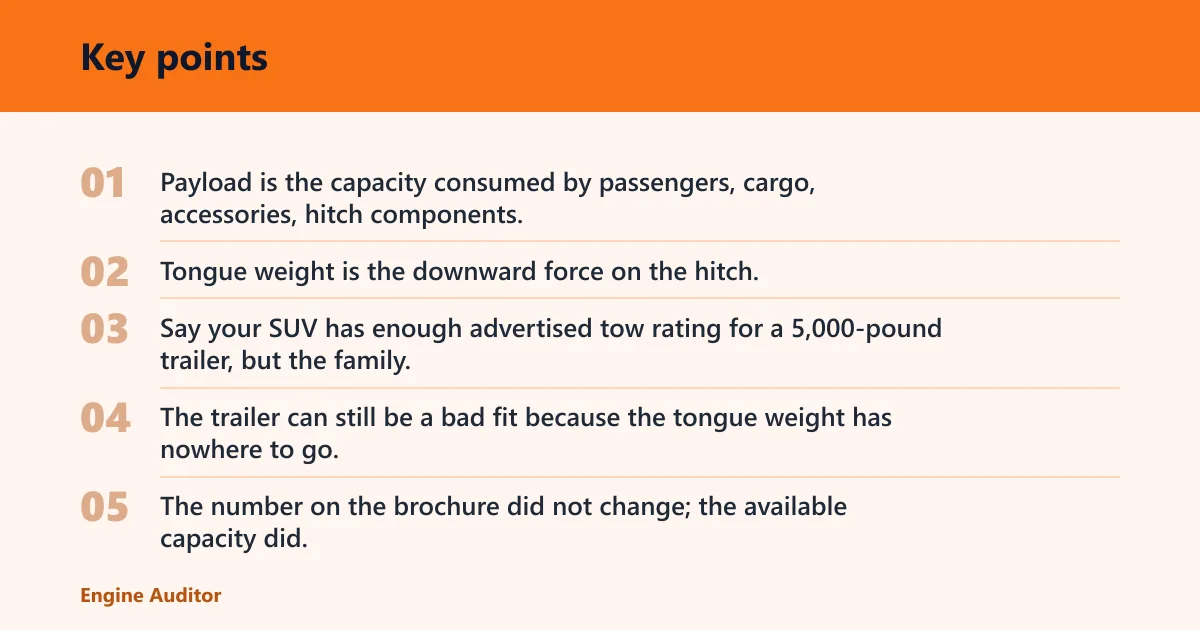
Payload is the capacity consumed by passengers, cargo, accessories, hitch components, and tongue weight. It is often the first limit reached. Tongue weight is the downward force on the hitch, and it commonly takes a share of trailer weight that can quickly eat into available payload, especially with travel trailers and enclosed cargo trailers.
Say your SUV has enough advertised tow rating for a 5,000-pound trailer, but the family, fuel, cooler, and hitch hardware already use most of the payload. The trailer can still be a bad fit because the tongue weight has nowhere to go. The number on the brochure did not change; the available capacity did.
GCWR and rear-axle load
GCWR is the maximum combined weight of the vehicle and trailer, and it varies by configuration. You must check it separately from tow rating. A vehicle can be within tow rating and still fail GCWR once passengers, cargo, and trailer are all counted together.
Rear-axle load is the other overlooked limit. A trailer that loads the rear of the vehicle hard can make steering vague, braking longer, and tire loads higher even when the combined rating looks fine on paper. That is why wheelbase, hitch placement, and cargo distribution matter together.
Hitch rating and brake controller needs
Never assume the receiver or ball mount matches the trailer. Verify the hitch rating on the label and confirm the trailer brakes are controlled the way the manufacturer requires. For heavier trailers, the brake controller is part of the towing system, not an optional extra.
Follow the vehicle and trailer manuals, never work under a vehicle held only by a jack, never exceed the vehicle’s rated roof, hitch, or tow limit, keep items out of airbag zones and the driver’s view, and check local laws.
How do you choose a tow vehicle for a 5,000-pound trailer?
For a 5,000-pound trailer, start with the trailer’s loaded weight, not its empty weight or brochure number. Then verify payload, GCWR, hitch rating, and rear-axle load on the exact vehicle configuration you plan to buy. A 5,000-pound trailer may fit an SUV, pickup, or van, provided the full combination stays within all relevant limits.
What to verify on the vehicle label and manual
- Check the door-jamb label for payload and tire information.
- Read the owner’s manual for the tow rating tied to that engine, cab, bed, axle, and drivetrain.
- Confirm GCWR for the exact configuration, not a similar trim.
- Check the hitch label for receiver rating and any weight-distribution limits.
- Add passengers, cargo, hitch hardware, and expected tongue weight before deciding.
Why reserve matters more than a single headline number
A single tow rating can hide the real constraint. The right setup leaves room for passengers, gear, trailer braking, road grade, heat, and wind. A heavier trailer may still be legal on paper and miserable in practice if the vehicle is already close to payload or rear-axle limits. That is why reserve matters more than a brochure maximum.
How much safety margin should I leave when towing?
Leave enough margin that the combined setup still works when the trailer is fully loaded, the cabin is occupied, and road conditions are worse than ideal. Do not size the vehicle to the exact trailer number and call it done. Safety margin should show up in payload, GCWR, hitch rating, and rear-axle load, not only in one headline rating.
A common first-timer mistake is choosing by tow rating first and payload later. The result is often a setup that looks fine until passengers, tools, fuel, and tongue weight are all on board. Then the rear suspension squats, steering lightens, and the hitch works too hard.
Can a motorhome tow a car or trailer at the same time?
A motorhome can tow a car or trailer if the coach and hitch are rated for it, but the combined load must still stay within the coach’s GCWR and hitch limits. The towed vehicle, trailer, and any gear behind the motorhome all count toward the same combined limit. Check the exact coach configuration before assuming it can pull both.
Frequently asked questions
What’s the difference between towing capacity and payload?
Towing capacity is the maximum trailer weight the manufacturer advertises for that vehicle configuration. Payload is how much weight the vehicle can carry in and on itself, including passengers, cargo, accessories, hitch hardware, and tongue weight. Payload is often the first limit reached in real towing.
Which hitch type do I need for my trailer?
Use a standard bumper hitch for smaller trailers, a weight-distribution hitch for many travel trailers, a fifth-wheel hitch for fifth-wheel trailers, and a gooseneck hitch for gooseneck trailers and many heavy-duty loads. The trailer type, loaded weight, and vehicle manual decide which setup is appropriate.
What should I check besides the advertised tow rating?
Check payload capacity, GCWR, tongue weight, receiver rating, rear-axle load, and the trailer brake setup. Also confirm the wheelbase, cab style, bed length, drivetrain, and SRW or DRW configuration. Tow ratings alone do not tell you whether the vehicle can carry the whole combination safely.
Products related to this article
Sponsored / affiliate links. As an Amazon Associate I earn from qualifying purchases. I may earn additional commission from eligible campaigns.