Wagon vs SUV: Key Differences Every Buyer Should Know
Pick a wagon if you want crisp steering, easier parking, and lower running costs; pick an SUV if you need more ground clearance, easier child-seat loading, or regular use on bad roads and in winter. Choose poorly, and you may burn more fuel, fight parking spaces, or live with cargo space that looks useful but works poorly day to day. This guide compares wagon vs SUV for commuting, child seats, weather, hauling, and ownership costs.
Wagon vs SUV: the real trade-off
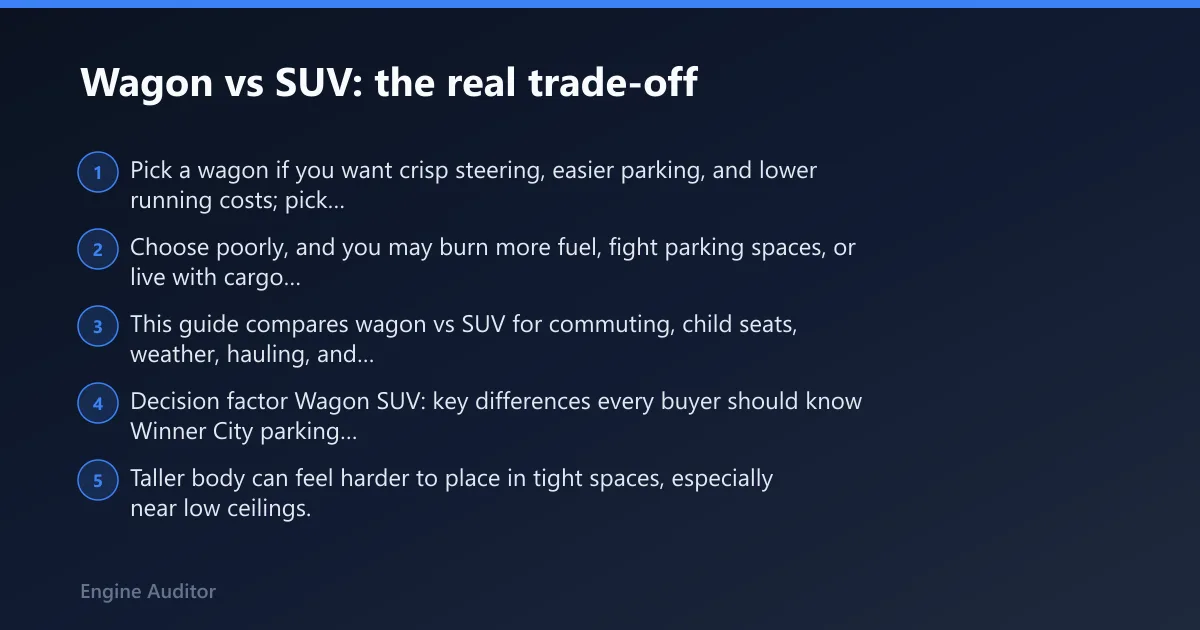
| Decision factor | Wagon | SUV: key differences every buyer should know | Winner |
|---|---|---|---|
| City parking | Lower roofline and car-based footprint usually make tight garages and street parking easier. | Taller body can feel harder to place in tight spaces, especially near low ceilings. | Wagon |
| Highway commuting | Lower ride height and more car-like shape usually mean calmer steering and less wind drag. | Higher stance can feel more upright, but taller shape often creates more wind resistance. | Wagon |
| Child-seat loading | Lower seat and cargo height can make lifting less awkward, but bending deeper is still common. | Higher ride height usually reduces bending when placing a child or carrier into the rear seat. | SUV |
| Winter roads | Works well with winter tires and available AWD, but lower ground clearance can limit deep snow clearance. | More ground clearance helps with snow ruts, slush, and steep driveways; AWD or 4WD is common. | SUV |
| Cargo hauling | Long-roof shape often fits flatter items well and keeps loading height low. | Usually offers taller cargo height and a more upright opening, useful for bulky boxes. | Tie |
| Fuel cost | Usually better, because the shape is lower and more aero-friendly. | Usually worse, because the taller body and extra mass tend to cost more at the pump. | Wagon |
| Visibility | Good forward view, but lower seating gives a less elevated road view. | Higher seating position gives a more commanding view over traffic. | SUV |
| Resale expectations | Often more niche, so demand can be narrower in many markets. | Broader shopper pool usually helps liquidity at resale time. | SUV |
Why the table favors different vehicles in different rows
The wagon wins where a lower, car-based body helps daily use: parking, commuting, and fuel use. The SUV wins where height matters more than efficiency, especially on winter roads and with child-seat loading.
Cargo is the real gray area. A wagon can carry long items with less wasted vertical space, while an SUV often swallows tall boxes and strollers more easily because of its upright shape.
What is a station wagon?
A station wagon is a long-roof passenger car with an extended cargo area behind the rear seats, a low roofline, and generally a lower ride height than many SUVs. It is generally built on a car-based unibody platform, so it behaves more like a car than a truck-based utility vehicle. (en.wikipedia.org)
Why the cargo area feels different
The rear opening is the key. A wagon’s roof continues farther back, so the load floor often sits low and long rather than tall and boxy. That shape makes it good for luggage, strollers laid flat, and anything that benefits from length more than height.
How the old meaning still matters
The word wagon originally described a heavy four-wheeled vehicle pulled by draft animals. Those freight wagons were used for transporting goods, commodities, agricultural materials, supplies and sometimes people, and they were not designed for comfort. The modern body style kept the cargo-first idea, but moved it into passenger-car packaging.

What is an SUV?
An SUV is a taller vehicle with a more upright body, more ground clearance, and often available all-wheel drive or four-wheel drive. In shopping terms, it usually trades some efficiency and ease of loading for a higher seating position, stronger weather clearance, and a more commanding road view.
Why the stance matters
Ride height changes everything a buyer touches. It affects step-in height, how far the driver sits above traffic, how high cargo must be lifted, and how much room the body has before scraping a steep driveway or snow rut.
AWD and 4WD in the shopping conversation
Drivetrain matters more than badge shape. Front-wheel drive can be enough for mild climates, while all-wheel drive or four-wheel drive helps when traction drops. An SUV often makes those drivetrains more common in the showroom, but the body style alone does not guarantee better grip.
What makes a vehicle a station wagon instead of a crossover?
A station wagon is usually the lower, longer, more car-like choice, while a crossover is car-based too but wears SUV-like styling and a taller stance. If the vehicle has unibody construction, an extended roof, and wagon proportions without true SUV ride height, it belongs in wagon territory even if the marketing language gets fuzzy.
Why shoppers mix them up
Modern crossovers sit in the middle. They often overlap with wagon practicality, but they add upright styling, extra height, and a market position aimed at buyers who want SUV cues without committing to a larger body-on-frame vehicle.
That is why body shape alone is not enough. The buyer should look at step-in height, cargo floor height, rear opening shape, and ground clearance before deciding which label matters.
How do wagons and SUVs compare on cargo and cabin use?
Wagons usually make better use of length, while SUVs usually make better use of height. For many buyers, that means a wagon is easier for flat luggage and long items, while an SUV is easier for upright gear, child seats, and bulky cargo that benefits from a taller opening.
Cargo volume with seats up and folded
Do not shop by cargo volume alone. Seat-up and seat-folded capacity both matter, but the rear opening shape decides how usable that space feels. A tall opening can make a number look generous while the floor and sidewalls waste space for certain items.
Rear opening shape and loading ease
A wagon’s lower load floor usually reduces lifting effort. An SUV’s taller opening helps when loading boxes, coolers, and gear that stack upward. For families, the difference becomes obvious on grocery runs and school drop-off days.
Rear headroom, child seats, and passenger space
The roofline changes rear headroom. A low roof can pinch tall passengers or limit upright child-seat clearance, while an SUV’s taller body gives more vertical room. That is one reason buyers who swap child seats often prefer the higher step-in and less awkward reach.
- Check whether the cargo floor is low enough for comfortable lifting.
- Open the rear hatch and judge the shape, not only the total volume claim.
- Install a child seat, then see whether the roofline and seatback angle make the job easy.
- Fold the rear seats and confirm that the space matches your longest regular item.
Which is better for daily driving, parking, and fuel cost?
For most urban and highway commuting, the wagon usually feels easier to live with. It is lower, lighter-feeling, and typically more fuel-efficient than an SUV, while the SUV trades that efficiency for visibility and a more upright driving position that some buyers prefer.
City parking and garage fit
A wagon can be easier to fit into tight garages, low-clearance structures, and crowded curb spaces because it sits lower and often feels less bulky. An SUV can be manageable, but tall ceilings and narrow drive lanes become more noticeable.
Highway commuting and ride feel
Wagons often feel steadier at speed because their shape is closer to a car’s. The lower roofline also tends to cut wind resistance, which helps with noise and fuel use. SUVs can still cruise well, but the taller body brings more drag and a more upright feel.
Fuel economy and aero drag
Do wagons have better fuel economy than SUVs? Usually yes, because the lower profile and smaller frontal area help. That does not guarantee a win on every trim, since drivetrain, tires, and engine choice matter, but the body shape gives the wagon an edge in many real-world shopping comparisons.
How do they compare in winter roads and rough pavement?
For snowy streets and rough pavement, an SUV often has an edge because it sits higher and may come with AWD or 4WD. A wagon can still handle light snow and bad pavement well, especially with the right tires, but lower ground clearance limits how far that advantage can go.
Ground clearance for snow, ruts, and driveways
Ground clearance is usually measured in inches or millimeters, and it affects how well the vehicle clears snow, ruts, and driveway lips. The higher stance of an SUV reduces scraping risk, while a wagon’s lower body may touch down sooner when the surface gets messy.
When an SUV matters and when it does not
If winter driving means plowed roads and normal commutes, a wagon with winter tires can be enough. If the route includes unplowed lanes, steep driveways, or repeated freeze-thaw ruts, the extra clearance of an SUV becomes more valuable than its fuel penalty.
Traction is not the same as clearance
Drivetrain and ride height solve different problems. AWD helps the wheels find grip, but it does not stop the body from scraping. A low wagon with good traction can still be the wrong tool for deep snow, while a higher SUV can clear the same driveway without drama.
Choose wagon if… / choose SUV if…
Choose a wagon if your life is mostly pavement, parking, and highway miles, and you want lower running costs with cargo flexibility. Choose an SUV if you need easier step-in height, higher clearance, or more confidence on snow-covered roads, rough driveways, or frequent bad-weather commutes.
Choose a wagon if…
Pick a wagon when the daily load is bags, luggage, sports gear, or flat cargo. It also fits buyers who care about easy parking, lower fuel use, and a car-like driving feel. It is a smart pick for city commuting and long-road comfort.
Choose an SUV if…
Pick an SUV when child-seat loading is frequent, the driveway is steep, or winter roads are a regular issue. It also fits buyers who want a higher eye point, a taller cargo opening, and broader resale demand in markets where SUVs draw the biggest share of shoppers.
Which buyer should skip each one
Skip the wagon if you regularly drive in deep snow, carry bulky upright cargo, or need the easiest possible entry and exit. Skip the SUV if fuel cost, parking ease, and highway efficiency matter more than ride height.
Buyer decision matrix: wagon vs SUV in 8 scenarios
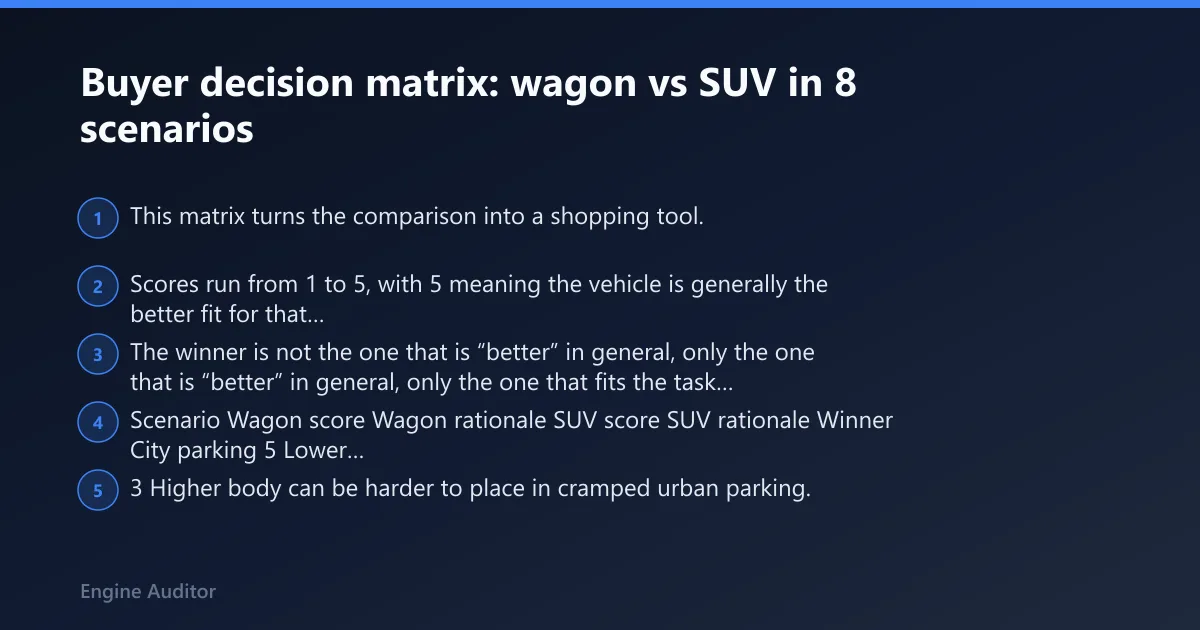
This matrix turns the comparison into a shopping tool. Scores run from 1 to 5, with 5 meaning the vehicle is generally the better fit for that scenario. The winner is not the one that is “better” in general, only the one that fits the task more cleanly.
| Scenario | Wagon score | Wagon rationale | SUV score | SUV rationale | Winner |
|---|---|---|---|---|---|
| City parking | 5 | Lower roofline and car-like proportions are easier in tight garages and curb spaces. | 3 | Higher body can be harder to place in cramped urban parking. | Wagon |
| Highway commuting | 5 | Lower stance and more aero-friendly shape usually feel calmer and more efficient. | 3 | Upright shape can feel less settled and often creates more drag. | Wagon |
| Child-seat loading | 3 | Lower load height helps, but the lower roof can still make reach awkward. | 5 | Higher ride height can make lifting a child seat less awkward. | SUV |
| Winter roads | 3 | Often fine for plowed roads and winter tires, but clearance is still the limiting factor. | 5 | Higher ground clearance and common AWD or 4WD help in snow and slush. | SUV |
| Cargo hauling | 4 | Long roof and lower floor work well for flat, long, or awkward items. | 4 | Taller opening helps with bulky cargo and stacked boxes. | Tie |
| Fuel cost | 5 | Lower body and better aero usually help at the pump. | 2 | Taller shape and added mass often cost more to run. | Wagon |
| Visibility | 3 | Good forward sightlines, but less height over traffic. | 5 | Higher seating gives a more commanding road view. | SUV |
| Resale expectations | 3 | Niche demand in many markets can narrow the buyer pool. | 5 | Broader demand usually helps resale liquidity. | SUV |
How to use the matrix without overthinking it
If the wagon wins the rows that matter most, do not let SUV demand talk you out of it. If the SUV wins on the rows tied to your real commute, winter, or family routine, that higher body is worth the trade-off. The right answer is the one that matches the weekly routine, not the showroom image.
Frequently asked questions
What is the difference between a wagon and an SUV?
A wagon is a long-roof passenger car with an extended cargo area and usually a lower ride height. An SUV is taller, more upright, and generally offers more ground clearance. The practical difference shows up in step-in height, loading ease, and how the vehicle handles rough roads.
Is a wagon better than an SUV for daily driving?
For many commuters, that can be true. A wagon is often easier to park, more efficient on fuel, and more car-like at highway speeds. An SUV makes more sense when daily use includes steep driveways, snow, or frequent child-seat lifting that benefits from the higher stance.
Do wagons have better fuel economy than SUVs?
Usually yes, because the lower roofline and smaller frontal area help reduce drag. Exact results depend on engine, drivetrain, and tire choice, so a specific SUV can beat a thirsty wagon, but body shape gives the wagon a natural advantage in many comparisons.
Are wagons cheaper to buy than SUVs?
Sometimes, but not always. In some markets wagons are priced lower because demand is narrower; in others, a wagon can carry a premium if it is tied to a luxury or performance trim. Buyers should compare the exact trim, not assume the body style alone decides price.
Which is easier to park, a wagon or an SUV?
A wagon is usually easier to park because it sits lower and feels less bulky in tight spaces. The lower roofline also helps in garages with limited clearance. An SUV can still park fine, but the taller body is more noticeable in crowded lots.
Can a wagon handle light snow or rough roads?
Yes, many can handle light snow or rough pavement, especially with winter tires and available AWD. The limit is ground clearance, not just traction. If the route includes deep ruts, unplowed snow, or steep driveways, an SUV usually has the better margin.
Products related to this article
Sponsored / affiliate links. As an Amazon Associate I earn from qualifying purchases. I may earn additional commission from eligible campaigns.