Which Vehicle Type Is Best for Tall Drivers?
For many tall drivers, a full-size SUV or full-size pickup can fit well because these vehicles often offer generous legroom, seat travel, and higher hip points. A full-size sedan is the next choice if you want a lower roofline. Poor fit means cramped knees, blocked sightlines, and fatigue on longer drives. This guide matches tall-driver body shape and use case to the vehicle type most likely to fit.
Minivans are often the best overall fit when entry height matters as much as space. If you want an easy step-in, generous front space, and room for an upright posture, start there. If you care more about towing, cargo height, or a higher eye line, a full-size SUV or pickup can be the better first pass.
Top pick for most tall drivers
Quick picks
- Longest torso: minivan or full-size SUV, because roof height and upright seating usually leave more usable headroom.
- Longest legs: full-size pickup or large sedan with strong front legroom and long seat travel.
- Mixed proportions: minivan, because seat height, roof clearance, and steering reach are easier to reconcile.
- City parking: hatchback or sedan, if the cabin still offers enough seat travel and the roofline does not pinch your head.
- Frequent passengers: minivan or three-row SUV, since the driver seat can stay tall without forcing a cramped wheel position.
Quick picks by body type
Do not shop by height alone. A 6-foot-4 driver with a 34-inch inseam can need a different cabin than a 6-foot-4 driver with a long torso and shorter legs. The best vehicle type depends on where your body needs space: above the seat, in front of it, or around it.
Long torso: prioritize headroom and roofline shape
If your torso is long, focus on front headroom, the lowest seat setting, and whether a moonroof reduces usable clearance. A taller roofline helps more than a longer hood. Minivans and many SUVs usually work better than low sedans because the driver can sit upright without brushing the headliner.
Long legs: prioritize seat travel and front legroom
If your legs are long, seat travel often matters more than headline cabin size. Front legroom is the pedal-to-seatback space, but the rail length is what decides whether you can move far enough back and still reach the wheel. Full-size pickups, some large sedans, and a few SUVs handle this best.
Frequent city parking: prioritize easier ingress and a shorter hood line
If you live with tight parking and short curbs, a lower step-in and a shorter hood can matter more than maximum room numbers. Hatchbacks and sedans can be easier to place in traffic, but only if the seat drops low enough and the roofline does not force a slouched driving posture.
Tall-driver fit matrix
This matrix translates body shape and use case into the vehicle type most likely to fit. Use it as a filter before you compare individual models. The useful numbers are the ones that affect your driving position, not the exterior footprint.
| Body type or use case | Best vehicle type | Headroom | Legroom | Seat travel | Entry height | Visibility | Common deal-breakers |
|---|---|---|---|---|---|---|---|
| Long torso, upright seating | Minivan | Usually strongest | Strong | Often wide | Easy | Good forward view | Moonroof trim, high seat cushion, bulky overhead console |
| Long legs, feet-forward posture | Full-size pickup | Strong | Strong | Often wide | High | High eye line | High floor, stiff step-in, wheel that does not telescope far enough |
| Balanced torso and legs | Full-size SUV | Strong | Strong | Moderate to wide | Moderate | Good | Sunroof penalty, center console intrusion, lower seat travel in some trims |
| Long torso, lower step-in need | Large sedan | Moderate to strong | Often strong | Varies | Low | Good on the highway | Low roofline, fixed cushion angle, reduced headroom with moonroof |
| Short trips, city parking | Hatchback | Mixed | Mixed | Often limited | Easy | Good around town | Low ceiling in sporty trims, short seat rails, rearward visibility |
| Family hauling with frequent entry/exit | Minivan | Strong | Strong | Wide | Easy | Strong | Power sunroof, console bulk, seat cushion that sits too high for some drivers |
How to read the matrix
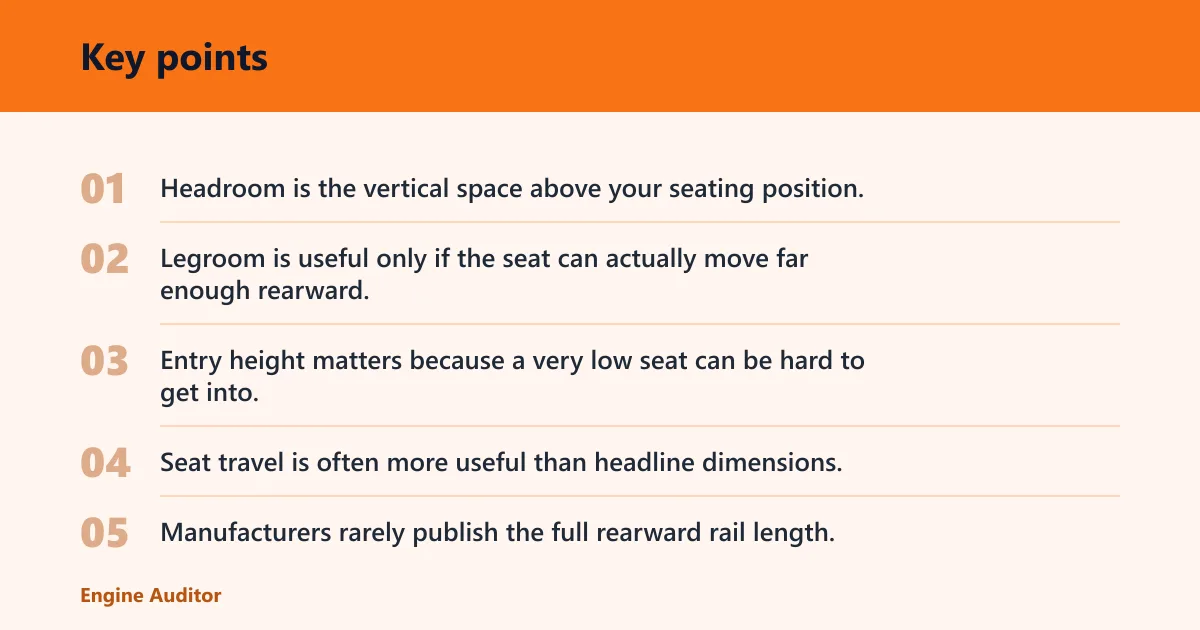
Headroom is the vertical space above your seating position. Legroom is useful only if the seat can actually move far enough rearward, and the steering wheel still reaches you. Entry height matters because a very low seat can be hard to get into, while a very high floor can force your knees up toward the wheel.
Seat travel is often more useful than headline dimensions. Manufacturers rarely publish the full rearward rail length, yet that range is what decides whether tall legs can stretch without pushing the wheel too close. Telescoping wheel range must match that seat position, or you end up choosing between bent knees and overextended arms.
Common deal-breakers by body type
Long torsos usually lose out to moonroof hardware, a low roofline, or a seat that cannot drop low enough. Long legs usually lose out to a high center console, a high floor, or a wheel that does not telescope far enough. Broad shoulders can also suffer in cars with narrow seats or a center stack that crowds the right knee.
Suppose a 6-foot-3 driver fits in a sedan with the seat all the way down, but the sun visor or roof liner still brushes the hairline over a dip. That is a headroom failure, not a legroom failure, and a taller roof or different trim is the fix. A different driver of the same height may have no problem there if the legs are the limiting factor instead.
Are SUVs better for tall drivers?
SUVs help many tall drivers because they usually place the seat higher, give a better outward view, and make entry easier than a low car. They are not automatic winners, though. A high floor, a short seat rail, or a moonroof trim can make an SUV worse than a well-packaged sedan.
Where SUVs help
An upright seating position often works well for tall torsos because the driver can sit higher without needing a deep recline. The door opening is usually easier to step into, and the higher hip point can improve visibility over traffic. AutoTechSpot lists the Hyundai Santa Fe Hybrid at 41.1 inches of front headroom and 44.4 inches of front legroom, numbers that show why some SUVs fit well on paper.
Where SUVs fail
Some SUVs have a high floor that forces the knees up, which can bother long-femur drivers even when the roof is tall. Roof hardware can also cut usable headroom. The trim with the biggest outside dimensions may still disappoint if the seat cushion sits too high or the wheel does not come back far enough.
Are sedans or hatchbacks better for tall drivers?
A sedan can fit surprisingly well when it has strong front legroom, a low seat cushion, and a telescoping wheel that comes back far enough. Hatchbacks can do the same, with easier entry than a low coupe and more upright seating than many sporty sedans. The drawback is the roofline: it can become the limiting factor fast.
When a sedan can fit surprisingly well
Some sedans package tall-driver space efficiently. The same source lists the Honda Accord at 39.5 inches of front headroom and 42.3 inches of front legroom, while the Toyota Camry Hybrid is listed at 38.3 inches of front headroom and 42.1 inches of front legroom. Those figures show that a sedan can offer usable front space even without SUV height.
When a low roofline becomes a problem
Low rooflines matter most for long torsos and drivers who sit upright. A moonroof can reduce usable headroom further, even if the published number looks acceptable in a base trim. If your hair brushes the liner before the wheel is in the right place, the car is too low for your body, regardless of badge or size class.
A common first-timer mistake is setting the wheel first and then moving the seat. That often creates a fake fit. Seat first, wheel second, then confirm that your knees stay clear when you press the pedals and that your shoulders are not reaching for the rim.
Why minivans often fit the tallest drivers best
Minivans often stand out because they combine low step-in, tall roof clearance, and wide seat travel in a way that can suit a range of body types. The driver can sit upright without losing headroom, and the entry height is easier than most SUVs. If you need one vehicle that works for tall parents, tall commuters, and regular cargo duty, this body style is hard to beat.
Low step-in plus high roof clearance
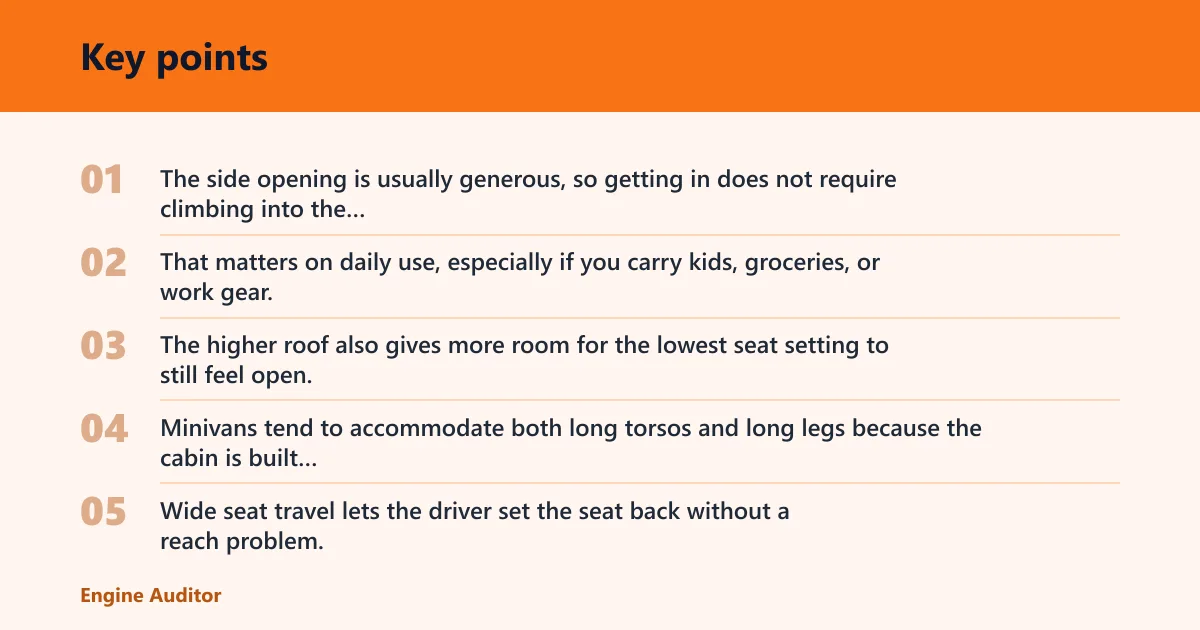
The side opening is usually generous, so getting in does not require climbing into the seat or dropping down into it. That matters on daily use, especially if you carry kids, groceries, or work gear. The higher roof also gives more room for the lowest seat setting to still feel open.
Why seat travel and upright seating help mixed body types
Minivans tend to accommodate both long torsos and long legs because the cabin is built around passengers rather than styling. Wide seat travel lets the driver set the seat back without a reach problem, and the wheel usually has enough adjustment to match. That reduces the chance of a forced compromise between knee room and arm reach.
Which truck body styles fit tall drivers best?
Pickups often fit tall drivers well because they usually offer a high hip point, good outward visibility, and enough room for long legs in full-size cabs. They are not perfect. Ride height can make entry harder, and some trucks place the pedals, console, and steering wheel in ways that work better for one tall body type than another.
Pickup strengths: headroom, seat height, and visibility
Truck cabins often give a high eye line and a useful amount of vertical space. U.S. News says the Lincoln Navigator has “Perfect Position Seats,” and while that is an SUV example, it shows how high-seat vehicles are often tuned for comfort in the tall-driver market. iSeeCars also says it studied how much front headroom a car offers and combined it with torso measurements, which is the right way to think about fit.
Pickup trade-offs: seat-to-pedal relationship, ride height, and cabin step-in
Full-size pickups can be excellent for long legs, but the high floor can make the knees sit higher than expected. That can matter on longer trips. If the seat base is tall but the wheel does not telescope enough, you can end up too close to the pedals or too far from the rim.
How to choose the right vehicle type for your body
Start with your body proportions, then match them to the cabin layout. Long torso points you toward roof height and seat height adjustment. Long legs points you toward rearward seat travel and pedal clearance. Broad shoulders point you toward seat width and a center stack that does not crowd the right knee.
Use the same seat-and-wheel setup on every test drive
Set the seat to your normal driving height first. Then adjust the wheel after the seat. Check whether the wheel still reaches your hands without pulling your shoulders forward, and see whether your knees stay clear of the rim and center console. That sequence gives you a fair comparison across body styles.
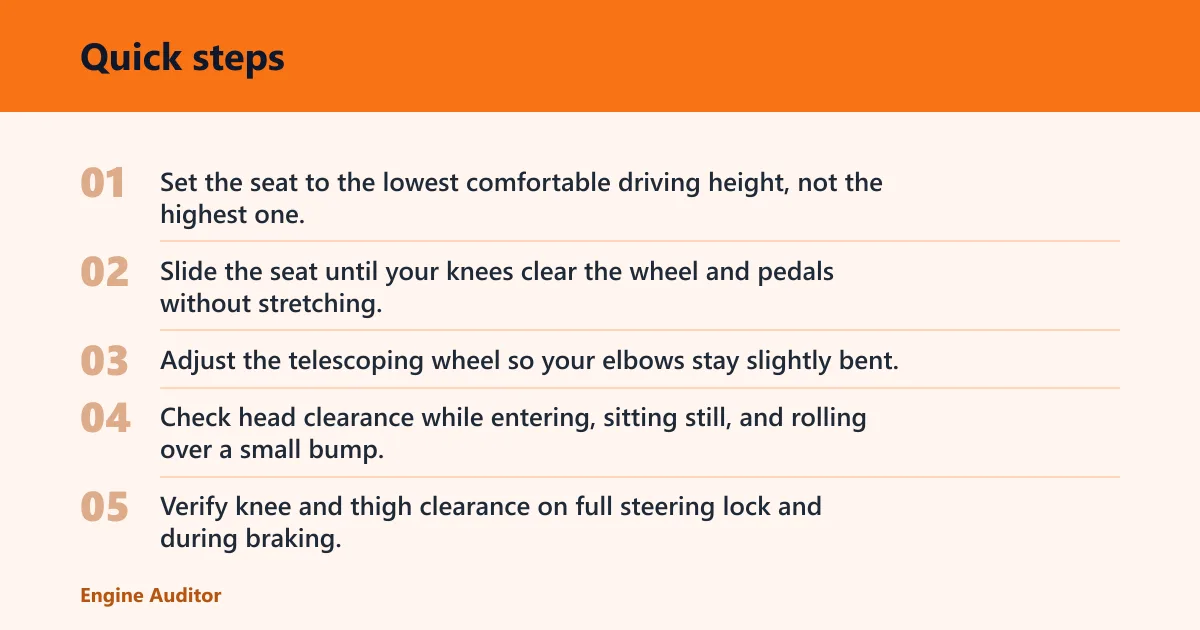
- Set the seat to the lowest comfortable driving height, not the highest one.
- Slide the seat until your knees clear the wheel and pedals without stretching.
- Adjust the telescoping wheel so your elbows stay slightly bent.
- Check head clearance while entering, sitting still, and rolling over a small bump.
- Verify knee and thigh clearance on full steering lock and during braking.
- Open the sunroof or moonroof trim only if you plan to buy that exact configuration.
Check head clearance over bumps and knee clearance on full lock
Static fit is not enough. A seat can feel acceptable in the showroom and still touch the headliner over a dip or driveway. Likewise, knees can look fine until the wheel is turned and the driver’s side thigh contacts the rim or the console.
Do not assume a bigger vehicle will fit better. Interior dimensions matter more than exterior length, and body style can beat size. AutoTechSpot’s numbers for the Santa Fe Hybrid, Accord, Camry Hybrid, and Forester show that a well-packaged cabin can offer serious room without relying on the largest footprint.
Frequently asked questions
What cars are best for tall people?
The best cars for tall people are usually the ones with strong front headroom, generous seat travel, and a telescoping wheel that matches the driving position. Full-size SUVs, minivans, and some full-size pickups are common fits, but a well-packaged sedan can also work if the roofline and seat adjustment are generous.
What vehicle type is best for tall drivers?
For many tall drivers, a full-size SUV or minivan is often a strong choice, with a full-size pickup also worth considering if high seating and visibility matter. The right answer depends on body shape. Long torsos need roof space; long legs need seat travel and legroom.
Which SUV has the most headroom for tall drivers?
There is no single SUV that wins every trim and market, because moonroofs, seat bases, and trim packages can change usable space. The better way to shop is by front headroom at the exact trim you want, then by seat travel and wheel reach. Published numbers are only part of the fit.
Are sedans or SUVs better for tall people?
Neither body style wins automatically. SUVs usually help with entry height and a taller seating position, while sedans can offer strong legroom and a lower, more car-like driving feel. A sedan with enough headroom can fit better than a poorly packaged SUV with a high floor or limited seat travel.
What should tall drivers test before buying a car?
Test the lowest seat setting, the full rearward seat position you would actually use, and the wheel after the seat is set. Then check head clearance over bumps, knee clearance at full lock, and thigh clearance under the wheel. If a moonroof trim is on the lot, test that exact version too.
Do sunroofs reduce headroom for tall drivers?
Yes, they often do. A sunroof or moonroof can reduce usable headroom because the hardware and roof structure take space away from the cabin. The penalty may not appear as a separate figure on every spec sheet, so tall drivers should compare the roofed and non-roofed trims before deciding.
Products related to this article
Sponsored / affiliate links. As an Amazon Associate I earn from qualifying purchases. I may earn additional commission from eligible campaigns.