Which Vehicle Type Is Best for Fuel Economy?
For the lowest fuel cost, a hybrid compact sedan or hatchback is usually the best all-around pick. If your driving is mostly highway, a diesel or efficient non-hybrid sedan can match it. SUVs and pickups usually cost more to fuel. Pick the wrong body style and fuel spend climbs fast, especially with heavy crossovers, three-row SUVs, and short-trip driving. This guide matches vehicle type and powertrain to city, highway, and family-hauling use cases, with the fuel-cost tradeoffs that matter.
What fuel economy number should you trust?
Use Natural Resources Canada ratings first. They list fuel consumption in L/100 km, and lower numbers are better. The page you compare should show city, highway, and combined values, because the same vehicle can look efficient in one setting and ordinary in another.
L/100 km versus mpg
Canada’s official format is L/100 km, not mpg. A simple conversion rule is to divide 235 by the L/100 km figure. That makes it easier to compare Canadian ratings with U.S.-style MPG claims, but the original Canadian numbers still matter most for local shopping.
Example: the Toyota Corolla hatchback is shown at about 6.7 L/100 km combined, and the Hyundai Elantra can reach up to 7.0 L/100 km combined. Those are close figures, which is why body style, cargo needs, and route type matter as much as the badge on the trunk.
City, highway, and combined ratings
City numbers reward stop-and-go efficiency, where hybrids often do well. Highway numbers reward steady-speed operation. Combined numbers sit between them, so they help with broad comparison, but they do not tell you enough if your drive is mostly urban congestion or long-distance travel.
A compact car that looks average in combined ratings can still be the best fit if it spends most of its time on short trips, where a hybrid system can save more fuel than a gas-only car.
Why vehicle type changes fuel use
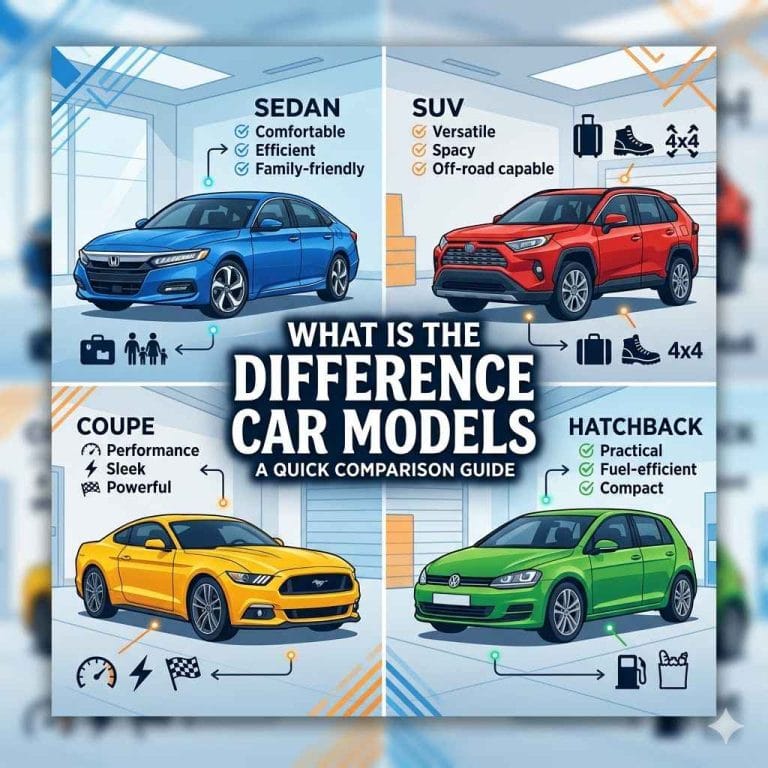
Body style changes fuel use because weight, height, and shape all affect how hard the engine must work. Smaller, lower vehicles usually need less fuel than larger ones. That is why hatchbacks and compact sedans remain strong choices, while SUVs and most crossovers usually pay a fuel penalty.
Weight and frontal area
Heavier vehicles need more energy to get moving, and taller vehicles push more air. A crossover often shares car-based architecture with a sedan or hatchback, yet its higher ride height and larger body still add drag and weight. That usually means more fuel burned for the same route.
Aerodynamic drag above highway speeds
Drag rises sharply as speed climbs. For most conventional petrol cars, fuel economy tends to get worse as highway speed increases. That is why the highway gap between body styles often widens.
That is why the highway gap between body styles often widens. A low sedan often slips through the air better than a tall SUV, while hatchbacks and sedans can both do well depending on their design.
Roof racks and open windows can worsen the bill. Add a box on top of a crossover, and the shape penalty grows. Load the cabin heavily, and the engine must move more mass even if the route does not change.
Fuel economy matrix
This decision table ranks vehicle types by use case, not by one universal winner. Scores use a 1-to-5 scale, with 5 indicating the best fuel savings or practicality and 1 indicating the weakest. Higher purchase price impact means a larger upfront cost.
| Vehicle type | City driving score | Highway driving score | Purchase price impact | Cargo practicality | Fuel-cost risk |
|---|---|---|---|---|---|
| Hybrid hatchback or hybrid sedan | 5 | 4 | 2 | 3 | Low for city, medium for highway |
| Gas hatchback | 4 | 4 | 4 | 4 | Low to medium |
| Gas sedan | 4 | 4 | 4 | 3 | Low to medium |
| Crossover | 3 | 3 | 3 | 4 | Medium |
| SUV | 2 | 2 | 3 | 5 | High |
| Diesel sedan or diesel wagon | 2 | 5 | 2 | 3 | Low on long highway trips |
Scenario recommendations: For a commuter with short, stop-and-go trips, start with a hybrid hatchback or hybrid sedan. For a family that needs cargo room, a hatchback or compact crossover is usually the better compromise. For a long-distance driver, a low-drag sedan or diesel highway model can keep fuel spend down.
- Check your split between city and highway driving.
- Pick the body style that fits cargo needs without overbuying size.
- Compare city, highway, and combined L/100 km ratings, not just one number.
- Look at transmission type, since CVT setups often help efficient compact cars stay in a lower-consumption band.
- Account for roof racks, winter tires, heavy loads, and towing before deciding.
Which vehicle type is best for city driving?
Hybrids usually win in city use because stop-and-go driving lets the electric motor do more work and reduces wasted fuel at idle. If you want a gas-only vehicle, a hatchback or compact sedan is usually next best. SUVs lose ground in traffic because they carry more weight and push more air.
Hybrids for stop-and-go use
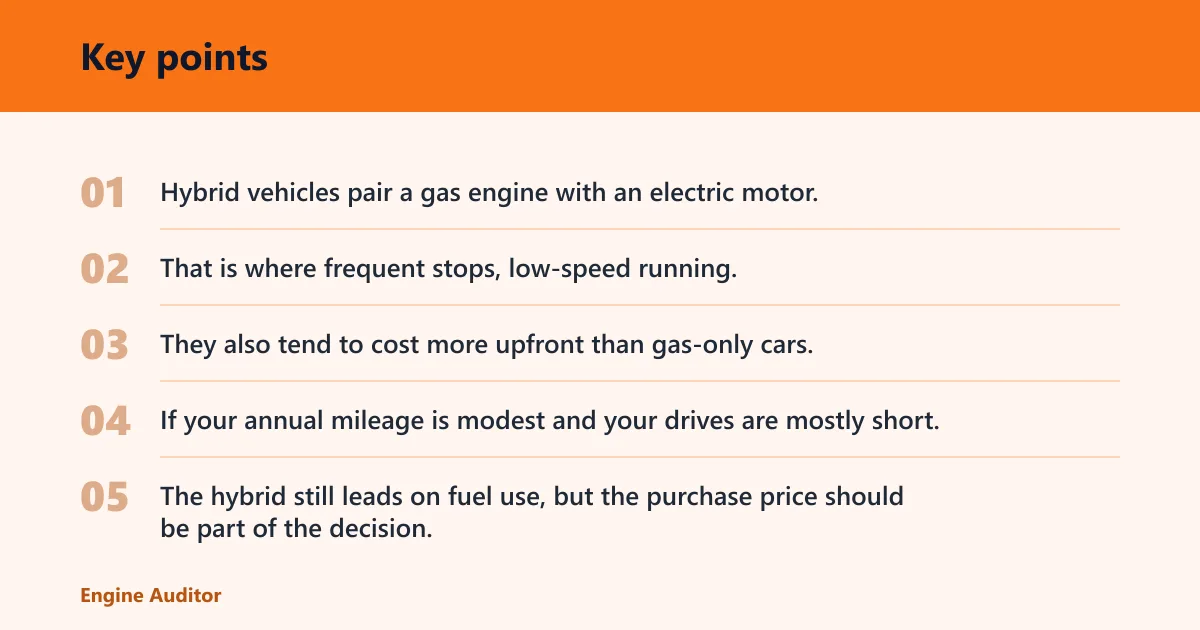
Hybrid vehicles pair a gas engine with an electric motor, and their strongest efficiency advantage usually appears in city driving and short-trip use. That is where frequent stops, low-speed running, and brief engine-off periods can cut fuel use the most. They also tend to cost more upfront than gas-only cars.
That upfront cost matters. If your annual mileage is modest and your drives are mostly short, the fuel savings may be real but slower to repay. The hybrid still leads on fuel use, but the purchase price should be part of the decision.
Hatchbacks and compact sedans
For gas-only buyers, hatchbacks and compact sedans are the main fuel-saving body styles. The compact and hatchback segments still have solid fuel-efficient options at reasonable prices. The Toyota Corolla hatchback remains one of the fuel-efficient compact cars in Canada without hybrid hardware, and hatchbacks can be a practical choice for buyers who need cargo flexibility without stepping up to an SUV.
The Corolla hatchback combines a practical body shape and lighter weight compared with an SUV. That shape helps on both city and highway routes, and the cargo area can still handle daily errands better than many sedans of similar size.
Why SUVs lose ground in traffic
SUVs sit higher, weigh more, and usually carry more frontal area. That combination hurts city fuel use because every stop requires more energy to get the vehicle moving again. A crossover softens the tradeoff slightly, but it still gives up efficiency to packaging and size.
Say your commute is 12 miles each way with heavy traffic and several stops. A hybrid sedan or hatchback will usually use less fuel than a small SUV on the same route, even if the SUV has a similar combined rating on paper.
Which vehicle type is best for highway fuel economy?
On highway routes, low drag matters more, so sedans and hatchbacks often lead among gas-only cars. A diesel can make sense for long motorway use because it often does better at steady speed, but it is less common in compact passenger cars in Canada and should be treated as a niche choice. Higher diesel fuel prices in some regions, emissions-system complexity, and shrinking passenger-car availability also make it a less straightforward buy.
Sedans and hatchbacks at steady speed
Sedans are a benchmark for compact-segment fuel economy because they are usually lower and more streamlined than taller body styles. Many are paired with a CVT or an efficient automatic transmission, which often helps economy in steady cruising and moderate-speed traffic.
Hatchbacks can match that efficiency closely while adding cargo flexibility. Their body shape can help reduce drag, and that matters more as road speed rises.
Where diesel can make sense
Diesel can be a smart answer if your mileage is concentrated on long, steady trips. Its highway efficiency advantage is more noticeable on long motorway journeys than on short urban runs. It is less appealing if your driving includes lots of cold starts, short errands, or low-speed congestion.
Suppose weekly driving is mostly one long highway loop of about 500 km with little city time. A diesel sedan may deserve a closer look than a crossover, because the highway profile lets its strengths matter more than its drawbacks.
Why drag matters more above about 60 mph
Air resistance rises fast at highway speeds. That is why the fuel gap between a sedan and an SUV often widens as speed climbs. Open windows can make it worse, and roof racks add another penalty because they disturb airflow on top of the vehicle.
How do hatchbacks, sedans, crossovers, and SUVs compare?
Hatchbacks usually give the best mix of non-hybrid fuel economy and cargo flexibility. Sedans often edge them in drag control, but hatchbacks can close the gap while offering a taller cargo opening. Crossovers trade some efficiency for packaging. SUVs usually give away the most fuel economy, though they provide the most space.
Hatchback advantages and limits
A hatchback is often lighter than many SUVs and can be easier to park and move through traffic. Its cargo area is flexible, which is why it remains a strong compact-segment option for buyers who want utility without stepping up to a larger body style.
The limit is simple: when size grows, efficiency usually falls. A hatchback can be efficient, but a very large hatch with all-wheel drive and heavy equipment will not behave like a small front-drive compact.
Sedan efficiency benchmark
Sedans are the clean benchmark in many compact showrooms because their lower drag helps fuel economy without demanding hybrid hardware. They are available in compact, midsize, and full-size classes, and efficient transmission tuning often helps them hold a good combined rating.
Crossover tradeoff
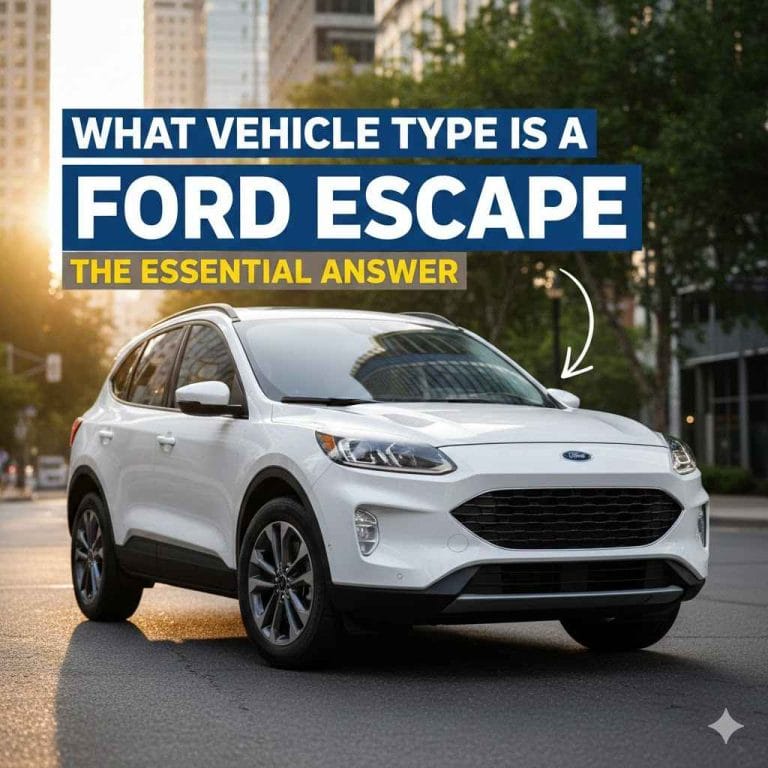
Crossovers use car-based architecture, so they are often easier to drive and more efficient than a traditional body-on-frame SUV. Even so, they usually are not as efficient as the most efficient small cars. A crossover can beat a small SUV, but it still rarely beats a compact hatchback or sedan on fuel use.
SUV penalty
SUVs usually carry the highest fuel cost among these body styles because of ride height, weight, and frontal area. That does not make them wrong for everyone. It does mean you should buy one for space, towing, or seating needs, not because it will be the cheapest thing to fuel.
How much do hybrids and diesels change the answer?
Hybrids usually shift the answer most in city use, while diesels shift it most in highway use. If you drive short trips in traffic, the hybrid advantage can be large. If you spend most of your time on long intercity routes, a diesel sedan can move closer to the top of the list.
Hybrid city advantage
Hybrid vehicles usually have the biggest fuel-saving edge in stop-and-go traffic because the electric motor reduces the load on the gas engine. That makes them especially attractive for commuters, delivery-style driving, and short errands where the engine never settles into its most efficient pattern for long.
Does a hybrid always get better fuel economy than a gas car? No. In a long, steady highway trip, an efficient gas sedan or hatchback can close the gap a lot, and some diesel cars can do even better on that specific route. The hybrid still wins many city cases, but it is not a universal answer.
Diesel highway advantage
Diesel’s main edge is highway efficiency. It is often better than gasoline at steady speed, and that matters most when the trip is long and the vehicle stays loaded lightly. In compact passenger cars in Canada, though, diesel is uncommon enough that it should be compared carefully against efficient gas and hybrid alternatives.
When upfront cost changes the math
Higher purchase price can erase some fuel savings if your annual distance is low. That is why the cheapest vehicle to fuel is not always the cheapest vehicle to own. A hybrid may use less fuel, but a gas hatchback or sedan can still make sense if you drive fewer kilometres and want lower entry cost.
A common first-timer mistake is to compare only the combined rating and ignore cargo, tires, and route type. A compact crossover may look close on paper, then lose ground once winter tires, roof cargo, and repeated cold starts enter the picture.
Frequently asked questions
What is the best fuel economy car?
There is no single best answer for every driver. For low fuel cost in mixed use, a hybrid compact sedan or hatchback is usually a strong all-around choice. If your driving is mostly highway, an efficient gas sedan or a diesel highway model can be competitive, especially over long distances.
What cars are good on fuel
Hatchbacks, compact sedans, and hybrids are usually the best answers. Hatchbacks give you cargo flexibility with low weight, sedans usually cut drag well, and hybrids help most in traffic. The Toyota Corolla hatchback is a clear example of a gas-only compact that stays near the top of the class.
Which vehicle type gets the best gas mileage?
Among common body styles, compact hatchbacks and compact sedans usually return the best gas mileage without hybrid hardware. Hybrids can do better overall, especially in city use. SUVs and most crossovers usually sit lower because they are taller, heavier, and less aerodynamic.
Is a hatchback more fuel efficient than an SUV?
Usually yes. A hatchback is often lighter than many SUVs and has a body shape that tends to use less fuel. The gap grows at highway speed and with added cargo, roof racks, or winter conditions that increase resistance.
Are sedans better on fuel economy than crossovers?
Usually yes, especially at highway speeds. Sedans typically have less drag and less weight than crossovers, so they burn less fuel in similar use. A crossover may offer easier cargo loading and a taller seating position, but it usually gives up efficiency to get those benefits.
Does a hybrid always get better fuel economy than a gas car?
No. Hybrids usually have the biggest advantage in city driving and short trips, but an efficient gas sedan or hatchback can come close on steady highway use. Diesel can also beat many gas cars on long motorway journeys, though it is a niche choice in Canada.
Products related to this article
Sponsored / affiliate links. As an Amazon Associate I earn from qualifying purchases. I may earn additional commission from eligible campaigns.