Ford dealer service vs independent shop: which is better?
For a brand-new or warranty-covered Ford, dealer service is often the safer default. For an older Ford that is out of warranty, pick the shop that can prove Ford-specific tools, calibration access, and real experience. Choosing wrong can mean denied warranty claims, failed calibrations, repeat fault codes, and paying twice for the same repair. This guide covers warranty rules, software-heavy repairs, routine maintenance, pricing, and how to vet both options.
This guide is part of our Ford car maintenance guide series.
Ford dealer service vs independent shop: the real trade-off



Access versus price is the real trade-off. Ford dealer service is strongest when the job depends on factory software, warranty claim handling, recalls, or model-specific procedures. An independent shop usually wins on labor rate and flexibility for routine, non-electronic work, especially once the Ford is out of warranty.
| Decision factor | Ford dealer service | independent shop: which is better | Winner |
|---|---|---|---|
| Warranty and recall handling | Best fit for Ford warranty repair and Ford recall repair | May repair the vehicle, but cannot handle factory claim approval the same way | Ford dealer service |
| Software, programming, and calibration | Direct access to manufacturer software, bulletin libraries, and specialized procedures | Possible only if the shop has the right scan tools, subscriptions, and calibration equipment | Ford dealer service |
| Routine maintenance cost | Usually higher labor rate | Usually lower labor rate | independent shop: which is better |
| Parts flexibility | OEM parts availability and Ford parts channel | OEM, OEM-equivalent, or aftermarket parts | Tie |
| Quality consistency | Brand-specific training, but results still depend on the individual technician | Quality varies more by shop and technician | Ford dealer service |
Warranty and recall handling
Dealer service wins here because Ford warranty repair is tied to the manufacturer, and Ford recall repair is performed at no charge at the dealership. That matters when coverage is active, because the wrong shop can leave the owner paying for work that should have been claimed.
Software, programming, and calibration
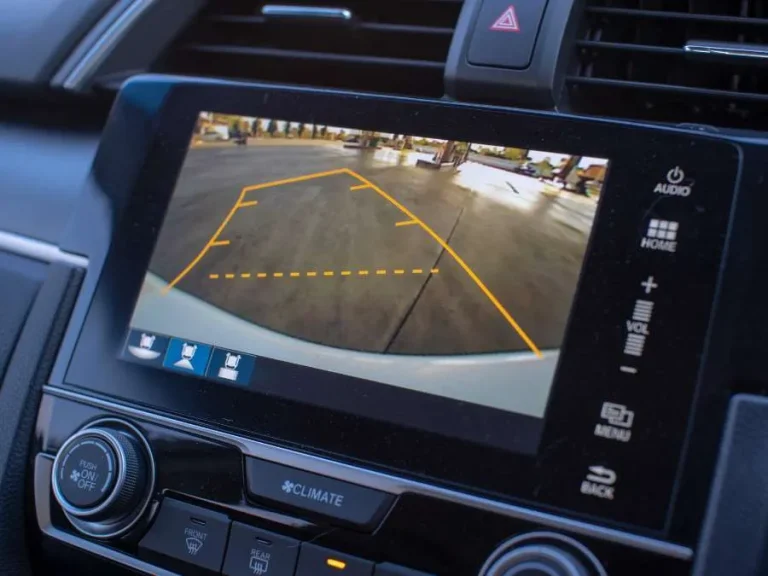
Ford dealer service often has direct access to manufacturer software updates, technical service bulletins, and the hardware needed for module-related work. Independent shops may be able to handle some of this, but they should be able to show they can do transmission relearn procedures, ADAS calibration, and key programming in-house.
Routine maintenance cost
Independent shops usually win on price because labor rates tend to be lower than dealerships. On simple work, that gap is obvious. On longer jobs, the difference grows because labor rate matters more than parts markup.
Parts choices
Dealer service usually stays close to OEM parts and Ford supply. Independent auto repair shops have more flexibility, including OEM, OEM-equivalent, and aftermarket parts. That can help on older vehicles, but it also means the owner should ask what brand is being installed and why.
Quality control and repeat repair risk
Dealer technicians have brand-specific training and access to Ford technical service bulletins, which lowers the risk of guessing on a known issue. Still, a strong independent shop can beat a weak dealership. The deciding factor is documented process, not the sign over the door.
When is Ford dealer service the right call?
Ford dealer service is the right call for warranty-covered repairs, recalls, and jobs that depend on Ford software or documented manufacturer procedures. It is also the safer choice when a complaint lines up with a technical service bulletin, because the dealer can check the bulletin library and apply the factory fix path.
Brand-new or warranty-covered Ford repairs
If the Ford is still under bumper-to-bumper warranty or powertrain warranty coverage, dealer service is usually the safe path. MechanicsRated says warranty-covered repairs must be done at an authorized dealer for coverage. That is the difference between a paid repair and a denied claim.
Recalls and safety campaigns
Ford recall repair belongs at the dealer. MechanicsRated says recalls are performed at no charge at the dealership, and Ford directs shoppers to find a dealer for service. If the vehicle has an open safety campaign, that is not the place to save a few dollars.
SYNC, module programming, and ADAS calibration
Anything involving SYNC, module updates, key programming, or ADAS calibration often belongs at the dealer unless the independent shop can prove the exact capability. MechanicsRated says software-dependent repairs can include transmission relearn procedures, ADAS calibration, and key programming. Missing a calibration step can leave the car driving poorly or lighting warning messages again.
Drivability problems tied to TSBs or software
Technical service bulletins matter when the car has a symptom the manufacturer already documented. Dealer technicians have direct access to TSBs, which helps when a rough shift, warning light, or intermittent fault matches a known Ford issue. That can shorten diagnosis and prevent parts swapping.
When is an independent shop the better value?
An independent shop is usually the better value for out-of-warranty routine maintenance and mechanical repairs that do not depend on factory software. Lower labor rates help most on common work like brakes, oil changes, batteries, tires, and filters, where the repair is straightforward and the shop does not need dealer-only access.
Oil changes, brakes, batteries, tires, and filters
Ford says Mobile Service can perform oil and filter changes, brakes, batteries, tire rotation, and more. That tells you these jobs are common enough to be handled outside a full dealership visit. An independent shop often does them for less, provided the parts quality is good and the technician follows the proper procedure.
Out-of-warranty repairs with no programming needs
Once the Ford is outside warranty and the fault is mechanical, the independent shop often wins on total cost. MechanicsRated says independent shops have lower labor rates and can source OEM, OEM-equivalent, or aftermarket parts. That makes them a strong fit for suspension work, leaks, exhaust issues, and many brake repairs.
Older Fords with simple mechanical faults
Older vehicles are more likely to need plain mechanical repair than dealer-specific software work. If the job is a belt, coolant leak, wheel bearing, or brake service, a good independent technician may be the most efficient choice. The key is confirming that the shop has experience with Ford packaging and torque procedures.
Jobs where a local technician already knows the vehicle
Long-term ownership often means keeping a vehicle for 150,000 miles or more. At that point, a familiar local shop can be an advantage because it knows the car’s history. That history helps when diagnosing repeat leaks, noisy driveline parts, or a slow battery drain.
Dealer vs independent: side-by-side comparison
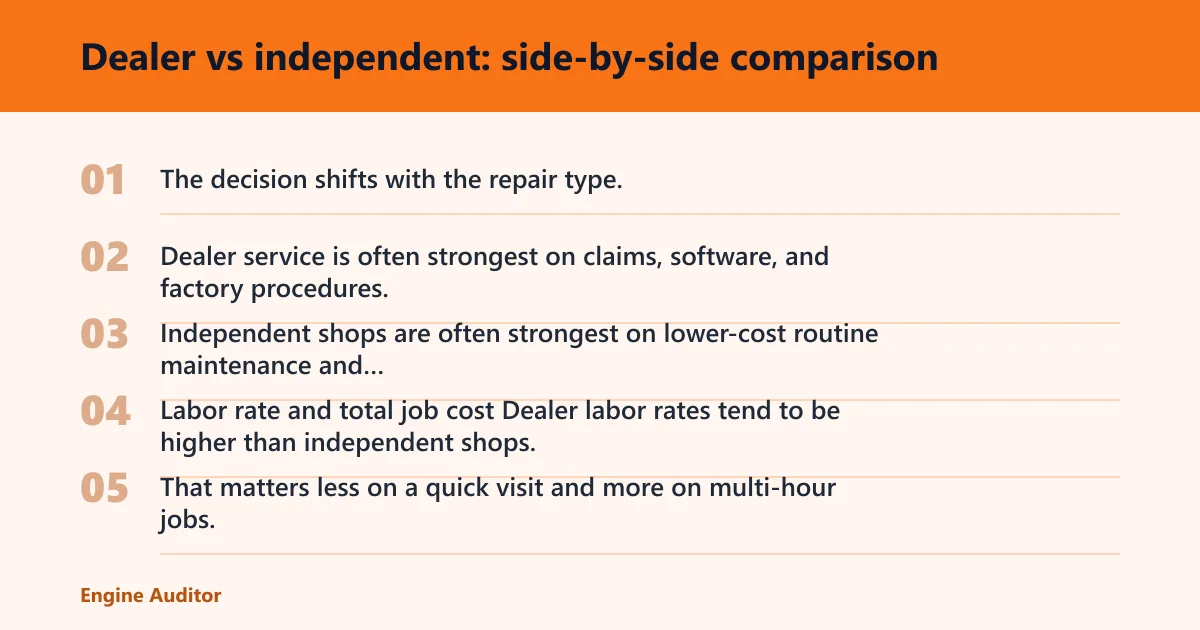
The decision shifts with the repair type. Dealer service is often strongest on claims, software, and factory procedures. Independent shops are often strongest on lower-cost routine maintenance and straightforward mechanical work, especially when the car is older and out of warranty.
Labor rate and total job cost
Dealer labor rates tend to be higher than independent shops. That matters less on a quick visit and more on multi-hour jobs. A brake job with pads, rotors, and fluid service can show a meaningful difference once labor time grows.
Parts choices and sourcing
Dealer service generally keeps the vehicle on OEM parts. Independent shops can choose among OEM, OEM-equivalent, and aftermarket parts. That flexibility helps with budget and availability, but it also means the owner should ask what is going on the car before approving the repair.
Software access and module work
Manufacturer software access is the divider. Dealer service connects directly to Ford’s update infrastructure, while an independent shop may or may not have that access. If the repair needs programming, relearn steps, or ADAS calibration, the shop must show it can complete the entire procedure, not just replace the part.
Warranty, recalls, and TSB access
Dealers are the natural home for warranty claims and recalls because the work is tied to Ford’s own approval process. They also have direct access to technical service bulletins. Independent shops can diagnose symptoms, but they do not have the same claim-handling role.
Quality control and repeat repair risk
Both shop types can do excellent work. Both can also miss a step. The risk drops when the shop documents the scan results, calibration steps, parts numbers, and final road test. Without that paper trail, repeat fault codes are more likely.
Ford service decision checklist
Use this checklist before you hand over the keys. It keeps the decision tied to the repair, not the badge on the building.
| Category | Dealer-only | Either, but verify tools | Independent-friendly |
|---|---|---|---|
| Recalls | Yes | No | No |
| Warranty status | Yes, for covered claims | No | No |
| SYNC/module programming | Often yes | Yes, only if the shop proves Ford software access | No |
| ADAS calibration | Often yes | Yes, only if the shop has calibration equipment and procedure access | No |
| Key programming | Often yes | Yes, only if the shop can program Ford keys in-house | No |
| Transmission relearn | Often yes | Yes, only if the scan tool supports Ford relearn steps | No |
| Brakes | No | Yes, if the shop uses correct parts and torque procedures | Yes |
| Batteries | No | Yes, if battery registration or reset is needed | Yes |
| Tires | No | Yes, if TPMS and rotation procedures are correct | Yes |
| Oil changes | No | Yes, if the shop follows Ford spec and filter procedure | Yes |
| Fluid services | No | Yes, if the shop knows the Ford fluid spec | Yes |
What should you ask before booking Ford service?
Ask for proof, not promises. A shop that truly knows Ford service can explain its scan tools, calibration access, and parts choices in plain language. If the answers are vague, the repair is probably better placed elsewhere.
- What scan tool and software do you use for Ford vehicles?
- Can you perform Ford programming and calibration in-house?
- Will you check for technical service bulletins before replacing parts?
- Can you document calibration results and relearn procedures?
- What warranty do you give on parts and labor?
- If the job fails a second time, who pays for the repeat diagnosis?
What proof should a shop show for Ford work?
Ask for the exact procedure, not just a yes. For module work, that means Ford-compatible software and the ability to finish the update. For ADAS, that means calibration targets, setup space, and final verification. For drivability complaints, that means a scan report and a bulletin check.
What a good answer sounds like
A credible shop can say whether the repair is routine, software-dependent, or calibration-heavy. It can also explain whether the car needs dealer access or can stay local. If the answer is “we do everything,” that is a red flag, not a selling point.
Choose Ford dealer service if… / choose independent shop: which is better if…
Choose Ford dealer service if the Ford is under warranty, has an open recall, needs a manufacturer-directed software update, or needs ADAS, key, or module programming. Choose an independent shop if the Ford is out of warranty and the job is routine, mechanical, or the shop can prove it has the right Ford-capable tools and calibration process.
Ford dealer service is the safer choice for warranty claims, recall work, and software-heavy diagnostics. An independent shop is the better value for routine maintenance and many out-of-warranty repairs when the technician can show real Ford competence.
Frequently asked questions
Should I take my Ford to the dealer or an independent shop?
Take a new or warranty-covered Ford to the dealer when the repair may involve claims, recalls, software updates, or a technical service bulletin. Take an older out-of-warranty Ford to an independent shop if the work is routine and the shop can prove it has the right scan tool, parts, and Ford experience.
Is dealer service better than independent mechanics for a Ford?
Dealer service is better for warranty, recall, and software-dependent repairs because it has Ford training, parts access, and claim handling. Independent mechanics are often better value for routine maintenance and simple mechanical repairs. The better choice depends on the job, not the badge on the building.
Does Ford warranty work have to be done at a dealer?
Yes, warranty-covered repairs are typically handled at an authorized dealer for coverage. That matters because the claim is tied to the manufacturer’s approval process. If the car is under bumper-to-bumper or powertrain coverage, dealer service is usually the safer path.
When is a Ford dealer the only right choice?
A Ford dealer is the only right choice for open recalls, warranty claims, and many programming-heavy repairs. That includes some module updates, key programming, and complex ADAS calibration work. It is also the best place to start when a complaint may match a technical service bulletin.
Which repairs are cheaper at an independent shop?
Independent shops are usually cheaper for oil changes, brakes, batteries, tires, filters, and many fluid services because labor rates are lower. That savings is most obvious on longer jobs. If the repair needs programming or calibration, the price gap can shrink fast.
Can an independent shop do Ford software or programming work?
Sometimes, yes, but only if the shop has the right Ford-compatible software, hardware, and procedure access. It must be able to complete the work, not just install the part. For transmission relearn, ADAS calibration, or key programming, ask for proof before authorizing the repair.
Are Ford mobile service appointments as good as dealer service?
Ford says Mobile Service can perform oil and filter changes, brakes, batteries, tire rotation, and more. That makes it a strong option for maintenance, but it is not the answer for every repair. Complex diagnostics, recalls, and programming work still belong at a full service department.
What should I choose for routine Ford maintenance?
For routine maintenance, choose the place that gives the best mix of price, correct parts, and documented service. An independent shop usually wins on cost. A dealer may be worth it if you want OEM parts, a factory service record, or the work overlaps with a recall or software concern.
Products related to this article
Sponsored / affiliate links. As an Amazon Associate I earn from qualifying purchases. I may earn additional commission from eligible campaigns.