Are Online Car Battery Reviews Trustworthy?
Online car battery reviews are only trustworthy when they include test data, vehicle fit, dates, and repeatable failure patterns; treat a battery as suspect if you cannot verify at least two of those four details. Weak reviews can point you to a battery that dies early, fits poorly, or lacks enough cold-cranking power for your climate. This guide gives you a simple checklist to separate lab tests, real owner reports, and review spam before you buy.
Can online car battery reviews be trusted?
Only partly. The useful ones show measurable results, the vehicle they fit, and the conditions behind the score. Star averages and short comments can still help spot obvious defects, but they are weak evidence unless you can tell whether the reviewer tested the same size, climate, and battery type you need.
What counts as evidence in a battery review
Good battery reviews often point to life-test results, reserve capacity, cold-cranking performance, and overall performance within group sizes. Those are checkable. A claim like “works great” tells you little unless it is tied to a test method, a battery date code, or a specific vehicle fit.
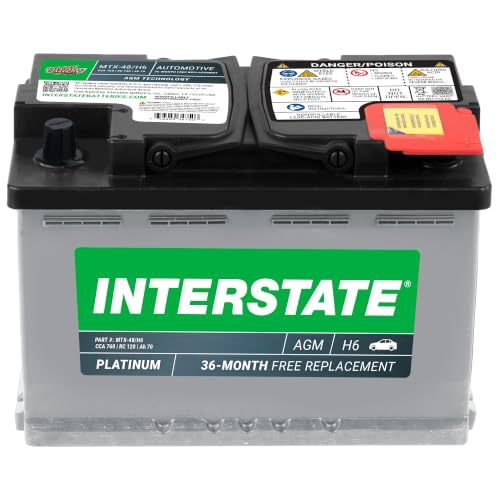
Suppose a review praises an H6 AGM battery for “strong performance” but never states the car, climate, or test method. That praise may still be true for that one car. It does not tell you whether the battery will fit your tray, survive winter cranking, or suit a start-stop system.
Why star ratings can mislead buyers
Star ratings compress too much into one number. They can be distorted by review bombing, seller incentives, or shoppers rating the shipping box instead of the battery itself. A five-star average says little if the sample is tiny, the batteries are old stock, or the reviewer never verified fitment.
Where expert tests usually outperform user comments
Expert testing usually beats anecdote when the review uses repeatable conditions and direct comparisons. A lab or buying guide can compare the same group sizes, separate reserve capacity from cold-cranking performance, and note when a model ranks high overall but weak on one metric that matters in your climate.
📊 Consumer Reports lists 124 car batteries in its ratings. Source: Consumerreports.
Battery review trust scorecard
Use this scorecard to audit any battery review before you believe the rating. Pass means the review gives enough detail to judge the claim. Fail means you should treat the score as weak evidence, even if the star count looks strong.
| Check | Pass | Fail | Notes |
|---|---|---|---|
| Test method | States how the battery was tested and what was measured | Uses vague praise or a star score with no method | Look for life-test results, reserve capacity, or cold-cranking performance |
| Sample size | Says how many batteries were reviewed or tested | Gives one review or a few comments as if they prove the model | Small samples can miss early failures and weak batches |
| Battery age at test | Lists the date code or age at sale or test | No date code, no age, no stock date | Freshness matters because battery age can affect performance before installation |
| Fitment match | Matches group size and terminal location to the vehicle | Reviews a battery without checking fit | Fitment is not optional; wrong layout can stop installation |
| Climate relevance | Explains hot-weather or cold-weather use | Ignores weather and driving pattern | Climate changes how you read CCA and life-test claims |
| Warranty clarity | Separates free replacement and prorated coverage | Mentions only the total warranty length | A long warranty can still hide weak service terms |
| Spec transparency | Lists group size, CCA, reserve capacity, and battery type | Leaves out the specs that drive the score | Specs let you compare batteries on equal footing |
| Conflict disclosure | States seller ties, affiliate links, or sponsorships | No disclosure and heavy sales pressure | Conflict does not prove bias, but hidden conflict should lower trust |
How to score a review fast
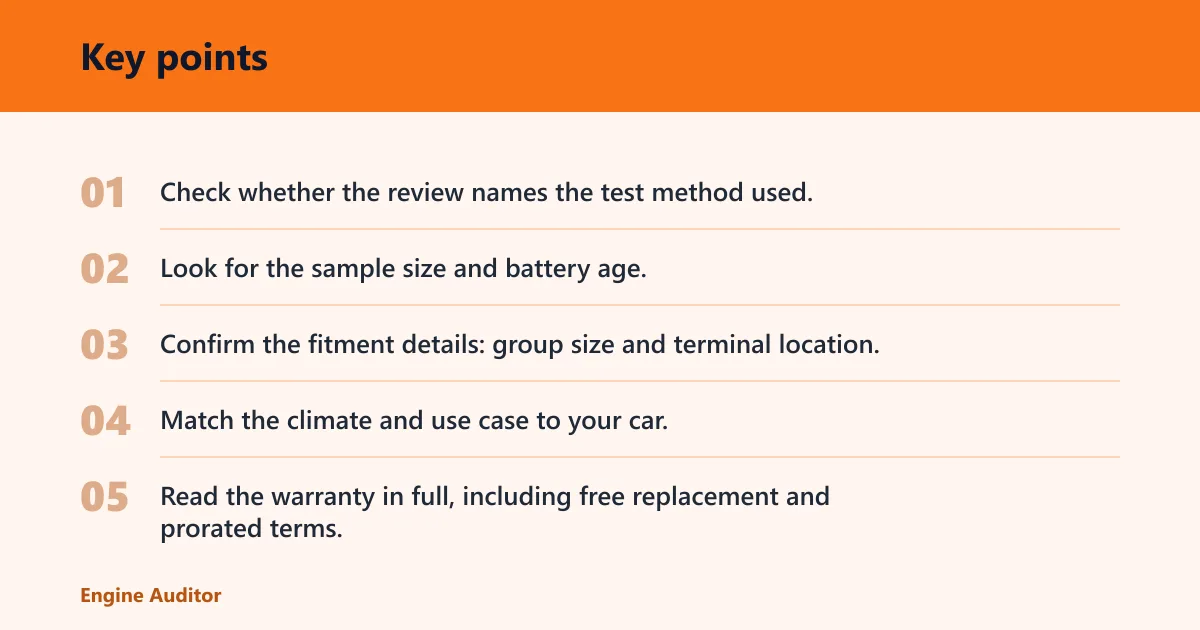
- Check whether the review names the test method used.
- Look for the sample size and battery age.
- Confirm the fitment details: group size and terminal location.
- Match the climate and use case to your car.
- Read the warranty in full, including free replacement and prorated terms.
- Look for conflict disclosure and spec transparency.
What good battery ratings actually measure
Strong battery ratings compare measurable outputs, not brand image. The best ones separate how long a battery lasts from how well it starts an engine and how much reserve power it has for accessories. That matters because one battery can score well in one category and fall short in another.
Life-test results and reserve capacity
Life-test results show endurance under repeated use. Reserve capacity tells you how long the battery can support electrical loads if charging drops or the alternator is stressed. A battery with solid reserve capacity may still age poorly in repeated cycling, so you want both measures, not one number alone.
Cold-cranking performance
Cold-cranking performance matters most when temperatures fall and the starter needs more current. This is where a battery can look fine in a mild climate and struggle in winter. If a review never states the testing temperature or the cold-cranking result, the rating is not very useful for cold-weather buyers.
A common first-timer mistake is buying a battery for a mild-climate sedan based on a high overall rating, then using it in a parked outside truck in a colder region. The battery may still be good, but the review never measured the condition that caused the hard starts.
Overall performance within group sizes
Overall ranking only works when batteries are compared within the right group size. Consumer Reports rates car batteries in order of overall performance within group sizes, which is the right way to avoid comparing apples to oranges. A strong battery in one size is not automatically the best choice for another size or terminal layout.
Can Consumer Reports car battery ratings be trusted?
Yes, as a comparison tool, not as a universal answer. The same source lists 124 car batteries in its ratings, uses a buying guide, and gives more weight to life-test results than to reserve capacity and cold-cranking performance. That makes it more useful than a star average, though membership access limits what you can see.
What 124 batteries rated means
That count suggests a broad comparison set, which helps you separate weak models from stronger ones inside the same group size. It does not mean every battery on the market is covered, and it does not replace fitment checks. It does mean the ratings are not built from a handful of comments.
How the buying guide helps
The buying guide gives context around recently tested models, battery types, and what matters most in the score. That context is useful because a battery can look average on one metric and still be a smart purchase for a specific vehicle or climate. The guide is where the score gets interpretation.
What membership access changes
Membership access matters because full details are behind the paywall. If you can only see a summary, you may miss the exact test notes, recent model coverage, or the explanation for why one battery ranks above another. A summary is helpful, but it is not the same as the full test record.
How to spot biased or weak battery reviews
Bias often shows up in the structure of the review, not only in the language. Watch for affiliate incentives, seller marketplace pressure, review bombing, and feedback loops where one bad batch triggers copycat complaints. Those patterns can drag down or lift up a rating without changing the battery itself.
Affiliate incentives and marketplace pressure
Sites that earn from referrals may favor batteries with higher commissions or easier returns. Marketplaces can push seller ratings above product evidence, which confuses shipping speed with battery quality. If a page spends more time selling than explaining test method, treat the score as marketing first and analysis second.
Review bombing and seller feedback loops
Review bombing can happen when a seller dispute or shipping delay floods the page with one-star posts. That does not always mean the battery is bad. It may mean the marketplace failed on fulfillment while the battery itself is unremarkable. Separate product failure from delivery failure before you trust the rating.
Missing test details and vague claims
If a review says “lasted forever” or “died in months” without age, climate, or use pattern, it is weak evidence. The same battery can fail early in a short-trip, high-load vehicle and last longer in a lightly used commuter car. Without details, you cannot tell which case the review describes.
What matters most in a battery review?
For most buyers, test method matters first, then fitment, then climate and age. CCA matters when cold starts are a concern. Reserve capacity matters when accessories and short trips are a problem. Warranty matters too, but it should never outrank performance data or battery freshness.
CCA versus reserve capacity
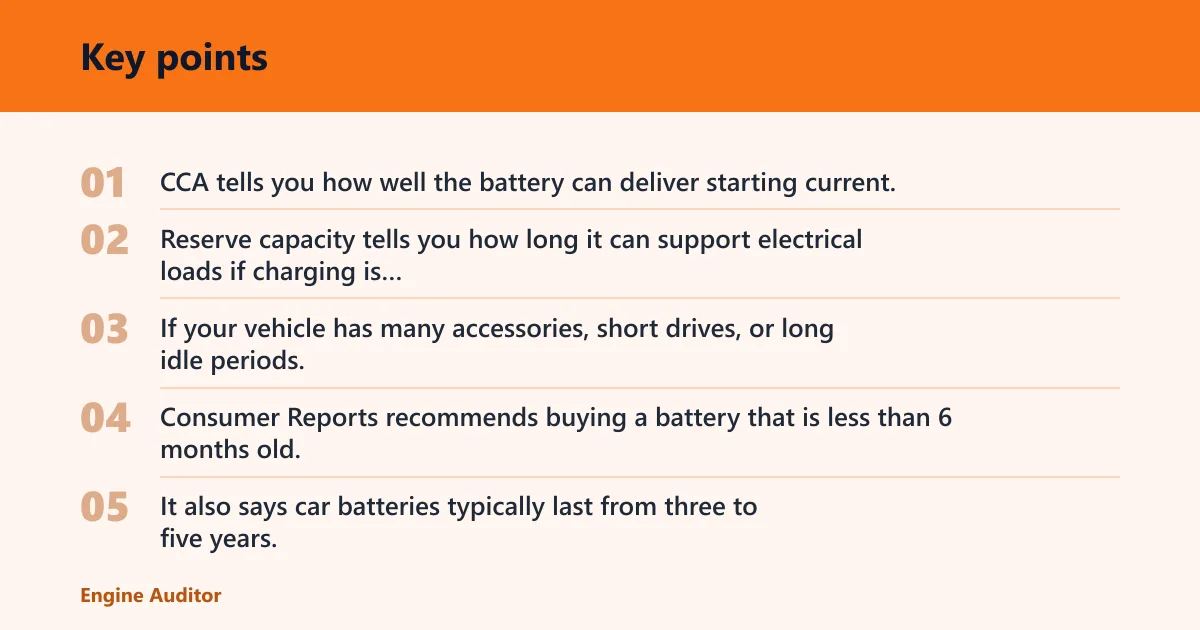
CCA tells you how well the battery can deliver starting current, especially in cold weather. Reserve capacity tells you how long it can support electrical loads if charging is limited. If your vehicle has many accessories, short drives, or long idle periods, reserve capacity may deserve more attention than a headline CCA number.
Why age and climate can matter more than averages
The same source recommends buying a battery that is less than 6 months old, and says 3 months is even better. It also says car batteries typically last from three to five years, with annual testing once the battery is 2 years old in warmer climates and once it is 4 years old in colder climates. Those timing rules matter because age and weather change how any rating should be read. (Consumerreports)
Say your car needs an H5 AGM battery and the store has two identical models. One has a fresh date code on top, the other has a side code showing it has sat longer. If both price the same, the fresher battery is the safer pick because storage age can erase part of the value before installation.
When warranty terms should change your choice
Warranty can help compare risk, but only if you read the structure. The same source gives an example warranty code of 24/84, which separates the free replacement period from the prorated period. A long total term with a short free replacement window may be less useful than a shorter warranty with stronger first-stage coverage.
What should you look for in a reliable car battery review?
Look for a review that gives the vehicle fit, the battery age, the test method, and the use case. Good reviews explain whether the battery is AGM or flooded lead-acid, whether it matches the terminal layout, and whether the claim comes from a test or from owner feedback alone.
Battery type overview: maintenance-free versus AGM
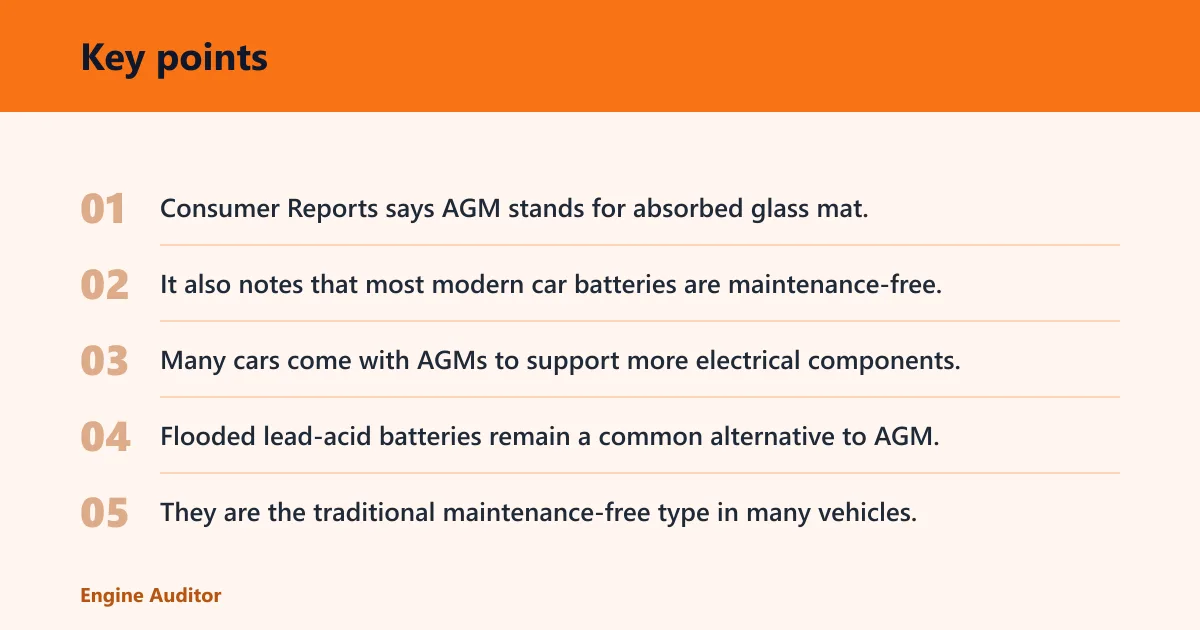
The same source says AGM stands for absorbed glass mat, and that AGM batteries are more advanced than traditional maintenance-free batteries. It also notes that most modern car batteries are maintenance-free. Many cars come with AGMs to support more electrical components, especially where start-stop operation or heavier electrical loads are part of the design.
Flooded lead-acid batteries remain a common alternative to AGM. They are the traditional maintenance-free type in many vehicles, and they can still fit some hot-climate replacements where the vehicle does not require an AGM. The review should tell you which type is being judged, because type affects performance and cost.
Do car battery reviews tell me if a battery will fit my car?
Not reliably unless they state the group size and terminal location. Fitment depends on the owner’s manual or an in-store fit guide, not on a high star score. A battery review can help narrow options, but it cannot replace the physical fit check needed for tray size, hold-downs, and cable reach.
Freshness and date code checks before purchase
Battery age is often printed as a date code on the top or side of the case. If you can read the code, compare it with the purchase date. Under 6 months old is preferred; 3 months is better. That check is simple and often more useful than a generic review score.
Warranty comparison basics
Compare both the free replacement period and the prorated period. A review that names only the total warranty can hide weak early coverage. If two batteries are otherwise similar, the one with a clearer and longer free replacement term may be easier to defend when a defect shows up early.
Frequently asked questions
Are online car battery reviews trustworthy?
Sometimes, but only when they include test data, battery age, fitment details, and enough context to compare conditions. If a review relies on stars, vague praise, or short owner comments, treat it as a clue rather than proof. Trust increases when the review can be checked against measurable specs.
How do I know which car battery reviews are biased?
Look for affiliate links, seller marketplace pressure, missing method details, and ratings that swing hard after shipping complaints or one bad batch. Bias is less about positive or negative tone and more about whether the page explains how the battery was measured, compared, and sold.
How fresh should a car battery be when I buy it?
Under 6 months old is the baseline worth accepting, and 3 months is better. The same source says battery age can matter before installation, and the date code can appear on the top or side of the case. Fresh stock gives you a better starting point for service life.
What matters more in a car battery review: CCA, reserve capacity, or life test?
Life-test results usually matter most for overall confidence, because they show how the battery holds up over time. CCA matters more in cold weather, while reserve capacity matters more for accessory load and short-trip driving. The best review explains which metric drove the ranking and why.
What car battery review sites compare models by group size?
Look for sites that sort by group size and state the fitment rules clearly, such as terminal location and vehicle application. Consumer Reports does this with overall performance within group sizes, which is the right comparison method. Any site that ignores fitment should be treated as incomplete.
Products related to this article
Sponsored / affiliate links. As an Amazon Associate I earn from qualifying purchases. I may earn additional commission from eligible campaigns.