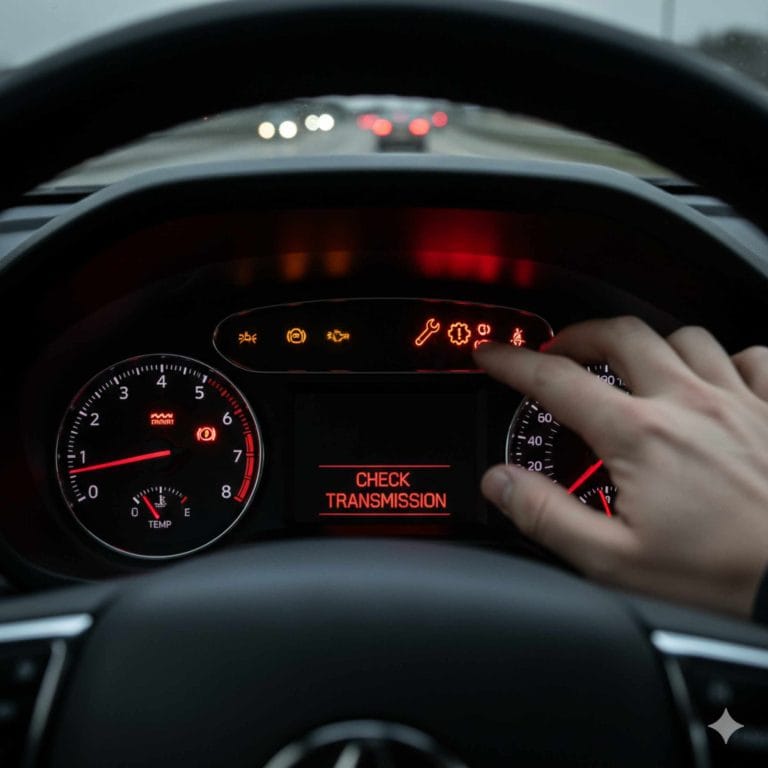
Transmission control system repair at dealer vs shop
Choose the dealer when the fault may need OEM software, module coding, or TCM programming. Choose a strong independent shop first when the problem looks mechanical, like wiring, solenoids, fluid, or internal wear. Bad diagnosis can turn a relatively low-cost scan into a much more expensive parts swap. This guide compares cost, access, warranty, and repair risk for both routes.
Transmission control system repair at dealer vs independent shop
The main trade-off is access against speed and cost. A dealer service department usually has factory scan tools, OEM procedures, software updates, and recall coordination for control-module work. An independent transmission shop usually wins when the issue needs faster diagnosis, lower labor cost, and rebuild or repair options rather than module programming.
| Decision factor | Transmission control system repair at dealer | Independent shop | Winner |
|---|---|---|---|
| Diagnosis capability | Strong for OEM-guided fault trees, factory scan data, coding checks, and recall-related faults | Strong for transmission-specific testing, road tests, fluid checks, wiring checks, and mechanical fault isolation | Tie |
| Programming access | Direct OEM access for module coding, software flashing, adaptation, and updates | Often limited; may sublet programming or send the vehicle to the dealer for final coding | Dealer |
| Likely cost bucket | Higher diagnostic and labor rates, plus OEM parts sourcing | Usually lower labor cost, with aftermarket or remanufactured parts and rebuild options | Independent shop |
| Warranty length | Usually tied to manufacturer policy and repair type | Often a labor warranty from the shop; length varies by rebuild or repair | Tie |
| Turnaround time | Can be slower when programming, parts sourcing, or recall coordination is required | Often faster for diagnosis and mechanical repair, especially when a rebuild is needed | Independent shop |
| Best-fit fault type | Module, software, adaptation, recall, or replacement that needs OEM coding | Wiring, solenoid, fluid, valve-body, or internal transmission wear | Depends on fault |
Diagnosis capability
Dealer and independent shops do different parts of the job well. The dealer has OEM scan paths and service information that help when the transmission control module is reporting communication faults, adaptation errors, or software-related problems. An independent transmission specialist often does a better first pass on road feel, line-pressure clues, and mechanical symptoms.
Programming, coding, and software flashing access
This is where the dealer usually wins. A transmission control module often needs reprogramming, adaptation, or software flashing after replacement, and a dealer service department is often set up for that kind of work with factory scan tools and manufacturer procedures. Some independent shops can diagnose the problem correctly, then sublet the programming or refer the final coding step to the dealer.
Cost buckets: diagnostic fee, labor rate, parts, and sublet programming
Dealer work often costs more because labor rates are higher and parts may come from the manufacturer. Independent shops usually save money with lower labor rates, aftermarket or remanufactured parts, and rebuild paths that avoid unnecessary module replacement. The diagnostic fee matters too; a phone quote is not the same as a scan, road test, and live-data diagnosis.
Warranty length, labor coverage, and turnaround time
Warranty policy is a real part of the decision. Repair coverage can depend on manufacturer rules like parts and labor coverage, mileage limits, and time limits, while independent shops usually offer their own labor warranty on top of any parts coverage. Turnaround is often faster at a specialist when the fault is mechanical, but dealer timelines can be longer if software access or recall coordination is required.
Best-fit fault type for each shop
Use the dealer for module faults, programming, and service campaigns. Use the independent shop for wiring repairs, solenoid faults, leaks, fluid service, and internal wear that may need a partial repair or rebuild. When the symptom is a no-move condition or erratic shifting, the right shop is the one that can prove whether the failure is electrical, software-based, or internal.
According to clintontransmissionmd.com — Clinton Transmission says it has served the Waldorf and Clinton, MD areas for over 40 years.
When should you choose a dealer?
Choose the dealer when the repair depends on OEM software, module coding, adaptation after replacement, or recall coordination. That route cuts the chance of a repeat visit when the vehicle needs manufacturer-specific updates or when the fault may be tied to a service campaign.
OEM updates, module coding, and adaptation
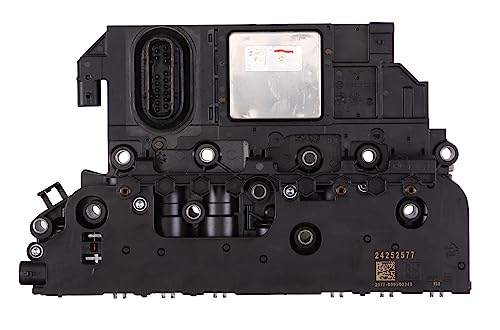
A transmission control module is not just a box to replace. It may need code reading and diagnosis, reprogramming, and adaptation so the transmission shifts correctly after repair. Dealer service departments are better equipped for those steps because they have factory scan tools, coding access, and software flashing support.
Active recalls and warranty coordination
If the car has an active recall or warranty work that overlaps with the transmission issue, the dealer can coordinate the claim and the repair path in one place. That matters when a module, harness, or related control issue could be covered by manufacturer policy. It also keeps the paperwork simpler if parts and labor coverage are disputed later.
Cases where dealer access reduces repeat work
Dealer access helps when a vehicle needs final programming after a part swap or when a repair must be verified against OEM procedures. An independent shop may find the fault first, but the dealer may still need to finish the software step. That split approach can be the least risky route for complex control-system work.

Can an independent shop diagnose it correctly?
Yes, a good independent transmission shop can diagnose a control-system problem correctly, especially when the fault is wiring, solenoid-related, fluid-related, or internal to the transmission. The key is whether the shop uses live data, bidirectional tests, and a real road test rather than guessing from stored codes alone.
What good transmission diagnostics should include
A proper diagnostic should read codes, review live data, compare commanded versus actual shift behavior, and test communication between modules. The technician should also inspect fluid condition, check connectors and harnesses, and confirm whether the symptom changes under load or at a certain temperature. A scan by itself is not diagnosis.
Signs the shop has the right tools
Look for OEM scan tools or equivalent diagnostic equipment that can do live-data monitoring, bidirectional tests, module coding, and software flashing where supported. If the shop can explain what the transmission is doing during a road test, it is usually closer to the problem than a shop that wants to sell a rebuild on day one.
When the shop should sublet programming or send you to the dealer
If the repair needs a factory security login, a module code, or a software update only the dealer can perform, the independent shop should say so. That is not a failure; it is good triage. The best independent shops diagnose first, repair the mechanical side, then hand off the programming step if needed.
How much more expensive is dealer transmission control system repair than independent repair?
Dealer repair is usually more expensive because of higher labor rates, OEM parts sourcing, and programming time. Independent shops often lower the bill with cheaper labor, remanufactured parts, or a rebuild path that fixes the worn component rather than replacing every electronic part in the system.
Diagnostic fee versus repair quote
The first number to compare is the diagnostic fee, not the repair estimate. A dealer may charge more for the scan and road test, while an independent transmission shop may credit the inspection toward the repair. Ask whether the diagnostic fee includes live data review, electrical testing, and a written estimate.
Where dealers usually cost more
Dealer cost rises when the job includes module replacement, software flashing, or manufacturer parts. That premium is tied to access and procedure, not just labor. Dealers also tend to coordinate recalls and warranty work, which can add time even when it protects the owner from paying twice.
Where independents usually save money
Independent shops often save money through lower labor cost, rebuild options, and aftermarket or remanufactured parts. For a mechanical fault, that can be a much better value than replacing a control module first and discovering the problem was a wiring break or a failed solenoid.
What does each option usually cost?
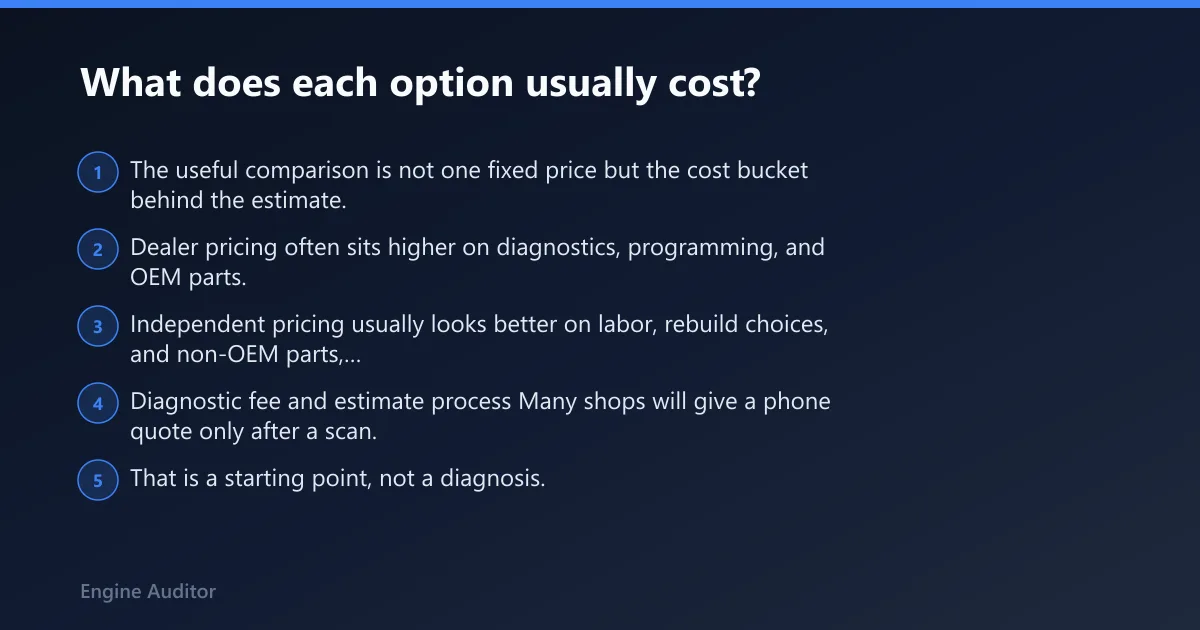
The useful comparison is not one fixed price but the cost bucket behind the estimate. Dealer pricing often sits higher on diagnostics, programming, and OEM parts. Independent pricing usually looks better on labor, rebuild choices, and non-OEM parts, especially when the diagnosis points to an internal transmission fault.
Diagnostic fee and estimate process
Many shops will give a phone quote only after a scan. That is a starting point, not a diagnosis. A serious estimate should separate inspection cost, scan time, road test, parts, programming, and labor, so the owner knows what is being bought before authorizing work.
Rebuild versus repair cost impact
If the fault is inside the transmission, a rebuild may cost more up front than a small repair but less than repeated part swapping. A rebuild also resets the wear picture and usually includes a post-repair relearn step. That can make sense when the transmission has clutch wear, hard-part damage, or repeated internal failures.
Can a transmission problem be fixed without a full rebuild?
Yes, many transmission problems can be fixed without a full rebuild if the fault is electrical, software-based, or limited to one component. Solenoids, wiring, connectors, fluid issues, valve-body concerns, and a bad transmission control module can sometimes be repaired on their own. A rebuild is for internal wear or damage that repair parts cannot correct.
When a repair is enough
If the transmission shifts badly because of a bad sensor, harness fault, solenoid failure, or software adaptation issue, a targeted repair may solve it. That is why diagnosis matters before approving major work. Replacing the wrong part turns a manageable repair into a bigger bill.
When a rebuild becomes the better answer
If the unit slips after warm-up, has debris in the pan, or fails internal pressure tests, a rebuild may be the right call. At that point, fixing one external part is unlikely to hold. A rebuild costs more and takes longer, but it may be the only durable answer for internal wear.
What diagnostic equipment is needed for transmission control system repair?
Transmission control system repair needs more than a generic code reader. The shop should have an OEM scan tool or equivalent diagnostic equipment that can read live data, run bidirectional tests, perform module coding, and support software flashing when the repair requires it. Road testing and electrical checks still matter.
Live data and bidirectional tests
Live data shows what the transmission is commanded to do and what it actually does. Bidirectional tests let the technician command solenoids or other outputs and watch the response. Those tools separate a bad command from a failed part and are often the difference between a correct diagnosis and a guess.
Module coding and software flashing
After a TCM replacement, the module may need coding and adaptation so the vehicle recognizes it correctly. Software flashing may also fix shift logic problems or compatibility issues. If a shop cannot do that in-house, it should say so before the repair starts.
Do independent shops offer warranties on transmission repairs?
Yes, many independent shops offer warranties on transmission repairs, but the terms vary widely by repair type. The key questions are parts coverage, labor coverage, mileage limit, and time limit. A warranty on a full rebuild is often different from a warranty on a small electrical repair.
What to read in the warranty policy
Check whether the warranty covers parts only or both parts and labor. Ask whether it applies to rebuilds, module replacements, and minor repairs in the same way. The written policy should also say what happens if another shop touches the unit later.
How rebuild warranties can differ from repair warranties
A rebuild often comes with a clearer warranty than a one-off repair because the work is more complete and easier to define. For example, Clinton Transmission says it offers a 1-year, 12,000-mile warranty on a standard rebuild and a 3-year unlimited mileage warranty on a premium rebuild. That kind of split shows how warranty strength can change with repair level.
How long do transmission repair warranties usually last?
There is no single warranty length that fits every transmission repair. Some shops limit coverage by mileage and time, while others extend coverage on premium rebuilds. A good warranty explanation should say exactly what is covered, for how long, and whether labor is included.
Warranty length, mileage limit, and time limit
The useful details are the mileage limit and the time limit. A warranty can look generous until the small print excludes labor or caps coverage early. That is why owners should compare written terms instead of assuming all transmission warranties mean the same thing.
Examples of shop-level warranty and service terms
Clinton Transmission says it has served the Waldorf and Clinton, MD areas for over 40 years, and it says walk-ins are welcome. Cottman of Waldorf lists Monday through Friday, 8:00 am to 5:30 pm, and Saturday, 8:00 am to 12:00 pm, and it offers a Free TransCheck Plus 21 Service. Those details do not tell the whole story, but they do show how diagnosis, access, and service terms vary by shop.
What should I ask before approving transmission control system repair?
Before approving the repair, ask what failed, how it was proven, whether the fix needs programming, and what warranty applies. A good quote should separate diagnosis, parts, labor, and programming. If the shop cannot explain why the fault is module, wiring, solenoid, software, or internal wear, pause before authorizing work.
Approval checklist
- Ask for the exact fault code and the live-data finding that supports it.
- Ask whether the repair needs OEM programming, adaptation, or software flashing.
- Ask for a written estimate that separates diagnosis, parts, labor, and sublet programming.
- Ask whether the repair can be done without a rebuild, and why.
- Ask for the warranty policy in writing, including parts coverage, labor coverage, mileage limit, and time limit.
- Ask whether a dealer visit is still needed for recall or module coding.
How to compare two quotes without guessing
Compare the diagnostic explanation first, then the repair path, then the warranty. A lower quote can be the wrong quote if it skips programming or assumes a part failure without proof. A higher dealer quote can be the right one if the car needs OEM access and the independent shop would only need to sublet that work anyway.
Choose Transmission control system repair at dealer if… / Choose independent shop if…
Choose transmission control system repair at dealer if the problem appears tied to TCM programming, module coding, software updates, adaptation, or an active recall. Choose the dealer if the vehicle needs OEM scan tools to finish the repair, or if warranty coordination is likely to matter.
Choose independent shop if the symptoms point to wiring, solenoids, fluid condition, valve-body wear, or other mechanical damage. Choose the independent route when you want faster diagnosis, lower labor cost, rebuild options, or a shop that can explain the fault clearly before any major parts are replaced.
Use a mixed path if the independent shop can diagnose the fault but needs dealer access for final programming. That is often the safest split when the mechanical diagnosis is strong but the control module still needs OEM coding.
Frequently asked questions
Is it better to repair a transmission control system at a dealer or independent shop?
It depends on what failed. Dealers are usually better for OEM software, module coding, programming, and recall coordination. Independent transmission shops are often better for mechanical diagnosis, lower labor cost, and repair or rebuild work when the fault is wiring, solenoids, fluid, or internal wear.
How much more expensive is dealer transmission control system repair than independent repair?
Dealer repair is usually more expensive because of higher labor rates, OEM parts sourcing, and programming access. The difference can be significant when the quote includes module flashing or replacement. An independent shop often comes in lower on labor and may offer remanufactured parts or a rebuild path.
Will an independent shop be able to diagnose a transmission control module problem correctly?
Yes, if the shop has the right tools and process. Good diagnosis should include live data, bidirectional tests, road testing, electrical checks, and a review of codes in context. If programming or OEM software access is needed afterward, the shop may need to sublet that step or refer the vehicle.
When should I choose a dealer for transmission control system repair?
Choose the dealer when the repair may require factory software, module coding, software flashing, or adaptation after replacement. Dealer service departments are also the safer choice when an active recall or warranty claim overlaps the transmission issue, because they can coordinate the paperwork and the repair in one place.
Do independent shops offer warranties on transmission repairs?
Yes, many do, but the terms vary. A warranty may cover parts only or both parts and labor, and it may carry a mileage limit and a time limit. For rebuilds, the warranty is often clearer than for minor repairs, so read the written policy before approving work.
Can a transmission problem be fixed without a full rebuild?
Often, yes. If the fault is software, wiring, solenoids, fluid, or a transmission control module issue, a targeted repair may solve it. A rebuild is usually reserved for internal wear, debris, or hard-part damage that cannot be fixed reliably with external repairs or programming alone.
Products related to this article
Sponsored / affiliate links. As an Amazon Associate I earn from qualifying purchases. I may earn additional commission from eligible campaigns.