Can Low Battery Voltage Trigger Transmission Control Problems?
Yes. Low battery voltage can trigger transmission control warnings, limp mode, erratic shifting, and communication codes. Start with battery and charging voltage if the system sits around 12.4 volts key-off or drops sharply during cranking. Skipping that step can lead to replacing a transmission control module, solenoids, or even the transmission itself when the fault is electrical. This guide explains how low voltage causes those symptoms, which codes point to power problems, and how to separate a weak battery from a real transmission fault.
Can low battery voltage trigger transmission problems?
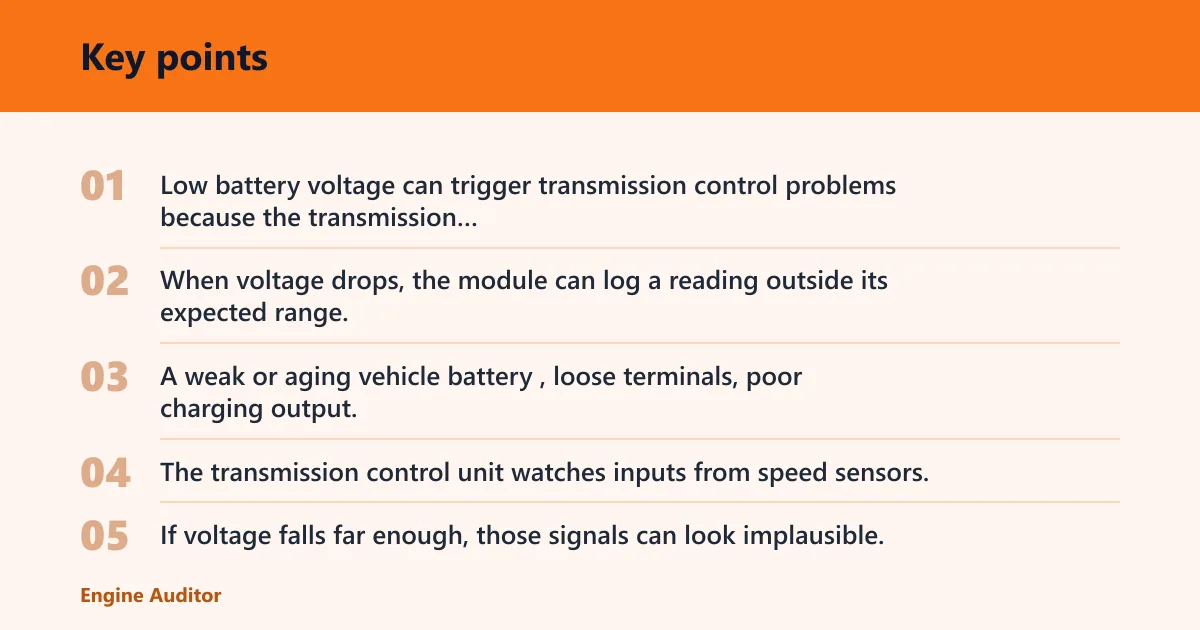


Yes. Low battery voltage can trigger transmission control problems because the transmission control unit expects stable power and clean sensor readings. When voltage drops, the module can log a reading outside its expected range, store fault codes, and switch into a protective strategy that changes how the vehicle drives.
The fault path is often electrical first. A weak or aging vehicle battery, loose terminals, poor charging output, or a brief low-voltage event during cranking can interrupt module logic long enough to create a transmission warning, even when the gearbox itself is fine.
How low voltage confuses transmission control logic
The transmission control unit watches inputs from speed sensors, pressure control circuits, solenoids, and other transmission data. If voltage falls far enough, those signals can look implausible. The module may then flag a fault because it cannot reconcile the data it is receiving with expected operation.
That does not mean the transmission has failed inside. It means the control unit saw a condition it could not trust, and voltage is a common trigger for that event.
What the transmission control unit stores when voltage drops
A transmission control unit can store fault codes and freeze-frame data when it sees readings outside range. Freeze-frame data captures the conditions at the moment the code set, such as voltage, gear state, and temperature history. That record matters because it helps separate a one-time low-voltage event from an ongoing transmission fault.
If battery power is disconnected, that data can be erased before diagnosis. That makes later troubleshooting less precise.
Why the warning can appear and disappear
A low-voltage transmission warning often comes and goes because the problem is intermittent. A low-voltage transmission warning may appear after a weak start, jump-start, or long sit, and it may come and go. The warning light may go out, but stored fault codes can remain until the module is scanned properly.
That pattern is common after a battery replacement, jump-start, or long period of sitting. The light going away does not clear the underlying cause.
What transmission symptoms can a weak battery cause?
A weak battery can cause a transmission warning light, a blinking D, a gearbox symbol, erratic shifts, delayed engagement, or limp-home mode. The key point is that these signs can come from voltage loss, not only from internal gearbox damage. A warning light alone does not prove a failed transmission.
Blinking D, gearbox symbol, or transmission warning light
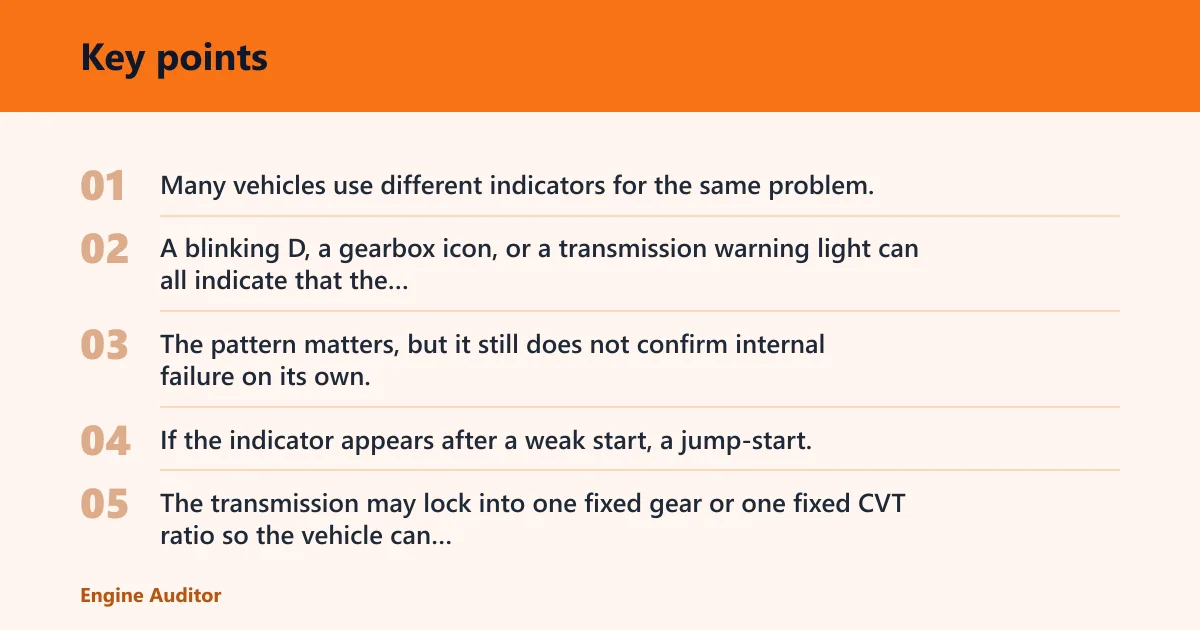
Many vehicles use different indicators for the same problem. A blinking D, a gearbox icon, or a transmission warning light can all indicate that the transmission control unit has stored a fault. The pattern matters, but it still does not confirm internal failure on its own.
If the indicator appears after a weak start, a jump-start, or a battery that is several years old, voltage moves higher on the suspect list.
Limp-home mode and one fixed gear
Limp-home mode is a protective strategy. The transmission may lock into one fixed gear or one fixed CVT ratio so the vehicle can move without causing more damage. F7 is commonly used to identify this as usually third gear or one fixed CVT ratio.
Drive carefully if that happens. Hard acceleration, towing, and long trips are poor ideas until the cause is known.
Intermittent shifts after jump-starts or weak starts
After a jump-start or a weak crank, a transmission may shift oddly because the control unit saw unstable voltage during startup. That can create temporary shift flare, hesitation, or a warning that disappears later. The disappearance does not erase the stored code history.
Suppose a sedan cranks slowly on a cold morning, then shows a gearbox symbol on the dash after the second restart. That pattern points first to battery condition and charging output, not immediately to a failed transmission.
Low voltage vs transmission fault decision table
This table gives a simple first-pass separation between voltage trouble and a true transmission issue. Use it with a battery check, a charging-system test, and a transmission-capable scan tool. Do not clear codes before you record them.
| Check | Low voltage pattern | Transmission fault pattern | Next test |
|---|---|---|---|
| Symptom pattern | Warning appears after weak start, jump-start, or long sit; may come and go | Warning returns under the same driving load, hot or cold, with repeatable shift problems | Note when it happens and whether voltage changed first |
| Battery resting voltage | Below about 12.4 volts key-off suggests a weak or discharged battery | Battery may test normal at rest | Measure resting voltage before starting the engine |
| Charging voltage | Low, unstable, or outside normal charging output points to an alternator or charging fault | Charging voltage stays normal while the problem continues | Perform a charging-system test with engine running |
| Scan results | Transmission module codes tied to low voltage, undervoltage, or communication errors | Transmission-specific codes that return after voltage is verified | Scan the transmission module, not only the engine module |
| Likely cause | Battery, terminals, ground, or charging system | Sensor, fluid, software, solenoid, or mechanical fault | Follow the scan data and symptom pattern |
| Next test | Inspect terminals, battery age, and charging output | Check code details, freeze-frame data, and transmission temperature history | Use a transmission-capable scanner before replacing parts |
Short triage flow
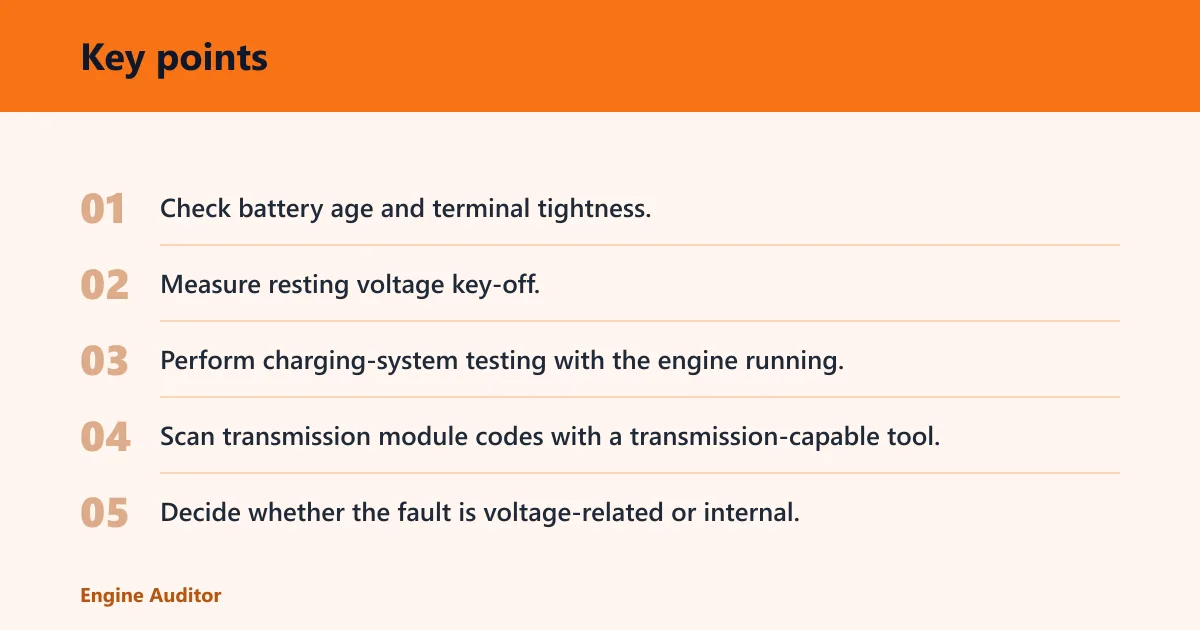
- Check battery age and terminal tightness.
- Measure resting voltage key-off.
- Perform charging-system testing with the engine running.
- Scan transmission module codes with a transmission-capable tool.
- Decide whether the fault is voltage-related or internal.
What should I check first when a transmission warning appears?
Start with the battery and charging basics. Check battery age, terminal tightness, and visible corrosion, then measure resting voltage and charging voltage. Those steps come before parts replacement because low voltage is a common trigger, and an aging battery is a frequent cause of transmission warnings.
Battery age and terminal tightness
An aging battery may still crank the engine and still be weak enough to disturb module operation. Terminal tightness matters too. A slightly loose terminal can create a brief voltage drop that is enough to set a transmission code or make the warning appear intermittently.
Look for green corrosion, white crust, broken clamps, or cable movement by hand. Fix those issues before moving deeper into diagnostics.
Resting voltage and charging voltage
Resting battery voltage gives a quick clue. A battery that sits below about 12.4 volts key-off deserves attention, especially if the warning appeared after a slow crank. Then check charging voltage with the engine running to see whether the alternator is holding the system in range.
If charging output is poor, the battery may never recover enough to keep transmission electronics stable.
Charging-system test before parts replacement
A proper charging-system test matters because a bad alternator, regulator, or ground path can mimic a transmission problem. A charging-system test should be done before replacing a transmission control unit, solenoid pack, or gearbox. The warning may be a power-supply issue, not a failed transmission component.
Why scanner results matter
Scanner results matter because transmission modules need a scanner that can reach them and read freeze-frames. Generic readers may report no faults even when transmission faults exist. If the scanner cannot access the transmission module, you do not have a complete diagnosis.
Transmission-capable scan tools vs generic OBD2 readers
A generic OBD2 reader often sees engine codes only. That is useful for emissions faults, but it may miss transmission codes, module communication faults, and live data that explain the warning. Use a tool that can talk to the transmission module directly.
If a generic reader says “no codes” while the dash still shows a gearbox warning, that result is incomplete rather than reassuring.
Freeze-frame data and temperature history
Freeze-frame data can show the exact conditions when the fault set. Temperature history matters because some transmission faults appear only when fluid warms up or when the module sees an abnormal rise in temperature. That kind of detail separates a momentary voltage drop from a repeatable internal issue.
Disconnecting the battery can erase freeze-frame data needed for diagnosis. Once that data is gone, the next scan may be less useful.
Stored fault codes after the light goes out
Stored fault codes can remain after the warning light goes out. That is why the vehicle still needs a proper scan even if the dash looks normal again. Clearing those codes without fixing the cause only hides the evidence.
Do not treat code clearing as a repair. It is a reset, not a fix.
When low voltage is not the whole story
Low voltage can be the trigger, but it is not the only cause. Sensor faults, fluid problems, software issues, and mechanical wear can all create transmission warnings. F5 notes that fluid state can create pressure behavior the computer cannot reconcile, and F6 notes that some warnings are fixed by calibration updates.
Sensor, fluid, software, and mechanical causes
Sensor faults can misreport speed or pressure. Low or degraded fluid can change pressure behavior. Software calibration may be outdated. Internal wear can also create a fault the module records as out of range. Those causes become more likely when battery and charging checks look normal.
Signs the fault points inside the transmission
If the warning returns after voltage tests pass, and the same shift issue repeats under the same road conditions, the fault is moving closer to the transmission itself. Harsh shifts, slipping, flare, or repeated limp-home events after a proper charge check are stronger clues than a one-time warning after a weak start.
When continued driving is not a good idea
Stop driving if the transmission slips badly, loses drive, shows repeated limp-home mode, or makes clunks and grinding noises. Limited careful driving may be acceptable only when the vehicle still moves normally and the warning followed a clear voltage event. Even then, avoid long trips and hard loads.
F12 advises against gearbox removal based on the warning light alone. That is the right caution here. Diagnose power supply and scan data first.
Frequently asked questions
Can low battery voltage trigger transmission control problems?
Yes. Low battery voltage can trigger transmission control problems because the transmission control unit depends on stable power and believable input data. It may log a reading outside its expected range, store fault codes, and shift into limp-home mode even when the gearbox itself is still sound.
Will a dead battery throw transmission codes?
It can. A dead or deeply discharged battery may create undervoltage or communication faults in the transmission module. Those codes can stay stored after the vehicle restarts, so a proper scan is still needed even if the warning light later goes out.
How do I know if it is battery voltage or the transmission module?
Check battery age, terminal tightness, resting voltage, and charging voltage first. If those are weak, fix them and rescan. If voltage is stable and the transmission module still stores the same codes with freeze-frame data and temperature history, the fault is more likely inside the transmission system.
Can disconnecting the battery reset a transmission warning?
It may turn the light off for a while, but it is not a repair. Disconnecting the battery can erase freeze-frame data needed for diagnosis and may hide the fault long enough to make troubleshooting harder. The warning often returns if the cause was not fixed.
Can a generic OBD2 scanner read transmission codes?
Sometimes, but not reliably. Generic readers may miss transmission-specific faults because they do not always access the transmission module. A transmission-capable scanner should read module codes, freeze-frames, and temperature history. That extra data is often what separates a voltage issue from an internal fault.
When should I stop driving if the transmission light is on?
Stop driving if the transmission slips, loses drive, makes harsh noises, or keeps falling into limp-home mode. If the warning came with a weak battery event and the vehicle still drives normally, short-distance careful driving may be acceptable until a proper voltage and module scan is done.
Products related to this article
Sponsored / affiliate links. As an Amazon Associate I earn from qualifying purchases. I may earn additional commission from eligible campaigns.