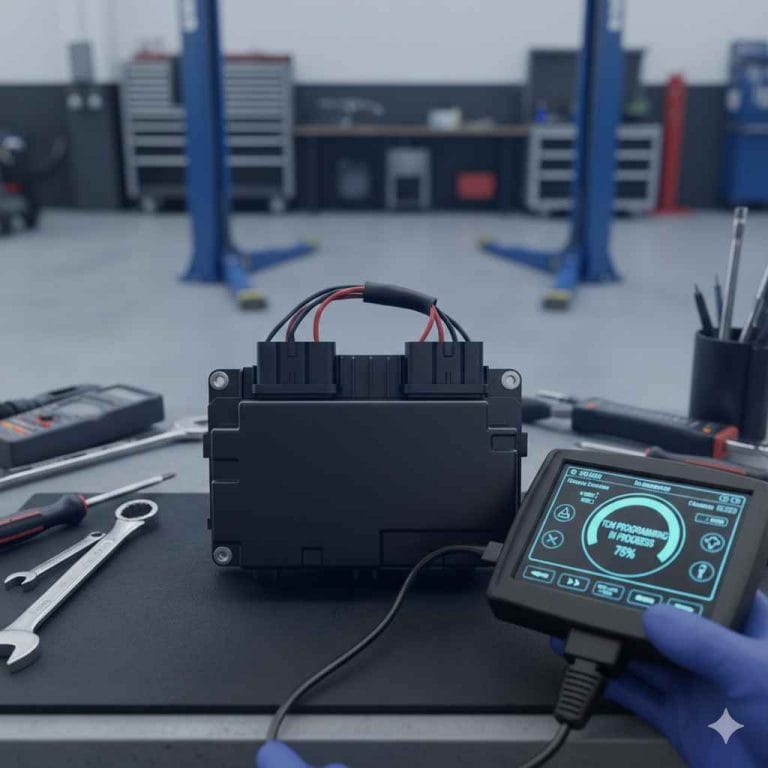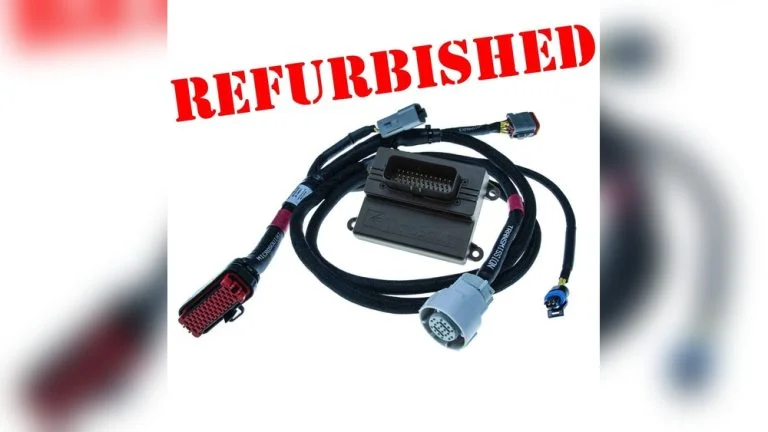
Transmission Control System Replacement Cost vs Repair Cost
A transmission control system repair usually costs in the low hundreds to under a thousand dollars if the fault is a module, sensor, wiring, or software issue; full replacement can run into the low thousands, so replacement usually makes sense only after confirming internal failure, a failed bench test, or repeated code return. I have seen shops burn through hundreds in labor by guessing at the wrong part. The same shift complaint stays, and the bill climbs. This guide gives a quote-audit checklist for separating internal failure, repairable components, and unnecessary replacement labor.
Transmission control system replacement cost vs repair cost
The core trade-off is plain: repair is usually cheaper, but once the transmission has to come out, labor can push an internal fix close to replacement pricing. That is why the lowest quote is not always the best quote. The real question is whether the fault lives in an external part, a serviceable internal component, or the unit itself.
| Decision factor | Transmission control system replacement cost | Repair cost | Winner |
|---|---|---|---|
| Up-front price | Usually higher, especially for remanufactured or new units | Usually lower for isolated faults and serviceable parts | Repair cost |
| Labor exposure | Often includes major transmission removal and installation labor | Can be light for solenoids, mounts, wiring, or fluid service | Repair cost |
| Best fit | Broad internal wear, repeated failure, failed internal tests | Single-component faults and external issues | Depends on fault |
| Warranty value | Usually stronger on remanufactured units | Shorter shop warranty is common | Replacement cost |
Up-front price
Replacement usually starts higher because the quote includes a larger assembly and more labor. Repair keeps the cost lower when the failure is limited to one part, such as a shift solenoid, valve body, or pan gasket.
Labor exposure
This is where the math changes fast. Transmission removal and installation labor costs $800-$1,500, and that charge can make internal repair almost as expensive as a swap if the unit must come out either way.
Best fit
Repair wins when the fault is narrow and the rest of the unit is healthy. Replacement wins when the failure is broad, repeated, or buried deep enough that opening the unit and rebuilding it would consume much of the same labor.
Warranty value
Replacement often carries the better warranty package, especially on remanufactured units. A common shop warranty is around a year or about 12,000 miles, while remanufactured coverage may be longer and sometimes advertised as a nationwide warranty.
According to fairrepairauto.com — Transmission fluid flush costs $150-$250 in the cited guide.
What drives the bill: parts, diagnosis, and labor
Separate the diagnostic fee from the repair estimate. Transmission diagnostic fees are often free to a few hundred dollars, and many shops may credit or waive the fee if the repair proceeds. That fee pays for scan work, test drives, and confirmation; it should not be buried inside the repair number.
Transmission fluid flush/service sits in a different bucket. The typical minor service cost is $150-$250, and it can help maintenance or some symptom cases, but it does not fix internal damage.
Parts and labor then set the real direction of the quote. A shift solenoid replacement usually runs $300-$600, while a valve body replacement often lands at $900-$1,800. Torque converter replacement is usually $800-$1,500, and a transmission rebuild is commonly $2,000-$4,000.

What transmission problems can be repaired instead of replaced?
Several common faults are repairable without replacing the entire unit. A shift solenoid problem, a valve body fault, a torque converter issue, a transmission mount failure, or an external leak can often be fixed for far less than a full replacement. The key is proving the failure source before approving major labor.
Shift solenoid faults
Shift solenoids control gear changes electronically. When they fail, the transmission may hang in gear, shift hard, or trigger a transmission-related code without any need for a full unit swap. In many cases, this is a repair, not a replacement decision.
Valve body faults
The valve body is the hydraulic control center. If it is worn or sticking, shifting quality can fall off sharply, but the transmission case itself may still be serviceable. This often sits in the middle ground between a small repair and a full rebuild.
Torque converter faults
A torque converter can create shudder, slip, or poor engagement. Because it sits in the driveline and ties into major labor, this repair can push the job toward rebuild territory even when the transmission internals are not fully ruined.
Fluid service, leaks, and external wiring issues
Fresh fluid, a fixed leak, a corrected connector issue, or a damaged mount can solve a symptom without touching the core unit. Most automatic transmissions require a fluid change every 60,000 to 100,000 miles, and manual transmissions generally need fresh fluid every 30,000 to 60,000 miles. Service is maintenance; it is not a cure for burnt clutches or hard internal wear.
When is a rebuild cheaper than replacement?
A rebuild is cheaper when the case and housing can be reused and the main damage is internal wear rather than a shattered unit. It can also be the better price when the transmission is already out of the vehicle, because much of the removal and installation labor is already being charged.
When the unit can be opened and reused
If the case is sound, the hard parts are not destroyed, and wear is broad rather than catastrophic, a rebuild often makes sense. It replaces worn parts inside the existing housing instead of paying for a whole different assembly.
When labor overlap matters
Removal and installation labor is a major cost driver. If the shop must already pull the transmission, the difference between a rebuild and a replacement can shrink quickly because both paths share a large chunk of the same labor.
When broad wear is present but the unit is not dead
A rebuild fits when the transmission has multiple worn components but no sign that the case is cracked, the housing is ruined, or the failure is repeated after prior repairs. The rebuild price of $2,000-$4,000 often sits below a remanufactured or new unit once labor is counted.
How do mileage, vehicle value, and ownership plans change the call?
Mileage changes the decision, but it should not make the decision alone. Under 100,000 miles often points toward repair, while over 150,000 miles often points toward replacement. Vehicle value and how long the owner plans to keep the car should decide whether that extra spend still makes sense.
Under 100,000 miles
Lower-mileage vehicles usually deserve a tighter diagnostic push before any full replacement recommendation. If the symptom is isolated, fixing the failing part often protects more of the car’s remaining value.
Over 150,000 miles
Higher-mileage vehicles are more likely to have multiple wear points, not just one bad part. If the transmission has broad wear, the owner may get better value from a remanufactured or new unit than from stacking repairs onto an aging assembly.
Vehicle value and ownership horizon
If the repair bill approaches the value of the car, replacement economics get worse fast. If the owner plans to keep the vehicle for several more years, a stronger warranty and more complete unit may justify the higher upfront cost.
Quote-audit decision table for transmission faults
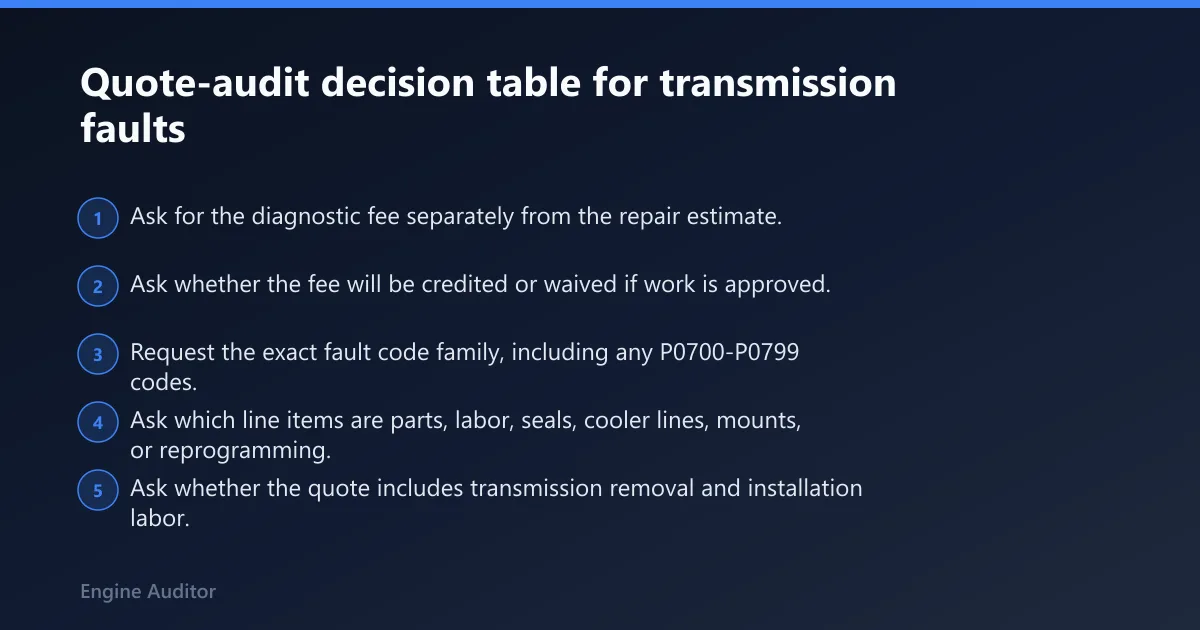
Use this table to match the fault to the likely fix. It separates repairable external problems from internal failures and shows where labor overlap starts to erase the savings of repair.
| Fault type | Likely repair cost | Likely replacement cost | Labor overlap | Repair-vs-replace call |
|---|---|---|---|---|
| Transmission fluid flush/service | $150-$250 | Not a replacement fix | Low | Repair/service if fluid condition is the issue; not for internal damage |
| Shift solenoid fault | $300-$600 | Often not needed | Low to moderate | Repair |
| Transmission mount failure | $200-$450 | Not needed | Low | Repair |
| Pan gasket leak | $300-$500 | Not needed | Low | Repair |
| Valve body fault | $900-$1,800 | May still be avoidable | Moderate to high | Repair first if the case and internals are otherwise sound |
| Torque converter fault | $800-$1,500 | May push into rebuild territory | High | Repair or rebuild, depending on wear pattern |
| Broad internal wear | $2,000-$4,000 | $2,500-$8,000+ | High | Rebuild or replacement, based on warranty and vehicle value |
Quote checklist to use at the shop
- Ask for the diagnostic fee separately from the repair estimate.
- Ask whether the fee will be credited or waived if work is approved.
- Request the exact fault code family, including any P0700-P0799 codes.
- Ask which line items are parts, labor, seals, cooler lines, mounts, or reprogramming.
- Ask whether the quote includes transmission removal and installation labor.
- Confirm whether related fluids are included.
- Ask whether the shop is quoting a repair, rebuild, remanufactured unit, or new unit.
- Ask for the warranty in mileage and time, in writing.
P0700-P0799 codes only tell you that the control system has detected a transmission-related problem. They do not prove the transmission itself is dead. A good quote should pair the code with fluid condition, shift behavior, wiring checks, and any bench or road test results.
Choose transmission control system replacement cost if… / repair cost if…
Choose the higher replacement path when the transmission has broad internal wear, repeated failures, a failed internal test, or a diagnosis that points to major damage inside the unit. Choose repair cost when the fault is isolated, the code points to a serviceable component, and the transmission case and hard parts still have life left.
Remanufactured units fit between those extremes. They cost more than a repair and less than a new unit, but they can pay off when the owner wants a stronger warranty and the vehicle has enough value to justify the spend.
How much does transmission repair cost compared with replacement?
Repair is usually cheaper than replacement because it targets the failed part instead of the whole assembly. A small fix may stay in the hundreds, while replacement can move into the thousands once parts, removal, installation, and related fluids are counted. The gap narrows fast if the transmission must come out either way.
What transmission problems can be repaired instead of replaced?
Shift solenoid faults, valve body issues, torque converter problems, leaks, mounts, and some wiring faults are often repairable. Fluid service can also help when the problem is maintenance-related or caused by degraded fluid. The shop should prove the failure source before calling for a full replacement.
When is a rebuild cheaper than replacement?
A rebuild is often cheaper when the unit can be disassembled and reused rather than swapped out for a remanufactured or new assembly. It also makes sense when removal labor is already being charged and the damage is widespread but not catastrophic. That keeps the cost closer to the rebuild range than the replacement range.
What symptoms suggest the transmission is beyond repair?
Repeated failures after prior repairs, severe internal contamination, burnt fluid with major slip, or evidence that the hard parts are damaged can point toward replacement. A single symptom like harsh shifting or a leak is not enough. The decision should rest on confirmed internal damage, not guesswork from one road test.
How much labor does transmission removal and installation add to the bill?
Transmission removal and installation labor costs $800-$1,500 and can dominate the quote. That is why a repair that needs the transmission out can creep toward replacement pricing. Once the labor is committed, the shop should explain why the selected fix is better than a rebuild or remanufactured unit.
What warranty should I expect on a repaired or replaced transmission?
Repair work often comes with a common shop warranty of 12 months/12,000 miles, though terms vary. Remanufactured transmissions may include 3 Years / 100,000 Mile Nationwide Warranty, which can be a strong value if the vehicle will stay in service. Always compare warranty length against the actual price gap.
Is a remanufactured transmission worth it over a used one?
Usually yes, when the vehicle is worth saving and the owner wants lower risk. A remanufactured unit has been rebuilt to a controlled standard and usually carries a stronger warranty. A used unit may be cheaper up front, but it often brings more uncertainty and far less coverage.
How does vehicle mileage change the repair-vs-replace decision?
Under 100,000 miles often favors repair because the vehicle still has meaningful life left. Over 150,000 miles often favors replacement because multiple wear points are more likely. Mileage should still sit beside symptom severity, vehicle value, and how long the owner plans to keep the car.
What diagnostic codes can point to transmission problems?
Codes in the P0700-P0799 family can point to a transmission-related fault detected by the control system. They are useful as a starting point, not a final diagnosis. A scan result should be paired with fluid checks, wiring inspection, and symptom verification before any major quote is approved.
How can I avoid overpaying for transmission work?
Ask for the diagnosis line separately, then compare the quote line by line: parts, labor, seals, mounts, cooler lines, reprogramming, and fluids. Make the shop explain why the fix is a repair, rebuild, remanufactured unit, or new unit. If the answer is vague, the quote probably is too.
Products related to this article
Sponsored / affiliate links. As an Amazon Associate I earn from qualifying purchases. I may earn additional commission from eligible campaigns.