Does Idling Make Your Car Overheat?
Yes, idling can make a car overheat if cooling airflow is weak, coolant flow is restricted, or the fan does not come on. Ignore it, and parts can warp, coolant can boil, and a small fault can turn into a tow bill. This guide explains why overheating shows up at idle or in traffic, then helps you sort airflow, circulation, and control faults fast.
Why stopped traffic exposes weak cooling systems

Yes. A car can overheat when it sits still, even if it drives fine on the highway. At idle, the cooling system depends on the radiator fan because natural airflow drops away. That makes stopped traffic the hardest condition for a weak cooling system to handle.
Highway speed can hide the fault because air passes through the radiator naturally. At low speed, the fan has to do more of the work. If that fan is weak, controlled badly, or stopped altogether, engine temperature can climb fast.
Why idle is the hard case for cooling
Idle removes one of the main heat-rejection aids, road speed. The engine still makes heat, but the radiator gets less air. That leaves the fan, coolant flow, and radiator condition to carry the load. If one part is marginal, the problem often appears first in traffic, not on open road.
What overheating at idle usually points
Most idle overheating fits three buckets: airflow, circulation, or control. Airflow means the fan or the radiator path cannot shed enough heat. Circulation means coolant cannot move or absorb heat as it should. Control means the ECU, fan switch, relay, or sensor is not commanding the fan correctly.
Idle overheating decision table
Use the symptom you see at idle, then move to the subsystem most likely to be at fault. This is a triage tool, not a final repair plan. It helps you separate a fan problem from a coolant-flow problem or a sensor and relay logic problem.
| Symptom observed at idle | Most likely subsystem | Next check |
|---|---|---|
| Fan never turns on | Control | Check fuse, relay, fan motor power, and coolant temperature sensor or fan switch input. |
| Fan runs but temperature still climbs | Airflow or circulation | Inspect fan speed, shroud fit, radiator blockage, coolant level, thermostat, and water pump output. |
| Temperature rises only with AC off | Control or airflow | Test whether the fan responds when the AC is switched on, since many cars command fan operation then. |
| Reservoir level drops slowly | Circulation or cooling system leak | Check for seepage, hose dampness, cap venting, radiator leaks, heater-core smell, and an external puddle after parking. |
How to read the symptom-to-subsystem map
If the fan never turns on, start with control logic before replacing the fan itself. A faulty coolant temperature sensor or fan switch can keep the fan off. If the fan runs but the gauge keeps climbing, the problem may be weak airflow, poor coolant circulation, or both.
Suppose the gauge climbs in a long line of traffic, but drops once the car moves again. That pattern points first to idle airflow, then to fan control. If the temperature rises even while the fan is clearly spinning, circulation or radiator heat rejection deserves a closer look.
Why airflow matters most at a stop
At idle, the radiator fan becomes the main airflow source. Electric fans pull air through the radiator, while belt-driven fan clutch systems use engine speed and clutch engagement to move air. If either type is weak, idle cooling suffers first.
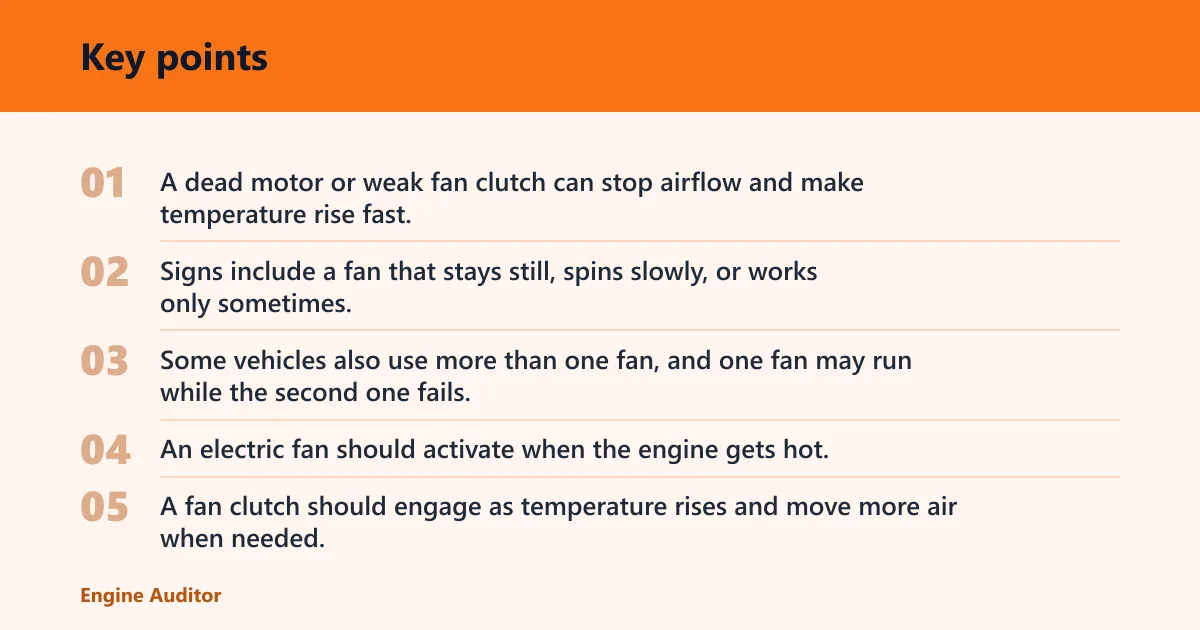
A dead motor or weak fan clutch can stop airflow and make temperature rise fast. Signs include a fan that stays still, spins slowly, or works only sometimes. Some vehicles also use more than one fan, and one fan may run while the second one fails, which can still leave the system short on airflow.
Electric fan versus fan clutch
An electric fan should activate when the engine gets hot, and on many vehicles it also comes on with the AC. A fan clutch should engage as temperature rises and move more air when needed. If fan operation is intermittent, that can point to the motor, wiring, relay, or control side rather than the blades themselves.
A common first-timer mistake is assuming “the fan spins” means “the fan is fine.” A fan that starts late, runs slowly, or cuts in and out can still let the engine overheat at idle. That is especially true if the fan only works when airflow demand is low.
What fan failure looks and sounds like
Look for a fan that never starts as the gauge climbs, a fan that is much quieter than expected, or one that comes on late and drops out early. If you turn the AC on and the fan behavior does not change, that is another clue that the fan command path or the motor itself may be at fault.
What should you check first?
Start with coolant level, then confirm fan operation, then look for visible airflow problems. Those three checks cover the most common idle overheating causes without guessing. If the engine is hot, do not open the cooling system cap; let it cool before opening it.
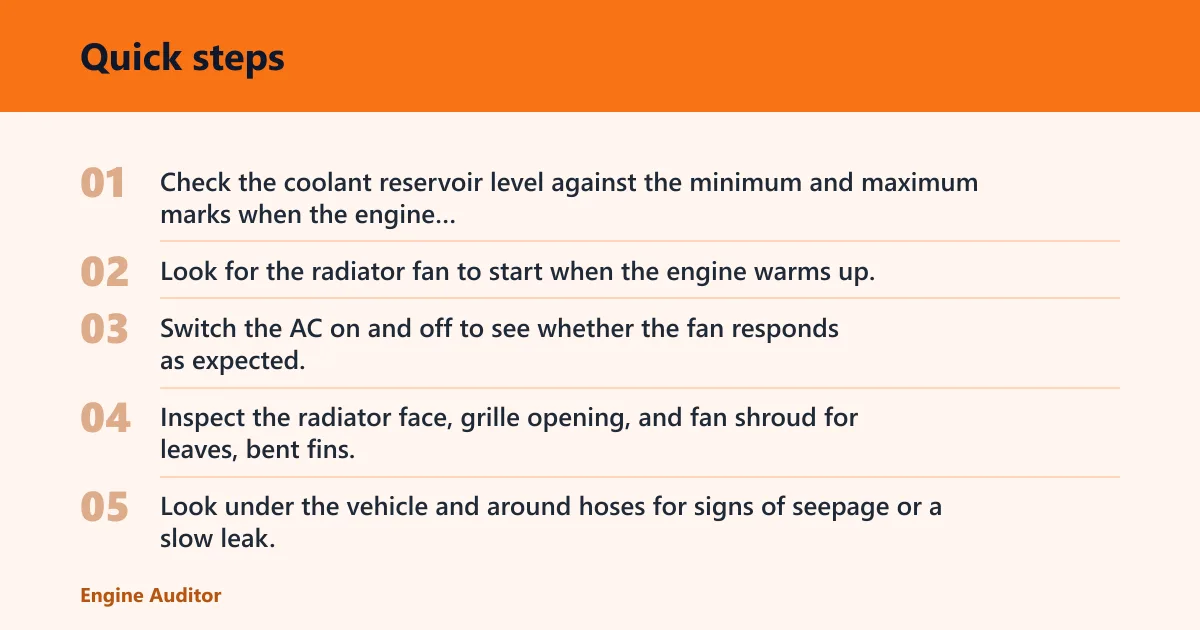
- Check the coolant reservoir level against the minimum and maximum marks when the engine is cool.
- Look for the radiator fan to start when the engine warms up.
- Switch the AC on and off to see whether the fan responds as expected.
- Inspect the radiator face, grille opening, and fan shroud for leaves, bent fins, or blockage.
- Look under the vehicle and around hoses for signs of seepage or a slow leak.
Coolant level in the reservoir
Coolant is the heat-transfer fluid that carries heat away from the engine. If the reservoir sits below the minimum mark, overheating can happen at idle because the system may not hold enough coolant to move heat well. Top up only after the engine is fully cool.
Slow coolant loss can be easy to miss. The reservoir may drift down over days or weeks without a clear puddle under the car. That can happen through a weak hose clamp, a small radiator leak, a cap that vents too soon, or a seep that evaporates before it drips to the ground.
AC on and off as a quick fan test
Many vehicles are set up to command at least one radiator fan when the AC is switched on. If the fan comes on with AC but not with rising engine temperature, the motor may be fine and the fault may sit in the control circuit, sensor, relay, or fan request logic. If the fan does not come on at all, the motor or power supply deserves attention.
Signs of leaks, bent fins, or blocked airflow
Inspect the radiator face for bent fins, debris, or packed dirt. Blocked radiator tubes can come from rust, scale, or old coolant. A leak or damaged fin area reduces heat rejection, and in some cases the radiator may need repair or replacement rather than a simple top-up.
Can a thermostat or water pump cause idle overheating?
Yes. A thermostat can cause heat rise at idle if it sticks closed or restricts flow, and a weak water pump can move coolant poorly even if the car seems better at speed. Both faults can hide during easy driving and show up most clearly when airflow and pump demand are both high.
Thermostat stuck closed or restricted
The thermostat regulates coolant flow. If it sticks closed, or opens only partly, coolant cannot circulate through the radiator properly. A stuck thermostat can limit coolant flow and trap heat in the engine, which is why it is a common overheating cause at idle and in traffic.
If the upper radiator hose stays much cooler than expected while the gauge climbs, that can fit a thermostat problem. A thermostat replacement usually costs between £100 and £200, but the correct diagnosis matters more than the parts price.
Water pump wear and weak circulation
The water pump circulates coolant through the system. If the impeller is worn or damaged, the pump may still move enough coolant at speed to hide the issue, then fail to keep up at idle. A weak water pump cannot push coolant through the system effectively.
That is why a car can seem normal on the highway and still overheat while sitting still. FixMyCar says water pump replacement averages £310.45. A poor pump can also create uneven temperature changes through the radiator and heater circuit.
Idling car overheat table
These faults can sit behind an idle overheating complaint even when the fan itself is working. They often show up as secondary clues: odd gauge behavior, slow coolant loss, or a system that reacts late to heat.
| Fault | What it can do at idle | What to check next |
|---|---|---|
| Radiator blockage, leak, or damaged fins | Reduces heat rejection and lets temperature climb in traffic. | Inspect for bent fins, blocked tubes, wet seams, and poor airflow through the core. |
| Coolant temperature sensor or fan switch fault | Prevents the fan from being commanded on at the right time. | Check sensor input, fan relay, wiring, and whether the fan responds to an AC request. |
| Pressure cap problem | Can lower system pressure and let coolant boil sooner. | Inspect the cap for damage, weak sealing, or venting issues only after the engine is cool. |
| Continued overheating | Raises the risk of head gasket damage, warped parts, and coolant loss. | Stop driving once overheating is confirmed and arrange repair before the engine is damaged further. |
Coolant temperature sensor or fan switch faults
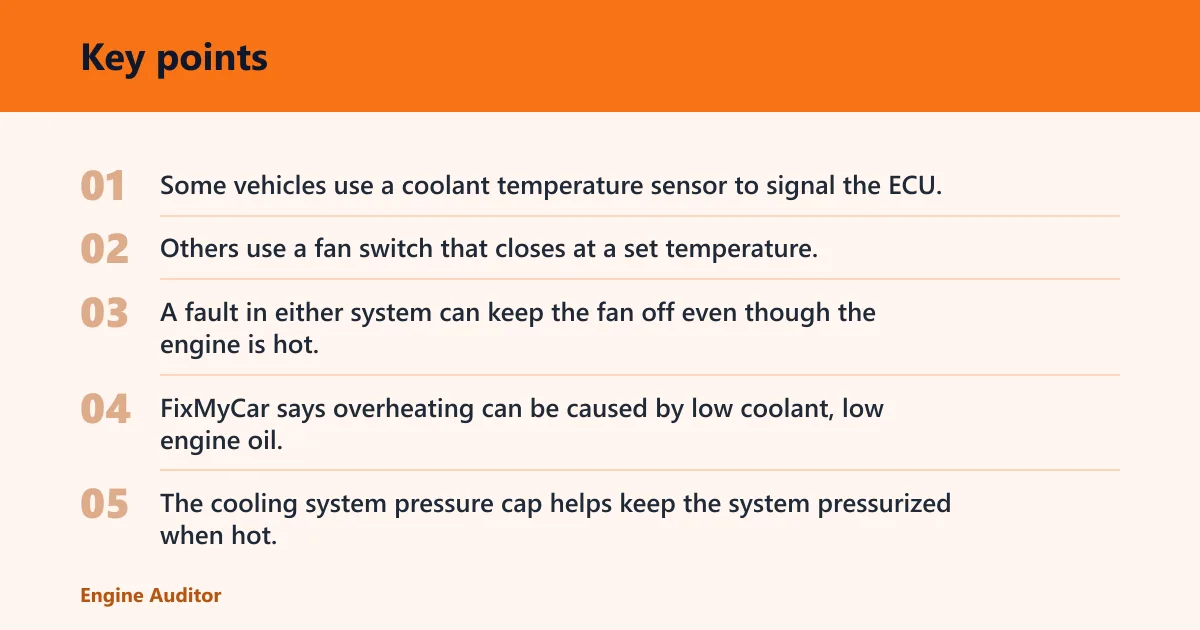
Some vehicles use a coolant temperature sensor to signal the ECU, which then commands the fan. Others use a fan switch that closes at a set temperature. A fault in either system can keep the fan off even though the engine is hot. The same source says overheating can be caused by low coolant, low engine oil, a faulty thermostat, a broken radiator, or a damaged water pump.
Pressure cap problems
The cooling system pressure cap helps keep the system pressurized when hot. If it is weak or damaged, the coolant can lose pressure and boil sooner. Do not open a hot cap. Wait until the engine is fully cool before checking it or any other pressurized part of the system.
When continued overheating risks head gasket damage
Stop driving when overheating is confirmed. Continued overheating can damage the head gasket, and once that happens the repair gets larger fast. Steam, a gauge in the red, and an unusual smell are all warning signs FixMyCar lists as overheating indicators.
Is it safe to drive if my car overheats at idle?
No, not if overheating is confirmed. Pull over, let the engine cool, and do not open the radiator cap while hot. If the temperature keeps rising at idle, the problem can worsen quickly, and continued driving raises the chance of head gasket damage, warped metal, and coolant boil-over.
After the engine cools, a short, careful check is reasonable if you need to confirm coolant level or fan behavior. If the gauge climbs again, or you see steam or a strong coolant smell, stop driving and arrange repair.
Frequently asked questions
Does idling make your car overheat?
Yes. Idling can make your car overheat because airflow drops when the vehicle is stopped, and the cooling system depends more on the fan. A weak fan, low coolant, a stuck thermostat, or poor circulation can turn stop-and-go traffic into the condition where the fault shows up first.
What causes a car to overheat while idling?
The usual causes are airflow faults, circulation faults, or control faults. That includes a radiator fan that never starts, a weak fan clutch, low coolant, a stuck thermostat, a weak water pump, a blocked radiator, or a bad coolant temperature sensor or fan switch.
How do I tell if the radiator fan is the problem?
Watch whether the fan starts when the engine gets hot, and whether it changes behavior with the AC on. If the fan stays still, runs slowly, or works only sometimes, the problem may be the fan motor, relay, wiring, or the control signal rather than the radiator itself.
Will low coolant make a car overheat while idling?
Low coolant can cause idle overheating because the system may not have enough coolant to move heat away from the engine. The reservoir can drop slowly without an obvious puddle, so check the minimum and maximum marks only after the engine has fully cooled.
Can a thermostat cause heat rise at idle?
Yes. A stuck thermostat can limit coolant flow and trap heat in the engine. That fault often shows up more at idle because the radiator already has less airflow, so any restriction in circulation becomes more obvious when the car is stopped or creeping in traffic.
What should I check first when my car overheats in traffic?
Check the coolant level in the reservoir, then confirm that the fan comes on as the engine warms up. After that, look for AC-triggered fan behavior, leaks, bent fins, and blocked airflow through the radiator. If the gauge is in the red, stop driving and let it cool.
Does idling your car cause damage?
Idling alone does not automatically cause damage, but idling with an overheating fault can. If the car is already running hot, continued idling can boil coolant, warp parts, and raise the risk of head gasket damage. The risk comes from the fault, not the idle time alone.
Products related to this article
Sponsored / affiliate links. As an Amazon Associate I earn from qualifying purchases. I may earn additional commission from eligible campaigns.