Why Is My Car Overheating at Idle but Fine When Driving?
If your car overheats only at idle or in traffic, the usual causes are weak radiator airflow, a fan that does not come on, poor coolant circulation, low coolant, or trapped air, not engine load. Ignore it and you can warp the cylinder head, damage the head gasket, or leave the car stuck in stop-and-go traffic. This guide separates airflow faults from circulation problems, then checks the fan, radiator, coolant level, thermostat, water pump, cap, and A/C-related clues.
Why does my car overheat only at idle or in traffic?
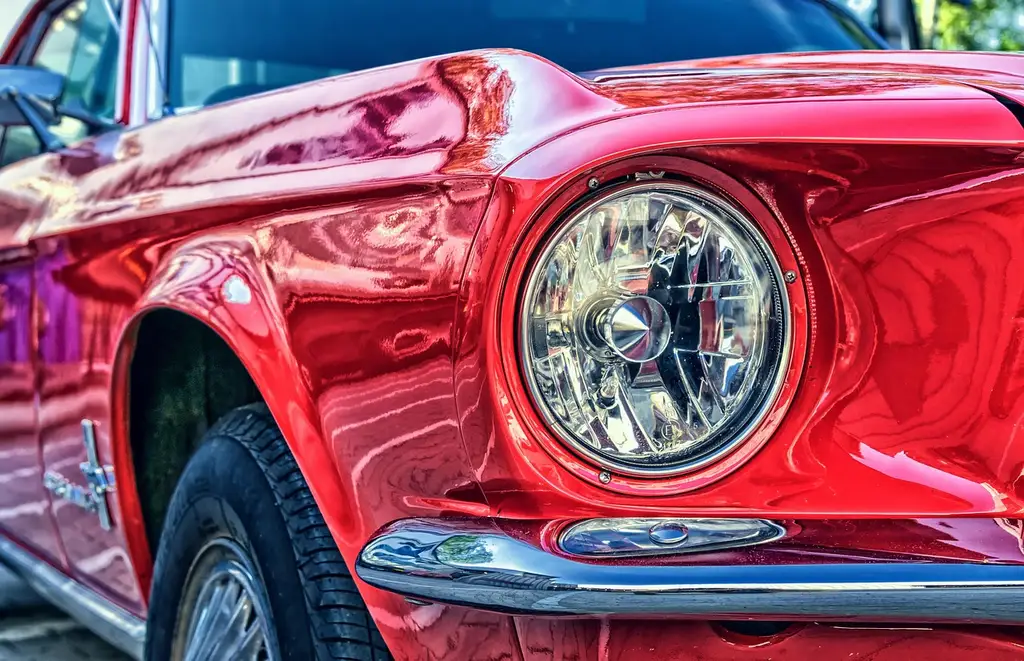


Overheating at idle usually points to heat removal at low speed. At road speed, natural airflow through the radiator can hide a weak fan, a partly blocked radiator, or a circulation problem that only shows up when the engine depends more on the fan and pump. That is why a car may run hot at a light and cool back down once it moves.
Why airflow matters more than load at idle
Traffic and A/C load matter because idle gives the cooling system less help. Fan operation, coolant level, thermostat movement, and pump flow do more of the work. A cooling system is also pressurized when hot, often around 13-18 PSI depending on the vehicle, so a small fault can become a bigger temperature swing once airflow drops. NHTSA guidance also warns that overheating can damage the engine quickly if ignored.
Diagnostic matrix
| Symptom pattern | Most likely component | Best cold-engine check | Next test |
|---|---|---|---|
| Idle-only overheating, normal while driving | Radiator fan, fan relay, or fan control | Watch for fan start-up as the engine warms; confirm fuse and relay condition | Check fan motor power, ground, and temperature-triggered command |
| A/C-on-only overheating at a stop | Weak fan or fan speed control fault | Turn the A/C on at idle and see whether the fan starts or speeds up | Test relay, control module, and fan motor current draw |
| Highway-only overheating | Restricted radiator, low coolant, or weak pump flow | Inspect coolant level and radiator face for debris or bent fins | Pressure-test the system and check for internal clogging |
| Temperature rises, then returns to normal | Thermostat sticking, air pocket, or erratic sensor reading | Monitor cold-start warm-up and heater output | Verify thermostat opening and scan live coolant temperature if possible |
| Heater blows cold while engine runs hot | Low coolant or air pocket | Check reservoir level cold and look for bubbles after startup | Bleed the system and inspect for leaks or hidden loss |
| Reservoir bubbles repeatedly | Head gasket leak or combustion gas in cooling system | Check for white smoke, coolant loss, and milky oil | Run a combustion-gas test or pressure test |
| Fan never runs or runs all the time | Relay, motor, sensor, or control fault | Check fuse, relay, connector, and coolant temperature signal | Bench-test the fan motor and verify command from the ECU or switch |
Say your sedan sits in a drive-thru line for ten minutes and the gauge climbs, but it drops back to normal once you reach 35 mph. That pattern fits an airflow problem far better than a load problem. A fan that does not come on, or a radiator that cannot shed heat at low speed, is the first place to look. SAE service literature commonly describes this kind of low-speed cooling dependence as a fan-command and airflow check, not a road-load issue.
Can a bad radiator fan cause overheating in traffic?
Yes. A failed radiator fan is one of the most common reasons a car overheats in traffic but stays fine on the highway. The fan is the low-speed substitute for road airflow. If the fan motor is weak, the relay is bad, or the control circuit never commands it on, the engine can run hot at idle and act normal once air moves through the grille.
How the fan should work
On many vehicles, the fan turns on when coolant temperature climbs into a range around 200-230°F, depending on the vehicle and calibration. OEM owner manuals and service information commonly tie fan operation to coolant temperature and A/C demand. At idle, the system relies more heavily on fans and coolant circulation, so a fan problem often shows up first in traffic.
A bad radiator fan can also bring A/C trouble and loud noise. If the A/C is on and the fan does not run, condenser heat builds up in front of the radiator, and coolant temperature can rise fast.
Relay, fuse, motor, and control checks
- Start with the engine cold. Check the fan blades for free movement and obvious damage.
- Inspect the fuse and relay listed for the cooling fan circuit.
- Let the engine warm up and watch whether the fan starts near the expected temperature.
- Turn the A/C on. On many cars, that should request fan operation.
- If the fan never starts, test for power and ground at the connector, then the motor or the control side may need attention.
Fan failure can come from electrical faults or a worn motor. A control problem can be just as important as a dead motor. A coolant-temperature sensor or the engine computer may never send the command if the signal is wrong, even when the fan itself is healthy.
How to tell if the thermostat is stuck closed
A thermostat that sticks closed can trap hot coolant in the engine and block flow to the radiator. Most thermostats open around 195-210°F, which matches common OEM specifications and service data. If it opens late, only partly, or not at all, the engine can rise into the hot zone quickly, then cool back down after the airflow or coolant pattern changes.
Stuck closed versus partially open
A fully stuck thermostat usually creates a fast overheat and a hot upper engine with little radiator heat. A partly closed thermostat may act more erratic. It can let enough coolant through at cruise, then restrict flow at idle when the system already depends more on the fan and circulation.
Intermittent failure is common enough to matter. If the gauge rises, then falls, then rises again, the thermostat is a suspect along with trapped air or a sensor issue.
What to look for first
- Cold start with the upper radiator hose staying cool too long.
- Rapid rise in gauge temperature before the radiator warms.
- Cabin heat that changes sharply as the gauge moves.
- One hose much hotter than the other after warm-up.
Can low coolant cause my car to overheat at idle?
Yes. Low coolant is one of the most common causes, and it can trigger overheating even when no puddle is visible. The level may be low because of a slow leak, a cap that does not hold pressure, or normal consumption that has gone unchecked. On a cold engine, the reservoir should sit between the minimum and maximum marks, and the mix should be 50/50 antifreeze and water.
Cold-engine reservoir check
Check the reservoir only when the engine is cold. The cooling system is pressurized when hot, and opening the cap then is unsafe. If the level is below minimum, top off with the correct mix only after you find the reason for the loss.
Low coolant can also be a clue to hidden loss. Look for damp hose ends, crusty residue near clamps, stains around the radiator tanks, or wet marks near the water pump housing.
What low coolant often means
- An external leak that appears only when the system is hot and under pressure.
- Slow consumption into the engine, which may not leave a driveway puddle.
- Air entering the system after the level drops.
Radiator and water pump checks for idle overheating
The radiator is the heat exchanger. It must shed heat to the air. If the core is clogged inside, packed with debris outside, or leaking at the tanks, the engine can overheat at idle because there is not enough heat transfer when airflow is weak. At road speed, extra air can mask part of the problem.
Radiator condition
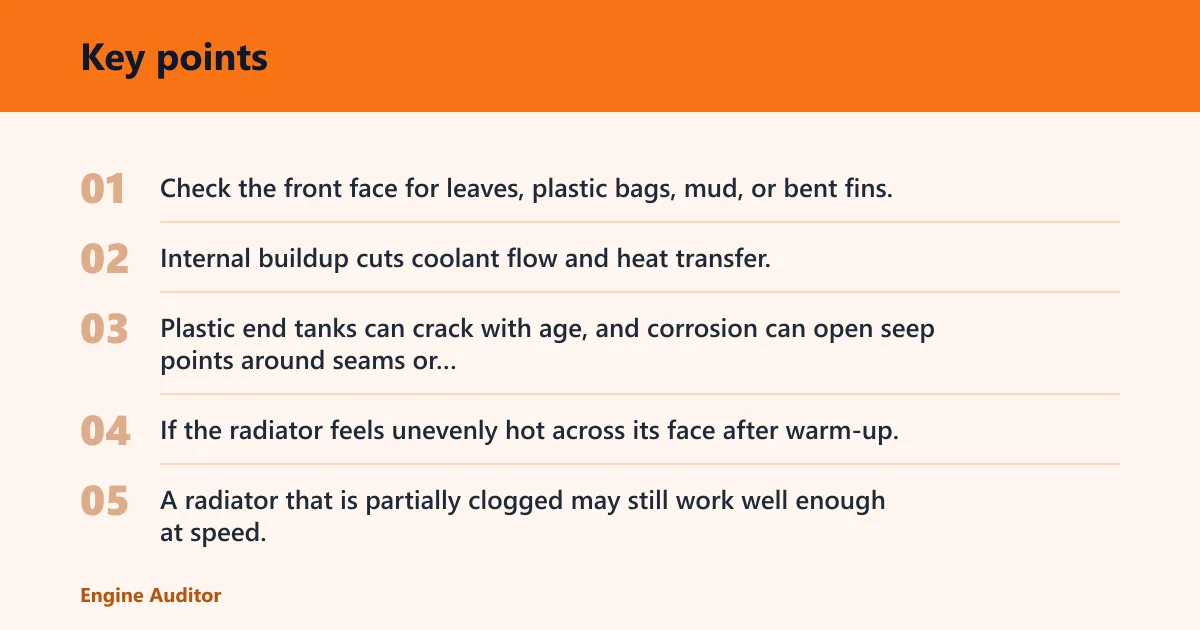
Check the front face for leaves, plastic bags, mud, or bent fins. External blockage cuts airflow. Internal buildup cuts coolant flow and heat transfer. Plastic end tanks can crack with age, and corrosion can open seep points around seams or hose necks.
If the radiator feels unevenly hot across its face after warm-up, that can point to restricted flow. A radiator that is partially clogged may still work well enough at speed, then fail to keep up in traffic.
Water pump wear
The water pump moves coolant through the engine, radiator, and heater core. If the impeller is worn or the shaft bearing is failing, circulation may be weak. A bad water pump may first cause intermittent overheating before complete failure. At higher RPM it may move enough coolant to hide the fault, while idle exposes the weak flow.
Listen for bearing noise, look for seepage at the pump, and check for wobble at the pulley if the design allows it. A pump problem is less common than a fan or coolant issue, but it belongs on the list when the symptoms do not fit a fan-only failure.
Picture a compact car that runs hot in a long idle, yet the gauge settles once the engine speed stays above 2,000 rpm. That pattern can fit a pump that is losing efficiency, or a thermostat that does not open cleanly. It is a circulation clue, not a pure airflow clue.
Could air in the cooling system make my car overheat at idle?
Yes. Air pockets can block coolant flow after low coolant, a repair, or a poor bleed. Trapped air can cause temperature swings, delayed thermostat operation, and weak heater output. If coolant is low, the system should never have air bubbles in it during normal running.
Heater performance as a clue
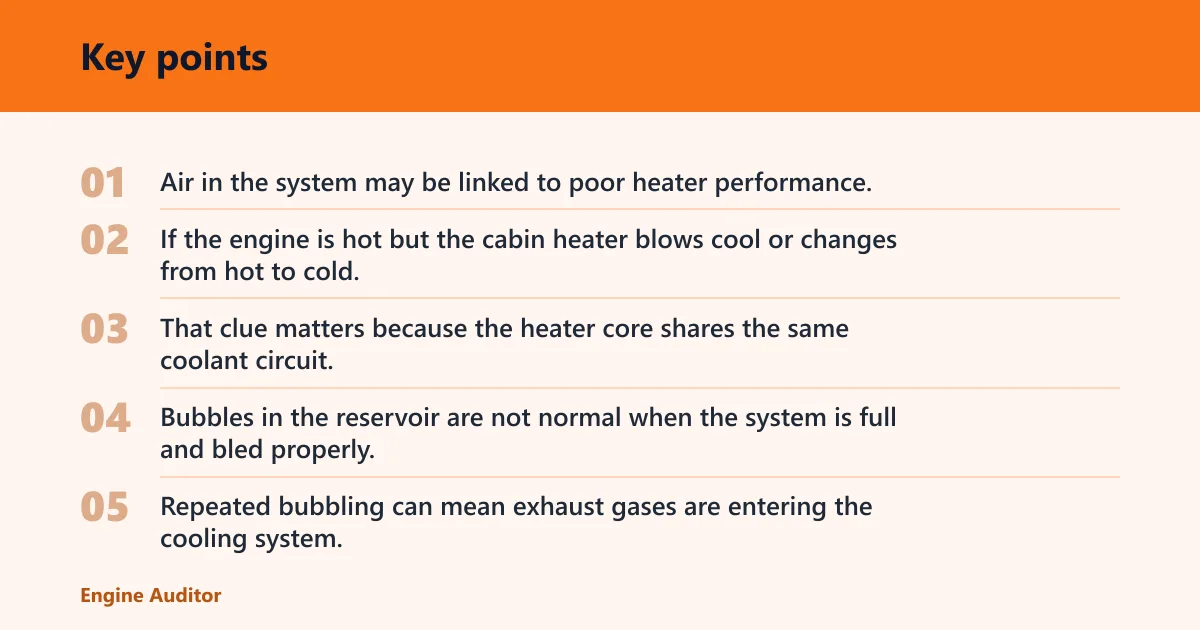
Air in the system may be linked to poor heater performance. If the engine is hot but the cabin heater blows cool or changes from hot to cold, coolant may not be moving through the heater core steadily. That clue matters because the heater core shares the same coolant circuit.
Reservoir bubbles and head gasket clues
Bubbles in the reservoir are not normal when the system is full and bled properly. Repeated bubbling can mean exhaust gases are entering the cooling system. That points toward a head gasket leak or, less often, another combustion-gas path into the coolant. White smoke from the tailpipe and milky oil raise that concern further.
Do not jump straight to a head gasket if the only symptom is idle overheating. First rule out low coolant, a fan fault, an air pocket, or a thermostat problem. A head gasket becomes more likely when bubbling, coolant loss, and white smoke appear together, or when the engine misfires after warm-up. For a broader step-by-step flow, see car cooling system problems and compare the symptom pattern with the lower-airflow failures above.
What does it mean when the temperature gauge rises and then goes back to normal?
A gauge that rises and then returns to normal can mean the cooling system is cycling around a weak point. The cause may be a thermostat that opens late, a fan that starts too slowly, air in the system, or a faulty coolant temperature sensor. A dashboard reading alone does not prove the engine is fine.
Dashboard symptom versus actual overheating
A faulty coolant temperature sensor can make the gauge act erratically. That means a gauge swing may be a false reading, or it may reflect a real temperature change. If the warning light or gauge enters the red zone, treat it as real until you confirm otherwise.
If the gauge jumps without any coolant smell, fan change, or heater change, check the sender, wiring, and scan data if available. If the gauge rises along with hot coolant smell, loss of heat from the vents, or boiling sounds, assume the engine is actually overheating.
Why does my AC make the car overheat at idle?
With the A/C on, the cooling system has to deal with extra heat from the condenser in front of the radiator. At idle, the fan has to pull more air through both heat exchangers. If fan speed control is weak, the relay is failing, or the motor is slow, the car may overheat only when the A/C is on and the vehicle is stopped.
What that pattern means
This symptom points strongly to fan performance, not engine load. The A/C can expose a marginal fan because the system needs more airflow than it gets from idle alone. If the temperature climbs with the A/C on and drops when you switch it off, the fan circuit deserves priority.
Is it safe to drive a car that overheats in traffic?
Only if you can keep the temperature out of the red and the car can shed heat again quickly. If the gauge enters the red, pull over and stop driving. Do not keep pushing it in traffic. Overheating can damage the head, head gasket, radiator, and hoses in a short time, as NHTSA service guidance and owner manuals routinely warn.
Do not open the cap when the engine is hot. Let the car cool first, then inspect the coolant level and visible leaks. If it cannot stay cool at idle, treat it as an active fault, not a minor annoyance.
Frequently asked questions about idle overheating
Why does my car overheat at idle but cool down when I drive?
That pattern usually means the cooling system is short on low-speed heat removal. The fan may not come on, the radiator may be blocked, coolant may be low, or the system may have air in it. Road speed adds airflow, which can hide the fault until you stop.
Can a bad radiator fan cause overheating only when stopped?
Yes. A failed fan is one of the classic traffic-only faults. If the fan motor, relay, fuse, or control side fails, the engine may stay cool on the highway but overheat at idle because the radiator no longer gets enough airflow.
How do I tell if my thermostat is stuck closed?
A stuck-closed thermostat usually causes a quick temperature rise, poor flow to the radiator, and sometimes a heater that does not behave normally. If the upper hose stays cool too long or the engine overheats before the radiator warms, the thermostat is a strong suspect.
Can a bad water pump cause overheating mostly at idle?
It can. A worn impeller or failing bearing may still move enough coolant at higher RPM, then fall short at idle where the system depends more on steady circulation. A bad pump often causes intermittent overheating before complete failure, so do not rule it out if the fan checks pass.
How do I check the radiator fan relay or fan motor?
Check the fan fuse first, then the relay, then the connector and ground at the fan motor. With the engine warmed, the fan should start near the temperature the vehicle expects, often around 200-230°F. If power and ground are present but the fan does not run, the motor is likely bad.
Products related to this article
Sponsored / affiliate links. As an Amazon Associate I earn from qualifying purchases. I may earn additional commission from eligible campaigns.