What Happens If You Put the Wrong Coolant in Your Car?
A small one-time top-off with the wrong coolant is usually not an emergency, but mixing incompatible coolant types can damage seals, gel the coolant, and shorten water-pump and radiator life. Ignoring it can turn a cheap drain-and-refill into a thermostat, heater-core, or head-gasket repair. This guide explains what matters most, what to check on the label, and when to flush the system now.
Coolant and heat transfer
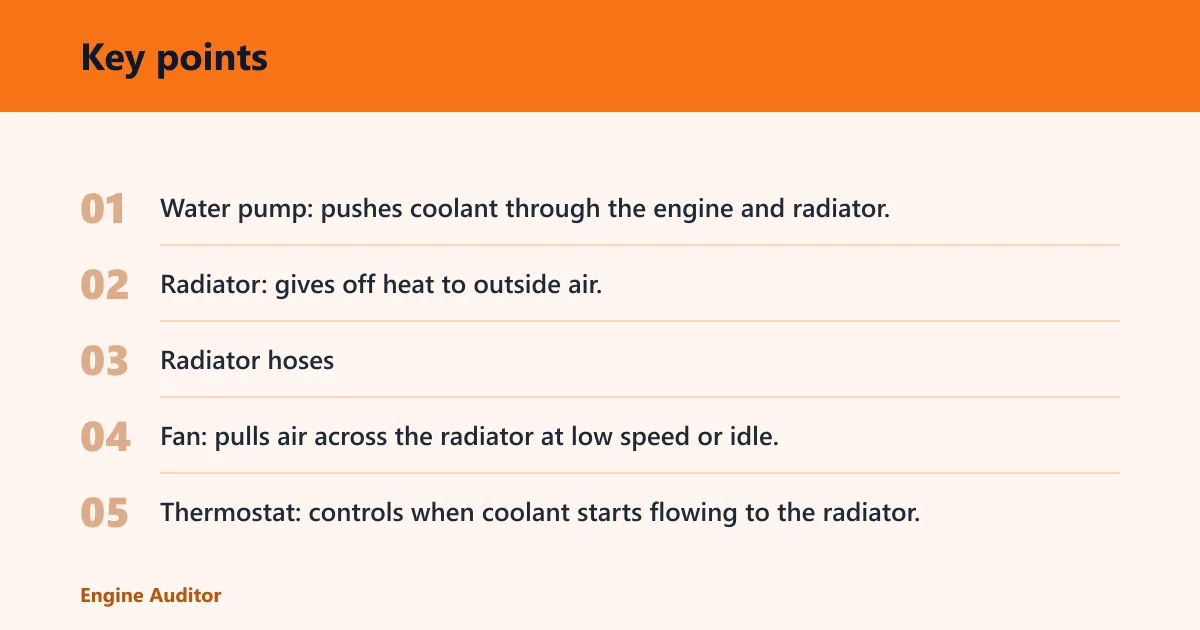


Engine coolant is glycol-based. In a liquid cooling system, it carries heat away from the engine, helps prevent freezing, and reduces corrosion inside the cooling system. The water pump, radiator, radiator hoses, fan, and thermostat all depend on the fluid staying compatible and clean.
Pure water moves heat, but it is a poor long-term choice because it can form rust on iron engine parts. Corrosion can also interfere with heat transfer. That matters because deposits and rust reduce the system’s ability to shed heat when the engine is under load or stuck in traffic.
What the cooling system parts do
- Water pump: pushes coolant through the engine and radiator.
- Radiator: gives off heat to outside air.
- Radiator hoses: carry coolant between components.
- Fan: pulls air across the radiator at low speed or idle.
- Thermostat: controls when coolant starts flowing to the radiator.
Coolant types and color ranges
There are three routinely used coolant types. IAT coolant is the conventional coolant used on older vehicles, and it can be green or yellow. OAT coolant uses organic acid technology and is available in several colors, including dark green, orange, pink, and blue. HOAT coolant blends ideas from IAT and OAT and is popular in most new vehicles. (UTI)
Color helps with identification, but it does not prove compatibility by itself. Two coolants can share a color and still have different chemistry. Two different colors can also sometimes be compatible if the manufacturer says they are the same spec. The label and the factory requirement matter more than the tint.
IAT coolant
IAT coolant is the conventional type for older vehicles. It typically needs more frequent changes than newer formulations. If the owner’s manual calls for IAT, using something else may shorten service life or change how the system protects metal parts.
OAT coolant
OAT coolant uses organic acid technology and is common across several brands. It often appears in dark green, orange, pink, or blue versions. Some systems tolerate a similar-looking OAT product; others do not. The exact specification decides that, not the color alone.
HOAT coolant
HOAT coolant combines features from IAT and OAT. It is popular in most new vehicles, but that does not mean every new vehicle uses the same HOAT formula. A bottle marked HOAT still has to match the vehicle’s required specification.
Why the owner’s manual matters
The owner’s manual gives the factory coolant specification, which is the safest match point for the cooling system. It names the exact type the engine, radiator, hoses, and seals were built around. Brand name and color are not enough, because two products can look similar and still use different additive packages.
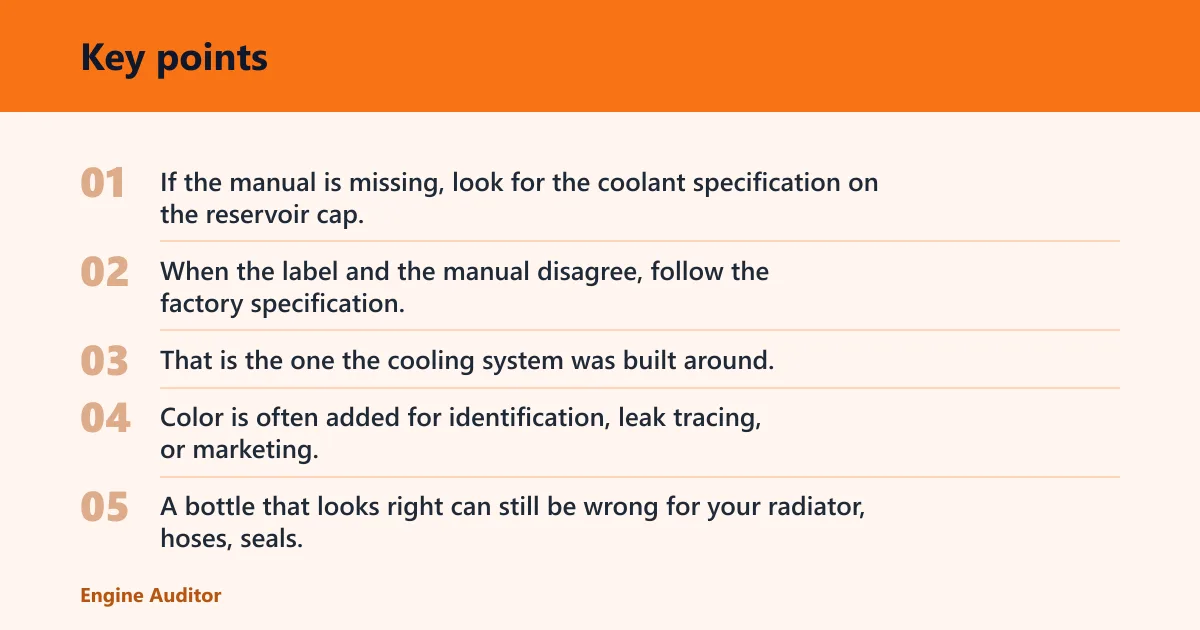
If the manual is missing, look for the coolant specification on the reservoir cap, under-hood label, or service information for that exact engine and model year. When the label and the manual disagree, follow the factory specification. That is the one the cooling system was built around.
Why brand and color are not enough
Color is often added for identification, leak tracing, or marketing. It is not a universal chemistry code. A bottle that looks right can still be wrong for your radiator, hoses, seals, and water pump if the additive package does not match the required spec.
What happens if you put the wrong coolant in your car?
A small top-off with the wrong coolant is often less serious than a full-system mix, especially if the product is close to the required spec. The risk rises when the coolant is clearly incompatible, added in a large amount, or left in the system for a long time. That is when sludge, corrosion, seal wear, and poor heat transfer become more likely.
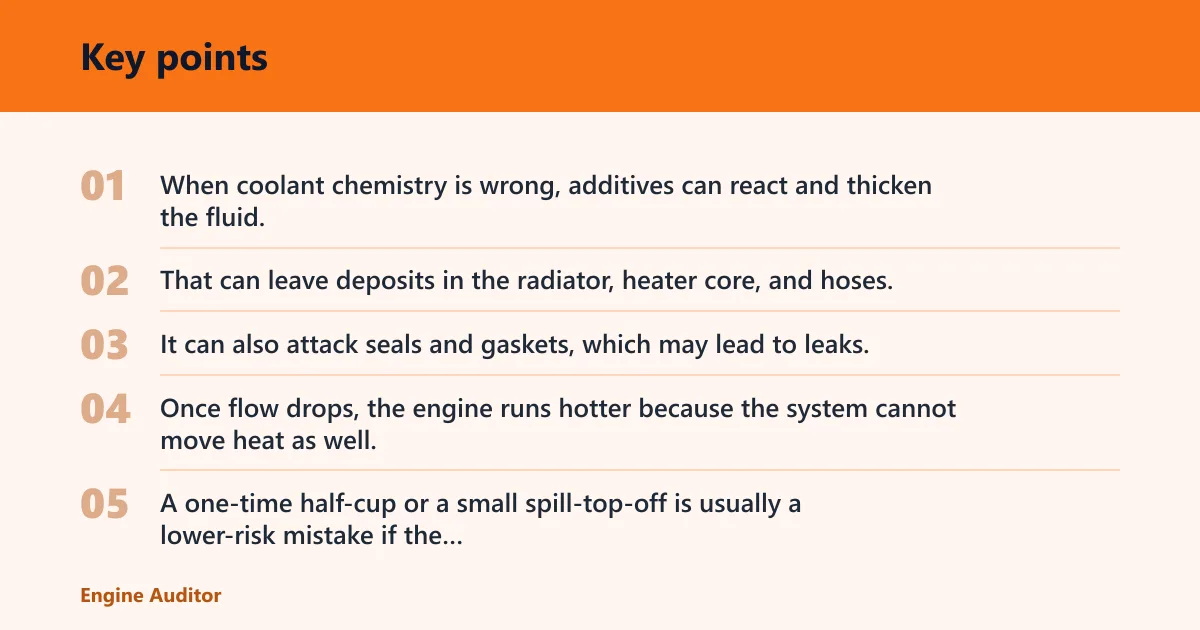
When coolant chemistry is wrong, additives can react and thicken the fluid. That can leave deposits in the radiator, heater core, and hoses. It can also attack seals and gaskets, which may lead to leaks. Once flow drops, the engine runs hotter because the system cannot move heat as well.
Small top-off versus large mismatch
A one-time half-cup or a small spill-top-off is usually a lower-risk mistake if the product is close to spec and the level was low. A full bottle of the wrong coolant, or repeated top-offs with the wrong type, generally creates a much higher chance of chemical conflict and long-term damage.
Picture a car that needed just enough coolant to reach the cold mark on the reservoir. A half-liter top-off of the wrong but similar spec may only need monitoring and a planned service. Add the same fluid to an already full system, or mix it with a different technology family, and the system may begin to form deposits over time.
Possible sludge, corrosion, and seal trouble
Sludge is one of the clearest signs of a chemistry mismatch. It can look like thick residue in the overflow tank or on the cap. Corrosion can pit metal surfaces, and that damage interferes with heat transfer. Seal wear can then follow, because contaminated coolant is harder on water-pump seals and hose connections.
Overheating risk if the mix is wrong
Using the wrong product can cause poor performance or engine failure. The first sign is often not immediate failure. It may start as a slightly higher temperature reading, weak cabin heat, or a heater that changes output at idle. If the restriction grows, overheating can follow.
Suppose a driver tops off an orange OAT coolant system with an incompatible older green IAT coolant. The car may drive normally at first. Over the next week, residue can appear in the reservoir, and the temperature gauge may begin to climb in traffic before the cooling system shows a larger problem.
Coolant decision table
| Scenario | Likely risk level | Next action |
|---|---|---|
| Small one-time top-off with a coolant that matches the factory spec | Low | Monitor the level, keep the receipt or label, and plan normal service. |
| Mixed-color top-off, but both products meet the same specification | Low to moderate | Check the label and manual, then watch for residue, leaks, or temperature changes. |
| Clearly incompatible coolant added in a larger amount | High | Schedule a flush or drain-and-refill as soon as practical. |
| Engine overheated after the fill | High | Stop driving, let the engine cool, and inspect for leaks or blocked flow before restarting. |
| Unknown coolant type in the reservoir or bottle | Moderate to high | Do not add more. Identify the spec before driving far or topping off again. |
| Do not drive: temperature gauge climbing, steam, sweet smell, or visible leak after the mistake | Critical | Shut the engine off and arrange towing or immediate service. |
What should you do after the mistake?
Start by checking the bottle label and the owner’s manual. If the coolant matches the required spec, the risk is usually lower. If it does not match, the safe choice is to plan a flush or drain-and-refill sooner rather than later, especially if a large amount went in.
Then watch the system closely for the next day, week, and month. A wrong-coolant mistake often shows up first as a slow problem, not an instant one. Watch for a rising temperature gauge, heater output changes, coolant discoloration, residue in the overflow tank, leaks, or a sweet smell near the front of the car.
- Check the owner’s manual or factory spec for the exact coolant requirement.
- Read the label on the bottle you added.
- Decide whether the fill was a small top-off or a large mismatch.
- Watch for temperature change, heater change, residue, leaks, or odor.
- Arrange a flush or drain-and-refill if the coolant is clearly incompatible.
- Call a mechanic if you cannot confirm the spec or if symptoms start.
A common mistake is topping off a late-model SUV with a universal coolant that does not match the engine’s specified chemistry, even though the overflow tank looks similar. It does not. If the coolant is unknown, treat the system as uncertain until the exact specification is confirmed. That is safer than adding more of the wrong product and hoping the mix will sort itself out.
Frequently asked questions
What happens if you put the wrong color coolant in your car?
Wrong color does not always mean wrong chemistry, and matching color does not guarantee compatibility. If the product meets the factory spec, the color may not matter much. If it does not, color is beside the point and the system may still face deposit buildup or seal problems.
What happens if you use the wrong coolant?
You may not notice anything right away. The problem often shows up later as hotter running, weak cabin heat, residue in the tank, or leaks from hoses, the radiator, or the water pump. The longer incompatible coolant stays in the system, the more likely damage becomes.
Can you mix different colors of coolant?
Only if the products are confirmed to meet the same manufacturer specification. Different colors can sometimes be compatible, and the same color can still be wrong. If you cannot verify the exact spec, do not assume a mixed-color blend is safe for the cooling system.
How do I know which coolant my car takes?
Use the owner’s manual first. If it is unavailable, check the under-hood label, reservoir cap, or service information for the exact year, engine, and model. The factory specification matters more than brand or color, because that is what the cooling system was built to use.
Should I drive the car after using the wrong coolant?
If the mistake was a tiny top-off and the engine is holding normal temperature with no leak, short driving may be reasonable while you verify the spec. If the gauge rises, the heater changes, or you see steam or smell coolant, stop driving and get the car serviced.
Products related to this article
Sponsored / affiliate links. As an Amazon Associate I earn from qualifying purchases. I may earn additional commission from eligible campaigns.