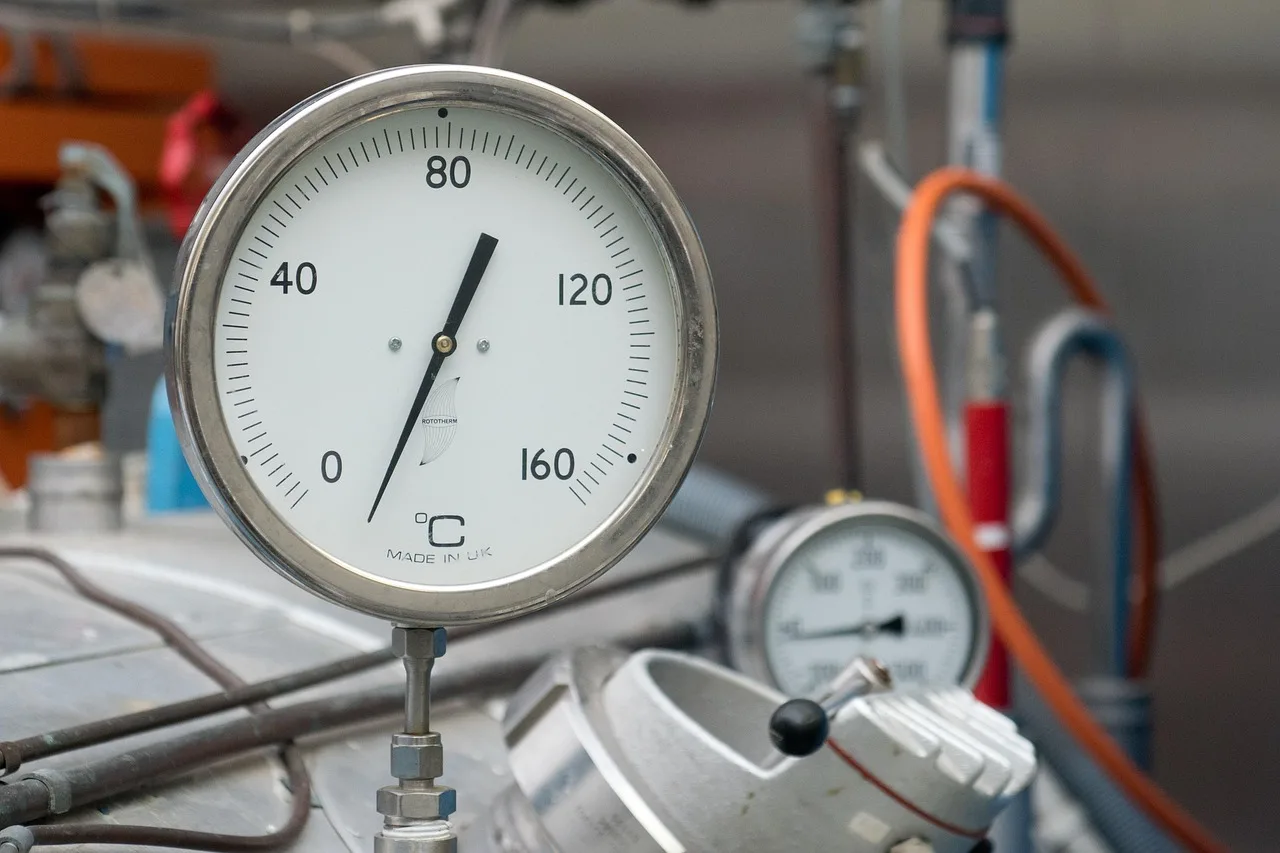
What Is the Normal Operating Temperature of a Car Engine?
For most cars, normal engine operating temperature is about 195–220°F, or roughly 90–105°C, once fully warm; a brief climb above that range is not normal if it keeps rising. If a true overheating warning is ignored, parts can warp, coolant can be lost, and the head gasket can fail. This guide explains coolant, oil, and gauge readings, plus the signs that point to a cooling-system fault.
Coolant temperature


That range is common because the thermostat, radiator, fan, and pressure cap are designed to bring the engine up quickly and then hold it there. The exact target still depends on the vehicle and load.
Oil temperature
Engine oil usually runs hotter than coolant after warm-up because it collects heat from internal engine parts. There is no single universal oil number for every car, but a healthy oil temperature should rise smoothly and then stabilize during normal driving. Oil temperature is useful context, but it is not the same reading as coolant temperature.
What the gauge means
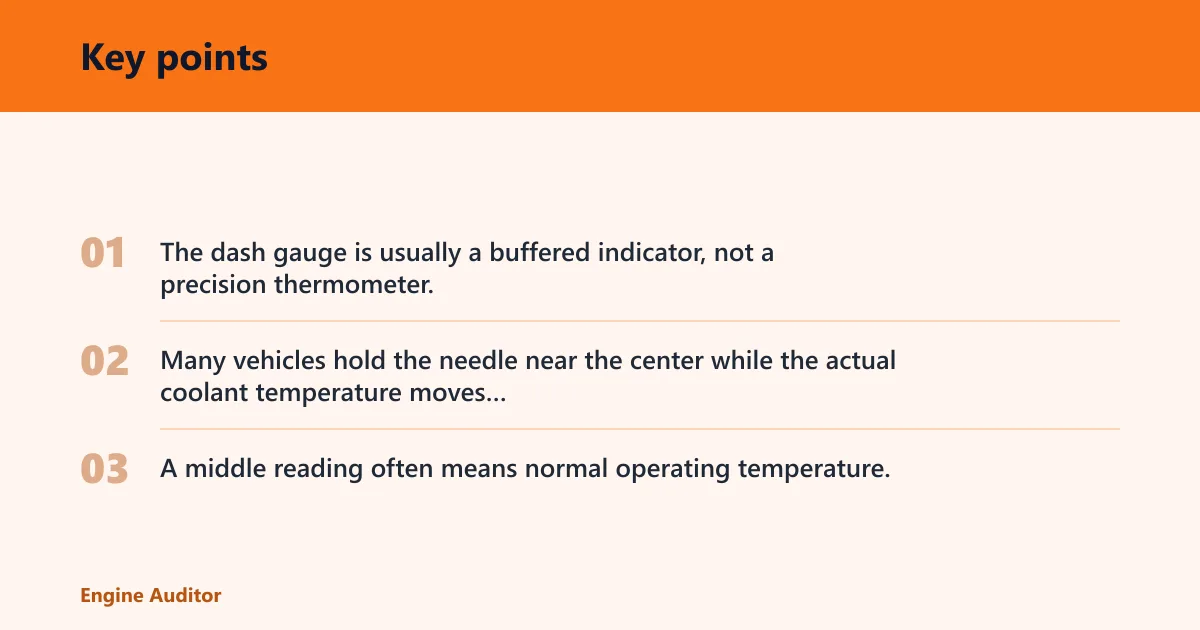
The dash gauge is usually a buffered indicator, not a precision thermometer. Many vehicles hold the needle near the center while the actual coolant temperature moves within a safe band. A middle reading often means normal operating temperature, while a move toward H indicates overheating and should be treated as a warning, not a minor fluctuation.
Abnormal signs
Abnormal behavior includes a needle that climbs in traffic and does not fall again, a reading that stays too low after the engine should be warm, or any rise toward H with a warning light. Those patterns can point to thermostat, fan, radiator, pump, sensor, airflow, or cap problems rather than a normal temperature swing.
First checks
Start with coolant level, leaks, fan operation, and airflow through the radiator. If the gauge seems questionable, confirm with scan data or an OBD-II tool. Those first checks separate a true overheating fault from a gauge issue and help you avoid replacing a part that is not actually causing the problem.
What temperature is normal?
Normal engine temperature is best judged from coolant, not from the dash needle alone. For many petrol engines, a healthy coolant reading sits around 90°C to 105°C, and some sources give the same band as 195°F to 220°F. The exact target changes with engine design, load, and ambient conditions.
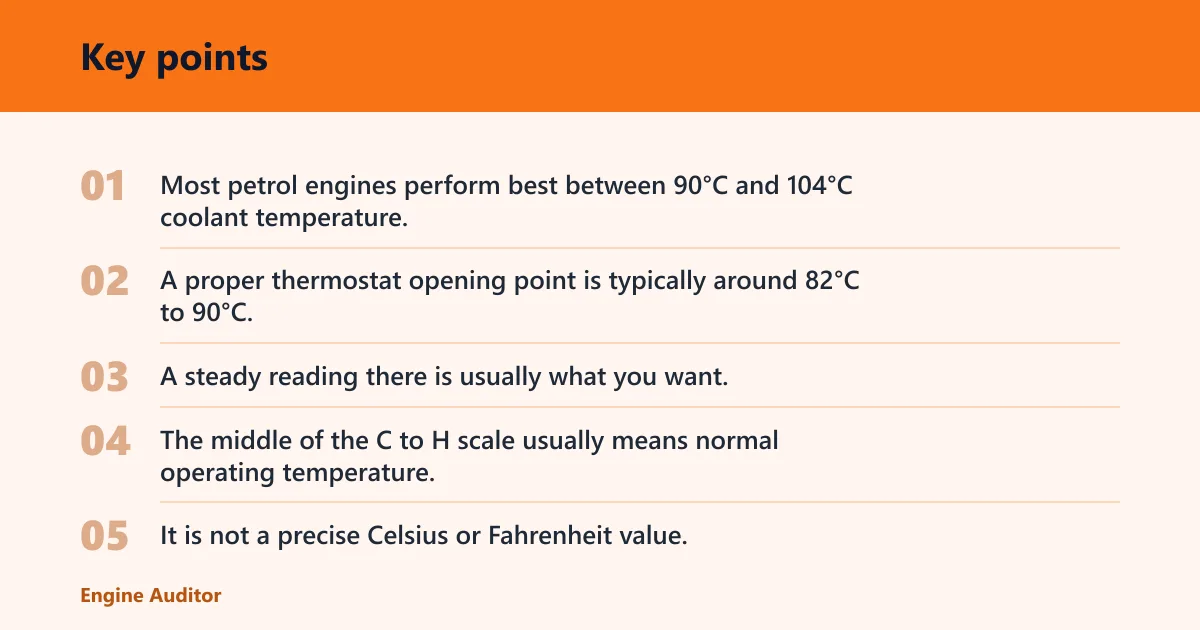
Most petrol engines perform best between 90°C and 104°C coolant temperature. A proper thermostat opening point is typically around 82°C to 90°C, so the system is built to warm up quickly and then settle near its intended range. A steady reading there is usually what you want.
What the gauge midpoint means
The middle of the C to H scale usually means normal operating temperature. It is not a precise Celsius or Fahrenheit value, because many dashboards buffer the signal and hold the needle near the center while coolant changes within a safe band. A needle that sits slightly below or around the midpoint can still be normal by design.
Near H on the gauge is described as overheating. That matters more than a small shift left or right of center. A reading that stays near the middle during mixed driving, then rises only slightly in traffic and falls again once airflow returns, often points to a normal cooling system.
Why exact numbers vary
Different engines use different calibration targets, thermostat ratings, cooling fans, and gauge strategies. That is why one car may sit a little below center while another sits close to the middle and both are fine. Load, towing, steep grades, hot weather, and stop-and-go traffic also raise temperature without meaning there is a fault.
Picture a compact sedan idling in summer traffic with the needle just above center, then dropping back when the car starts moving again. That pattern can be normal because airflow through the radiator improves at speed. The same reading, if it keeps climbing toward H, is a different story.
Normal temperature by reading type
| Reading type | Normal value or position | What it tells you |
|---|---|---|
| Coolant temperature | About 90°C to 105°C, or 195°F to 220°F, in many vehicles | The engine has reached its intended warm operating range |
| Oil temperature | Typically hotter than coolant once fully warmed | Oil is thin enough for proper flow, but it is not the same reading as coolant |
| Thermostat opening point | Around 82°C to 90°C | The thermostat begins sending coolant to the radiator |
| Dashboard gauge | Middle position, or slightly below or around the midpoint | Usually indicates normal operating temperature, not an exact number |
This table helps separate three things drivers often mix together: coolant temperature, oil temperature, and gauge behavior. A car can have a normal gauge needle while the oil is still warming up. It can also show a centered gauge while the actual coolant temperature moves within the normal band.
How oil temperature differs
Oil temperature is not the same as coolant temperature. Once fully warmed, engine oil often runs hotter than coolant because it is collecting heat from moving parts inside the engine. That makes oil temperature useful for lubrication and load management, but it is not what the dashboard coolant gauge is usually showing.
What is the normal oil temperature for a car engine? There is no single figure that fits every car, because oil temperature depends on engine design, driving load, and oil cooler setup. The key point is that a healthy oil reading can be noticeably higher than coolant while the coolant gauge still looks normal.
A common first-timer mistake is reading a hot oil value as if it were the coolant number. Suppose a turbocharged car shows hot oil after a long highway run, but the dash gauge stays centered and coolant is stable. That can be normal. If both oil and coolant keep rising, the problem is elsewhere.
Why does my gauge sit near the middle?
The gauge often sits near the middle because many manufacturers tune it that way. The needle is buffered to avoid constant tiny movement. As long as the coolant system is controlling temperature in the normal band, the driver sees a calm center reading rather than a live, exact temperature trace.
Buffered gauge behavior
The dash gauge is often not a precision thermometer. The engine coolant temperature gauge displays engine coolant temperature on Honda’s 2026 CR-V, and Honda warns that driving in the upper zone can cause serious engine damage. That warning matters because the upper zone means real overheating, while the center is only a normal operating band.
Some vehicles also sit a little below center by design. Others hold closer to the exact middle. Both can be normal if the scan data and driving behavior match. The gauge position should be read as a trend indicator, not as a direct substitute for a scan tool.
What parts control engine temperature?
Several parts set normal temperature. The thermostat decides when coolant starts flowing to the radiator. The radiator moves heat into outside air. The cooling fan helps when road speed is too low for strong airflow. The water pump circulates coolant through the engine. The sensor tells the ECU and the gauge what the coolant is doing.
Thermostat and coolant flow
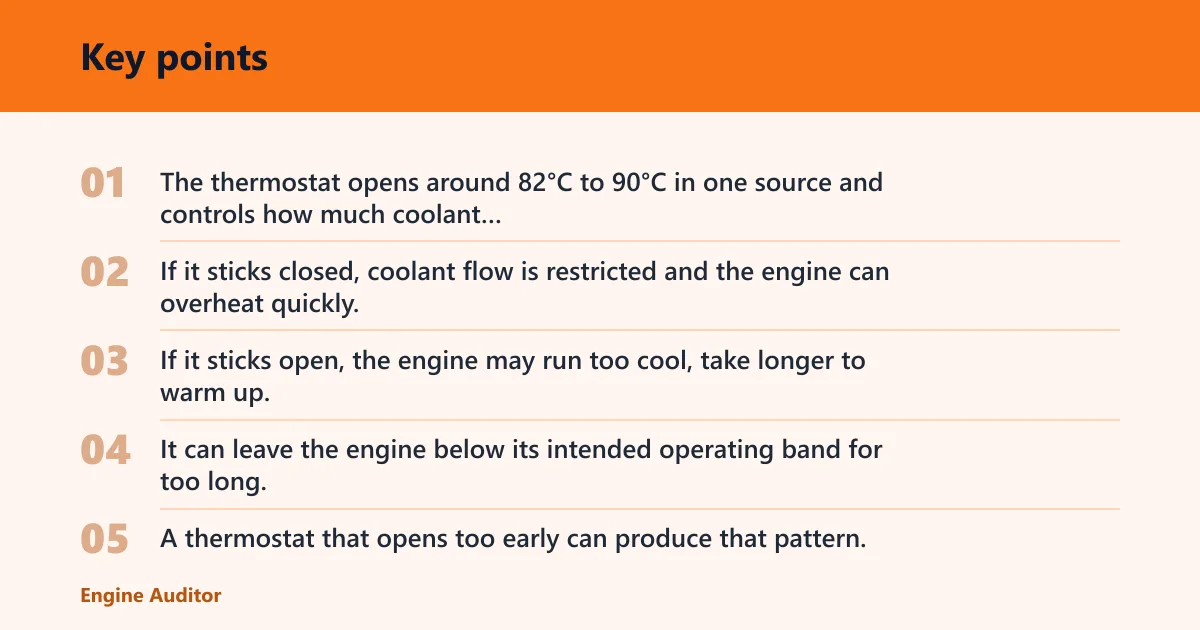
The thermostat opens around 82°C to 90°C in one source and controls how much coolant reaches the radiator. If it sticks closed, coolant flow is restricted and the engine can overheat quickly. If it sticks open, the engine may run too cool, take longer to warm up, and lose fuel economy and emissions performance.
Running too cold is not ideal. It can leave the engine below its intended operating band for too long, which hurts efficiency and can keep the oil from reaching its best working temperature. A thermostat that opens too early can produce that pattern.
Radiator, fan, and water pump
The radiator rejects heat from coolant to outside air. If it is clogged, internally restricted, or starved of airflow, coolant can run hotter than normal. The cooling fan matters most at idle and low road speed, where natural airflow is limited. Fan failure often shows up in traffic or at a stop.
The water pump circulates coolant through the system. A weak pump can reduce flow and create temperature inconsistency, especially when load changes. A slipping impeller or worn pump may let the gauge rise and fall in odd ways instead of holding a stable reading near normal.
Sensor and pressure cap
The coolant temperature sensor feeds dashboard and engine-control data. If it is faulty, the gauge can mislead diagnosis even when the engine itself is not overheating. A bad sensor can also hide a real fault, so a scan reading is more useful than guessing from the needle alone.
The radiator cap or pressure cap raises the boiling point in a pressurized system. If the cap cannot hold pressure, the boiling margin falls and the system can overheat sooner. Do not open a hot radiator or reservoir cap. Toyota says to wait until the engine has completely cooled before checking it.
When is a reading abnormal?
A reading becomes abnormal when it does not behave like a warmed engine should. That includes a gauge that stays too low after the engine has clearly been running long enough, a needle that climbs in traffic and does not fall again, or any move toward H with a warning light. Stable, slightly high, and slightly low all mean different things.
Cold when fully warmed up
If the engine is fully warm but the gauge stays low, the thermostat may be stuck open, the sensor may be off, or the gauge may be buffered in a way that hides the true reading. The car may also take too long to reach normal temperature on short trips. That pattern often points to overcooling rather than overheating.
Hot at idle or in traffic
If the gauge rises at idle or in traffic and then improves once the car moves, airflow is a prime suspect. The fan may not be coming on, the radiator may be blocked, or the pressure cap may be weak. That traffic-only pattern is one of the clearest signs of a cooling-system issue.
Near H or warning light
Near H means overheating, not a minor drift. If the gauge climbs there, pull over safely and shut the engine down if needed. Do not keep driving and do not open any hot cap. A serious overheat can damage the head gasket, warp metal parts, and push coolant out of the system.
Diesel engines and warm-up behavior
Diesels can warm more slowly than petrol engines, especially in light-load driving, cold weather, or short-trip use. They may also run a bit cooler at steady light load. Even so, once warmed, the coolant reading should stabilize in a normal band instead of continuing to climb. Under tow or heavy load, a sustained rise is not normal.
What should you check first?
Start with the simplest checks: coolant level, obvious leaks, fan operation, and airflow through the radiator. Then confirm the reading with scan data or an OBD-II tool if you can. That approach separates a true temperature problem from a dash gauge issue and helps you avoid replacing the wrong part.
- Check coolant level only when the engine has completely cooled.
- Look for leaks at hoses, the radiator, the reservoir, and the water pump area.
- Watch whether the cooling fan comes on when the engine gets hot or the air conditioning is running.
- Inspect the radiator face for blockage from dirt, leaves, or debris.
- Read coolant temperature with a scan tool or OBD-II data if the gauge seems suspicious.
Common scenarios and what they usually mean
| Scenario | Likely normal or abnormal | Next step |
|---|---|---|
| Cold start | Normal for the gauge to read low at first | Watch for a steady climb to the normal band as the thermostat opens |
| Warm idle | Normal if the needle stays near the middle and fan cycling is expected | Check for stable coolant level and fan operation if it drifts upward |
| Highway cruise | Normal if the reading is steady and near the usual operating band | Look for airflow restrictions or thermostat issues if the reading is low or unstable |
| Traffic idle | Normal only if the gauge remains stable and falls again when moving | Suspect fan, radiator, cap, or airflow faults if it keeps rising |
| Near-H | Abnormal | Pull over safely, shut down if needed, and do not open a hot cap |
Say your sedan sits just below the midpoint on the gauge during a 20-minute commute, then rises a little in a long traffic jam before dropping again once you reach open road. That can still be normal if scan data shows coolant holding in its expected band and the fan is cycling as designed.
Suppose a diesel pickup reaches the middle of the gauge on the highway but climbs close to H when towing up a steep grade. Diesel engines can have different operating behavior, but the same coolant-gauge logic applies: load raises temperature, and a climb that keeps building is a warning sign, not a normal steady state.
Frequently asked questions
What is the normal operating temperature of a car engine?
That range refers mainly to coolant temperature. The gauge needle usually sits near the middle, but the exact position can vary because many dashboards buffer the reading.
What is the normal running temperature of a cars diesel engine?
Diesel engines can use different calibration targets, but the same basic rule applies: once warmed up, the coolant should settle into its normal operating band and stay there under steady driving. If the gauge climbs in traffic or under load and keeps rising, treat it as abnormal.
What is the normal temperature of a car engine in celsius?
A common normal coolant range is about 90°C to 105°C in many vehicles. That is the figure to watch for a warmed engine, not a cold start. Some engines sit slightly below the middle of the gauge by design and still operate normally.
What is the normal oil temperature for a car engine?
Oil temperature is usually higher than coolant temperature after warm-up. There is no single universal oil number for every car, because engine design and load change it. What matters most is that oil gets fully warm and stays consistent during normal driving.
What temp should my engine?
A gauge at the middle is usually normal. A steady rise toward H is not.
What is the normal operating temperature for a car?
Normal operating temperature for a car usually means the coolant has reached its intended band and the gauge has settled near the midpoint. The exact number depends on the engine. The key is a stable reading, not a specific needle position to the nearest mark.
Products related to this article
Sponsored / affiliate links. As an Amazon Associate I earn from qualifying purchases. I may earn additional commission from eligible campaigns.