How Long Should You Let an Engine Cool Down After Overheating?
After an overheat, wait at least about 30–45 minutes before opening the hood, and wait longer if steam is still coming out. Do not open the radiator cap until the upper hose is cool enough to hold. Opening a hot cooling system can spray boiling coolant and turn a minor fault into burns, warped heads, or a seized engine. This article explains when to inspect, when to add coolant, and when to tow instead of restarting.
What to do first when it overheats
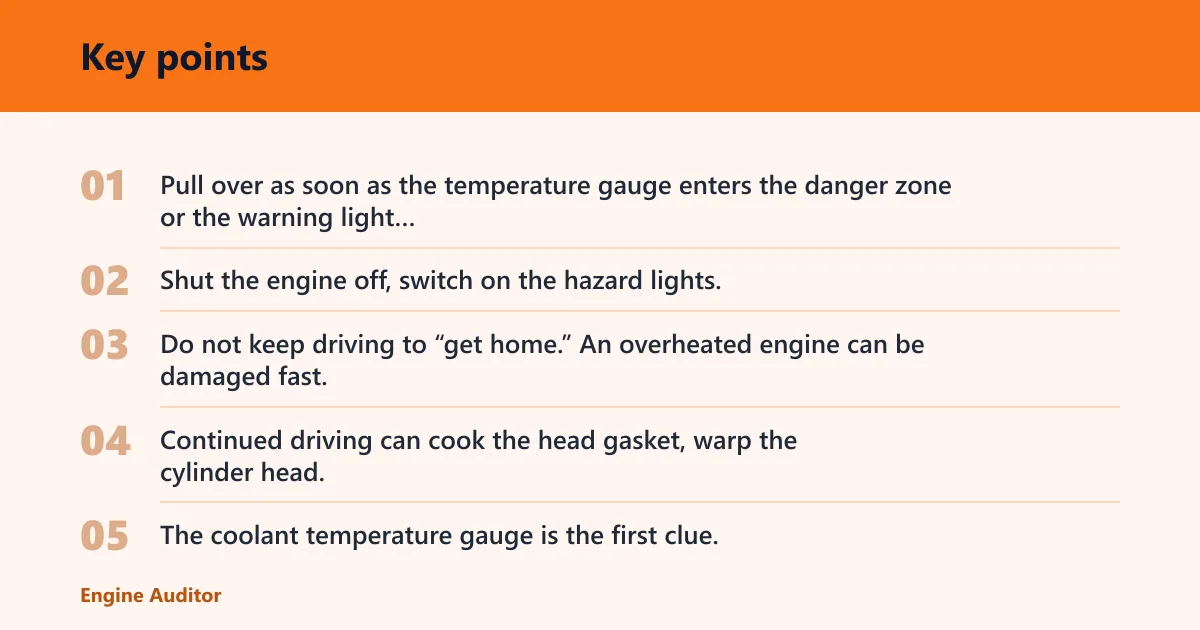


Pull over as soon as the temperature gauge enters the danger zone or the warning light comes on. Shut the engine off, switch on the hazard lights, and leave the radiator cap and reservoir cap alone until the system has cooled. Do not keep driving to “get home.”
An overheated engine can be damaged fast. Continued driving can cook the head gasket, warp the cylinder head, or seize the engine if oil temperature and coolant temperature keep climbing together.
What the gauge and warning light mean
The coolant temperature gauge is the first clue, but it is not the same across makes and models. Some dashboards move from normal to hot in a narrow band, while others stay centered longer and then rise quickly. Treat any move into the hot zone, warning light, or message as a stop-now signal.
When the gauge drops after shutdown, that does not always mean the cooling system is safe. A hot hood can cool faster than the radiator, hoses, and coolant inside. The upper hose is the better checkpoint for pressure, not the hood skin.
How long should you wait?
There is no single cooldown time that fits every vehicle, but there is a practical rule: wait until steam stops, the upper hose is no longer rock-hard, and the hood can be touched briefly without feeling heat pouring off it. For a mild overheat, that is often about 30–45 minutes. Heavier overheating can take longer.
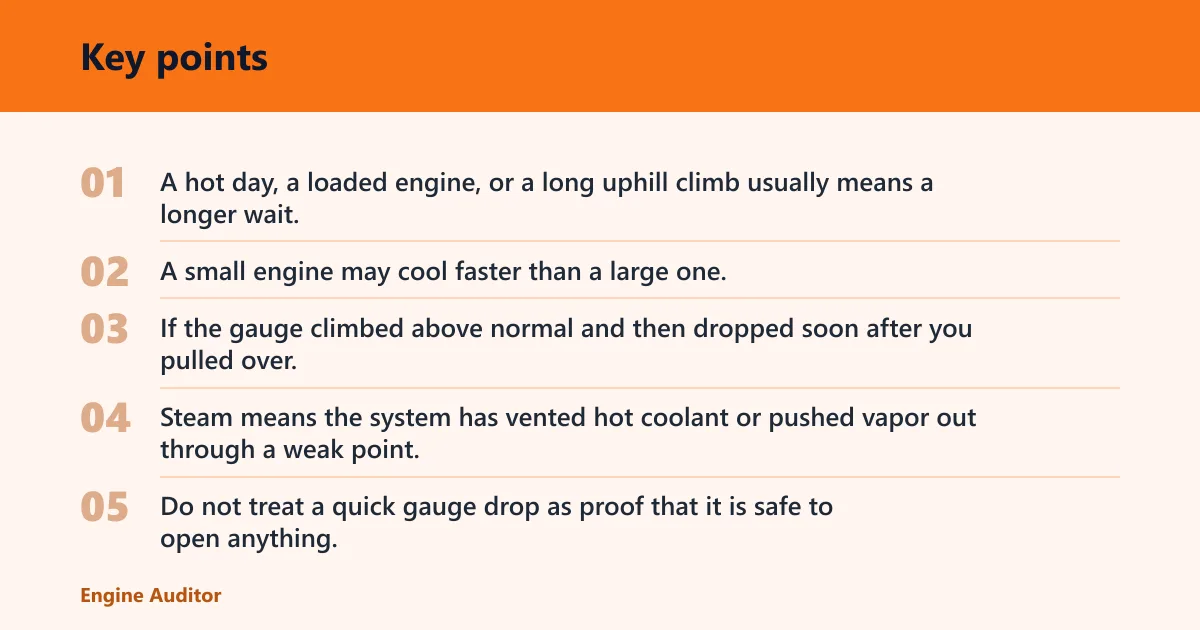
Ambient temperature matters. A hot day, a loaded engine, or a long uphill climb usually means a longer wait. A small engine may cool faster than a large one, but both can still hold pressure long after the gauge starts to fall.
Mild overheating
If the gauge climbed above normal and then dropped soon after you pulled over, a short wait window is often enough before a careful inspection. The key is not the clock alone. The system must lose pressure first.
Steam from the hood
Steam means the system has vented hot coolant or pushed vapor out through a weak point. Wait longer before any inspection. Do not treat a quick gauge drop as proof that it is safe to open anything.
Say your compact sedan idles in traffic on a 95-degree day and the gauge reaches the hot zone with light steam at the hood gap. Even if the gauge falls after shutdown, the safer move is still a longer cooldown, then a reservoir check only after the upper hose softens.
Boil-over
Boil-over is the severe case. Cool the car fully before inspecting the cooling system, and expect a longer wait than a mild overheat. Boiling coolant can stay hot and pressurized after the engine is off.
Picture a truck that crests a grade, then dumps coolant onto the pavement from the overflow path. That is not a quick roadside reset. Let it cool fully, then inspect for coolant loss, fan failure, hose damage, or a thermostat that may have stuck closed.
Safe to open the hood?
The hood can be safe to lift before the cooling system is safe to open. Those are different checks. You may be able to open the hood and look for steam, leaks, or obvious hose damage while still keeping your hands away from caps, the belt area, and the radiator neck.
Do not confuse “cool enough to touch the hood” with “cool enough to service.” The radiator cap is a pressure cap on the cooling system. If it is opened hot, it can release scalding coolant and steam.
What you can inspect without opening caps
With the hood open and the engine off, look for steam, wet spots, split hoses, coolant trails, or a fan that failed to run when the engine was hot. Check the temperature gauge position before and after shutdown if it is visible from outside the car.
Do not squeeze hoses hard or reach near the fan until you know the fan has stopped. Some electric fans can continue to run briefly after shutdown.
Signs the system is still too hot
If steam is still rising, the upper hose feels tight, or the hood area throws off a strong heat shimmer, wait longer. Bubbling in the reservoir also means the system still has heat and pressure. Do not open the cap to “see what is going on.”
Radiator cap and reservoir
Leave the radiator cap closed while the engine is hot. The reservoir cap is also part of the pressure path on many vehicles. Either one can spray hot coolant if opened too soon. The safer check point is the coolant reservoir after the engine has cooled enough to inspect.
Most reservoirs have MIN and MAX marks. Check the level against those marks only after the engine has cooled enough that the system is no longer boiling or venting. A level that changes as the system depressurizes is normal, so recheck only after the car has sat long enough to stabilize.
How to read MIN and MAX marks
Read the reservoir on level ground. If the level is below MIN after cooldown, the engine may have lost coolant through a leak, boil-over, or hose split. If it is at or above MAX when cold, do not assume that means the system is healthy; a bad cap or trapped air can still cause repeat overheating.
Use the reservoir as a clue, not the final diagnosis. Low coolant is a symptom, not a root cause. Common follow-up suspects include a leak, failed cooling fan, stuck thermostat, weak radiator cap, or bad water pump.
Cooling system cooldown table
The table below gives a practical decision rule for when the car is safe to inspect. It separates a hood you can open from a cooling system you can actually check.
| Symptom | Minimum wait window | Next safe action |
|---|---|---|
| Mild overheating: gauge climbed into the danger zone, but no steam and no boil-over | 30–45 minutes, longer in hot weather | Open the hood, then check for leaks and inspect the reservoir only after the upper hose is cool enough to hold |
| Steam from the hood or a brief coolant smell after shutdown | At least 45–60 minutes, or until all steam stops | Wait longer, then inspect for visible leaks, hose damage, and fan operation before checking coolant level |
| Boil-over: coolant pushed out, bubbling reservoir, or fluid on the ground | Full cooldown before any inspection | Do not restart until the engine is fully cool; check for coolant loss, leaks, and signs of a failed cap, fan, or thermostat |
| Repeat overheating after a cooldown and restart | Do not wait to try again | Tow instead of restarting again; repeated overheating is a red flag for deeper damage or a fault that will return quickly |
What to inspect after it cools
Once the engine is cool enough to inspect safely, check coolant level first, then look for the reason it overheated. The most useful checks are visible coolant loss, hose damage, fan operation, thermostat clues, and engine oil level.
Coolant level and visible leaks
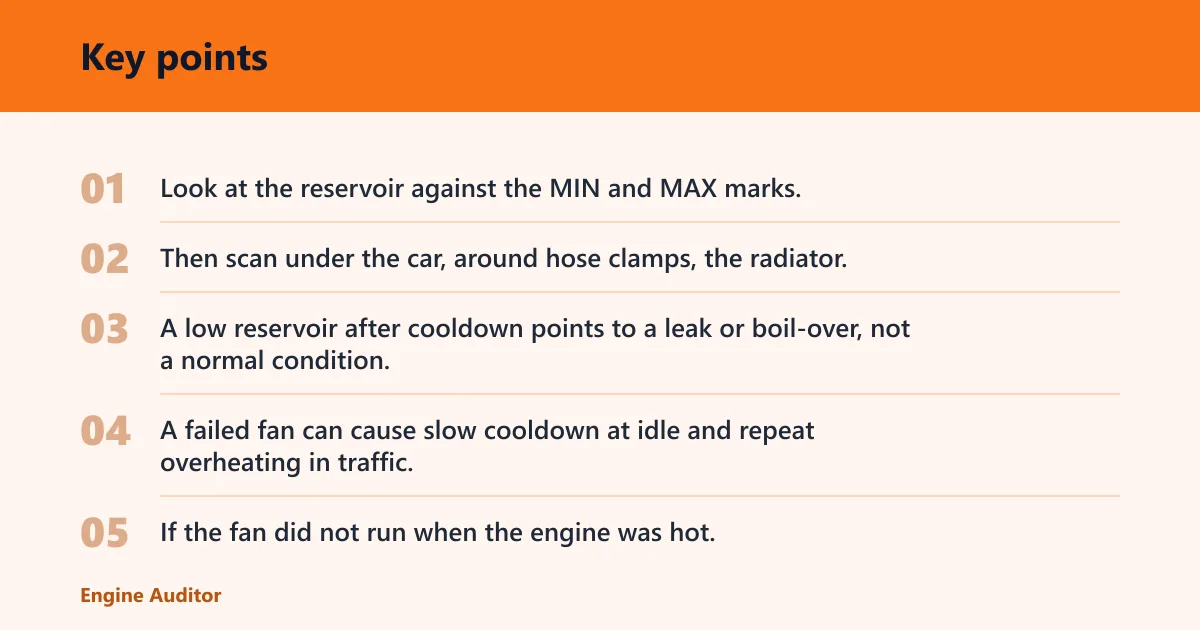
Look at the reservoir against the MIN and MAX marks. Then scan under the car, around hose clamps, the radiator, and the water pump area for wet trails or dried coolant residue. A low reservoir after cooldown points to a leak or boil-over, not a normal condition.
Cooling fan operation
A failed fan can cause slow cooldown at idle and repeat overheating in traffic. If the fan did not run when the engine was hot, or if the car overheats again at low speed, fan control, relays, wiring, or the fan motor should be checked.
Thermostat and flow clues
A stuck thermostat can block coolant flow and make the engine heat up fast. If the upper radiator hose stays cool while the gauge climbs, or if the lower hose never warms as expected, thermostat trouble moves higher on the list. That is a common diagnosis after the car has cooled.
Engine oil level and warning signs
Overheating does not stop at the cooling system. Engine oil helps lubricate hot internal parts, and low oil can make heat buildup worse. Check the oil level after cooldown if the engine was driven hot, and stop if you see oil pressure warnings, knocking, or rough running.
Do not ignore repeat overheating even if the gauge briefly returns to normal. A normal-looking gauge after a short cooldown does not erase the damage risk. If the car overheats again, the fault is still active.
Should you restart or tow?
A cautious restart is only reasonable after a full cooldown, a safe inspection, and no repeat temperature rise on the gauge. If the reservoir is low but not empty, the leak is small enough to trace, and the fan seems to operate normally, a brief restart may help confirm whether the problem is fixed enough to move the car a short distance.
If the car overheats again, stop driving and arrange a tow. Repeated overheating is a red flag, especially if the gauge climbs fast, steam returns, or the reservoir keeps dropping. Do not keep cycling the engine in hopes that it will settle down.
When to call a tow truck
Call for a tow if the car cannot cool safely, if the coolant loss is obvious, if steam comes back after restart, or if the engine made knocking, rattling, or low-oil warning sounds during the overheat. Towing is cheaper than another round of heat damage.
A common first-timer mistake is to restart after a 10-minute wait because the hood no longer feels hot. That is too soon if the upper hose is still pressurized or the reservoir is bubbling. In that case, the right move is to wait longer or tow.
Frequently asked questions
How long should I let my engine cool down after overheating?
Use 30–45 minutes as a minimum for a mild overheat, and wait longer if you still see steam or smell hot coolant. The safe point is not a fixed minute count. It is when the upper hose is cool enough to hold and the system is no longer pressurized.
Can I open the radiator cap right after the car overheats?
No. Do not open the radiator cap hot. A pressurized cooling system can spray boiling coolant and steam, which can cause serious burns. Wait until the engine is cool enough that the upper hose is no longer hard and steam has stopped completely.
How do I know when the engine is cool enough to check coolant?
Check the coolant reservoir only after the hood is no longer throwing off strong heat, the upper hose is soft enough to hold, and there is no steam or bubbling. Then compare the level to the MIN and MAX marks on level ground. That is the safer check, not the radiator cap.
What should I do first when my car starts overheating?
Pull over, shut the engine off, and stop driving as soon as the gauge reaches the danger zone or the warning light appears. Leave the caps closed and let the engine cool. If the temperature rises again after restart, stop again and arrange a tow.
Can driving an overheated engine cause permanent damage?
Yes. Driving an overheated engine can damage the head gasket, warp the cylinder head, or seize the engine. The risk rises when the engine is kept running after the gauge is already in the hot zone, especially if oil pressure drops or coolant is lost.
Should I tow the car if it overheats in traffic?
Yes, if it overheats again after cooldown, if steam or boil-over returns, or if the cause is not obvious and safe to fix roadside. In traffic, a failed fan, low coolant, or stuck thermostat can send the temperature right back up. A tow is the safer call.
Products related to this article
Sponsored / affiliate links. As an Amazon Associate I earn from qualifying purchases. I may earn additional commission from eligible campaigns.