Does Head Gasket Sealer Actually Work?
Head gasket sealer can buy time for a tiny external coolant leak or very early seepage. It is a poor choice for combustion-gas leaks, mixed fluids, or overheating, and it is not a permanent repair. Used on the wrong failure, it can waste money, clog the cooling system, and let engine damage spread. This guide shows which symptoms and leak types make sealer worth trying, which ones rule it out, and what to do next.
What sealer can and cannot fix

What it can do for a small leak
A bottle of sealer may slow a small coolant loss long enough to arrange a proper repair. That is the narrow use case. F1 says it may temporarily slow a small leak, but it is not a dependable substitute for diagnosing and repairing a failed gasket.
That short window can help if the engine still runs normally, the coolant loss is light, and there are no signs of combustion gas entering the cooling system. F3 also notes that the average head gasket sealer is going to give you a quick repair when it works.
What it cannot fix
Sealer does not fix warped heads, cracked heads, cracked blocks, or a torn gasket large enough to move a lot of coolant or combustion gas. Hank O'Hop says major leak cases should skip sealer and replace the gasket. That line is the practical cutoff.
It also should not be treated as a cure for oil contamination. Milky or polluted oil points to coolant in the crankcase, which is a repair-now problem, not a sealer problem.
How head gasket sealer works
Head gasket sealer goes into the cooling system and moves with the engine running. It travels through the radiator, coolant passages, heater core, and related hoses, then reacts where a leak lets it reach a hot escape point. F8 says it is introduced through the radiator cap or expansion bottle.
Where it goes in the cooling system
The fill point varies by vehicle. Some cars use a radiator cap, while others use an expansion bottle. The engine must be cool before you open either one, because the cooling system runs under pressure when hot.
That pressure matters. A pressurized cooling system raises the boiling point of the coolant/antifreeze mixture, but it also means opening the system hot can spray scalding fluid.
Why circulation and heat matter
Most sealers need coolant flow and engine heat to reach the leak and set up. F12 says some sealers need the engine to run 15 to 30 minutes. The exact run time depends on the product label, engine size, and how much heat the system can hold. (Thedrive)
Results vary because not every leak sits in the same place. A small seep between coolant and the combustion chamber may respond differently from an external gasket leak around a coolant passage. That is why symptom pattern matters more than the label on the bottle.
Head gasket sealer decision checklist
Use the pattern below before you buy anything. The question is not whether the bottle is cheap. The question is whether the leak is small enough and clean enough for a temporary trial.
| Symptom pattern | Likely leak severity | Whether head gasket sealer is a reasonable temporary trial |
|---|---|---|
| Slow coolant loss, no overheating, no white smoke, no bubbling, oil looks clean | Small leak or early seepage | Yes, a temporary trial can be reasonable if the label matches the engine and coolant type |
| Intermittent overheating with light coolant loss, but no milky oil and no repeated pressure loss | Possible small internal leak | Maybe, but test first and watch closely after a short drive |
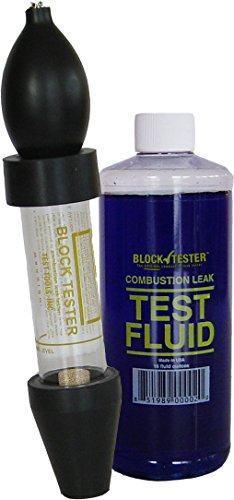
| Bubbling in the radiator or expansion bottle after startup, plus white smoke from the exhaust | Likely combustion-gas leak | Use caution; sealer is often a poor bet and a real repair is more likely |
| Coolant loss plus milky oil, thick oil, or contaminated oil on the dipstick or under the filler cap | Major internal damage | No, sealer is not advised; stop and repair now |
| Repeated overheating, no heat from the cabin, and evidence of clogged passages or prior stop-leak use | System restriction or larger failure | No, sealer is not advised; it may make the restriction worse |
| Warped head, cracked head, cracked block, or compression-related symptoms that do not improve | Severe mechanical damage | No, sealer is not advised |
| External seep at a hose joint, radiator seam, or clamp that is not a head gasket issue | Not a head gasket failure | No, use the correct part repair instead |
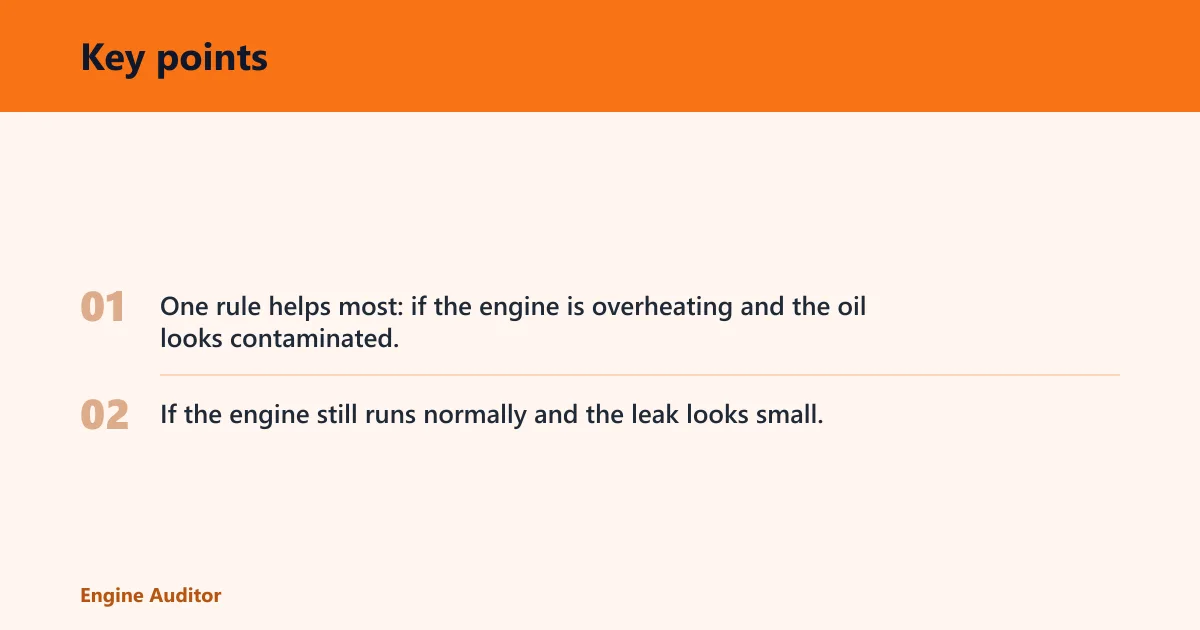
One rule helps most: if the engine is overheating and the oil looks contaminated, treat that as stop-now territory. If the engine still runs normally and the leak looks small, a short-term trial is the only lane where sealer makes sense.
When is sealer a bad idea?
Sealer is a bad idea when the engine shows major damage, clear fluid mixing, or signs that the cooling system is already restricted. In those cases, the bottle is more likely to hide the problem than solve it.
Major coolant loss
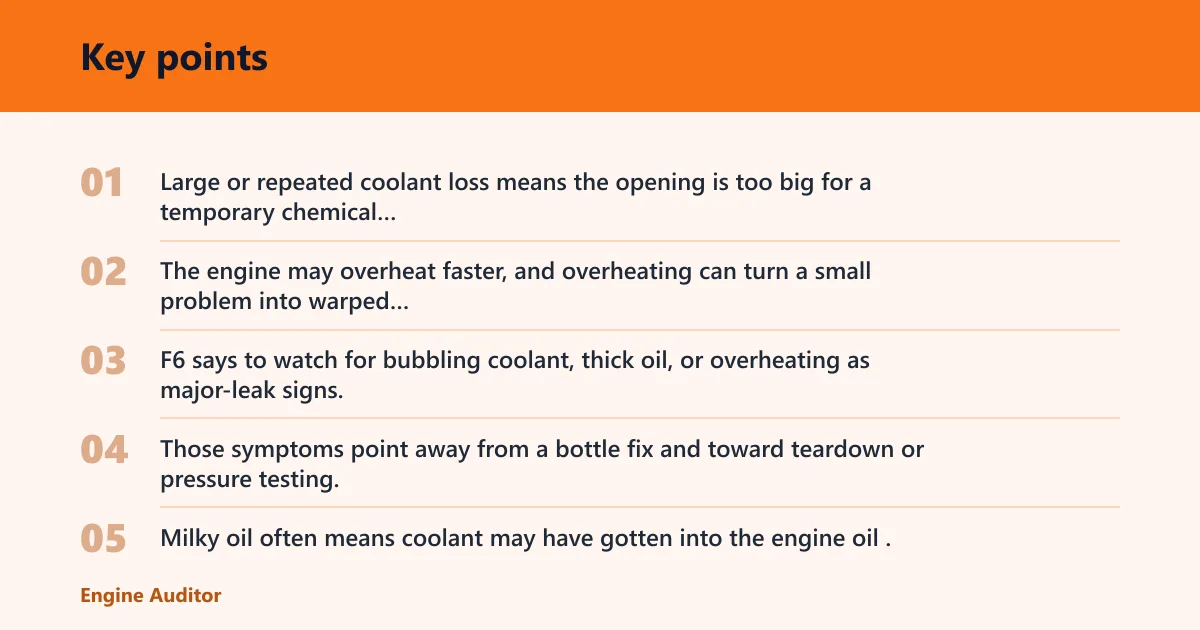
Large or repeated coolant loss means the opening is too big for a temporary chemical patch to be dependable. The engine may overheat faster, and overheating can turn a small problem into warped metal or a cracked casting.
F6 says to watch for bubbling coolant, thick oil, or overheating as major-leak signs. Those symptoms point away from a bottle fix and toward teardown or pressure testing.
Milky oil or coolant in oil
Milky oil often means coolant may have gotten into the engine oil. That can damage bearings and other internals quickly. If the dipstick or filler cap shows a cream-colored residue, do not treat the engine with sealer and hope for the best.
An oil change may be needed after repair, and in a severe case the contamination may already have done deeper harm. Sealer does nothing to remove coolant from oil passages.
Warped heads, cracked heads, or cracked blocks
Warped heads, cracked heads, and cracked blocks are mechanical failures. Sealer does not restore flat sealing surfaces or mend cast metal. Those defects usually need disassembly and machine work, or part replacement.
Prior stop-leak products and clogged passages
Prior stop-leak history matters because each additive can leave residue behind. Mechanic Base warns that sealers can create a powdery substance that builds up in the system, and that buildup can clog narrow cooling passages. F11 says sealer can clog narrow cooling passages.
That risk is highest in engines with small coolant routes, a sensitive thermostat, or an already weak heater core. If the system has been treated before, a flush and inspection may be smarter than another bottle.
Use the label first, not internet advice. Some products are only meant to work with a certain engine type, and coolant compatibility varies. F2 says some head gasket sealers are only meant to work with a certain engine type.
- Check the product label and the vehicle manual for coolant, engine, and diesel compatibility.
- Let the engine cool fully before opening the radiator cap or expansion bottle.
- Confirm the correct fill point for your vehicle and add the sealer to the cooling system there.
- Follow the label on whether the coolant needs draining, flushing, or dilution changes first.
- Run the engine for the time listed on the bottle. F12 says some sealers need 15 to 30 minutes.
- Watch the temperature gauge and heater output while the engine circulates the mixture.
- After a short drive, recheck for leaks, coolant level, and any new overheating.
Coolant/antifreeze compatibility matters too. Some sealers tolerate one color or brand better than another, but color alone is not a guarantee. If the coolant is old, dirty, or mixed with previous stop-leak products, flush requirements become more important.
Say your 4-cylinder sedan has a slow coolant drop, no white smoke, and clean oil. A label-matched sealer may buy time while you plan the repair. Now change one variable: if that same car starts bubbling in the expansion bottle and the oil turns milky, the bottle is no longer the right move.
What can go wrong after using it?
The biggest risk is clogging. A sealer that circulates too far can settle in the thermostat, heater core, radiator, or narrow coolant passages. That can trade one leak for a flow problem.
Thermostat and heater core blockage
The thermostat is a critical flow-control component. If residue builds up there, the engine may overheat or cycle poorly. The heater core can also restrict, which may show up as weak cabin heat or a sudden temperature climb.
That is why some flush procedures call for thermostat removal. A flush is not always required, but if the product instructions demand it, do not skip that step.
Harder diagnosis later
A common first-timer mistake is using sealer before confirming the fault. If the leak slows for a while, later pressure testing can be less clear, and residue can muddy the diagnosis. That can delay the real repair.
Suppose a pickup starts losing coolant on long hills, but only mildly. Sealer might stretch the timeline by weeks or months, as FixMyCar notes for some cases, but it can also make the eventual teardown harder to read if the engine starts acting up again.
Follow-up checks after a short drive
After the first drive cycle, check for fresh coolant loss, temperature rise, heater performance, and bubbling at the radiator or expansion bottle. If symptoms return quickly, the temporary window has already closed.
That is the point where you should stop treating the bottle as a plan. It was only ever a bridge.
Does head gasket sealer work on diesels?
Sometimes, but only when the label says it does. Diesel engines run different combustion and cooling loads, and product compatibility varies. Some sealers claim gasoline and diesel use, but you should read the label before use.
Do not assume a diesel-safe result because a bottle says “head gasket” on the front. A product can still be wrong for your engine size, cooling system volume, or coolant type. F9 notes that engine size matters too, with four or six cylinders needing less than larger engines.
Is head gasket sealer worth it?
It can be worth it when the leak is small, the engine is still stable, and you need time before a proper repair. It is less attractive when the failure is severe or the vehicle is already overheating. F4 says the average head gasket repair can cost upwards of $2,000 or even more.
That cost gap explains why many owners consider sealer first. A bottle is cheap next to a teardown. But the cheaper option only makes sense if it does not push a failing engine into worse damage.
Does head gasket sealer work for oil leaks?
No, not in the way most people mean. Head gasket sealer is meant for coolant-side leaks or combustion-gas leaks into the cooling system, not for a true engine oil leak. If oil is escaping externally from the gasket area, that calls for a mechanical repair.
If oil and coolant are mixing, that is a different problem. Milky oil or polluted oil means the seal has failed badly enough that the engine needs inspection, not a temporary additive.
Frequently asked questions
Does head gasket sealant actually work?
It can slow a small leak, and that is the right expectation. It does not reliably repair a failed gasket, especially when the engine is overheating, bubbling coolant is present, or fluids are mixing. Treat it as a short-term bridge, not a fix.
Do head gasket repair fluid really work?
They can work in a narrow set of cases: small internal seepage or light coolant loss with no major symptoms. They are much less dependable on larger leaks, warped parts, cracked blocks, or any engine that already shows coolant in the oil.
Does Blue Devil head gasket sealer actually work?
Some sealant products may help in small-leak situations if the label matches the engine and cooling system. The brand name matters less than the failure type. If the engine is overheating or the oil is contaminated, the bottle is the wrong tool.
Will head gasket sealer ruin an engine?
It can, if it is used on the wrong problem or if residue clogs the cooling system. The main risks are thermostat blockage, heater core restriction, and narrow passage clogging. Used correctly on a small leak, it is less likely to cause harm.
Products related to this article
Sponsored / affiliate links. As an Amazon Associate I earn from qualifying purchases. I may earn additional commission from eligible campaigns.