Why Does My Car Overheat When the AC Is on?
If your car overheats only with the AC on, especially at idle or in traffic, suspect an airflow or cooling-fan problem first, then check coolant level, radiator blockage, and a weak water pump. Ignoring it can push coolant past the boil point, damage the head gasket, and turn a simple fix into a much larger repair bill. This guide shows how to read the symptom pattern and match it to the most likely fault path before you replace parts.
The AC compressor puts extra drag on the engine. That load can expose a cooling system that was already marginal, so the temperature may rise only when the compressor is requested. On many cars, the problem shows up first when road speed is low because the radiator depends on fan pull and front-of-car airflow at idle and in traffic.
How AC load and idle airflow reveal cooling weakness

What changes when the AC clutch engages
When the AC clutch engages, the compressor loads the belt drive and raises under-hood heat. The condenser, mounted directly in front of the radiator, also dumps heat into the same airflow path. That means a system that looks fine at highway speed can run hot the moment the AC asks for both more engine load and more heat rejection.
That pattern matters. If the temperature rises only with the AC on, the AC system may be revealing a cooling-system weakness rather than causing a true AC fault. A marginal engine-cooling system may remain hidden until the AC adds load.
Why the problem shows up at idle first
Idle and stop-and-go traffic are the hardest conditions for cooling because natural ram air is weak. Electric fans usually turn on around 200 to 230 degrees F depending on the vehicle, and some vehicles use multiple fan speeds or variable fan control. If the fan does not pull enough air, temperature climbs quickly once the car stops moving.
Picture a sedan that stays near normal on the highway, then creeps up at a long light with the AC on. That pattern points first to airflow, fan output, or condenser and radiator restriction, not to a refrigerant-charge problem.
Car overheat decision table
Use the timing of the temperature rise to narrow the fault path before you buy parts. The quickest safe check is the one that matches the symptom pattern most closely.
| Symptom timing | Likely causes, ranked | Quickest safe check | Do not replace yet |
|---|---|---|---|
| Idle-only overheating |
1. Cooling fan weak or inoperative 2. Fan relay, fuse, wiring, controller, resistor, or clutch fault 3. Condenser or radiator airflow restriction 4. Low coolant |
With the engine hot and AC on, verify whether the fan comes on and pulls strong air through the grille. Check the fuse, relay, and connector before condemning the motor. | Fan motor, radiator, compressor |
| Overheating with AC on while driving slowly |
1. Restricted condenser or radiator fins 2. Weak fan that cannot meet requested speed 3. Shroud or air-gap issue 4. Low coolant |
Inspect the condenser face and radiator fins for dirt, debris, bent fins, or blocked gaps between the fan shroud and core. Confirm the fan reaches the requested higher speed. | Radiator, condenser, water pump |
| Immediate temperature rise on AC engagement |
1. Fan-command or fan-speed fault 2. Compressor drag or belt slip 3. Severe airflow restriction 4. Cooling system already near its limit |
Watch whether the fan output changes the moment AC is requested. Listen for belt squeal, compressor noise, or vibration when the clutch engages. | Compressor, belt, radiator, thermostat |
| Overheating even with AC off |
1. Low coolant from a leak 2. Stuck-closed thermostat 3. Water pump failure 4. Radiator clogging or leak |
Check coolant only after the engine cools. Look for repeat loss, crusty residue, wet hoses, or a slow drip. If the engine climbs fast from cold, suspect the thermostat. | AC compressor, condenser, fan only |
Do not use the AC as a diagnosis shortcut by itself. A bad compressor can create drag, but most AC-on overheating cases still trace back to cooling airflow, coolant level, thermostat behavior, water pump flow, or a fan-control fault.
What the AC compressor can reveal
The compressor does not usually create overheating on its own. More often, it adds enough load to expose a weak belt drive, a marginal fan circuit, or a cooling system that is already running near its limit. If the temperature only rises with the AC engaged, treat the compressor as a load trigger first, not the root cause.
Noise, vibration, or belt slip clues
If the temperature jumps when the compressor engages and you also hear squeal, chatter, or feel vibration, look at the belt drive next. A slipping belt can reduce compressor drive and water-pump speed on some engines. That can cut coolant circulation and make the engine run hot under load.
Suppose the AC is switched on at a stoplight and the belt squeals for a second, then the temperature starts climbing. That points toward belt drag, a seized accessory, or compressor load that the engine is struggling to carry.
Why airflow matters at low speed
The condenser is mounted directly in front of the radiator, so both heat exchangers share the same airflow path. Dirt, debris, bent fins, and blocked air gaps reduce how much heat each core can shed. At road speed, airflow can mask the problem. At idle, the fan has to do the work.
Condenser and radiator restriction are not the same
A dirty condenser can block airflow before it reaches the radiator. A clogged radiator restricts heat transfer inside the coolant side, even if the outside looks clean. A collapsed shroud, missing air seal, or misrouted aftermarket part can also let the fan pull air from the wrong place instead of through the fins.
Moderate cleaning can cost less than replacement; condenser or coil cleaning commonly ranges from $75 to $400. Do not replace the radiator until you have checked the condenser face, the fan pull, and the air path between the two cores.
Could the cooling fan be the problem?
Yes, and this is one of the first places to look. Overheating that happens mainly at idle or in traffic points first to fan performance and airflow. The fan may spin but still fail to reach the requested higher speed, which is why a quick visual check is not enough on vehicles with multi-speed or variable fan control.
Check the full fan-control chain
The fault may sit in the motor, relay, fuse, wiring, controller, resistor, clutch, or sensor input that commands fan speed. Some vehicles need a high-speed request from the engine controller before the fan moves from low to high. If the command is present but the fan output stays weak, do not blame the motor alone.
- Check the fuse for an open circuit.
- Check the relay for contact failure.
- Inspect the wiring and connectors for heat damage or corrosion.
- Confirm the controller or resistor is allowing the requested speed.
- Verify the fan motor actually pulls strong air through the core.
Requested speed versus actual fan output
The useful question is not whether the fan spins. It is whether the fan reaches the commanded speed under load. A fan that turns slowly at idle can still fail when the AC requests higher output, and that mismatch can cause the temperature to rise the moment the compressor comes on.
Could low coolant or a thermostat be to blame?
Yes. Low coolant is a common trigger, and repeat loss points to a leak, not a one-time top-off fix. A stuck-closed thermostat can stop circulation and cause rapid overheating. If the engine runs hot soon after cold start, the thermostat moves higher on the list.
Safe coolant check after the engine cools
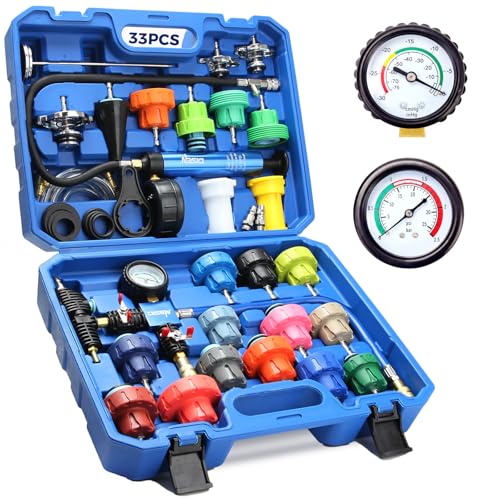
Check the reservoir only after the engine cools. The cooling system is pressurized to 13 to 18 PSI when hot, so opening it hot can spray scalding coolant. If the level is low, inspect hoses, the radiator cap area, the water pump, and the ground under the car for repeat loss.
Signs of a stuck-closed thermostat
A stuck-closed thermostat can trap coolant in the engine and block circulation to the radiator. The thermostat opens around 195 to 210 degrees F. If the gauge rises quickly, the upper radiator hose stays cool longer than expected, and the heater output is poor, the thermostat deserves attention before parts swapping starts.
When to suspect the water pump or radiator
If the car overheats with the AC off too, move beyond airflow and look at coolant movement and heat exchange. A failing water pump can reduce or stop flow through the engine and radiator. A radiator can also clog internally, leak, or lose cooling ability when its fins are blocked by debris.
Reduced coolant flow from pump failure
Water-pump problems may be mechanical or belt-driven related. A worn impeller, leaking shaft seal, loose belt, or bearing noise can cut flow enough to cause overheating under load. If the temperature rises with the AC off, the pump becomes more likely than the condenser.
Radiator issues that keep showing up
Radiator problems often show up as repeat overheating at highway speed, during hills, or under acceleration, especially if coolant level keeps dropping. At that point, the issue is no longer limited to AC use. The engine cooling system itself needs inspection for flow restriction, leak points, or internal blockage.
What to do right now
Turn the AC off if the gauge starts climbing. Watch the temperature closely, and pull over if it keeps rising. Do not open a hot radiator cap. If the engine cools back down and the problem returns only with the AC on, the most likely path is still airflow, fan control, or another engine-cooling fault rather than an AC refrigerant issue.
- Turn the AC off and reduce engine load.
- Watch the temperature gauge for continued rise or recovery.
- If the temperature keeps climbing, stop safely.
- After the engine cools, check coolant level in the reservoir.
- Inspect the condenser face, radiator fins, and fan operation.
- Check for fan fuse, relay, wiring, and control faults if the fan is weak or missing high speed.
- Only after those checks should you move to thermostat, water pump, or radiator replacement planning.
Frequently asked questions
Why does my car overheat when the AC is on and idling?
Idle overheating with the AC on usually points first to fan performance and airflow. The condenser and radiator need strong fan pull when road speed is low. If the fan is weak, the relay or controller is faulty, or the fins are blocked, the temperature can climb quickly in traffic.
Why does my car overheat when the AC is on?
AC use adds compressor load and extra heat at the condenser, which can expose a weak cooling system. If the problem appears only with the AC on, inspect the fan, coolant level, condenser face, and radiator airflow before replacing major parts. The AC system may be a trigger, not the fault.
Why does my car overheat when the air conditioner is on?
The air conditioner can reveal a cooling system that is already near its limit. Added compressor load plus reduced available airflow through the condenser and radiator can push temperatures up. That is especially likely at idle, in traffic, or when the fan cannot reach the requested higher speed.
Why does my car only overheat when the AC is on?
That pattern usually means the engine-cooling system is marginal rather than broken in a single obvious way. Common causes include weak fan output, condenser or radiator restriction, low coolant, or a thermostat that is slow or stuck. The timing matters more than the AC setting itself.
Is it safe to drive with the AC off if my car overheats with it on?
Turning the AC off can reduce load and may keep the engine cooler for a short drive, but it is not a fix. If the gauge still rises, stop safely. If the temperature stays normal only with the AC off, the cooling system still needs diagnosis before you rely on that workaround.
Why does my car run hot when the AC is on?
Because the AC compressor adds load and the condenser shares airflow with the radiator. If the fan is weak, the fins are blocked, or coolant flow is poor, that extra demand can push the engine over its normal range. Hot weather, traffic, and uphill driving make the pattern more obvious.
Why is my car overheating when the air conditioner is on?
Start with the symptom timing. Immediate rise on AC request points to fan-command or compressor-load issues. Idle-only overheating points to airflow and fan output. If it overheats with the AC off too, move to coolant level, thermostat, water pump, and radiator checks instead of focusing on the AC alone.
Products related to this article
Sponsored / affiliate links. As an Amazon Associate I earn from qualifying purchases. I may earn additional commission from eligible campaigns.