Why Is My Radiator Fan Always Running?
If your radiator fan runs constantly on a cold engine, the ECU may be in fail-safe, the A/C or a bad relay may be commanding it, or the cooling system may genuinely be overheating; if live coolant temp stays near ambient but the fan is full-on, suspect an electrical fault first. Ignoring it can drain the battery, hide an overheating engine, and damage wiring or the fan motor. This guide shows a cold-start, live-data-first way to separate normal fan behavior from a fault.
What normal fan operation looks like


A radiator fan can run all the time for valid reasons when the engine is hot, the A/C is on, or the control system is still shedding heat after shutdown. Factory service information for many vehicles describes fan operation as an ECU-controlled response to coolant temperature, A/C pressure request, vehicle speed, and after-run logic; the exact thresholds vary by make and model. But a fan that never stops on a cold start, or keeps running with no heat load, points to a sensor, relay, module, wiring, or ECU command fault.
Normal hot-engine fan behavior
An electric radiator fan is not normally meant to run at full speed from a cold start until the engine is switched off. Normal operation may involve the fan starting and stopping at intervals as coolant temperature changes, with the exact turn-on point defined by OEM calibration rather than a universal number. Some manufacturers also allow after-shutdown operation for a limited time, and that time window is engine- and platform-specific in factory service information.
That means “always running” is only suspicious when it happens outside those conditions. If the engine is hot after a long climb, a tow, or stop-and-go traffic, constant fan operation may be the correct response.
When constant run points to a fault
The split is simple: normal fan operation follows heat load, while a fault often ignores it. If the fan is roaring on a fully cold engine, or it stays on long after the temperature drops, the ECU may be reacting to a bad input or fail-safe logic. A stuck relay, faulty fan control module, or wiring fault can also hold the fan on.
Fast split between command and problem
Start with three questions: Is the engine actually hot? Is the A/C requesting fan operation? Does the fan still run when the command should stop? That quick split tells you whether you are looking at normal control, ECU fail-safe, or a hardware fault.
| Symptom pattern | Likely cause | First test | Urgency |
|---|---|---|---|
| Cold start, fan on immediately | Bad coolant temperature sensor, ECU fail-safe, relay stuck closed | Compare live coolant temperature to ambient on a fully cold engine | High |
| A/C on, fan cycles normally | Normal condenser cooling request | Switch A/C off and see whether fan request drops | Low |
| Highway only, fan runs hard | Airflow, condenser load, wiring logic, or overheating at speed | Check live coolant temp, A/C status, and radiator airflow path | Medium |
| Idle only, fan runs often | Normal low-speed control or weak cooling system | Watch coolant temperature rise at idle and compare to fan request | Medium |
| After shutdown, fan runs briefly | Normal heat soak after-run | Time the run length and confirm whether it stops within the expected window | Low to medium |
| High gauge, fan stays on | True overheating, low coolant, restricted flow, stuck thermostat, radiator issue | Check coolant level and scan live temperature before driving farther | High |
| No codes, fan still on | Relay, module, wiring, or sensor signal issue without a stored fault | Use live data and relay command checks, not just the dash light | Medium |
| Battery drain overnight | Stuck relay, module fault, or fan motor being held powered | Listen for after-shutdown operation and test for parasitic draw | High |
Say your sedan’s fan starts the moment you turn the key on a 12°C morning, but the scan tool shows coolant at 11°C and ambient at 12°C. That pattern does not fit hot coolant. It points first to a bad input, a stuck relay, or fail-safe fan logic, not a cooling system that is truly overheated.
Is the fan being commanded on?
A scan tool is the quickest way to tell whether the ECU is asking for fan operation or the fan is being held on by hardware. On a fully cold engine, coolant temperature on live data should closely track ambient after the vehicle has sat long enough to equalize; factory diagnostic charts commonly treat a large mismatch as a sensor or circuit fault rather than a temperature problem. If the reading is wildly off, the ECU may be seeing a bad signal.
Scan tool live data on a cold engine
Key the ignition on, engine off, after the car has sat long enough to cool fully. Read coolant temperature, A/C request, and fan command data. If the scan tool says the engine is hot when the metal is cold, the engine coolant temperature sensor or its circuit is suspect. Delphi, Denso, and NTK technical guidance all emphasize verifying sensor plausibility against ambient before condemning the fan itself.
Coolant temperature versus ambient temperature
A cold-engine reference matters because it separates real heat from false input. If ambient air is 18°C and coolant live data reads 40°C on a car that has sat overnight, the ECU may command fan operation in response to a reading that does not match reality. That is the kind of fault that can trigger fail-safe fan behavior.
ECU fail-safe logic and bad inputs
The ECU uses coolant temperature, A/C input, and related signals to decide fan speed or fan request. When input data is implausible, it may enter fail-safe mode and turn the fan on to protect the engine. That can happen even if the dash gauge looks ordinary, so do not trust the gauge alone.
A common first-timer mistake is to replace the fan motor because it runs constantly, while the real problem is a sensor signal that makes the ECU think the engine is hot. Live data stops that guesswork.
How to verify fan-command vs stuck-relay faults: with the engine stone-cold, use the scan tool to compare ambient, ECT, A/C request, and fan command. If the ECU is not commanding the fan yet the fan still runs, move to relay/module power and ground checks. If the ECU is commanding the fan with a plausible coolant reading, follow the command path and look for a genuine heat load, A/C request, or a control strategy issue. If unplugging the control side stops the fan but power feed remains present, that points away from a welded relay contact and toward ECU control logic; if power remains at the motor with the relay de-energized, suspect a stuck relay or a short to power. This command-versus-power split is the fastest way to avoid replacing the wrong part.
Why does the fan stay on with the A/C?
The A/C system can request fan operation because the condenser adds heat at the front of the vehicle. OEM repair data routinely treats A/C fan request as normal behavior when refrigerant pressure or condenser temperature rises. If the fan changes behavior when you switch the A/C off, that is strong evidence that the request is intentional rather than a fault.
Condenser load and fan request
When the A/C is on, the cooling fan may run to move air through the condenser and radiator stack. That extra load can make the fan run sooner, longer, or at a different speed than it would with the A/C off. This is expected on many vehicles.
What changes when you switch the A/C off
If the fan slows down or stops shortly after the A/C is switched off, the A/C request was likely the reason. If it keeps running at the same speed with the A/C off, look harder at coolant temperature, relay behavior, or module control.
When A/C behavior still points to a fault
If the fan is on full blast even with the A/C off, and coolant is not hot, the problem is no longer simple condenser load. That can point to a stuck relay, a fan control module locked at one speed, or an ECU command issue based on bad inputs.
What parts usually cause nonstop fan operation?
The usual suspects are the engine coolant temperature sensor, fan relay, wiring, fan control module, and ECU command logic. Low coolant or true overheating can also keep the fan on as a valid response. The parts list matters, but the test order matters more.
Engine coolant temperature sensor
The engine coolant temperature sensor sends temperature input to the ECU. If it reads implausibly high or low, the ECU may command the fan on as a protective response. A cold-engine scan reading that does not match ambient is a strong clue. Service manuals for many makes instruct technicians to compare ECT to ambient and then check sensor resistance, reference voltage, and signal return if the data is implausible.
Fan relay
A fan relay can stick closed, which keeps the fan powered even after the ECU command stops. If the fan still runs with the control side disconnected or after relay removal, the relay moves up the list. Delphi-style relay diagnostics focus on checking coil command, switched output, and contact status rather than assuming the motor is bad.
Fan control module
A fan control module regulates power to the fan motor. If it fails, it can lock the fan at one speed or cause continuous operation without a valid request. That can look like a healthy fan that simply never gets told to slow down.
Wiring faults and ECU command issues
Shorted wiring, corroded connectors, or a bad ECU output can mimic a bad relay or module. The ECU may also enter fail-safe mode if it sees bad data. That is why the diagnosis should follow live data and command checks before parts are changed.
Is the engine actually overheating?
Constant fan operation can be the correct response to low coolant, restricted flow, a stuck thermostat, or a radiator problem. The first move is to confirm whether the engine is truly overheating. That means checking coolant level, warning lights, and live temperature together, not one at a time.
Low coolant and flow issues
Low coolant can leave the sensor reading air or a hot pocket, which makes fan control unreliable. A restricted system can also push temperature up even while the fan runs hard. Check coolant level only when the engine is safe to inspect, and look for leaks, wet hoses, or dried residue.
Stuck thermostat
A thermostat that is stuck closed can trap heat in the engine and make the fan run constantly while the control system tries to compensate. A thermostat stuck open can create odd warm-up behavior, but the fan problem here usually comes from excess heat or bad temperature feedback, not the thermostat alone.
Radiator restriction or airflow problem
A blocked radiator, bent fins, debris in front of the core, or poor airflow through the condenser stack can all raise temperature at idle or low speed. Suppose the fan runs hardest in traffic but calms down on the highway; that points toward airflow or load issues more than an always-bad fan motor.
When the fan is doing its job
If the live coolant temperature is high and the fan cycles around the normal control range, the system may be working as designed. The problem is not the fan in that case. The problem is what is making the engine run hot.
Can you keep driving if the fan never stops?
Driving can be risky if the fan never stops and you do not know why. A stuck fan can drain the battery, and a true overheating condition can damage the engine fast. If the gauge is high, warning lights are on, or live data shows high coolant temperature, stop driving and inspect the cooling system now.
Battery drain risk
A fan that runs after shutdown for a short time may be normal, but repeated or endless operation can flatten the battery. If the fan is still running hours later, suspect a relay, module, or wiring fault and avoid parking the car where a dead battery will leave you stranded.
Warning lights and high gauge
A high temperature warning changes the priority. That is no longer a fan question alone; it is a cooling-system problem until proven otherwise. Check coolant level, scan live temperature, and look for signs of boil-over, leaks, or loss of coolant circulation.
When to stop and inspect now
If the gauge is in the red, the warning light comes on, steam appears, or the temperature keeps climbing, stop driving as soon as it is safe to do so. At that point, continuing to drive can turn a cooling fault into engine damage.
Cold-start checklist: how to diagnose a fan that always runs
Step 1: Confirm the engine is fully cold and the vehicle has sat long enough for coolant and ambient to equalize.
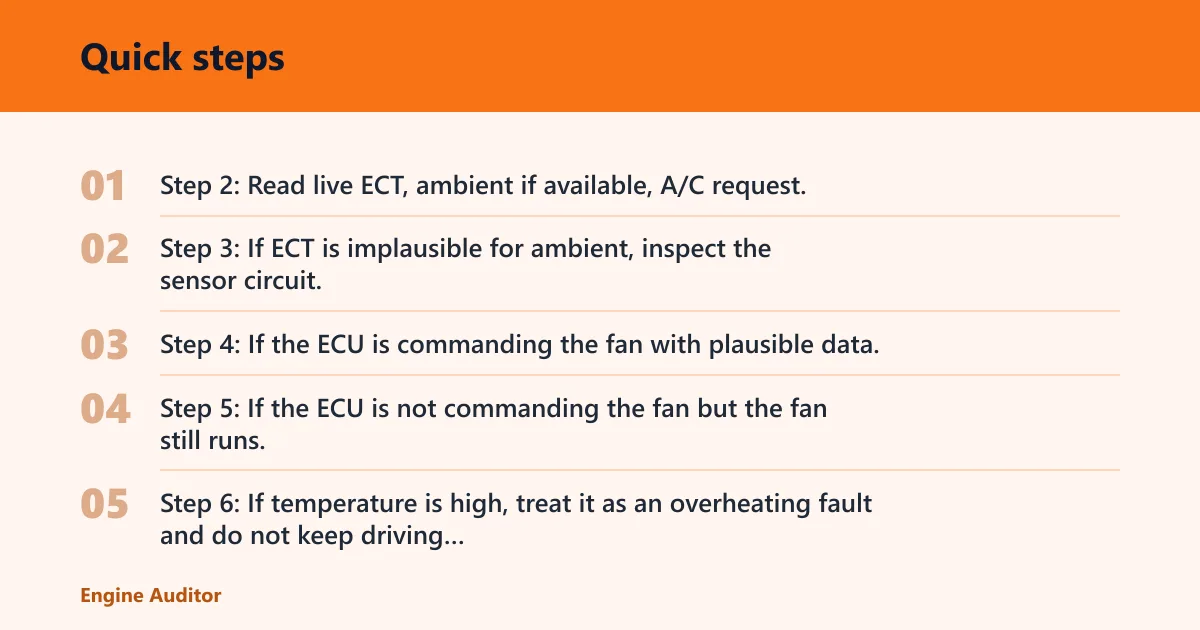
Step 2: Read live ECT, ambient if available, A/C request, and fan command with the ignition on and engine off.
Step 3: If ECT is implausible for ambient, inspect the sensor circuit, connector condition, and reference/ground integrity before condemning the fan.
Step 4: If the ECU is commanding the fan with plausible data, branch into normal control causes: A/C request, heat soak after-run, or genuine overheating.
Step 5: If the ECU is not commanding the fan but the fan still runs, test relay contact status, module output, and power feed at the fan motor.
Step 6: If temperature is high, treat it as an overheating fault and do not keep driving until coolant level, flow, and airflow are verified.
| Cold-start live data | Expected diagnostic interpretation | Branch test | Safe to drive? |
|---|---|---|---|
| ECT closely matches ambient after full cool-down | Sensor plausibility is good | Check fan command and A/C request | Usually yes, if no overheating signs |
| ECT is far above ambient on a stone-cold engine | Suspect sensor/circuit or implausible input | Inspect connector, wiring, reference, and ground | Use caution |
| Fan command on, ECT plausible, A/C off | Likely valid ECU request or heat-load issue | Verify cooling system temperature and airflow | Depends on actual temp |
| Fan command off, fan still running | Stuck relay, module fault, or short to power | Test relay and output side power | Stop if battery drain or wiring heat is present |
| Coolant temperature high with warning light | Overheating fault | Check coolant level and flow, then do not continue driving | Stop now |
Frequently asked questions
Why is my radiator fan always running?
It can be normal when the engine is hot, the A/C is requesting cooling, or the fan is doing brief after-run work. If it runs on a fully cold engine or never shuts off, check live coolant temperature, relay behavior, and ECU inputs before replacing parts.
Why is my radiator fan constantly running while driving?
If it happens mostly at speed, look at coolant temperature, A/C load, and airflow through the radiator and condenser. A fan that runs hard on the highway can point to real overheating, a control fault, or abnormal request logic rather than a bad fan motor alone.
Why does my radiator fan keep running after I turn the car off?
Brief after-shutdown running can be normal heat soak control. Factory manuals may allow a limited after-run period depending on engine and ambient conditions. If it runs much longer, repeats often, or drains the battery, suspect a relay, module, or wiring fault.
Should my radiator fan always run when the engine is cold?
No. On a cold engine, the fan should not normally run at full speed from the start. If it does, compare live coolant temperature to ambient and check for fail-safe behavior, because a bad sensor signal can make the ECU command the fan on.
Can a bad coolant temperature sensor make the fan stay on?
Yes. The sensor feeds temperature data to the ECU, and a bad reading can force fail-safe fan operation. A cold-engine scan should roughly match ambient, with factory diagnostics commonly treating a large mismatch as a circuit or sensor fault.
Could a stuck relay cause the radiator fan to keep running?
Yes. A fan relay can stick closed and keep power applied after the ECU command stops. If the fan keeps running regardless of temperature, relay diagnosis should be part of the first round of checks, especially when battery drain is also present.
Products related to this article
Sponsored / affiliate links. As an Amazon Associate I earn from qualifying purchases. I may earn additional commission from eligible campaigns.