What Is the Difference Between Antifreeze and Coolant?
Antifreeze is the concentrated fluid. Coolant is the working mix of antifreeze plus water, though many stores use the words interchangeably. Use the exact type and mix ratio your owner’s manual specifies, usually 50/50 for concentrate, or straight from the bottle if it is premixed. Wrong fluid can corrode parts, clog the system, and cause overheating; this guide explains when the terms match, when they do not, and how to choose the right one.
Antifreeze vs. coolant


On a bottle, the terms can point to the same product family, but they do not always mean the same form. Antifreeze often means concentrate. Coolant often means the ready-to-use fluid that circulates through the cooling system. The label matters more than the shelf word.
What the label is telling you
Antifreeze usually refers to a base fluid made with ethylene glycol or propylene glycol. It needs water in many applications before it can work as the engine’s heat-transfer fluid. Coolant usually refers to the mixed service fluid already meant to go into the radiator and engine passages.
The wording matters most when you are topping off, flushing, or refilling. If you pour concentrate where a premixed product is required, the system can end up too strong. If you add premixed fluid where concentrate is expected, the protection level may be weaker than intended.
Why people use both words for the same fluid
Many parts stores and owners use antifreeze and coolant as if they were the same thing because both products are sold for the same cooling system. That habit is common. It is also why the bottle label, not the shelf tag, should decide what goes in the car.
A common first-timer mistake is grabbing a jug by color alone. A green bottle does not automatically mean the same chemistry as another green bottle. The cooling system cares about the formulation, the mix ratio, and whether the product is concentrate or premixed.
What does antifreeze do?
Antifreeze is the concentrate that helps lower the freezing point of water and raise its boil point once it is mixed correctly. In many vehicles it is based on ethylene glycol or propylene glycol. By itself, it is usually not the final fill; it needs dilution in many applications.
Concentrate form and dilution
Concentrate gives you the raw chemical package. It must be mixed with water to reach the right protection level for the vehicle and climate. A common target is 50/50, but the owner’s manual or bottle label may call for a different ratio.
Freeze protection and boil protection
Freeze protection matters because water expands as it freezes, which can crack a radiator, hose, or engine passage. Boil protection matters because hot coolant must keep circulating without flashing to steam. The mix ratio controls both numbers, so a “stronger” mix is not automatically better.
Too much antifreeze can reduce heat transfer. Too little can leave the fluid vulnerable to freezing and boil-over. Both problems can show up as overheating, reservoir overflow, or poor cabin heat when the cooling system is under load.
What does coolant do?
Coolant is the working fluid that carries heat away from the engine. It moves through the engine block and cylinder head passages, then through the radiator, where heat is released to the air. The water pump keeps it moving, and the thermostat controls when flow opens and closes.
How the cooling system moves heat
Heat starts in the engine block and cylinder head. Those internal passages absorb heat from combustion. The water pump pushes coolant through those passages, then through the radiator, which acts as a heat exchanger. The thermostat helps the engine warm up quickly and then regulates operating temperature.
Why the radiator and reservoir matter
The radiator is part of the cooling system, not a separate add-on. Its job is to transfer heat from the moving coolant to the air. The coolant reservoir, sometimes called the overflow or expansion tank, gives the fluid room to expand and provides a safer place to check the level when the engine is cool.
Do not open the radiator cap on a hot engine unless the service manual specifically allows it and the system is fully depressurized. Use the reservoir as the usual level check point. It is there for that purpose.
Antifreeze and coolant types
OAT, HOAT, and IAT are coolant chemistry families, and they are generally not interchangeable. Color is not a universal standard. Two fluids that look alike can still use different inhibitor packages, and a vehicle may need one family for the original fill and another for service.
OAT, HOAT, and IAT in plain language
OAT means organic acid technology. These formulas are common in many newer vehicles and are built around long-life corrosion protection. HOAT blends organic acids with other inhibitors and is also common in vehicle-specific applications. IAT is the older inorganic additive type, still seen in some older systems.
Those families are not a free-for-all. A vehicle built for one chemistry may not tolerate another well, especially if the system is already full of one type. Match the manual first, then match the label.
Why color is not enough
Green, orange, pink, yellow, blue, and purple do not mean the same thing across brands. Dye is used for identification, not as a universal chemistry code. A bottle labeled with the right chemistry and approval is more useful than a bottle that merely matches the old fluid’s color.
Vehicle-specific compatibility checks
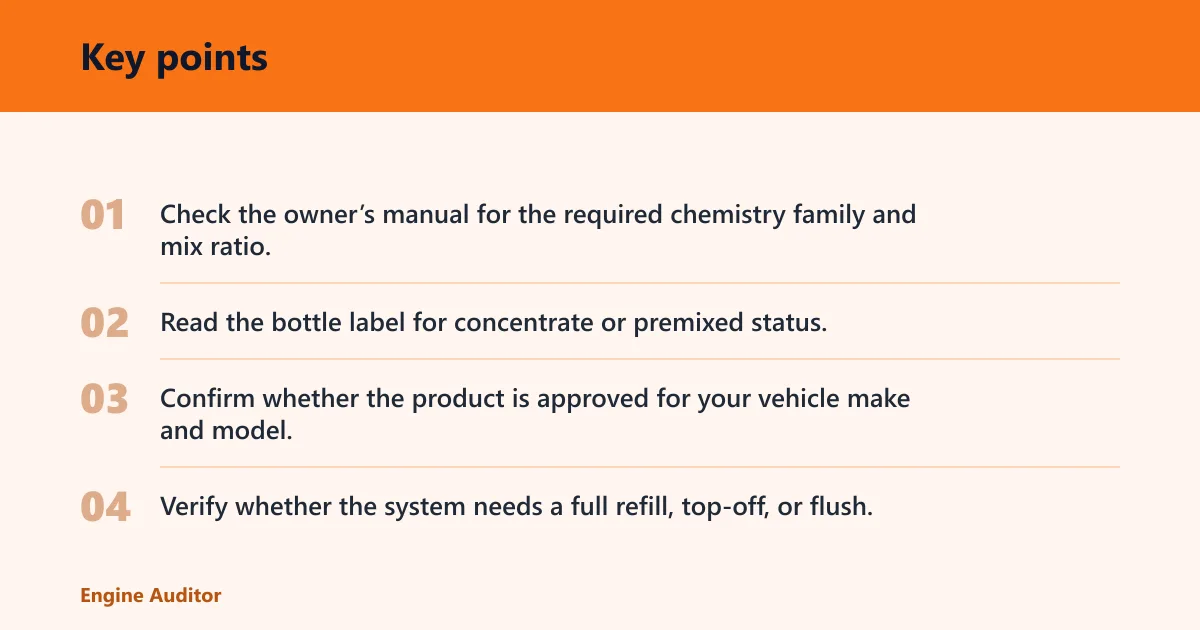
- Check the owner’s manual for the required chemistry family and mix ratio.
- Read the bottle label for concentrate or premixed status.
- Confirm whether the product is approved for your vehicle make and model.
- Verify whether the system needs a full refill, top-off, or flush.
Suppose your sedan calls for a specific OAT coolant and the reservoir is low after a hose replacement. A premixed bottle that matches the required specification can be used as a top-off. A universal-looking bottle with no clear compatibility statement should trigger a pause, not a pour.
How much water should you add?
If the bottle is concentrate, you usually need water. If it is premixed 50/50, do not add water unless the manual tells you to. Distilled water is commonly preferred for dilution because it can reduce mineral contamination that may build scale or leave deposits inside the cooling system.
Concentrate only versus premixed 50/50
Concentrate is sold so you can mix it to the needed ratio. Premixed 50/50 already contains the correct amount of water for many service fills. The wrong assumption here causes trouble fast. A concentrate bottle is not ready-to-pour in every case, and a premixed bottle is not meant to be “improved” with extra water.
Why distilled water is preferred
Tap water can contain minerals that leave deposits in the radiator, thermostat housing, water pump area, and narrow engine passages. Distilled water reduces that risk. It is the safer choice when a manual calls for dilution and plain water is allowed.
How mix ratio changes freeze point and boil point
Mix ratio changes how the fluid behaves in cold weather, hot weather, stop-and-go traffic, towing, and long idle periods. A roughly 50/50 mix is commonly used because it balances freeze protection, boil protection, and heat transfer. More concentrate is not always better, and too much water is not safe either.
Picture a truck that tows uphill in summer with a 70/30 concentrate-heavy mix. That stronger ratio can reduce the system’s ability to shed heat, which can push temperatures up under load. The owner may see the reservoir level rise, then hear the cooling fan run longer than usual.
Coolant decision table
Use the bottle label first. Then decide whether the fluid can go in as-is, whether water is needed, and whether the manual must be checked before you add anything. This is the quickest way to avoid a bad fill.
| Label says | Use as-is? | Water needed? | Stop and verify with owner’s manual? |
|---|---|---|---|
| antifreeze | No, not until you confirm form | Usually yes if it is concentrate | Yes, if the label does not say premixed or ready-to-use |
| coolant | Often yes, but check the bottle | No if it says ready-to-use or 50/50 | Yes, if chemistry or mix ratio is not clear |
| premixed 50/50 | Yes | No | Yes, if the vehicle requires a different chemistry family |
| concentrate only | No | Yes, usually with distilled water | Yes, before choosing the final ratio |
| unknown type | No | No until identified | Yes, stop and check the manual before use |
How to use the table in real service decisions
If you are topping off a small loss, the bottle must match the vehicle’s chemistry and form. If you are doing a drain-and-fill, the mix ratio matters across the full system volume. If you are doing an emergency roadside add, adding the wrong fluid can be worse than waiting for a proper fill.
Can you mix different coolants?
Sometimes two coolants can be mixed without immediate damage, but compatibility is not guaranteed. If the formulas are different, the result can be weaker protection, gel-like sludge, or poor corrosion control. When the system has been filled with the wrong chemistry, a flush may be needed before the next fill.
What happens when formulas are incompatible
Incompatible coolant can lose its ability to protect metal surfaces, or it can form deposits that restrict flow. Those deposits may collect in the radiator, heater core, thermostat area, or narrow engine passages. The cooling system then has to work harder to move heat away from the engine.
Warning signs after the wrong fill
- Sludge or thick residue in the reservoir
- Repeated overflow or bubbling in the expansion tank
- Overheating at idle or in traffic
- Sweet smell, wet spots, or crust around hoses and clamps
- Poor cabin heat even when the engine is warm
Say your compact car gets a top-off with the wrong chemistry after a warning light comes on. The next week, the reservoir may look foamy and the temperature gauge may climb during stop-and-go driving. That pattern is reason to stop adding fluid and check whether the system needs a drain, flush, and refill with the correct product.
Frequently asked questions
What is the difference between antifreeze and coolant?
Antifreeze is usually the concentrate, while coolant is the working mixture that moves through the engine cooling system. Many people use the words interchangeably, but the label still matters. Check whether the bottle is concentrate or premixed before you pour it into the radiator or reservoir.
What is the difference between antifreeze and engine coolant?
Engine coolant is the fluid circulating through the engine, radiator, water pump, and thermostat-controlled passages. Antifreeze is the base fluid that often needs water added before it becomes usable coolant. The distinction matters most when you are choosing a refill, top-off, or flush product.
What is the difference between coolant and antifreeze for cars?
For cars, coolant is usually the final mixed fluid, and antifreeze is usually the concentrate that gets diluted. Some bottles use both terms loosely, which is why you should read the fill instructions on the label. The owner’s manual should always win if the wording conflicts.
What’s better, antifreeze or coolant?
Neither is “better” in every case. The right choice depends on whether the product is concentrate or premixed, what chemistry family the car requires, and the mix ratio specified by the manufacturer. Using the correct fluid matters more than choosing the more familiar word.
What antifreeze and coolant do I need?
You need the chemistry family, form, and mix ratio listed in the owner’s manual or on a clearly approved bottle. Match OAT, HOAT, or IAT as specified, and check whether the system calls for concentrate mixed with distilled water or a premixed 50/50 fluid.
Is antifreeze and coolant for the radiator?
Yes. The radiator is part of the cooling system that coolant passes through to shed heat. The same fluid also moves through the engine block and cylinder head passages. Use the reservoir as the normal level check point when the engine is cool.
Products related to this article
Sponsored / affiliate links. As an Amazon Associate I earn from qualifying purchases. I may earn additional commission from eligible campaigns.