What Do the Different Coolant Colors Mean?
Coolant color is only a clue. Match the vehicle maker’s specification first, because the same color can point to different chemistries, and one wrong mix can damage seals, shorten service life, or cause overheating. Mixing the wrong coolant can cost you a radiator, water pump, heater core, or more labor. This guide explains common coolant colors and how to choose, top off, or replace coolant by spec, not color.
Coolant is dyed so it can be identified during service, but dye does not set the formula. That is why a green or red bottle can still be the wrong product for your car. The safer check is the vehicle owner’s manual, then the exact coolant specification listed for the cooling system.
What coolant color means


Color also cannot tell you whether the fluid still has the right corrosion inhibitors for your engine metals. Those inhibitors protect aluminum, cast iron, seals, and soldered joints, and their package varies by manufacturer. A coolant that looks right can still be wrong on chemistry.
Why coolant is dyed
Manufacturers and service companies dye coolant so it is easier to identify leaks, residue, and fill level. Dye helps you spot contamination and trace old fluid. It does not tell you whether the coolant matches the chemistry your engine needs.
A common mistake is to treat the bottle color as a compatibility rule. It is not. The same dye can appear in more than one chemistry family, and the same chemistry can be sold in different shades.
Why dye is not a spec
The coolant specification matters more than the dye because the spec sets the additive package, corrosion protection, and service interval. Examples include GM DexCool and MB 325.0. Two fluids can both be red and still be built for different systems.
That is why the manual comes first. The manual may call for a specific factory spec, not a color name. If the current fluid is unknown, guessing from dye alone can create a problem that is more expensive than a proper flush.
How do I read coolant colors?
Use color as a starting point, then verify the required spec on the label and in the manual. Green often points to older IAT coolant. Orange and red often point to OAT coolant. Yellow, pink, and blue are commonly grouped as HOAT. Those are broad patterns, not guarantees, so the manual still decides the correct refill.
Think of color as a label that may narrow the field, not a final answer. Same-color coolants can still differ in inhibitors and service life, and some vehicles use a fluid that does not match the common color tied to that chemistry family.
Green and older IAT formulas
Green coolant uses Inorganic Additive Technology, or IAT. It is the old-school formula and is typically associated with shorter service intervals. Kwik Fit says pre-1998 vehicles generally require silicate-based antifreeze, and green antifreeze usually needs changing around every two years.
IAT formulas rely on silicates and phosphates for corrosion control. That makes them different from long-life coolants, even if the bottle looks simple and familiar. Green coolant should still be checked against the vehicle’s required spec before topping off.
Orange and red OAT formulas
Orange coolant uses Organic Acid Technology, or OAT. Red coolant can also be OAT-based. The same source says vehicles after 1998 generally use OAT-based antifreezes. Many GM applications use GM DexCool, which is an example of a spec that matters more than dye.
OAT formulas are often long-life coolants. They use organic acids rather than the older silicate-heavy approach. That does not make every orange or red fluid interchangeable, because the package can still vary by maker and engine design.
Yellow, pink, and blue HOAT formulas
Yellow, pink, and blue are commonly grouped under HOAT, or Hybrid Organic Acid Technology. HOAT combines organic acids with a small dose of silicates. It is used in some European, Toyota, Honda, Subaru, and Korean applications.
HOAT is still a chemistry family, not a universal answer. Some Mercedes applications, for example, call for coolant meeting MB 325.0, and that coolant is commonly blue or clear in the W208 CLK example. Color alone still does not prove it is the right one.
Coolant chemistry families
The three broad families are IAT, OAT, and HOAT. Each uses different corrosion inhibitors, and those inhibitors are tuned for different metals, seals, and service intervals. That is why two fluids with the same dye can behave differently inside the cooling system.
Coolant chemistry affects protection against rust, scale, cavitation, and deposit buildup. It also affects how the fluid ages. A short-life formula and a long-life formula are not automatically interchangeable just because both are green, red, or blue.
IAT coolant
IAT coolant is the older inorganic additive formula. It uses silicates and phosphates, and it is usually green. The shorter service interval is part of the tradeoff. It is common in older vehicles, especially those built before late-1990s chemistry changes.
OAT coolant
OAT coolant uses organic acid technology and is often orange or red. It is designed as a long-life formula and appears in some GM, Toyota, and European applications. A red coolant bottle does not prove OAT by itself, but it is a common pattern.
HOAT coolant
HOAT coolant blends organic acids with a small dose of silicates. It is often yellow, pink, or blue and appears in some European, Toyota, Honda, Subaru, and Korean applications. HOAT is common where a maker wants long-life protection with some silicate support.
Coolant ID and top-Off decision table
Use this table when you see coolant in the reservoir or radiator and need to decide whether to top off, verify further, or flush. It treats color as a clue, then moves to the safer next step. When in doubt, choose the more conservative action.
| Observed coolant color | Likely chemistry family | What it does and does not prove | Safe next action | When to flush instead of top off |
|---|---|---|---|---|
| Green | IAT | Often points to the old-school formula, but color alone does not prove the exact spec or brand. | Check the owner’s manual, then top off only with the listed coolant spec or matching approved fluid. | Flush if the system history is unknown, if the fluid looks muddy, or if the manual calls for a different family. |
| Orange | OAT | Often points to a long-life OAT fluid, but orange dye does not guarantee compatibility. | Verify the required spec before adding any fluid. | Flush if the current fluid type is unknown or if the vehicle calls for IAT or HOAT instead. |
| Red | OAT or a related maker-specific formula | Can be OAT-based, but it still does not prove the coolant matches your vehicle. | Match the specification in the owner’s manual, not the dye. | Flush if the system may already contain mixed formulas or if the spec is unclear. |
| Yellow | HOAT | Often points to HOAT, but does not identify the exact additive package. | Use the manual and label spec before topping off. | Flush if the color is mixed, dull, or contaminated, or if the system’s history is unknown. |
| Pink | HOAT | Often points to HOAT, but same-color fluids can still be chemically different. | Confirm the exact spec for the vehicle maker. | Flush if prior coolant type is uncertain or if a different family is already in the system. |
| Blue | HOAT or maker-specific formula | Can be HOAT, and MB 325.0 coolant is commonly blue or clear in one Mercedes example, but blue does not guarantee compatibility. | Check the manual and the bottle spec before adding anything. | Flush if you suspect mixed red OAT and blue HOAT, since that can reduce corrosion protection and cooling efficiency. |
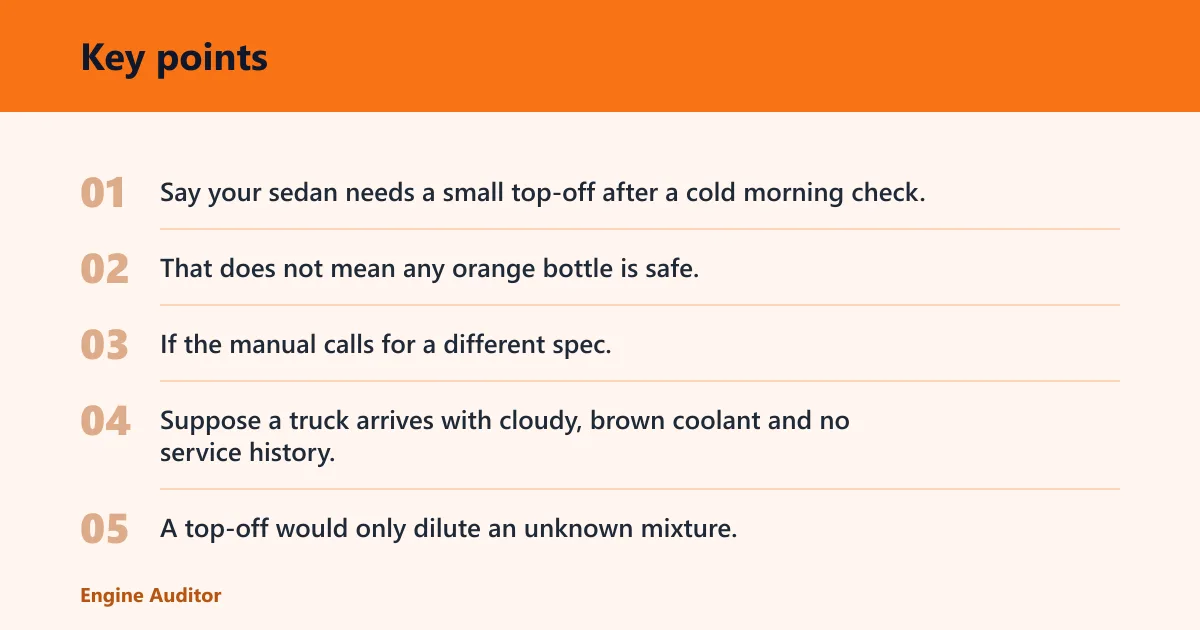
Say your sedan needs a small top-off after a cold morning check, and the reservoir shows orange fluid. That does not mean any orange bottle is safe. If the manual calls for a different spec, the correct move is to buy the listed coolant or flush first if the existing fluid is already mixed.
Suppose a truck arrives with cloudy, brown coolant and no service history. A top-off would only dilute an unknown mixture. A full flush is safer, followed by refilling with the specified coolant and distilled water if the product is concentrate.
Can you mix different coolant colors?
Mixing different colors is risky because color does not guarantee the same chemistry. Some mixes may seem fine at first, then form sludge, deposits, or reduced corrosion protection later. If the manual does not allow the mix, do not rely on the dye to make it safe.
Same-color coolants can also be incompatible. Two red coolants may use different inhibitor packages, and a blue HOAT can still differ from another blue product. Mixing red OAT and blue HOAT can reduce corrosion protection and cooling efficiency.
What happens when formulas are mixed
Incompatible coolant mixes can gel, form sludge, or leave deposits in narrow passages. Those deposits can reduce heat transfer and restrict flow through the radiator, heater core, and engine jacket. Corrosion protection can also drop if the inhibitor package is diluted or disrupted.
The failure mode is often slow. You may not see a dramatic problem right away, but the cooling system can become less effective over time. That is why a guessed top-off is a bad trade.
When universal coolant is only a fallback
Universal coolant is a compromise, not a preferred default. It may work as a temporary fallback in some cases, but it is not the best match for every engine or every manufacturer spec. The manual still has priority.
If the system history is unknown, universal coolant can be less risky than mixing random products, but a full flush remains the cleaner fix. Use it only when the label and manual support it, or as an emergency stopgap until proper service can be done.
Which coolant should you use?
Use the coolant that matches the vehicle’s specification, not the dye. The owner’s manual is the primary source, and the exact coolant spec matters more than the color name on the bottle. If the system is unknown, a flush is safer than guessing.
Once you know the spec, buy coolant that meets that standard and follow the fill ratio on the label. For concentrate, mix with distilled water. For a flushed system, distilled water is the preferred refill water before the final fill with the correct coolant mixture.
Check the owner’s manual first
The vehicle owner’s manual is more reliable than color alone. It tells you whether the engine needs IAT, OAT, HOAT, or a maker-specific standard. If the manual names a spec such as GM DexCool or MB 325.0, follow that spec rather than the shade in the reservoir.
When the manual is missing, look for the exact coolant specification on the cap, service literature, or the product label. Brand buckets and color charts are not enough on their own.
Match the coolant specification, not the dye
Spec-first thinking prevents mistakes. A green fluid may be IAT in one car and not acceptable in another. A blue or clear fluid may meet a Mercedes spec such as MB 325.0, while another blue coolant might not.
That is the core rule: the standard matters more than the bottle color. If the product label does not clearly state the required spec, choose another product that does.
Use distilled water for concentrate and refills
When mixing concentrate, use distilled water at the recommended ratio on the label. Distilled water is commonly preferred for refilling after a flush. Tap water can bring minerals into the system, and minerals can contribute to scale or deposit buildup.
If you are doing a partial top-off with the correct concentrate, keep the mix consistent with the product instructions. If the system was flushed, use distilled water only as the rinse and mix medium unless the coolant is sold as premixed.
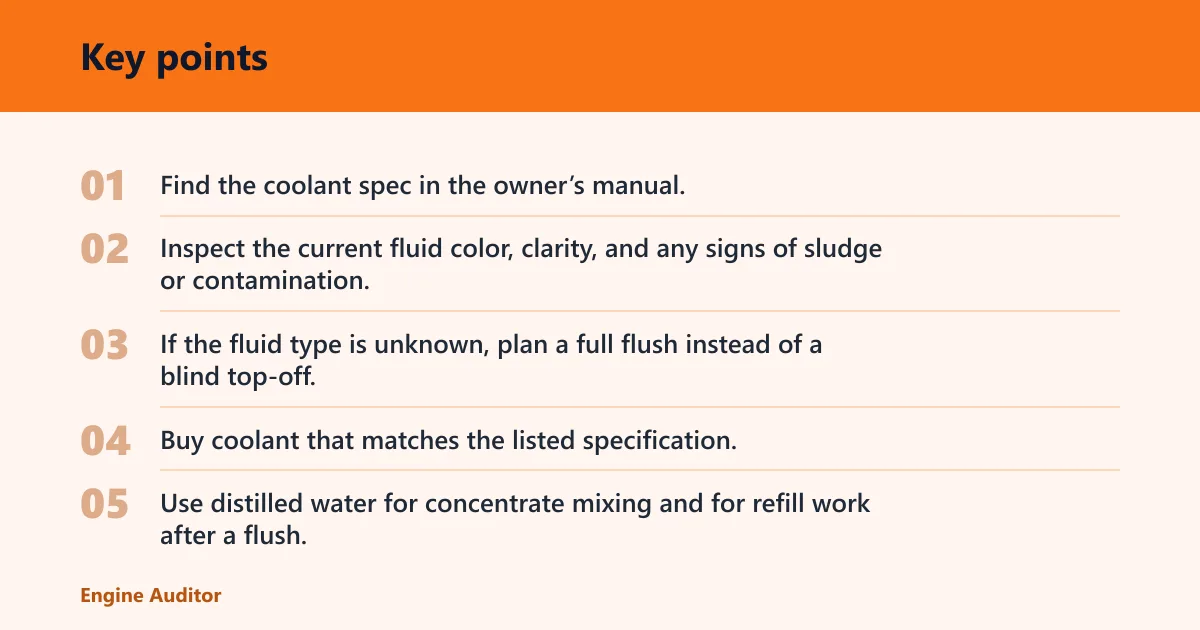
- Find the coolant spec in the owner’s manual.
- Inspect the current fluid color, clarity, and any signs of sludge or contamination.
- If the fluid type is unknown, plan a full flush instead of a blind top-off.
- Buy coolant that matches the listed specification, even if the color differs from what you expected.
- Use distilled water for concentrate mixing and for refill work after a flush.
- If the system already contains mixed or contaminated coolant, service it fully before adding more.
Frequently asked questions
What do the different coolant colors mean?
Different colors usually point to broad chemistry families, not exact formulas. Green often means IAT, orange and red often mean OAT, and yellow, pink, and blue are often HOAT. The vehicle manual still matters more, because color alone does not define compatibility.
What do the different antifreeze colors mean?
Antifreeze colors are a service clue, not a final rule. They can suggest IAT, OAT, or HOAT, but the same color can appear in different products. Check the exact coolant specification before topping off or mixing anything.
What does the coolant color mean?
Coolant color usually tells you which chemistry family is most likely in the bottle or reservoir. It does not tell you the full additive package, the service life, or whether it matches your car. The owner’s manual is the better source.
What’s the difference between coolant colors?
The difference is usually the chemistry behind the dye. Green often points to IAT, orange and red to OAT, and yellow, pink, and blue to HOAT. Even then, two same-color coolants can be chemically different, so the spec still decides.
What coolant should I use if I don’t know what’s in the system?
Do not guess based on color. If the current fluid type is unknown, the safest move is a full coolant flush, then refill with the correct specification from the owner’s manual. That avoids incompatible mixing and keeps the system on the right chemistry.
Is universal coolant safe to use?
Universal coolant is best treated as a compromise, not the ideal default. It may fit more than one application, but it is not equally right for every engine. Use it only when the label and vehicle spec support it, or as a temporary fallback.
Products related to this article
Sponsored / affiliate links. As an Amazon Associate I earn from qualifying purchases. I may earn additional commission from eligible campaigns.