Can Old Coolant Cause Overheating?
Yes. Old coolant can cause overheating once its additives break down, pH drops, or rust and scale slow flow; coolant that looks dirty, sludgy, or is more than about 5 years old should be inspected. Leave it alone, and you can warp a head, damage a water pump, or clog the radiator. This guide explains how aged coolant creates heat problems and how to tell it apart from low coolant or a failed part.
Can old coolant cause overheating?
Yes. Old coolant can overheat an engine when corrosion inhibitors wear out, the mix picks up contamination, or trapped air cuts circulation. The risk is highest when the coolant is overdue, the wrong type was mixed in, or deposits have narrowed passages in the radiator, heater core, or engine.
What old coolant means in practice
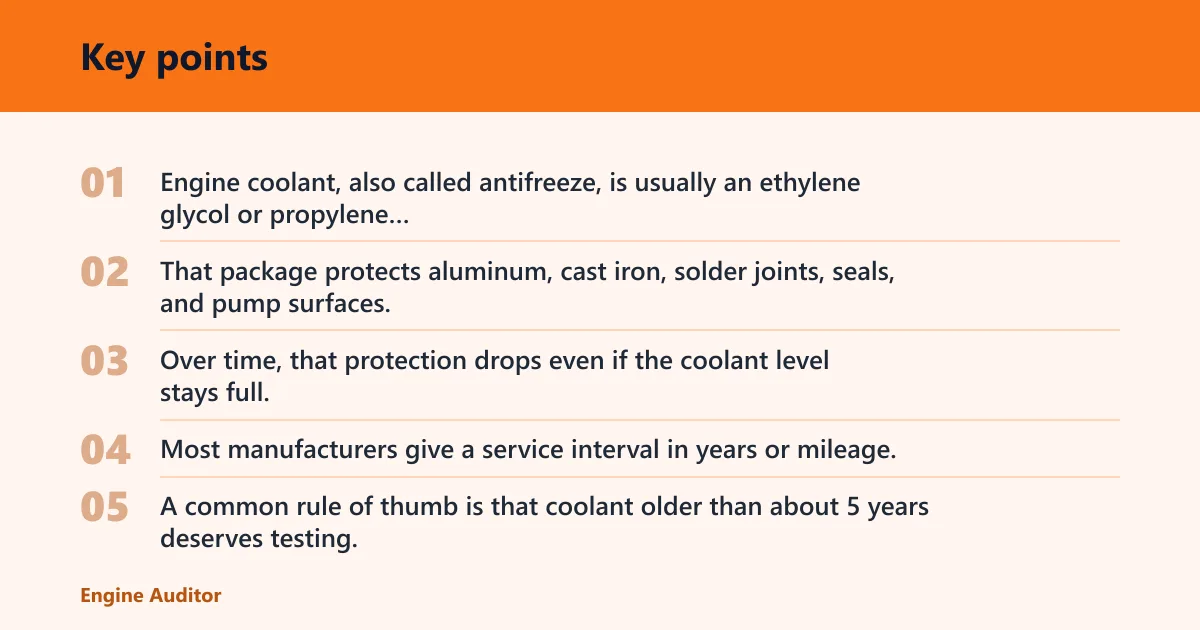
Engine coolant, also called antifreeze, is usually an ethylene glycol or propylene glycol base with a corrosion inhibitor package. That package protects aluminum, cast iron, solder joints, seals, and pump surfaces. Over time, that protection drops even if the coolant level stays full.
Most manufacturers give a service interval in years or mileage, and the exact number matters. A common rule of thumb is that coolant older than about 5 years deserves testing, though the vehicle maker’s interval should take priority.
How coolant age changes boil protection and corrosion control
Fresh coolant does three jobs at once: it helps prevent freezing, raises the boiling point under pressure, and protects metal surfaces from corrosion. As additives deplete, the coolant can acidify, and that pH drift raises aluminum corrosion risk. Small flakes, scale, and sludge then start to reduce heat transfer.
That failure path is easy to miss because the engine may still hold temperature at idle, then run hot under load, on hills, or with the air conditioner on. Old coolant usually does not fail all at once. It loses margin first.
When aged coolant becomes a real overheating risk
Aged coolant becomes a serious problem when it stops moving heat quickly enough or stops boiling as a pressurized liquid. That can happen from inhibitor depletion, a wrong mix, contamination, or air trapped in the system. The engine then sees hot spots even though the reservoir looks full.
Say your sedan still has a normal level in the reservoir, but the coolant is dark and the temperature gauge climbs after 10 minutes of highway driving. That pattern points more toward degraded coolant, partial restriction, or air than toward simple low level alone.
How coolant fails over time
Coolant failure usually starts chemically, then becomes mechanical. Additives deplete, the coolant can turn acidic, and corrosion products begin to circulate. Once that happens, the radiator and heater core can lose flow, and the water pump may start moving dirty liquid instead of clean coolant.
Additive depletion and pH drift
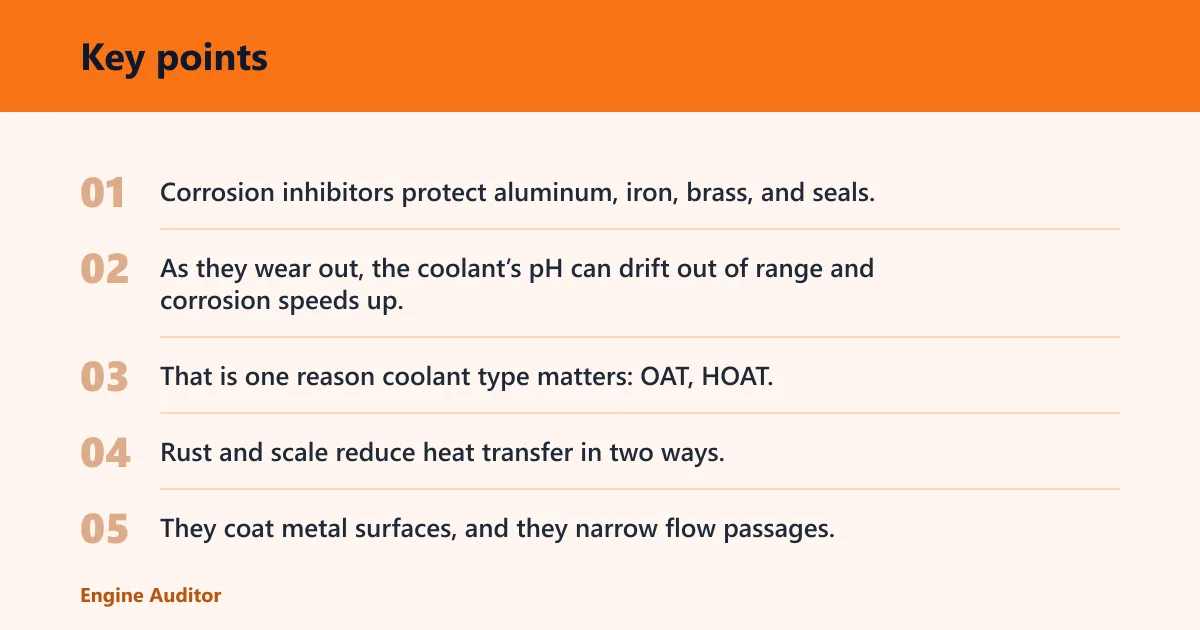
Corrosion inhibitors protect aluminum, iron, brass, and seals. As they wear out, the coolant’s pH can drift out of range and corrosion speeds up. That is one reason coolant type matters: OAT, HOAT, and IAT formulas are not interchangeable in every system, especially in mixed-fleet vehicles that depend on a specific chemistry.
Rust, scale, and sludge formation
Rust and scale reduce heat transfer in two ways. They coat metal surfaces, and they narrow flow passages. Sludge can also settle in the radiator tank, heater core tubes, thermostat area, and pump inlet. Once deposits build up, the engine may overheat even with a correct fluid level.
Dirty coolant is a warning sign, but the color alone is not enough. Brown coolant can mean rust, mixed formulas, or old additive breakdown. Oily contamination points to a different problem, often a gasket or cooler leak.
Wrong mix and mixed-coolant problems
Coolant concentration matters. A 50/50 mix of coolant and water is a common baseline because it generally balances freeze protection, boil protection, and heat transfer. Too much coolant can reduce heat transfer compared with a proper mix, while too much water cuts freeze and boil protection.
Mixed or unverified coolant type can make matters worse. Some combinations gel, lose corrosion protection, or form deposits. If the color and formula are unknown, treat it as a compatibility problem, not just an old-fluid problem.
Old coolant vs low coolant
Low coolant and old coolant can both cause overheating, but they fail differently. Low coolant usually causes poor circulation, a low reservoir, heater output loss, and rapid temperature swings. Old coolant often keeps the level normal while slowly losing corrosion protection, boil margin, and flow quality.
Level loss symptoms
Low coolant often creates obvious air ingestion, repeated topping off, or a heater that blows cool at idle. You may see a low reservoir, a steam smell, or a gauge that climbs fast after startup. That points to quantity loss, not just chemistry loss.
Chemistry loss symptoms
Old coolant can leave the level looking normal while the engine runs hotter than it should. Warning signs include stained coolant, sediment, crust around hose joints, and overheating during load rather than immediately after startup. That pattern often points to degraded chemistry, not a simple leak.
Why the two problems can look alike
Both problems can trigger hot spots and a rising gauge. Both can reduce heater performance. The difference is that low coolant leaves empty space and traps air, while old coolant keeps volume but weakens protection and can create internal restriction. A level check and a coolant-condition check are both needed.
Coolant condition decision table
| Coolant appearance or odor | Likely chemistry state | Probable failure mode | Overheating likelihood | Recommended action |
|---|---|---|---|---|
| Normal color, no odor, overdue by time or mileage | Additives likely depleted | Lower corrosion protection, reduced boil margin | Moderate, rises under load | Test pH and freeze protection; replace at the manufacturer interval if results are weak |
| Rusty or brown | Corrosion products present | Scale, sludge, and flow restriction | High | Inspect radiator, thermostat area, and heater core; flush only after confirming the cause |
| Oily or slick smell | Possible contamination from oil or transmission fluid | Heat transfer loss, seal damage, sludge formation | High | Check for cooler, gasket, or head-gasket leak before refilling |
| Foamy or bubbly | Air, contamination, or chemical incompatibility | False level reading, hot spots, cavitation risk | High | Bleed the system, verify cap seal, and confirm coolant type compatibility |
| Mixed or unverified type | Unknown OAT, HOAT, or IAT compatibility | Gel, deposits, inhibitor conflict | Moderate to high | Drain, flush if needed, and refill with the correct specification |
What old coolant does to the radiator
The radiator is the main heat exchanger. Hot coolant passes through narrow tubes, air moves across the fins, and the heat leaves the system. Old coolant can hurt that process by leaving deposits inside the tubes, coating surfaces with sludge, or creating air pockets that block flow.
Internal clogging and restricted flow
Internal clogging is one of the most direct ways old coolant causes overheating. Rust, scale, and gelled coolant narrow the passages, so less heat reaches the fins. If the upper hose is very hot and the lower hose stays much cooler than expected, restricted flow may be part of the problem.
External fin blockage and poor airflow
Debris on the outside of the radiator also matters. Leaves, dirt, bugs, and bent fins reduce airflow, which means the radiator cannot shed heat even if the coolant is fine. That fault often shows up at idle or in slow traffic before it appears at highway speed.
Pressure cap interaction and boiling margin
The cooling system pressure cap raises the boiling point by holding pressure in the system. If the cap seal fails or the rating is wrong, coolant boils sooner and can flash to vapor near hot spots. Old coolant with a weak cap has much less margin than fresh coolant with a healthy cap.
Can old coolant make the thermostat or water pump look bad?
Yes. Old coolant can create symptoms that resemble a bad thermostat or water pump by reducing flow, forming deposits, or trapping air. That is why overheating diagnosis should start with coolant condition, then move to temperature control parts, not the other way around.
Stuck-closed thermostat symptoms
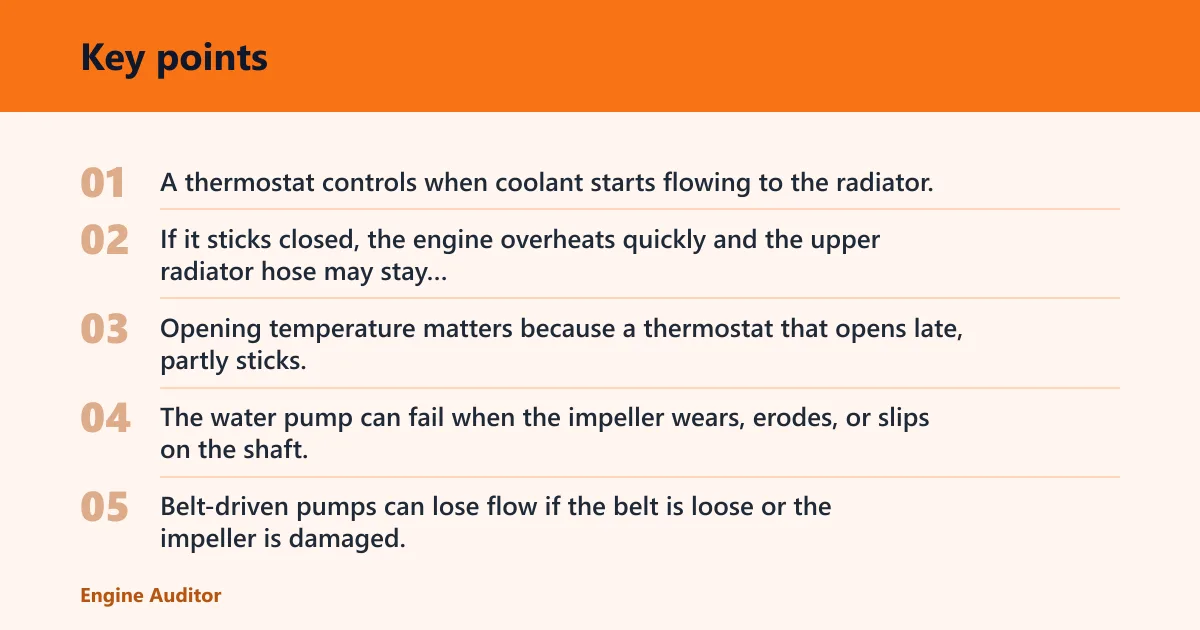
A thermostat controls when coolant starts flowing to the radiator. If it sticks closed, the engine overheats quickly and the upper radiator hose may stay cool longer than it should. Opening temperature matters because a thermostat that opens late, partly sticks, or is coated with debris can delay circulation.
Impeller wear or erosion in the water pump
The water pump can fail when the impeller wears, erodes, or slips on the shaft. Belt-driven pumps can lose flow if the belt is loose or the impeller is damaged. Electric pumps can fail through motor or control problems. A weak pump often causes overheating at higher rpm, poor heater output, or temperature swings.
Suppose a truck overheats only after climbing a grade, but idles normally in the driveway. That pattern can fit pump flow loss, a partial radiator restriction, or a cap problem far better than a simple level issue.
How poor circulation shows up at the hoses
Check the hoses for clues. A hot upper hose with a much cooler lower hose may point to thermostat trouble or poor radiator flow. Uneven hose temperatures, bubbling in the reservoir, or repeated hot spots after refilling can point to air or impeller problems instead of coolant age alone.
Can trapped air or a bad cap cause overheating?
Yes. Air trapped in the cooling system can create hot spots, reduce pump efficiency, and make the temperature gauge rise even when the coolant level appears acceptable. A bad pressure cap can do the same by lowering system pressure and letting coolant boil too early.
Air pockets and hot spots
Air does not carry heat like liquid coolant. A trapped pocket near the cylinder head or thermostat can prevent proper heat transfer and cause false overheating symptoms. The engine may spike on the gauge, then drop suddenly when the pocket moves.
Bleeding the system after service
After service, the system needs to be bled according to the vehicle procedure. That may involve a bleed screw, a vacuum fill tool, or a specific warm-up routine. If the system was opened and not bled correctly, old coolant may get blamed for a problem caused by trapped air.
Pressure cap failure symptoms
A weak cap can show coolant smell, overflow after shutdown, or early boil-over without a major leak. Because pressure affects boiling point, a seal failure can make even decent coolant behave badly. Check the cap rating against the vehicle specification before replacing parts at random.
How to tell the cause apart
- Check the coolant level only when the engine is cool.
- Look at the coolant color, clarity, and odor in the reservoir and, if safe, at the filler neck.
- Inspect the radiator fins for blockage and the hoses for collapse, swelling, or soft spots.
- Verify the pressure cap rating and seal condition.
- Confirm the coolant type and concentration; 50/50 is a common baseline unless the maker specifies otherwise.
- Compare the symptom pattern with thermostat, pump, and fan behavior.
- Use the engine coolant temperature sensor reading, if available, to see whether the gauge matches actual temperature.
The engine coolant temperature sensor can help separate a real overheat from a bad gauge reading. If the sensor data shows a steady climb while the dash gauge behaves normally, the issue is real. If the sensor reading and gauge disagree sharply, wiring or the cluster may be part of the fault.
A common first-timer mistake is topping off a low reservoir with the wrong coolant type and assuming the problem is fixed. That can turn a simple low-level issue into a compatibility problem, especially in systems that rely on a specific OAT, HOAT, or IAT formula.
Frequently asked questions
Will old coolant cause overheating?
It can, but not always by itself. Old coolant raises risk by reducing boil protection and corrosion control. If the level is correct and the system is otherwise healthy, it may run normally for a while. Once sludge, scale, or air appears, the risk rises quickly.
Can old antifreeze cause overheating?
Yes. Antifreeze is the coolant base plus additives, and those additives wear out over time. When protection drops, the fluid can acidify, corrode aluminum, and form deposits that block passages. That creates heat buildup even if the reservoir still looks full.
Can too much coolant cause a car to overheat?
Overfilling usually does not cause overheating by itself, but it can create other problems if the system cannot vent excess fluid correctly. The more common issue is that an incorrect mix, not a slightly high fill level, reduces heat transfer or boiling margin.
What happens if coolant gets too hot?
If coolant gets too hot, it can boil, form vapor pockets, and lose its ability to carry heat away from the engine. That can lead to rapid temperature rise, hose swelling, overflow, head-gasket damage, or warped metal if the engine stays hot long enough.
Can an old radiator cause overheating?
Yes. An old radiator can clog internally with scale or externally with debris and bent fins. It can also suffer tank corrosion or poor flow through its tubes. Even with good coolant, a restricted radiator can cause overheating at idle, speed, or both.
Products related to this article
Sponsored / affiliate links. As an Amazon Associate I earn from qualifying purchases. I may earn additional commission from eligible campaigns.