Why Does My Car Overheat When Going Uphill?
Your car overheats going uphill when engine load rises faster than the cooling system can shed heat, often because of low coolant, weak airflow, a slipping water pump, a stuck thermostat, or head-gasket leakage. Ignore it and you can warp the cylinder head, damage the gasket, or leave the engine stranded. This guide shows how to diagnose uphill overheating in severity order, starting with airflow, then coolant circulation, then combustion-pressure faults.
Steep grades raise heat in two ways at once. The engine works harder, and the car usually moves slower than it does on the highway, so less air passes through the radiator. That combination is why a system that seems fine on level ground can fail on a climb.
Why uphill driving makes engines run hotter


Why low speed makes it worse
Radiators depend on moving air. At about 15 to 35 mph on a hill, ram air drops while engine output rises, so the cooling system has less margin than it does at steady highway speed. A weak fan, partial blockage, or low coolant level can stay hidden until that load spike arrives.
How towing or payload stacks the heat load
Towing, a full cargo area, roof load, or a long climb in hot weather all add heat. The transmission also works harder, especially if it stays in a high gear and forces the engine to lug. That is why some vehicles overheat only when fully loaded, not during ordinary commuting.
What the symptom pattern can tell you
The place and timing of the temperature rise points to the fault family. Hills-only overheating usually means the system is losing cooling margin under load, while idle-only overheating points more strongly to fan or airflow problems. Highway-only overheating often points to flow restriction or cooling capacity, not simple speed-related airflow loss.
Overheats only on steep grades
This pattern usually points to weak coolant circulation, a partially restricted radiator, a radiator cap that cannot hold pressure, or combustion gas entering the coolant. A hill is the first time the system is asked to reject near-maximum heat for a sustained period.
Overheats only with the air conditioning
That points toward condenser airflow, fan performance, or an already marginal cooling system. The A/C condenser sits in front of the radiator and adds heat to the air stream, so a fan that is barely adequate without A/C may fail the moment the compressor is on.
Overheats only at low speed
This is the classic airflow clue. Electric fans, fan clutches, relay control, or blocked grille passages move to the top of the list because road speed is too low to supply enough ram air on its own.
Overheats only when coolant is low
Low coolant often means air is entering the system. The pump can pull air instead of liquid on a climb, and the temperature can spike fast because air does not carry heat well. If the level keeps dropping, look for leaks before any deeper diagnosis.
Uphill overheat triage
Use this matrix to separate airflow, circulation, and combustion-pressure problems before you replace parts. Start with the easiest checks and move toward deeper faults only if the first results point that way.
| Symptom | Likely subsystem | Quick test | Likely cause | Next action |
|---|---|---|---|---|
| Overheats only on steep grades | Cooling system or engine load | Watch the gauge on a moderate hill in a lower gear | Weak airflow, low coolant, restricted radiator, pump weakness | Check coolant level, fan operation, and radiator fins |
| Overheats only with A/C on | Radiator fan and condenser airflow | Idle with A/C on; confirm fan starts and stays on | Bad fan motor, relay, fuse, clutch, or blocked airflow | Inspect fan command, power supply, and fan movement |
| Overheats only at low speed | Airflow at low road speed | Compare temperature at 20 mph and 55 mph | Fan failure or airflow restriction | Inspect fan, grille, condenser, and radiator face |
| Overheats only when coolant is low | Coolant level and sealing | Check level only when the engine is fully cool | Leak, trapped air, poor bleed, cap leak | Find the leak, correct the level, bleed air from system |
| Overheats with bubbles in reservoir | Combustion gas intrusion | Look for steady bubbling after warm-up | Head gasket or cracked head | Stop driving and arrange pressure or gas testing |
What to check first if your car overheats going uphill
- Pull over if the gauge climbs into the hot zone or a warning light appears.
- Let the engine cool fully before opening any pressurized part of the cooling system.
- Check the coolant reservoir level only after the engine is cold.
- Inspect for leaks, wet hoses, dried residue, or a sweet coolant smell.
- Look through the grille and radiator face for packed debris, leaves, plastic bags, or bent fins.
- Confirm whether the radiator fan runs when commanded on.
- If the problem persists, move to scan data and pressure testing.
If a sedan climbs a long 8% grade at about 25 mph and the gauge rises only after the A/C is switched on, that often points more toward fan or airflow loss than a pure engine problem. That points more toward fan or airflow loss than a pure engine problem. If the same car stays cool at 55 mph on level ground, the clue is the low-speed airflow gap.
Could low coolant or trapped air be the cause?
Yes. Low coolant can make a car overheat on hills only because the pump loses its solid liquid supply first when load rises. Air pockets make the problem worse, since the pump can cavitate and the heater core or radiator may not stay full enough to move heat.
How low coolant shows up on climbs
The level may look acceptable when cold, then drop enough on a climb to uncover the pump inlet or leave part of the radiator empty. That can create a sudden temperature rise under load, followed by a temporary recovery once the engine cools or the load drops.
Air pockets and circulation loss
Trapped air often follows a coolant service, a slow leak, or a failed bleed procedure. A pocket in the thermostat housing or radiator can keep hot coolant from circulating, which is why a system may overheat on hills but seem ordinary in stop-and-go traffic.
Correct mix and boil protection
A 50/50 coolant-to-water mix is a common target because it raises boil protection and improves freeze protection compared with plain water. If the mix is too weak, the system can boil sooner on a climb, especially if the radiator cap is weak or the coolant level is already low.
Could the radiator fan be failing?
Yes. A bad radiator fan can cause overheating uphill, especially at low speed or with the A/C on, because the vehicle loses the airspeed that normally helps the radiator. Electric fans, fan clutches, relays, fuses, and motors can all fail in ways that show up only under load.
Electric fan versus clutch fan
An electric fan should switch on when coolant temperature rises or when the A/C request calls for it. A clutch-driven fan should couple more firmly as underhood air gets hotter. If either type fails to move enough air, the car may run fine on flat roads and then overheat on grades.
Fuse, relay, motor, and fan-command checks
With a scan tool, compare coolant temperature PID data to fan command status. If the module commands the fan on and the fan does not run, check the fuse, relay, wiring, ground, and motor. If the fan runs but is weak, check for damaged blades, a worn clutch, or obstruction.
Why fan problems show up at low speed
At highway speed, ram air can partly cover for a weak fan. At climb speed, it cannot. That is why a marginal fan often shows up on hills before it shows up anywhere else.
Thermostat, water pump, and radiator restrictions
Once airflow and coolant level look normal, the next layer is circulation and heat rejection. A stuck-closed thermostat, a worn water pump, a clogged radiator, blocked fins, or a restricted hose can all reduce flow enough to trigger overheating on a climb.
Stuck-closed thermostat symptoms
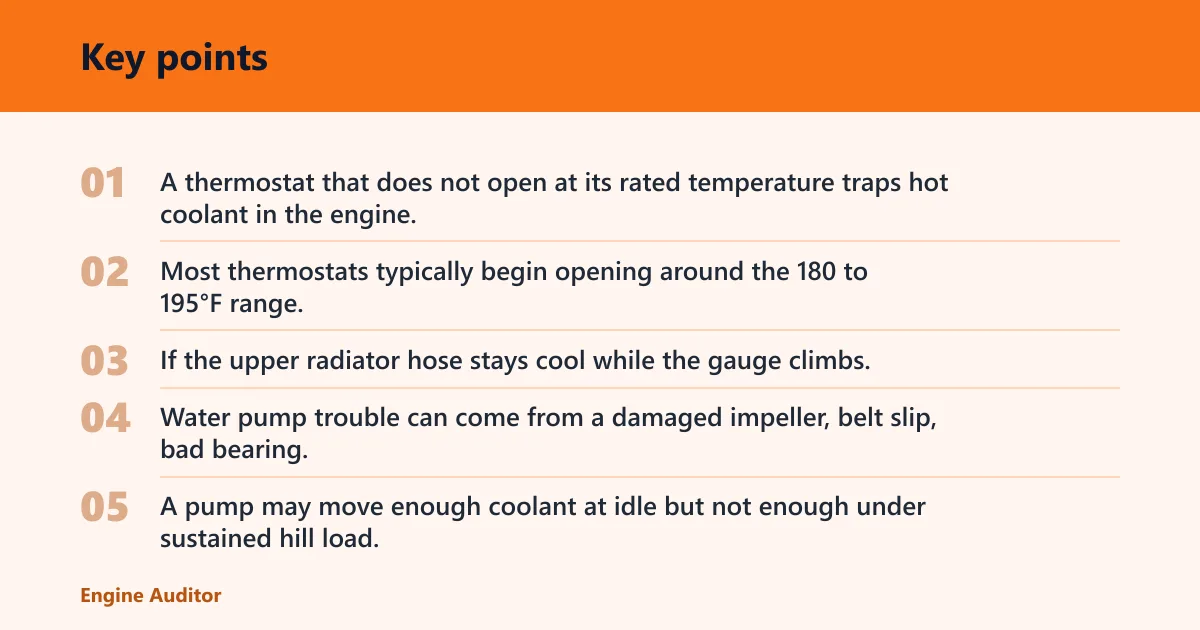
A thermostat that does not open at its rated temperature traps hot coolant in the engine. Most thermostats typically begin opening around the 180 to 195°F range, though exact ratings vary by vehicle. If the upper radiator hose stays cool while the gauge climbs, restricted flow is a strong clue.
Water pump flow problems
Water pump trouble can come from a damaged impeller, belt slip, bad bearing, or weak electric drive. A pump may move enough coolant at idle but not enough under sustained hill load. If the heater output drops while the engine runs hot, circulation deserves close attention.
Clogged radiator, blocked fins, and restricted hoses
A radiator can lose capacity from internal scale, external debris, or bent fins that block air passage. Hoses can also flatten internally or shed material that narrows flow. These faults often show up after long climbs because that is when the cooling system needs full capacity for the longest time.
Suppose a crossover cools fine around town but starts to climb past normal only after 10 minutes on a mountain road. If the upper hose gets very hot while the lower hose stays much cooler than expected, that pattern leans toward restricted flow or a thermostat issue rather than a simple gauge fault.
Could the engine or transmission be adding too much heat?
Yes. Climbing in too high a gear raises engine load and can also add transmission heat. Downshifting reduces lugging, keeps the engine in a more efficient speed range, and can lower the heat the cooling system has to reject on a long grade.
Too high a gear on a climb
When the engine labors at low rpm in a high gear, cylinder pressure and heat rise. The transmission may also slip more while trying to hold speed. That extra heat has to go somewhere, and the cooling system is the usual first limit.
How downshifting changes heat load
Downshifting increases engine speed and usually improves coolant pump flow, water flow through the radiator, and throttle response. It also reduces the chance of lugging. If the temperature stabilizes after a downshift, gearing was part of the problem even if a cooling fault still exists.
Towing, payload, and grade effects
Towing a trailer, climbing with heavy cargo, or holding speed into a headwind increases heat output. If the problem appears only under those conditions, the system may be marginal rather than completely failed. That still needs attention, because a marginal system can turn into a roadside overheat quickly.
Head gasket warning signs on hills
A head gasket issue can mimic ordinary overheating, but the hill pattern is often more specific. If combustion gases enter the cooling system, pressure builds fast under load, coolant is pushed out, and the reservoir may bubble even after the thermostat and fan have already come online.
Bubbles in the reservoir
Steady bubbles after warm-up are a warning sign, especially if they appear during a climb or right after one. A few random bubbles after recent service can come from trapped air, but repeated bubbling with coolant loss points toward combustion gas intrusion.
Pressure buildup and white exhaust
If hoses feel very hard soon after a cold start, or if white exhaust appears along with coolant loss, suspect a leak between the cylinders and the cooling system. White exhaust alone is not proof, but paired with bubbling and unexplained coolant loss it deserves prompt inspection.
When combustion gas enters the cooling system
That fault often shows up most clearly under sustained load, which is why a car may overheat on hills before it overheats in daily driving. This is the point where pressure testing, combustion-gas testing, or compression testing usually moves from useful to necessary.
Is it safe to keep driving if my car overheats on hills?
No, not if the gauge keeps rising, the warning light comes on, or the engine starts losing power. Short movement to a safe stop is one thing. Continuing to drive an overheated engine can warp the head, damage the gasket, and turn a repairable fault into a major engine job.
Do not open the radiator cap when the engine is hot. Wait until the system is fully cool. If the temperature climbs again after a brief cooldown, the fault is not fixed and the car needs diagnosis before another climb.
Frequently asked questions
Why does my car overheat when going uphill?
Uphill driving raises engine load while reducing the air available to the radiator at low road speed. That exposes weak coolant level, fan performance, thermostat opening, pump flow, radiator restriction, or head-gasket leakage. If the car only overheats on climbs, start with airflow and coolant circulation before deeper engine faults.
Why does my car overheat when going up a hill?
The short version is that the cooling system loses margin on a grade. The engine makes more heat, the car often moves slower, and airflow drops. If the problem appears only on hills, the first suspects are low coolant, a weak fan, restricted flow, or a radiator that cannot shed heat well.
Why does my car only overheat going uphill?
That pattern usually means the system is marginal under load rather than failed all the time. A weak pump, air pocket, clogged radiator, bad cap, or fan problem may stay hidden in city driving and then show up during sustained climb load. Transmission lugging can add heat to that same pattern.
Can low coolant make a car overheat on hills only?
Yes. Low coolant can still cover the system on flat roads, then uncover the pump inlet or leave an air pocket exposed when the engine works hard on a grade. The result is a fast temperature spike under load. A leak or poor bleed usually sits behind the low level.
Could a bad radiator fan cause overheating uphill?
Yes, especially if the overheating happens at low speed or with the A/C on. At highway speed, ram air can hide a weak fan. On a climb, that backup disappears. Check whether the fan runs when commanded, and inspect the fuse, relay, motor, clutch, and wiring.
Can a slipping transmission or low gear cause overheating on climbs?
Yes. Climbing in too high a gear can make the engine lug and raise heat output, while a slipping transmission adds its own heat load. Downshifting often lowers strain and can stabilize temperature. If the gauge improves after a downshift, load and gearing are part of the problem.
Products related to this article
Sponsored / affiliate links. As an Amazon Associate I earn from qualifying purchases. I may earn additional commission from eligible campaigns.