How to compare minivans vs SUVs for family travel needs
Choose a minivan if your family regularly loads strollers, luggage, or three kids across. Choose an SUV only if you need higher ground clearance or all-wheel-drive first, and can live with harder access and tighter cargo use. Pick wrong, and you get door-dings, sore backs, cargo Tetris, and extra stops on trips that should have stayed simple. I compare them here by packing, parking, third-row access, kid logistics, road-trip comfort, and the failure modes that matter most.
Minivan vs SUV for family travel: the real trade-off
| Decision factor | How to compare minivans | SUVs for family travel | Winner |
|---|---|---|---|
| Access in tight spaces | Sliding side doors, wide opening, easier when parked close to another car | Hinged doors need more swing room; child loading can be awkward in crowded lots | Minivan |
| Third-row usability | Third rows are spacious enough for adults, with easier access | Third rows are often tighter and harder for adults to use on longer trips | Minivan |
| Cargo with family aboard | More useful cargo behind the third row in many setups; better loading shape | Cargo shrinks faster once seats are up, especially in three-row midsize models | Minivan |
| Towing and clearance | Typical tow ratings sit around 3,500 pounds | Many SUVs exceed 5,000 pounds and ride higher off the ground | SUV |
| Weather traction | Front-wheel drive is standard; all-wheel drive is limited in this segment | AWD is common or standard on many trims, which helps in snow and wet roads | SUV |
| Fuel cost and price | Often cheaper to buy, and hybrid options can cut fuel use | Usually costs more for the same seating, with higher fuel use in many trims | Minivan |
Access in tight parking spots
Minivans win this row because sliding side doors make loading easier in tight spaces. That matters in school drop-off lanes, grocery lots, and city garages where a wide-opening SUV door can bump the car beside it. The first ding usually happens when the family is rushed.
Third-row comfort and adult usability
Minivans usually carry the better third row for adults. That means less knee-folding on airport runs and less arguing over who sits in back on a long drive. In many SUVs, the third row is fine for kids but punishing for grown passengers once the trip lasts beyond a few exits.
Cargo shape with seats up
Minivans tend to pack better when every seat is in use. The cargo floor is lower and squarer, so a stroller, cooler, and several bags fit with less wasted space. A tall SUV can have a large cargo number on paper and still be harder to use with all rows occupied.
Towing and ground clearance
SUVs win when the trip includes a trailer, boat, or rough driveway. A family that really needs towing headroom will usually find a minivan’s 3,500-pound benchmark limiting, while a large SUV can move into 5,000-pound territory or beyond. Higher ground clearance also helps on rutted roads and steep curb cuts.
Fuel use and purchase price
Minivans usually cost less than comparable three-row SUVs, and hybrid versions can reduce fuel stops on long family trips. The Kia Carnival starts at $36,990, while the Chevrolet Tahoe starts at $60,700. That gap matters because family travel costs do not stop at the dealer.
Which is easier to live with every day?
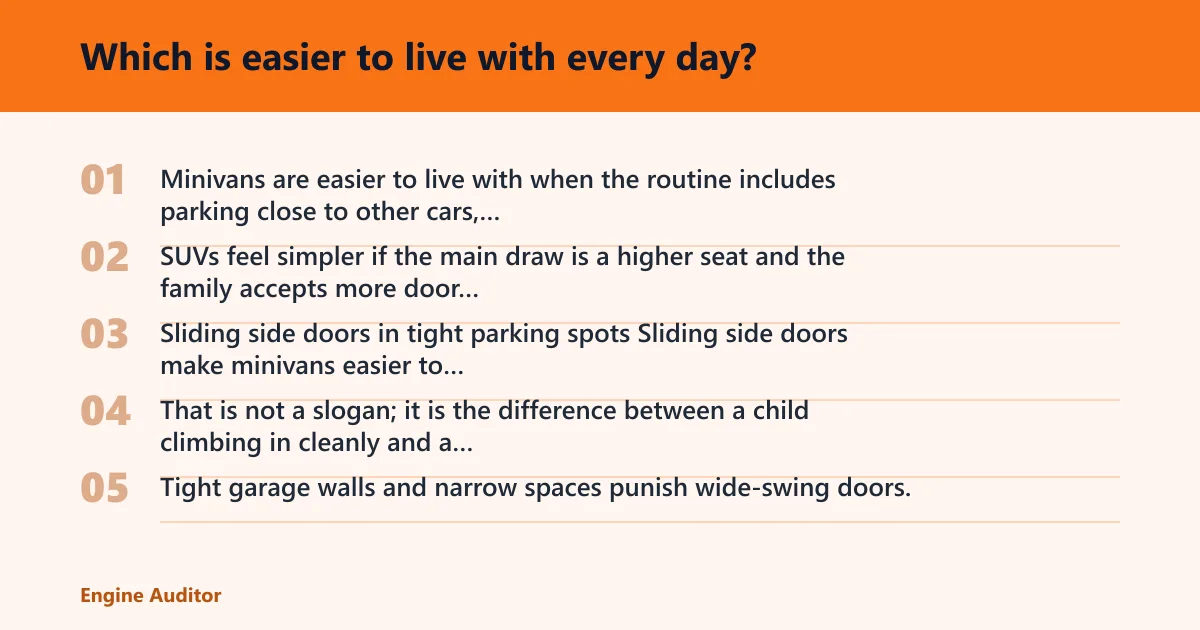
Minivans are easier to live with when the routine includes parking close to other cars, lifting children into seats, and opening doors with both hands full. SUVs feel simpler if the main draw is a higher seat and the family accepts more door swing, more climbing, and more strain while loading.
Sliding side doors in tight parking spots
Sliding side doors make minivans easier to access in tight spaces. That is not a slogan; it is the difference between a child climbing in cleanly and a parent threading a door around the next vehicle’s mirror. Tight garage walls and narrow spaces punish wide-swing doors.
Step-in height, child seats, and hands-full loading
An SUV’s higher step-in height is useful in snow, but it makes repeated loading harder. Child seats are easier to reach when the door opens wide and the sill is low. Families carrying a diaper bag in one hand and a toddler in the other usually feel the difference by the third stop.
Third-row access for kids and adults
Minivans have third rows spacious enough for adults, and that changes the daily math. It means a parent or grandparent can sit back there without treating the seat like a punishment. In many SUVs, the third row is more of a backup plan than a real place for full-size passengers.

Which carries more when the whole family is aboard?
Minivans usually carry family-trip cargo better when all seats are up, while SUVs can look larger but lose usable room faster once the third row is occupied. If the plan includes a stroller, beach gear, or airport bags behind a full cabin, the minivan’s shape often beats the SUV’s height.
Cargo with all seats up
This is where many comparisons go wrong. The headline cargo figure matters, but family travel fails in the space behind the third row, not in an empty showroom layout. The Kia Carnival has 145.1 cubic feet of maximum cargo capacity, while the Chevrolet Tahoe has 122.7 cubic feet, and the real difference appears when passengers stay in every row.
Cargo with the third row folded
Folding the third row changes the contest, but not equally for every body style. The Pacifica and Grand Caravan can fold both second- and third-row seats into the floor, which simplifies bulk hauling. That is useful for moving coolers, folding chairs, or stacked luggage without removing seats.
Usable cargo length for strollers, coolers, and bags
Usable cargo length matters because tall cargo volume is not enough by itself. A wide stroller frame, a camp cooler, and upright bags need a floor that accepts real shapes. Minivans usually make that loading pattern easier because the floor is flatter and the opening is lower.
How do towing, ground clearance, and AWD change the answer?
Towing, clearance, and all-wheel drive shift the answer toward SUVs when the family’s trips include trailers, rough roads, or regular snow. For most paved-road families, those gains come with tradeoffs: more fuel use, harder loading, and less forgiving parking behavior. The question is whether those needs are frequent or occasional.
3,500-pound minivan benchmark vs 5,000+ pound SUV benchmark
Minivans are usually limited here. The Kia Carnival and Toyota Sienna each have a tow rating of just 3,500 pounds. By contrast, large SUVs can move much heavier loads, and the Jeep Grand Wagoneer can tow up to 10,000 pounds. That is a different class of job.
AWD availability for snow and wet roads
All minivans come standard with front-wheel drive, and the Sienna is the only entry offering all-wheel-drive in that comparison. Many SUVs offer AWD more broadly, which helps on snowy driveways and wet boat ramps. The tradeoff is usually more weight, more cost, and less efficiency.
Ground clearance for curbs, rough roads, and trailheads
Ground clearance matters when the route includes curb-heavy neighborhoods, gravel pull-offs, or a steep trailhead road. SUVs handle that better because the body sits higher above the ground. That extra height can also make entrances feel easier in bad weather, though it usually raises the load floor too.
Which gets better fuel economy and costs less to buy?
Minivans usually win on purchase price and often on fuel use, especially in hybrid form. SUVs can cost much more for equivalent seating and equipment, then return more expensive fuel bills over a year of road trips. If a family drives often, that spread becomes visible quickly.
EPA combined mpg: gas vs hybrid models
Fuel economy varies by trim and drivetrain, but the pattern is clear. Minivans with hybrid powertrains often do better than comparable gas-only SUVs in family use, especially for city-heavy school and errand driving. That advantage matters most when the vehicle spends as much time in drop-off lines as it does on highways.
Starting MSRP and trim-to-trim price gap
The Kia Carnival starts at $36,990, while the Chevrolet Tahoe starts at $60,700. That gap is before adding AWD, towing gear, or entertainment options. A family should compare equivalent trims, not just base stickers, because the real price often rises when the same comfort features are added.
Value per seating capacity over a family road-trip year
Minivans often win value per seat because they can seat up to eight people and make those seats easier to use. If a vehicle carries multiple children weekly, access and packing ease matter as much as price. Paying less for the same passenger count is useful only if the cargo still fits.
Proof asset: score six family-trip scenarios before you buy
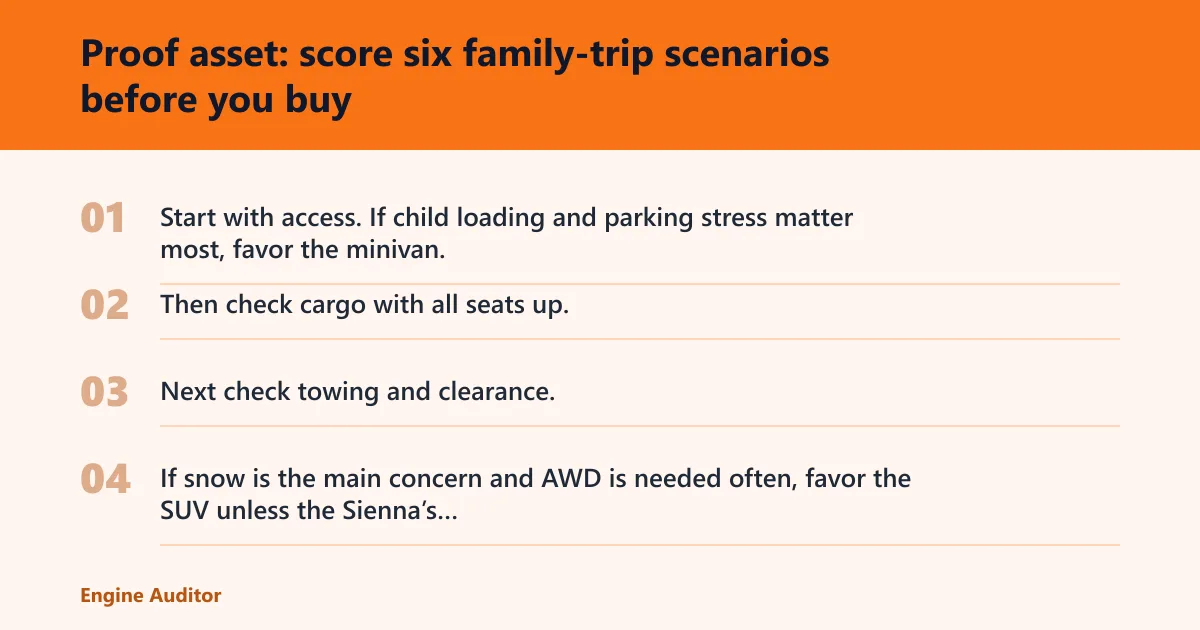
This worksheet turns the comparison into a decision-making exercise. Score each vehicle from 1 to 5 across a few categories, such as passenger access, luggage fit, towing, weather traction, and parking stress. Then total each row across the six scenarios below and compare the totals with your real calendar, not a brochure.
| Family-trip scenario | Passenger access | Luggage fit | Towing | Weather traction | Parking stress |
|---|---|---|---|---|---|
| School runs | 5 for minivan, 3 for SUV | 3 for minivan, 3 for SUV | 1 for both | 2 for minivan, 3 for SUV | 5 for minivan, 3 for SUV |
| Airport transfers | 5 for minivan, 3 for SUV | 5 for minivan, 3 for SUV | 1 for both | 2 for minivan, 3 for SUV | 4 for minivan, 3 for SUV |
| Beach road trip | 5 for minivan, 3 for SUV | 5 for minivan, 3 for SUV | 1 for both | 2 for minivan, 3 for SUV | 4 for minivan, 3 for SUV |
| Ski trip | 4 for minivan, 3 for SUV | 4 for minivan, 3 for SUV | 1 for both | 3 for minivan, 5 for SUV | 4 for minivan, 3 for SUV |
| Camping and towing | 3 for minivan, 3 for SUV | 3 for minivan, 4 for SUV | 2 for minivan, 5 for SUV | 2 for minivan, 4 for SUV | 4 for minivan, 3 for SUV |
| Car-seat-heavy daily use | 5 for minivan, 3 for SUV | 3 for minivan, 3 for SUV | 1 for both | 2 for minivan, 3 for SUV | 5 for minivan, 3 for SUV |
How to read the worksheet
If a family lives in school lanes and parking lots, the minivan usually wins by a wide margin. If the family spends weekends towing a trailer or driving steep snowy roads, the SUV gains ground. The worksheet works because it separates trip types instead of mixing them into one vague impression.
Simple recommendation rule
- Start with access. If child loading and parking stress matter most, favor the minivan.
- Then check cargo with all seats up. If that must fit a stroller plus luggage, favor the minivan.
- Next check towing and clearance. If the trailer or road surface matters often, favor the SUV.
- If snow is the main concern and AWD is needed often, favor the SUV unless the Sienna’s AWD setup fits the budget and cargo plan.
Choose How to compare minivans if… / Choose SUVs for family travel if…
Choose a minivan if your trips revolve around kids, luggage, and parking ease. Choose an SUV if towing, ground clearance, or a rugged image matter more than easy door access. The right answer is the vehicle that fails least often on your actual routes, not the one that looks tougher in the driveway.
Choose How to compare minivans if…
Pick it if you have multiple car seats, load in tight lots, or want adults to ride in the third row without complaints. Pick it if airport bags, beach gear, and daily school runs all share the same vehicle. Pick it if a lower purchase price and better seat-for-seat value matter.
Choose SUVs for family travel if…
Pick it if you tow a trailer, drive rough roads often, or need AWD for snow and wet pavement more than you need sliding doors. Pick it if you want a higher driving position and are willing to trade some cargo usability for that stance. Pick it if the family can live with tighter loading in exchange for capability.
Frequently asked questions
Is a minivan or SUV better for family road trips?
A minivan is usually better for family road trips when the trip includes kids, luggage, snacks, and repeat stops. It loads easier, packs better with the third row in use, and keeps adults more comfortable in back. An SUV wins mainly when towing or ground clearance matters more than access.
Which has more cargo space for family travel, a minivan or SUV?
Minivans usually have the edge for family travel cargo because the floor is easier to use and the shape wastes less space. The Kia Carnival’s 145.1 cubic feet of maximum cargo capacity is a strong example. The Chevrolet Tahoe has 122.7 cubic feet, but the usable space changes a lot with seats up or down.
Are minivans safer than SUVs for families?
Safety depends on the specific model, equipment, and crash performance, not the body style alone. Families should compare braking, visibility, seat-belt fit, child-seat installation, and available driver-assist systems. A minivan’s easy loading and better access can reduce daily missteps, but that is different from a blanket safety claim.
Do SUVs or minivans get better fuel economy?
Minivans usually do better, especially when a hybrid version is available. The Pacifica plug-in hybrid can run for the first 33 miles on battery power, which helps on short family trips. SUVs often burn more fuel because they are heavier and sit higher, especially in three-row formats.
Which is easier to load kids into: minivan or SUV?
A minivan is easier to load kids into because sliding side doors make access simpler in tight spaces. That matters when the car next to you is parked close or when the adult has a diaper bag, backpack, and one child on each hip. SUVs ask for more reach and more door clearance.
Which family vehicle is better in snow, minivan or SUV?
An SUV is usually better in snow because all-wheel drive is more common and ground clearance is higher. The Sienna is the only entry offering all-wheel-drive in that comparison, while all minivans come standard with front-wheel drive. For families on plowed roads, a good set of winter tires may matter more than body style.
Do minivans have enough third-row space for adults?
Yes. Minivans have third rows spacious enough for adults, and that is one of their strongest advantages over many three-row SUVs. The difference shows up on airport shuttles, long beach drives, and days when the grandparents come along. Adults can sit back there without treating the seat like a last resort.
Is an SUV better than a minivan for towing a trailer?
Yes, usually. The Jeep Grand Wagoneer can tow up to 10,000 pounds, while the Kia Carnival and Toyota Sienna each have a tow rating of just 3,500 pounds. If towing is a regular family task, the SUV is the cleaner fit.
Products related to this article
Sponsored / affiliate links. As an Amazon Associate I earn from qualifying purchases. I may earn additional commission from eligible campaigns.