How to Compare Crossovers vs SUVs: What Buyers Should Know
Compare crossovers and SUVs by use case: choose a crossover for commuting, family hauling, and lighter winter duty; choose an SUV when you need real towing, higher ground clearance, or more off-road hardware, especially above about 5,000 pounds of tow rating. Pick the wrong category and you can overspend on fuel, buy too little cargo space, or miss the towing and traction hardware you actually need. This guide explains platform differences, towing thresholds, seating and cargo tradeoffs, road-condition needs, and ownership costs so you can choose by requirements, not badges. (motortrend.com)
This guide is part of our Car comparison guide series.
| Factor | How to compare crossovers | SUVs | Winner |
|---|---|---|---|
| Best-fit use | Best for commuting, school runs, family hauling, and lighter winter duty. | Best when you need real towing, higher ground clearance, or more off-road hardware. | Tie |
| Ride and daily comfort | Car-based unibody design, smoother ride, easier parking, more car-like handling. | Truck-based or reinforced construction, firmer ride, more truck-like feel. | How to compare crossovers |
| Towing and payload | Usually lower tow ratings and lighter payload limits. | Usually higher tow ratings and stronger payload capacity. | SUVs |
| Fuel use and ownership cost | Generally better fuel economy, often lower tire and brake costs. | Usually heavier, often more fuel use, larger tires and higher wear exposure. | How to compare crossovers |
| Off-road and rough-road use | Good for mild dirt roads and snow, limited hardware on many models. | Better for rugged trails, and some models add low-range gearing. | SUVs |
| Cargo loading and family hauling | Lower lift-over height, easier loading, flexible seat folds. | More cargo volume and payload in many models, but loading height can be higher. | Tie |
| Platform and structure | Usually built on a unibody, car-based platform for comfort and efficiency. | More often body-on-frame or reinforced unibody built for stronger towing and load carrying. | Tie |
What is the difference between a crossover and an SUV?
A crossover is usually built on a unibody, car-based platform, while an SUV is more often body-on-frame or a reinforced unibody built for stronger towing and load carrying. That platform split changes ride quality, handling, fuel use, cargo behavior, and how much abuse the vehicle is expected to handle.
Platform is the real separator
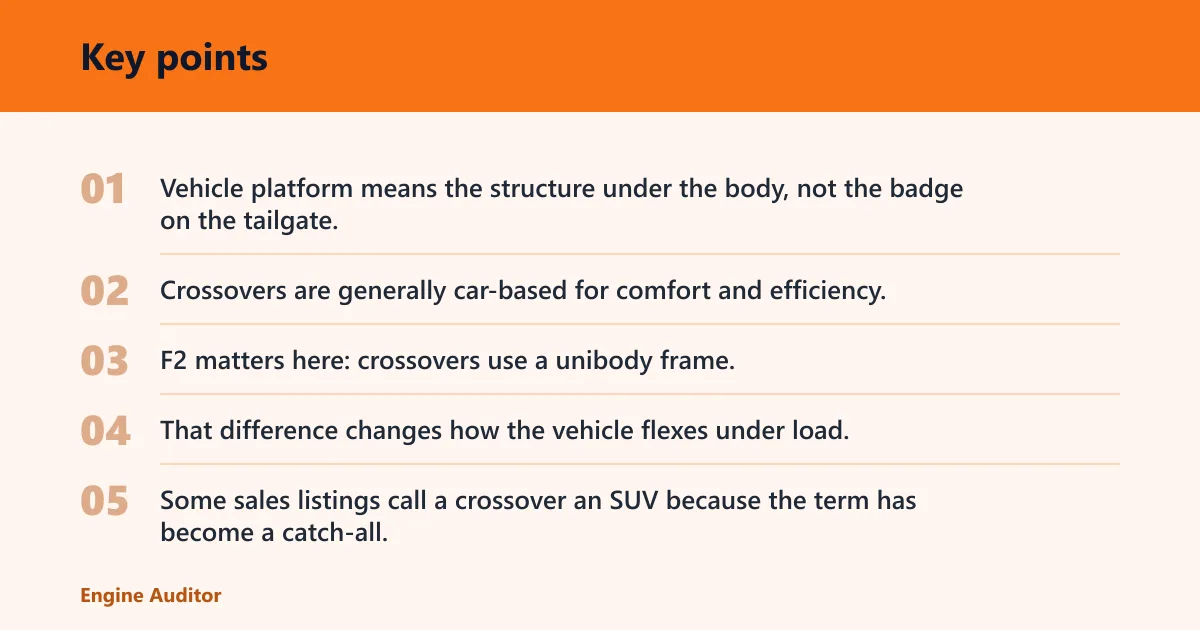
Vehicle platform means the structure under the body, not the badge on the tailgate. Crossovers are generally car-based for comfort and efficiency, while SUVs are truck-based for strength and towing, which is why listings can mislabel similar-looking vehicles.
F2 matters here: crossovers use a unibody frame, while SUVs often use body-on-frame or reinforced unibody construction. That difference changes how the vehicle flexes under load, how it rides over broken pavement, and how much towing and payload margin you should expect.
Why the name can mislead
Some sales listings call a crossover an SUV because the term has become a catch-all. A buyer should not rely on the body style label alone, especially on used listings where one generation of a nameplate may be unibody and another may be truck-based.
Many compact and midsize examples listed as crossovers include Toyota RAV4, Honda CR-V, Mazda CX-5, and Subaru Forester. Body-on-frame examples include Toyota 4Runner, Ford Bronco, Chevrolet Tahoe, and Jeep Wrangler.
📊 Many compact and midsize examples listed as crossovers include Toyota RAV4, Honda CR-V, Mazda CX-5, and Subaru Forester. Source: Suv Vs Crossover Differences: Clear Guide To Choosing.
Which one fits your daily driving?
For commuting, school runs, and crowded parking, crossovers usually fit better because they are simpler to park, ride more like cars, and often return better fuel economy. SUVs make more sense when your daily use includes a taller seating position, frequent full loads, or roads where extra clearance and stronger hardware matter more than easy parking.
City driving and parking
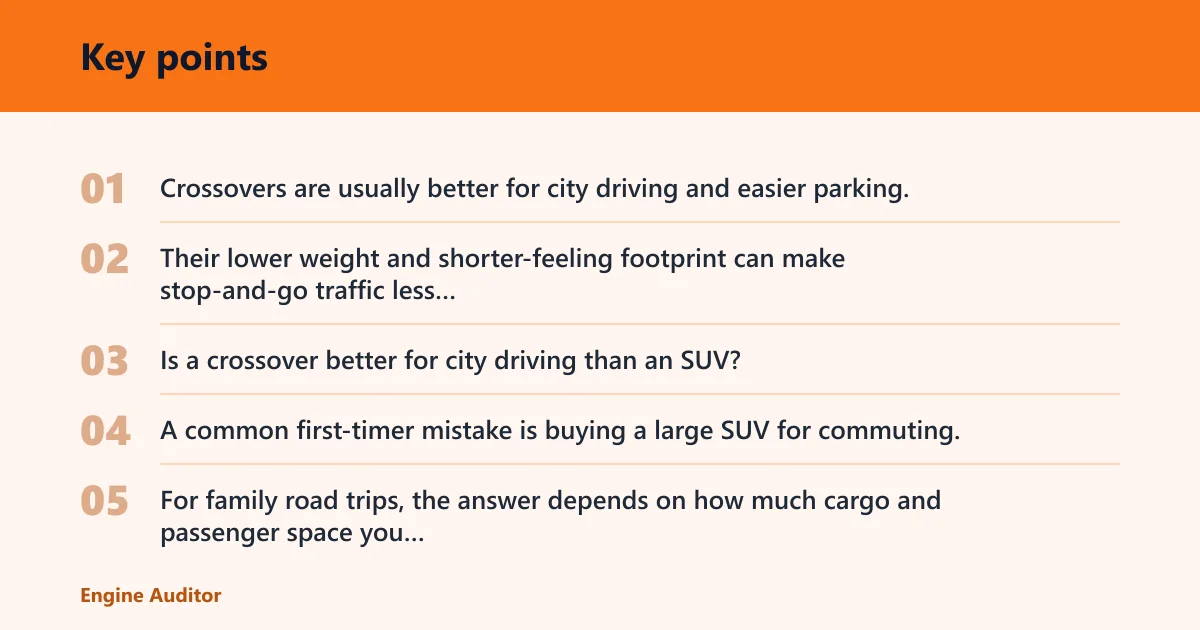
Crossovers are usually better for city driving and easier parking. Their lower weight and shorter-feeling footprint can make stop-and-go traffic less tiring, and the lower lift-over height helps when loading bags, strollers, or groceries.
Is a crossover better for city driving than an SUV? In most cases, yes. A common first-timer mistake is buying a large SUV for commuting, then discovering that fuel use, parking stress, and tire costs all rise without any daily benefit.
Family trips and seating needs
For family road trips, the answer depends on how much cargo and passenger space you actually need. A crossover is often enough for five people and luggage, while a larger SUV makes more sense if you need a usable third row, extra cargo volume, or easier access to the rear seats.
Suppose you have two child seats, a folded stroller, and a week’s worth of bags. A midsize crossover may handle that load well. If the third row must be used often, a larger SUV usually gives more usable space behind it and a stronger payload margin.
Ride comfort and noise
Crossovers tend to feel more car-like because the platform is tuned for passenger comfort and everyday efficiency. SUVs usually feel more truck-like, especially over sharp bumps and on rough pavement, because the suspension and frame are built with heavier work in mind.
That does not make one better in every case. It means your answer should follow the road you drive most often. If the vehicle spends most of its life on pavement, the smoother platform usually wins.
How do towing and payload change the answer?
Towing and payload are where the category split becomes hard to ignore. SUVs generally have higher towing capacity and stronger cargo and passenger limits, while crossovers usually stay within lighter-duty numbers that fit small trailers, bikes, and occasional hauling rather than serious trailer work.
Towing capacity by model and trim
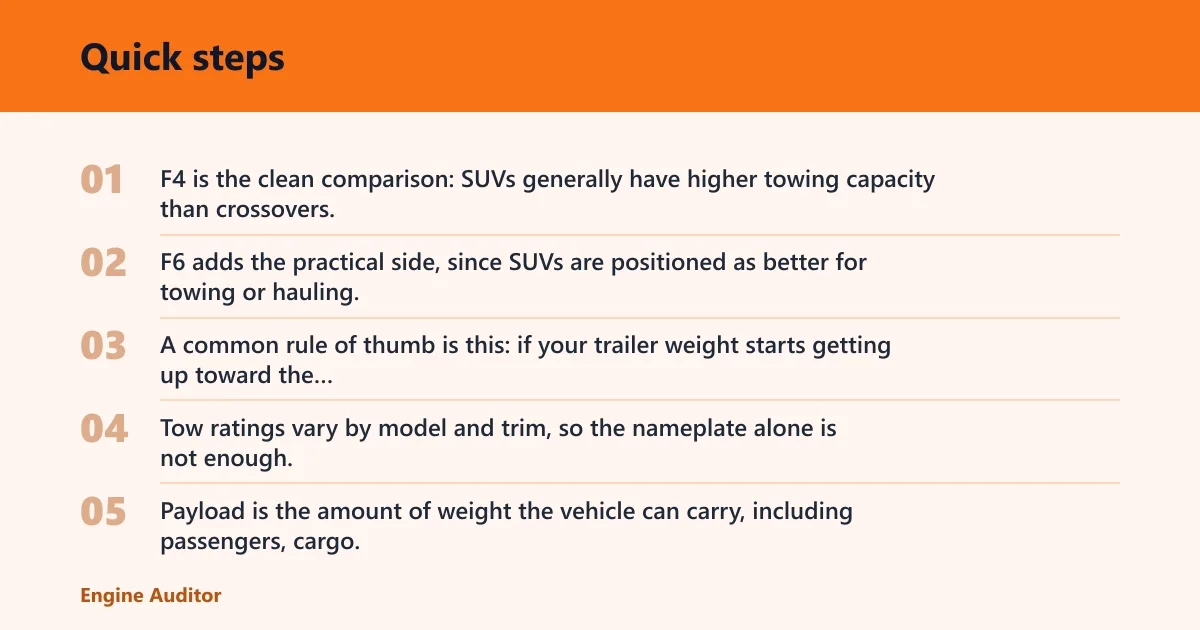
F4 is the clean comparison: SUVs generally have higher towing capacity than crossovers. F6 adds the practical side, since SUVs are positioned as better for towing or hauling, while most crossovers top out well before the needs of heavy boats, campers, or equipment trailers.
A common rule of thumb is this: if your trailer weight starts getting up toward the upper end of what many SUVs can handle, start with an SUV and verify the exact tow package, axle ratio, cooling, hitch rating, and brake controller requirements for that model year. Tow ratings vary by model and trim, so the nameplate alone is not enough.
Payload matters more than many shoppers expect
Payload is the amount of weight the vehicle can carry, including passengers, cargo, and sometimes tongue weight from a trailer. SUVs often have the edge here because they are built for cargo volume and payload, while many crossovers are tuned more for passenger comfort and lighter loads.
That matters on vacation trips and in winter, where extra people, luggage, and gear can add up fast. A vehicle can have enough tow rating on paper and still run out of payload first.
Cargo loading and flexibility
Crossovers usually win on loading ease because they sit lower to the ground and often have fold-flat seats that create a simple cargo area. SUVs can offer more cargo volume, but the higher floor and taller load height can make repeated loading less convenient.
Think about roof racks, rear hatch shape, and how often heavy items go in and out. If you move bulky gear every week, the lower cargo opening of a crossover can matter more than raw cubic space.
How do crossovers and SUVs compare on fuel and ownership costs?
Crossovers generally use less fuel and often cost less to run day to day, but ownership cost is not one number. Tire size, brake wear, insurance, engine complexity, and how much weight the vehicle carries all affect what you pay over time, and those factors often move in different directions.
Fuel economy
F3 is the baseline: crossovers generally have better fuel economy than SUVs. The reason is straightforward. They are usually lighter and built around smaller, more efficient drivetrains, while many SUVs add weight and size that push fuel use up.
That said, engine size and drivetrain choice still matter. A four-cylinder crossover and a V8 SUV are not comparable on fuel cost, and an all-wheel-drive option can raise consumption in either category.
Tires, brakes, and insurance
Heavier SUVs often need larger tires, and larger tires can cost more to replace. Brakes may also wear differently under towing and heavy passenger loads, and insurance can rise with vehicle price, repair complexity, and the claims profile of the model.
Crossovers often keep these costs in a lower band, especially in mainstream trims. The savings are not guaranteed, but they are common enough that buyers should compare the exact trim, not only the badge.
Complexity and long-term costs
More towing hardware, more off-road equipment, and larger drivetrains can mean more complex maintenance over time. That does not make SUVs a bad buy, only a more demanding one if your use case does not need the extra capability.
If your driving is mostly commuting and errands, the simpler, lighter platform is often the lower-cost fit. If you need the stronger hardware, the added cost is part of the job.
Are SUVs safer than crossovers?
Not automatically. Safety depends on crash-test performance, stability control, visibility, active safety equipment, and how the vehicle is used. SUVs can bring a higher seating position and stronger structure in some cases, but a taller vehicle also has more rollover risk, so the rating sheet matters more than the segment label.
Rollover risk and center of gravity
F9 says rollovers were involved in roughly 34% of SUV occupant deaths in 2023, while F10 says rollovers were involved in about 21% of passenger car occupant deaths in 2023. A higher center of gravity matters, even though modern stability control reduces risk and helps the vehicle recover from sudden maneuvers.
That is why buyers should not treat a taller vehicle as automatically safer. Stability control, tire quality, braking, and driver-assist systems all influence the result, and the specific model’s safety record still needs review.
What safety scores to check
Look at crash-test results for the exact model year, not just the nameplate. Check frontal, side, and rollover ratings where available, and compare how the vehicle performs with its standard equipment rather than assuming every trim includes the same safety tech.
Modern driver-assist features can help, but they do not erase physics. A crossover with strong safety ratings may be a better fit for a family than a larger SUV with weaker results on the same tests.
Which scenarios favor each type?
The best choice changes with the job. Use this matrix to match the body style to the actual threshold in your life: commute length, cargo load, winter severity, trailer weight, and the kind of road surface you expect most often.
| Buyer scenario | Crossovers | SUVs | Winner |
|---|---|---|---|
| City commuting | Better fuel use, simpler parking, lower cargo lip | Usually larger and less efficient in tight spaces | Crossovers |
| Family road trips | Good for five passengers and moderate luggage | Better when a third row or more cargo volume is needed | Tie |
| Occasional towing | Fine for light trailers and small utility loads | Better when trailer weight and tongue load rise | SUVs |
| Snowy climates | Good for plowed roads and lighter winter duty | Better for deeper snow, rough access roads, and larger tires | SUVs |
| Light off-road use | Works for gravel, campsites, and mild trails | Better for rugged trails and low-range hardware | SUVs |
How to read the matrix
City use strongly favors the crossover because the ride, parking, and fuel savings add up quickly. On the other hand, once towing, winter depth, or trail difficulty rises, the SUV’s stronger structure and hardware become the deciding factor.
Picture a buyer who camps twice a year on maintained roads. A crossover with all-wheel drive may be enough. Picture a buyer who tows a pop-up camper, fills all seats, and drives unplowed mountain roads in winter. That buyer should start with an SUV shortlist.
- List your heaviest regular load, including passengers and cargo.
- Write down the heaviest trailer you expect to tow, if any.
- Check whether your roads are mostly paved, snowy, or rough.
- Compare model-year towing, payload, and crash ratings for the exact trim.
- Only then decide whether the nameplate should be a crossover or an SUV.
How do I know if a vehicle is a real SUV or a crossover?
Check the platform first. If the vehicle is built on a unibody, car-based structure, it is a crossover even if the listing calls it an SUV. If it uses body-on-frame construction or a reinforced truck-style setup with higher towing and payload targets, it fits the SUV side of the split.
Verify the model year before trusting the listing
Do not compare nameplates without checking the generation and model year. A vehicle can change from one platform to another across redesigns, and trim differences can alter drivetrain, towing hardware, and safety equipment within the same model line.
The safest method is simple: confirm the exact model year, then verify the platform, tow rating, payload label, and crash-test data for that year and trim. That step prevents a lot of bad comparisons.
Questions to verify on every listing
Use these questions before you buy or compare:
- Is this model built on a unibody or body-on-frame platform?
- What is the exact model year and generation?
- What is the tow rating for this trim with the listed equipment?
- What is the payload rating on the door sticker?
- Which safety ratings apply to this exact year and drivetrain?
- Does this version include the clearance, gearing, or tow package you need?
Which costs less to own, a crossover or an SUV?
Crossovers usually cost less to own because they tend to burn less fuel, use smaller tires, and place less stress on brakes and suspension in normal driving. SUVs can cost more, especially when they are heavier, more powerful, or fitted with towing and off-road hardware that needs more upkeep.
What really drives ownership cost
Fuel is only one part of the bill. Tires, brakes, insurance, and the complexity of the drivetrain all matter, and those costs can move in different directions depending on the trim and powertrain.
A crossover that stays on pavement may be inexpensive to live with. A high-output SUV with all-terrain tires and tow equipment can cost much more, even if the purchase price was only moderately higher.
Which is better for family use, a crossover or an SUV?
For many families, a crossover is the better default because it offers a smoother ride, easier loading, and good fuel economy without feeling oversized. An SUV becomes the better family choice when you need a third row often, carry heavy cargo, tow a trailer, or drive on rough roads with regular winter strain.
Do crossovers get better gas mileage than SUVs?
Yes, crossovers generally get better gas mileage than SUVs because they are usually lighter and built on car-based platforms. Fuel economy still depends on engine size, drivetrain, and vehicle weight, so a specific crossover can be thirstier than a smaller SUV trim if the powertrain choices differ.
Which has more towing capacity: a crossover or an SUV?
SUVs generally have more towing capacity than crossovers. The difference comes from stronger structures, more support hardware for cooling and drivetrains, and payload margin that better supports trailer tongue weight. Always verify the exact trim, because tow ratings vary a lot within both categories.
Frequently asked questions
Is a crossover better for city driving than an SUV?
Yes, most of the time. Crossovers are usually simpler to park, easier to see around in tight spaces, and more efficient in stop-and-go traffic. An SUV only makes more sense in the city if you need its cargo space, seating, or winter and towing hardware.
Products related to this article
Sponsored / affiliate links. As an Amazon Associate I earn from qualifying purchases. I may earn additional commission from eligible campaigns.