How to compare CVT vs automatic transmission cars for buyers
Choose a CVT for quiet commuting and lower EPA fuel use. Choose a traditional automatic for towing, repeated highway passes, or higher resale confidence, especially if you want lower long-term risk. Pick the wrong one and you can pay more in repairs, heat-related wear, and resale losses. This guide compares both by city use, highway merging, towing, reliability, and ownership cost.
This guide is part of our Car comparison guide series.
| Factor | How to compare CVT | automatic transmission cars | Winner |
|---|---|---|---|
| City commuting | Smooth low-speed operation, no stepped shifts, and often keeps the engine in a narrow rpm band; described as calmer and good for stop-and-go traffic. | Good in traffic, but repeated upshifts and downshifts are more noticeable, especially in older units. | How to compare CVT |
| Highway merging and passing | Can feel slower to respond, and engine speed may hold steady under hard throttle. | Usually better for quick downshifts and repeated passing moves, especially 8-speed and 10-speed units. | automatic transmission cars |
| Towing and heavy loads | Mainstream belt/chain designs are more limited by torque and are better suited to smaller engines and lighter vehicles. | Handles high torque loads better and is the safer default for heavy vehicles. | automatic transmission cars |
| Long-term reliability and repairability | More sensitive to fluid, service intervals, and model-specific support; less forgiving of missed service. | Mature technology with broader repair knowledge and parts support; diagnosis and parts sourcing are easier in many markets. | automatic transmission cars |
| Maintenance and fluid requirements | Needs special CVT fluid that is not interchangeable with ordinary automatic fluid; missed intervals or wrong fluid can cause expensive damage. | Routine service is more familiar, and the hardware is widely understood. | automatic transmission cars |
| Fuel economy | Often better in steady commuting and light-load use because it can keep the engine in its sweet spot. | Modern 8-speed and 10-speed units can be efficient, but the article says a CVT often has the edge in light-load use. | How to compare CVT |
| Driving feel and comfort | Very smooth, but some drivers dislike the steady rpm and less sporty feel. | More shift feel and better driver engagement in many cases. | automatic transmission cars |
| Best-fit use | Best for quiet commuting and lower EPA fuel use. | Best for towing, repeated highway passes, and higher resale confidence, especially if you want lower long-term risk. | Tie |
What is the difference between a CVT and an automatic transmission?
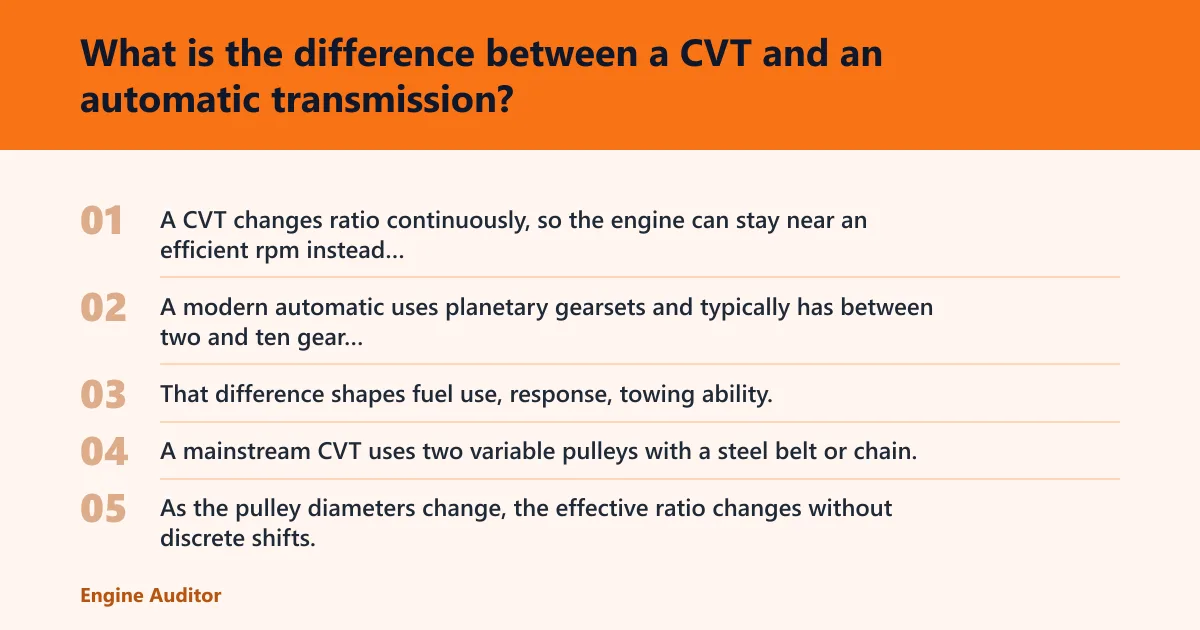
A CVT changes ratio continuously, so the engine can stay near an efficient rpm instead of stepping through fixed gears. A modern automatic uses planetary gearsets and typically has between two and ten gear ratios. That difference shapes fuel use, response, towing ability, and the way the car feels under acceleration.
How a CVT changes ratio
A mainstream CVT uses two variable pulleys with a steel belt or chain. As the pulley diameters change, the effective ratio changes without discrete shifts. That is why many CVTs feel smooth in traffic but can hold rpm steady under hard throttle, which some drivers read as engine drone.
How a conventional automatic changes ratio
A modern automatic uses planetary gearsets and fixed gear ratios. Automatics have been around for many decades and have continued to improve, so the design is fairly mature and broadly understood. The tradeoff is that you feel gear changes, but that also helps with quick downshifts, passing, and load handling.
Why the same road feel can mean different things
Two cars can accelerate at the same pace while feeling very different. A CVT may keep the engine at a constant rpm as speed rises, while a traditional automatic climbs through gears in steps. One feels calm. The other feels more mechanical and often more familiar to drivers used to shifts.
📊 Automatics have been around and improving since 1939. Source: CVT vs. Automatic Transmission: Your Burning Questions Answered.
How do CVT and automatic transmissions compare in daily driving?
For commuting, a CVT usually feels calmer and can be more efficient in light-load city use. A traditional automatic often feels stronger when traffic opens up, especially on highway merges and short passes. If your day includes stop-and-go driving plus frequent lane changes, the better choice depends on whether you prefer smoothness or response.
City commuting and stop-and-go traffic
CVTs often do well in city traffic because they avoid repeated gear changes. That can reduce shudder and keep motion smooth at low speeds. Automatics are still good here, but their stepped shifts are more noticeable, especially in older 6-speed units.
Highway merging and passing
Highway use changes the picture. A CVT can be fine for steady cruising, but some units feel less eager when you ask for a fast pass, because engine rpm may rise and stay there. A modern multi-speed automatic often gives a more direct kickdown and a clearer sense of acceleration.
Noise, engine rpm behavior, and driver comfort
CVTs are described as inherently smooth, but smooth does not always mean quiet to the ear. Under hard acceleration, the engine may hold a higher rpm longer than some drivers expect. Automatics usually give more shift feel, which many people read as more natural or more sporty.
Which lasts longer, CVT or automatic transmission?
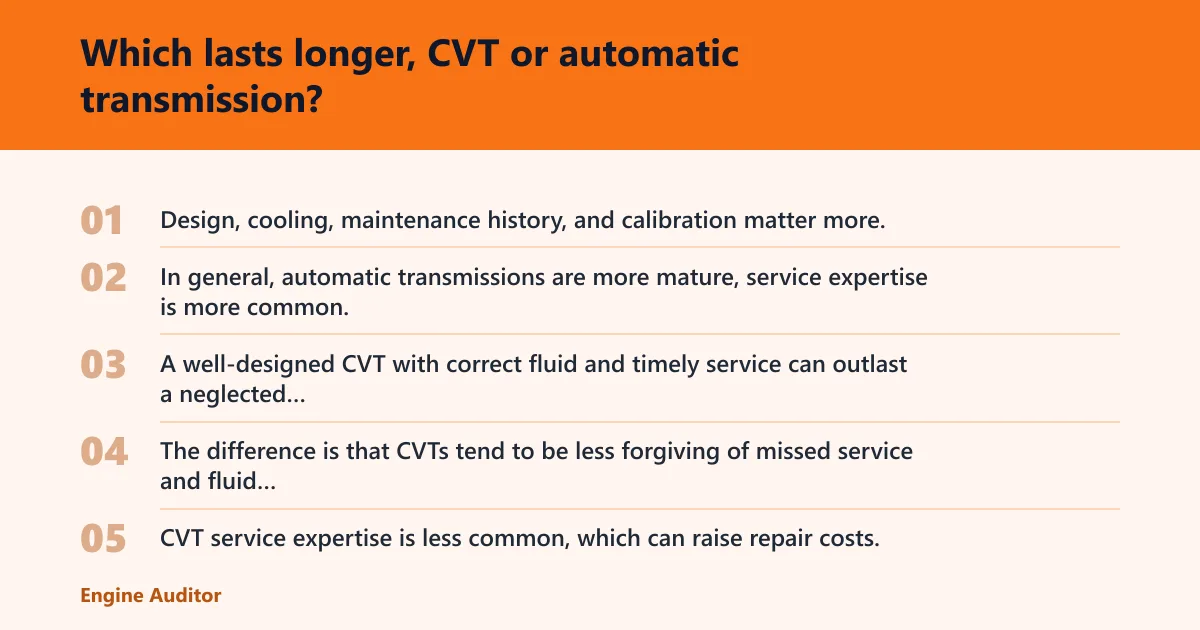
The label alone does not decide lifespan. Design, cooling, maintenance history, and calibration matter more. In general, automatic transmissions are more mature, service expertise is more common, and repairs are usually easier to source, while early CVTs had higher-than-average problems and failure rates in some applications.
Why age, design, and maintenance history matter more than the label
A well-designed CVT with correct fluid and timely service can outlast a neglected automatic. A bad service record can kill either one. The difference is that CVTs tend to be less forgiving of missed service and fluid mistakes, so ownership risk rises faster when maintenance slips.
How service expertise and parts availability affect repairability
CVT service expertise is less common, which can raise repair costs. Automatic transmission work is usually more familiar to independent shops and dealers because the hardware is widespread. That does not make every automatic cheap to fix, but it does make diagnosis and parts sourcing easier in many markets.
What owners should expect from modern 6-speed, 8-speed, and 10-speed automatics
Older 6-speed automatics are still fairly common and can be durable, but newer multi-speed units often improve response and cruising efficiency. They also give engineers more room to balance passing power with fuel economy. For a buyer, that matters because the “automatic” label covers a wide range of behavior and repair risk.
When does torque capacity make the choice for you?
Torque demand can settle the decision before you get to feel or fuel economy. Mainstream belt/chain CVTs are often cited near 300 lb-ft in this design family, with examples such as 280 lb-ft in the Infiniti QX50 and QX55 and 277 lb-ft in Subaru’s 2.4-liter turbo CVT applications. High-torque automatics scale far above that. (motortrend.com)
Why mainstream CVTs have tighter torque limits
A CVT’s belt or chain must transmit force across variable pulley surfaces, so torque capacity is a hard engineering limit. That is why many mainstream CVT setups are aimed at smaller engines and lighter vehicles. Once torque rises, heat and belt load become more serious concerns.
Why turbo engines, towing, and heavier vehicles favor conventional automatics
Turbo engines, tow ratings, and heavier vehicles push transmission load higher for longer periods. That is where a conventional automatic usually makes more sense. If your vehicle will pull a trailer, carry passengers plus cargo often, or climb grades under load, choose the transmission with the larger torque margin.
How to check the transmission rating before you buy
- Find the engine torque figure in the spec sheet.
- Check the transmission’s stated torque limit or the vehicle’s tow rating.
- Match that number to your real use, not your best-case use.
- Give extra margin if you live in a hot climate or drive hills often.
How much does transmission fluid matter for CVT ownership?
It matters a lot. CVTs need special fluid, and that fluid is not interchangeable with ordinary automatic transmission fluid. Missed intervals or the wrong fluid can cause expensive damage, so CVT ownership risk depends heavily on whether the service schedule is followed exactly.
Why CVT fluid is specific and not interchangeable
CVT fluid is formulated for the belt or chain, pulley contact, and pressure control inside the unit. Ordinary automatic fluid does not behave the same way. Using the wrong fluid can trigger wear, slip, overheating, or catastrophic failure.
Why fluid-change intervals matter more on CVTs
MotorTrend advises considering more aggressive CVT maintenance. That is a practical warning, not a marketing slogan. Fresh fluid helps control heat and internal wear, and those two issues matter more when the transmission is working near its design limits.
What maintenance mistakes raise failure risk
Late fluid changes, the wrong spec fluid, and poor service records all increase the odds of trouble. A common first-timer mistake is assuming “automatic fluid” means any ATF can be used everywhere. With a CVT, that mistake can become an expensive repair quickly.
CVT vs automatic buyer decision matrix
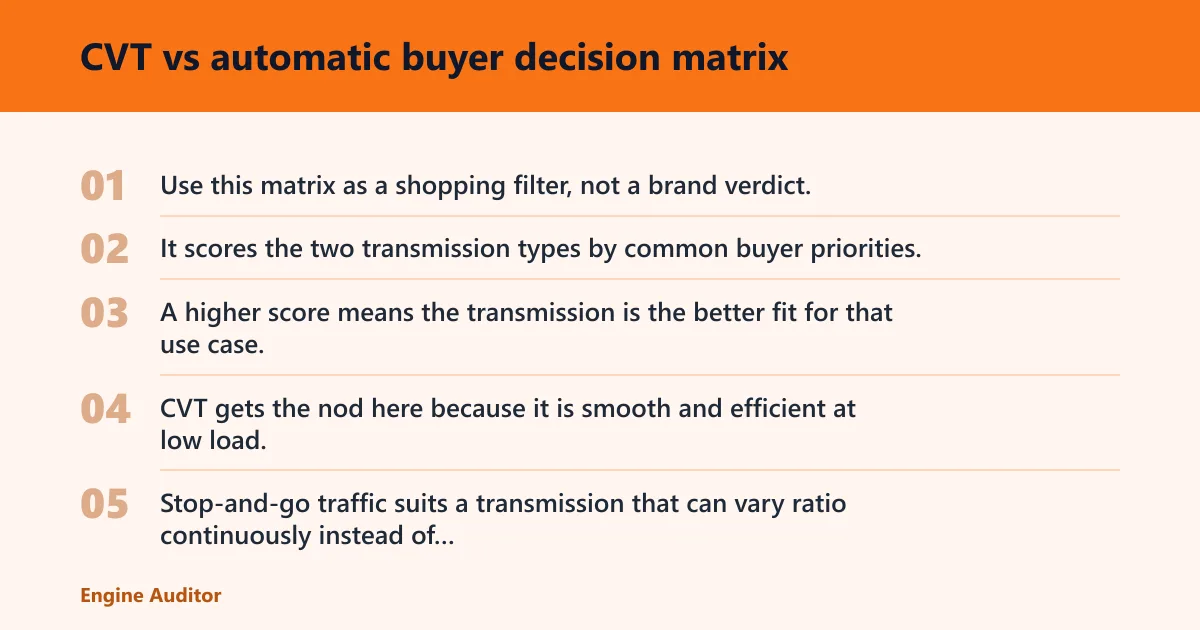
Use this matrix as a shopping filter, not a brand verdict. It scores the two transmission types by common buyer priorities, then turns that into a simple recommendation. A higher score means the transmission is the better fit for that use case, not that every version will behave the same way.
| Buyer priority | CVT score | Automatic transmission cars score | Winner |
|---|---|---|---|
| City commuting | 5 | 4 | CVT |
| Highway merging and passing | 3 | 5 | Automatic transmission cars |
| Towing | 2 | 5 | Automatic transmission cars |
| Long-term reliability | 3 | 4 | Automatic transmission cars |
| Service complexity | 2 | 4 | Automatic transmission cars |
| Driving feel | 3 | 4 | Automatic transmission cars |
City commuting
CVT gets the nod here because it is smooth and efficient at low load. Stop-and-go traffic suits a transmission that can vary ratio continuously instead of shifting often. If your commute is mostly city streets and moderate throttle, the CVT’s behavior is usually an asset.
Highway merging and passing
Automatic transmission cars win because they usually respond better when you ask for a quick downshift. That matters when merging into fast traffic or passing at two-lane speeds. A modern 8-speed or 10-speed automatic often gives better control over that burst of acceleration.
Towing
Automatic transmission cars win by a wide margin. Towing puts sustained heat and torque into the drivetrain, and mainstream CVTs have tighter limits. If the vehicle will regularly pull a trailer or carry heavy loads, pick the transmission with more torque headroom.
Long-term reliability
Automatic transmission cars get the edge because the technology is more mature and the service network is broader. That does not mean every automatic is bulletproof, and CVT history varies by brand and model. It does mean a conventional automatic usually carries less ownership uncertainty.
Service complexity
Automatic transmission cars again score better because parts, procedures, and repair knowledge are more familiar. CVTs can be perfectly serviceable, but special fluid and model-specific expertise make mistakes more likely and repairs less forgiving. This is where ownership risk often shows up first.
Driving feel
Automatic transmission cars usually feel more natural to drivers who want stepped shifts, engine braking, and predictable response. CVTs feel smoother, but some buyers interpret the constant rpm as less sporty. That subjective difference matters more than many spec sheets admit.
Should you avoid a CVT if you tow, drive fast, or keep cars a long time?
Yes, many buyers should avoid a CVT if towing, repeated hard acceleration, or long service life under rough conditions are central needs. A CVT can be fine for light commuting, but its fluid sensitivity, torque limits, and repair risk make it a weaker choice for heavy use. Brand tuning still matters, so some CVTs are better sorted than others.
Which buyers are a poor fit for many CVT setups
Skip many CVTs if you tow often, live in hills, drive aggressively, or plan to keep the vehicle well past the warranty period with high mileage. Buyers who care most about resale confidence and broad repair support usually lean toward an automatic.
Which buyers are usually fine with a CVT
Daily commuters who want low-stress city driving and efficient cruising are often a good match. If your vehicle is a small or midsize car with modest torque and no towing duty, a well-maintained CVT can be a practical choice. Maintenance discipline matters here more than usual.
How brand tuning changes the answer
Not all CVTs feel the same. Some brands tune them to simulate shift points, while others keep the engine speed more constant for efficiency. That tuning changes perceived drivability, but it does not change the underlying torque and fluid sensitivity issues that shape ownership risk.
What about AMT vs CVT vs DCT?
AMT, CVT, and DCT solve different problems. An AMT is basically a manual gearbox shifted by automation, a CVT varies ratio continuously, and a DCT uses two clutches for fast shifts. Comfort, response, and reliability rank differently across the three, so the best choice depends on use case.
How AMT differs from both CVT and regular automatics
An automated manual transmission keeps manual-style gears but automates the clutch and shifting. It can be cheaper to build, but comfort is often weaker because shifts can feel abrupt at low speeds. In daily use, AMTs usually trail both CVTs and conventional automatics for smoothness.
Where DCT fits for performance and response
A dual-clutch transmission is aimed at fast gear changes and strong response. It can feel sharper than a CVT and quicker than many regular automatics, especially under hard driving. The tradeoff is that low-speed behavior and repair complexity can be less friendly than a mainstream automatic.
How to compare comfort and reliability across all three
If comfort matters most, CVT and regular automatic transmissions usually beat AMT. If response matters most, DCT often leads. If reliability and repairability matter most for a broad range of buyers, a conventional automatic still tends to be the safest default because it is widely understood and less fluid-sensitive than a CVT.
Frequently asked questions
Is a CVT better than a regular automatic for daily driving?
For city-heavy daily driving, a CVT can be better because it is smooth and often more efficient in light-load use. For mixed driving with highway passing, a regular automatic may feel easier to live with. The better daily choice depends on whether you value calmness or stronger response more.
Which lasts longer, CVT or automatic transmission?
Neither label guarantees lifespan. A well-maintained CVT can last a long time, but a conventional automatic usually has the edge in maturity, service familiarity, and repairability. History, heat control, and fluid discipline matter more than the badge on the shifter.
Does a CVT improve fuel economy compared with an automatic?
Often, yes, especially in city and steady cruising conditions. A CVT can keep the engine in its efficiency sweet spot more easily than a stepped gearbox. Modern 8-speed and 10-speed automatics have narrowed the gap, though, so the advantage is no longer automatic on every model.
Is a CVT good for highway driving and passing?
It can be good for steady highway cruising, but not every CVT feels good when you need a quick pass. Some units hold engine rpm high under hard throttle, which can sound busy and feel less eager. For frequent passing, a conventional automatic often gives a better result.
What are the signs a CVT may need more careful maintenance?
Watch for shudder, delayed response, overheating warnings, unusual rpm flare, or changes in how the engine holds speed during acceleration. Those symptoms do not prove failure, but they are a reason to check fluid condition and service history quickly. CVTs are less forgiving of delayed maintenance than many buyers expect.
Should I avoid a CVT if I tow or carry heavy loads?
Yes, in many cases. Towing and heavy cargo raise heat and torque demand, which is exactly where mainstream belt/chain CVTs are less comfortable. If those tasks are routine, a conventional automatic is usually the safer and more durable fit.
How do I compare AMT, CVT, and DCT for comfort and reliability?
For comfort, CVT and regular automatic transmissions usually rank above AMT. For response, DCT often feels quickest. For broad reliability and easier repair planning, a conventional automatic is typically the safest all-around pick, while CVT ownership depends more heavily on exact model, fluid, and service history.
Choose CVT if… choose automatic transmission cars if…
Choose a CVT if your driving is mostly city commuting, your vehicle has modest torque, and you will follow the exact service schedule with the correct fluid. Choose automatic transmission cars if you tow, drive long highway distances, want stronger passing behavior, or prefer broader repair support and lower ownership uncertainty.
For many shoppers, the decision is simple. Pick CVT for calm, efficient commuting. Pick a conventional automatic for everything that asks more of the drivetrain.
Products related to this article
Sponsored / affiliate links. As an Amazon Associate I earn from qualifying purchases. I may earn additional commission from eligible campaigns.