How to Compare Safety Ratings Between Two Cars
Compare two cars on the same safety baseline: same test program, same model year generation, and the same categories for crash protection, crash avoidance, and recalls. Star counts alone can hide gaps in side-impact protection, child-seat fit, or an open recall on the used car. This guide shows you how to line up NHTSA, IIHS, Euro NCAP, and recall data so the comparison stays fair.
What you’ll need
- The exact model year and trim for each car
- The official rating page for each vehicle
- The trim or window sticker that lists standard safety equipment
- The recall status for each vehicle
- A note to record the rating program, test type, and score side by side
📊 NHTSA says its 5-Star Safety Ratings help consumers make smart decisions about safety. Source: Nhtsa.
How do you compare safety ratings between two cars?
Start by matching the rating program, then the model year and trim, then the test type. Use the same program and the same equipment level, because a newer version of the same nameplate can have different scores, airbags, or driver-assistance gear.
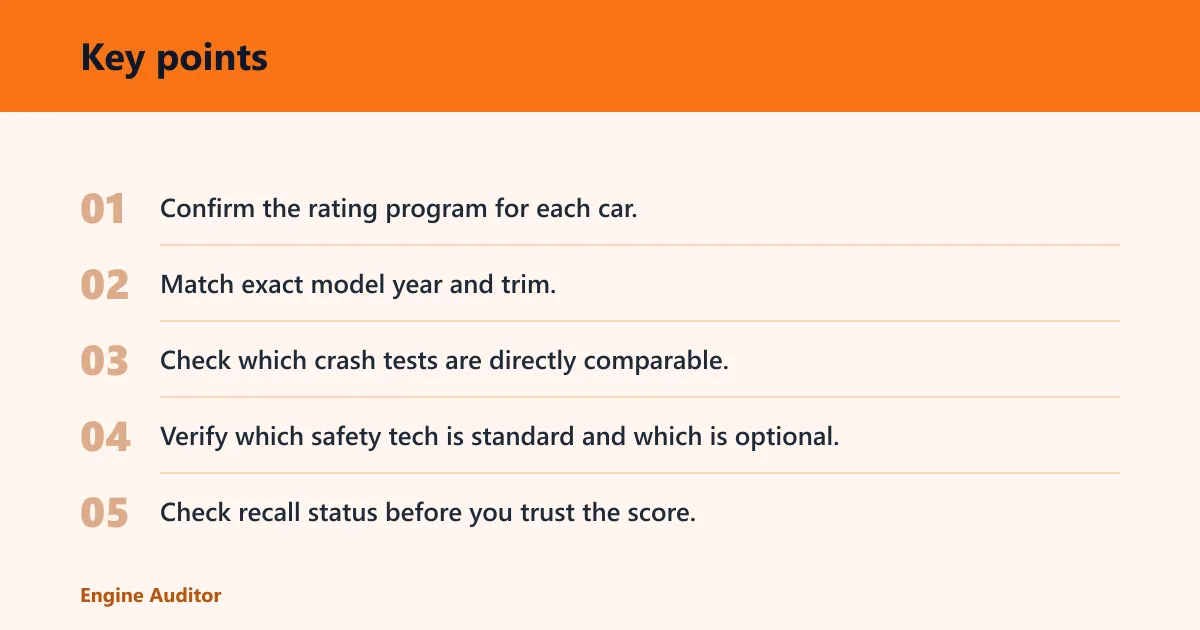
- Confirm the rating program for each car.
- Match exact model year and trim.
- Check which crash tests are directly comparable.
- Verify which safety tech is standard and which is optional.
- Check recall status before you trust the score.
- Choose the car with the stronger combined case for crash protection and crash avoidance.
Step 1: confirm the rating program
NHTSA 5-Star Safety Ratings are built to help consumers make smart decisions about safety, and NHTSA offers a Vehicle Comparison Tool to view 5-Star Safety Ratings and recall information at a glance. IIHS crash ratings are U.S.-based and focus on structural crash performance, while Euro NCAP and ANCAP are regional programs with their own standards.
Step 2: match model year and trim
Do not compare one model year or trim level with a different one as if they are the same car. Safety equipment changes by model year and trim, and the rating page that applies to one version may not apply to the other.
Step 3: check test-by-test comparability
NHTSA conducts frontal, side, and rollover tests. Its frontal crash ratings must only be compared between vehicles from the same weight class. For side barrier ratings, it is possible to compare all vehicles with each other. For side pole ratings, it is possible to compare all vehicles with each other.
Step 4: verify crash-avoidance equipment and recalls
Check whether automatic emergency braking and rearview video systems are standard or optional. Then check recall status. A car with a strong star count can still have an open recall that changes the real-world interpretation of the rating.
Step 5: decide which car has the stronger safety case
Use the car with the better match across program, year, weight class, and equipment. If one car is stronger in crash protection and the other has better standard crash avoidance, break the tie by the use case: city driving, long highway trips, or family hauling change which gap matters more.
Which rating system should you trust?
Use the system that matches the market you are buying in, then keep the program separate from the score. For U.S. buyers, NHTSA is the cleanest starting point because it includes frontal, side, and rollover results plus recall lookup. IIHS adds structural crash performance detail. Euro NCAP and ANCAP matter when the car was sold in those regions, but their scores are not directly interchangeable with U.S. ratings.
Use NHTSA for U.S. comparison
NHTSA works best when both cars appear in its database. The Vehicle Comparison Tool lets you compare 5-Star Safety Ratings and recall information together, which keeps you from reading a star count without the context that changes it.
Use IIHS for structural detail
IIHS is useful when you want more detail on how the body structure manages a crash. Do not treat IIHS and NHTSA as the same scoring system; they ask related questions, but they do not answer them the same way.
Keep regional programs separate
Euro NCAP and ANCAP can be very useful within their own markets, but they are not direct equivalents to U.S. ratings. CarVertical notes that the same car in the U.S. and Europe can have different airbag systems because of different safety standards.
How to read the test results
Read each test on its own terms. Some results are only valid inside a weight class. Others can be compared across vehicles. That difference matters more than the headline star count when you are choosing between two cars with different sizes or markets.
Frontal crash
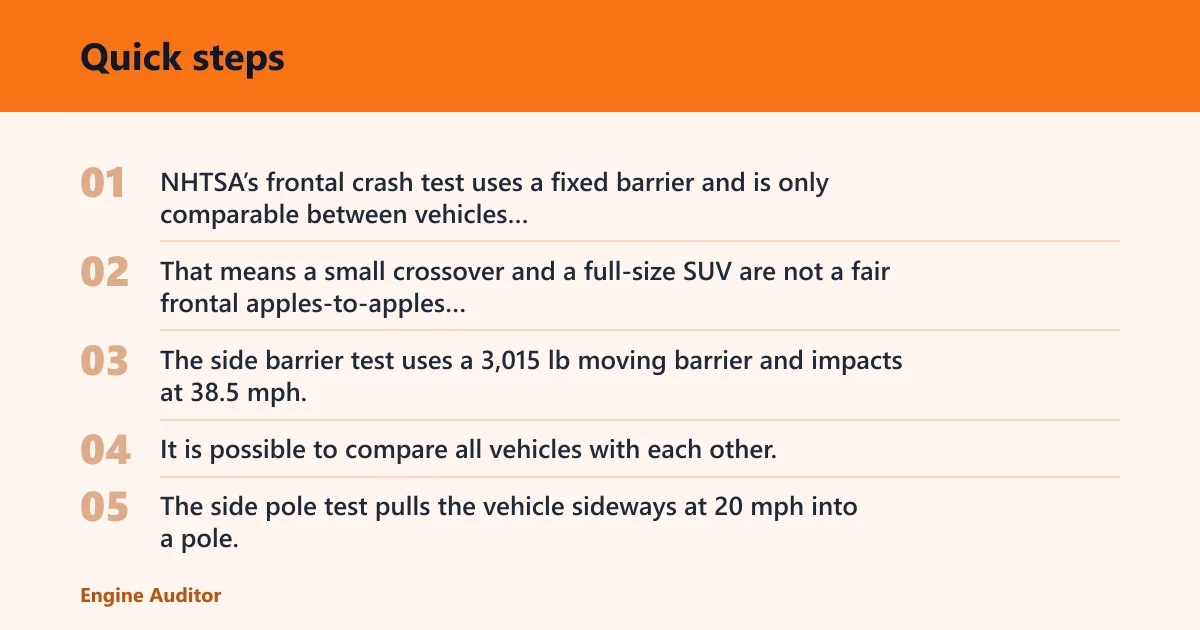
NHTSA’s frontal crash test uses a fixed barrier and is only comparable between vehicles from the same weight class. That means a small crossover and a full-size SUV are not a fair frontal apples-to-apples comparison, even if both wear five stars.
Side barrier crash
The side barrier test uses a 3,015 lb moving barrier and impacts at 38.5 mph. It is possible to compare all vehicles with each other, so this is one of the cleaner cross-model comparisons in the NHTSA set.
Side pole crash
The side pole test pulls the vehicle sideways at 20 mph into a pole. It is also possible to compare all vehicles with each other, and it is especially useful for judging driver-side intrusion risk in a narrow-impact crash. (Nhtsa)
Rollover resistance
Rollover resistance is especially useful for SUVs and other taller vehicles. NHTSA uses Static Stability Factor here, so a taller vehicle with a higher center of gravity deserves a closer look even if its side ratings look strong.
Safety ratings worksheet
Use this worksheet to put two cars on one page before you decide. Fill in exact values from the official rating page, the window sticker, and the recall lookup, then mark whether the result is directly comparable.
| Field | Car A | Car B | Directly comparable? |
|---|---|---|---|
| Rating program | Enter the official program name | Enter the official program name | Only if the program and region match |
| Model year | Enter the exact model year | Enter the exact model year | Only if the same generation and equipment apply |
| Weight class | Enter the NHTSA weight class | Enter the NHTSA weight class | Frontal only, and only within the same class |
| Frontal stars | Enter the star score | Enter the star score | No, unless weight class matches |
| Side stars | Enter the side crash score | Enter the side crash score | Yes, for NHTSA side barrier and side pole |
| Rollover score | Enter the rollover resistance score | Enter the rollover resistance score | Yes within the same program |
| Crash-avoidance tech | List automatic emergency braking and rearview video systems | List automatic emergency braking and rearview video systems | Only if standard equipment matches |
| Recall status | Open recalls or no open recalls | Open recalls or no open recalls | Always check before deciding |
| Final call | Use the car with the better match across program, year, and equipment. If one rating is from a different region or generation, treat it as a separate comparison, not a tie. | Do not call them equivalent | |
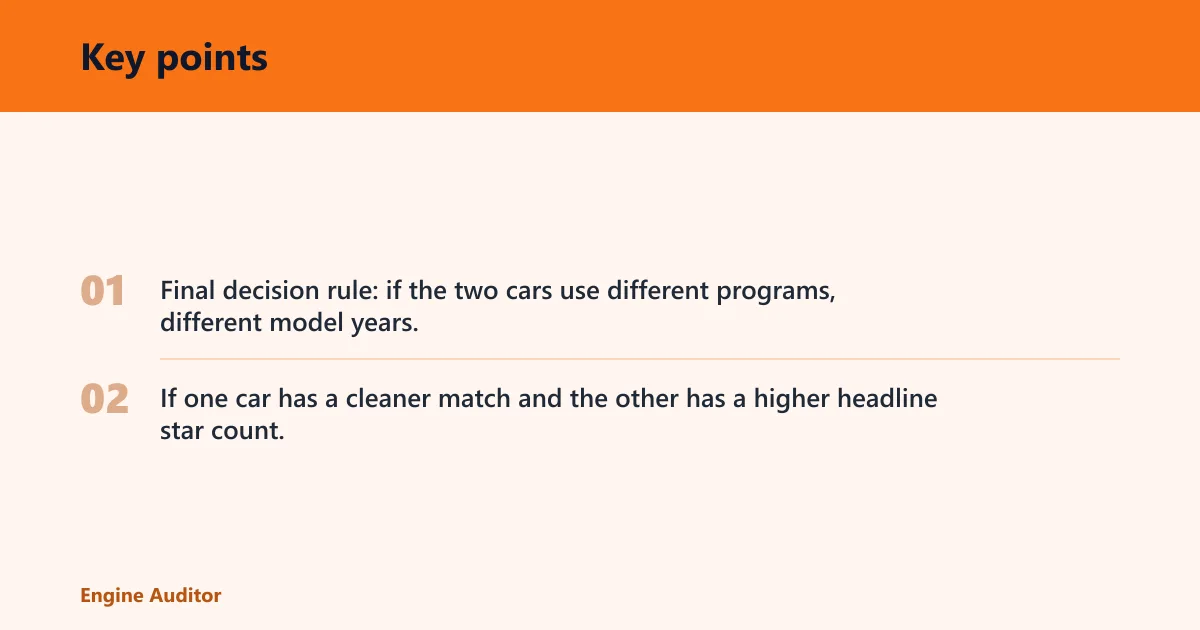
Final decision rule: if the two cars use different programs, different model years, or different safety equipment, do not treat the scores as equal. If one car has a cleaner match and the other has a higher headline star count, trust the cleaner match first.
Common mistakes
The biggest mistake is comparing ratings from different countries as if they mean the same thing. A second mistake is treating optional safety tech as standard without checking the trim sheet, window sticker, or official equipment list. The third is using one overall score to judge every crash scenario.
Say your first car is a U.S. model with NHTSA data and the second is an imported version with Euro NCAP data. Even if both show strong scores, the numbers do not sit on the same scale. Compare each car within its own program first, then compare equipment and recalls.
Suppose a used SUV has five stars but an open recall on a restraint component, while the newer rival has four stars and standard automatic emergency braking. The five-star score does not end the comparison. The recall and the standard equipment can change the practical result.
What to do if the ratings are not directly comparable
If the ratings come from different programs, model years, or weight classes, compare the cars only after you normalize those differences. Start with the same market, the same generation, and the same equipment list. If that still does not line up, pick the car with the more complete safety documentation.
Frequently asked questions
Which safety rating system is best to use when comparing cars?
For U.S. shoppers, NHTSA is the most practical starting point because it covers frontal, side, and rollover results and includes a vehicle comparison tool with recall information. Use IIHS when you want more structural detail, and keep Euro NCAP or ANCAP within their own regions.
Can I compare NHTSA ratings between any two cars?
You can compare side barrier and side pole results across vehicles, but NHTSA says frontal crash ratings must only be compared between vehicles from the same weight class. For a fair comparison, match the class first and then read the star count.
Do safety ratings from different countries mean the same thing?
No. Euro NCAP, ANCAP, and U.S. programs use different standards and different regional assumptions, so the scores are not directly interchangeable. Use each rating inside its own market, then compare the equipment list and recall status separately.
What matters more in a crash test: overall stars or individual test scores?
Individual test scores matter more when the cars differ in size, program, or equipment. Overall stars are useful shorthand, but frontal, side, pole, and rollover results can tell a different story. Read the underlying tests first, then use the star total as the summary.
How do I know whether a car’s safety tech is standard or optional?
Check the trim sheet, window sticker, or official equipment list for the exact trim you are buying. Do not assume automatic emergency braking or rearview video systems are standard unless they are listed for that model year and trim. The rating only reflects the equipment installed on that version.
Should I compare safety ratings with reliability too?
Yes, but keep them separate. Safety ratings answer how a car performs in crash testing and avoidance tech. Reliability answers how often the vehicle needs repair. A strong safety score does not replace a reliability check, and a reliable car is not automatically the safer one in a crash.
Products related to this article
Sponsored / affiliate links. As an Amazon Associate I earn from qualifying purchases. I may earn additional commission from eligible campaigns.