How to compare petrol vs diesel cars for long trips
For long motorway commutes, diesel usually makes sense only if you cover roughly the low-to-mid teens in annual miles, drive mostly outside cities, and keep the car long enough to recover the higher purchase price and maintenance. Miss those conditions, and you can spend more on fuel, servicing, and depreciation than you save at the pump. This guide compares mileage, driving pattern, fuel prices, and total ownership cost so you can choose petrol or diesel with confidence.
| Decision factor | How to compare petrol | Diesel cars for long-distance driving | Winner |
|---|---|---|---|
| Buy price | Usually cheaper to buy than a similar diesel model. | Usually higher sticker price. | How to compare petrol |
| Motorway fuel use | Can be good, but often less efficient at steady-speed cruising. | Often more economical on motorways and at steady speeds. | diesel cars for long-distance driving |
| Maintenance risk | Typically simpler emissions hardware and fewer diesel-specific parts. | Extra cost risk from DPF and AdBlue systems. | How to compare petrol |
| City and clean air zone risk | Usually less exposed to diesel-specific restrictions. | Older models are more likely to face low-emission zone charges. | How to compare petrol |
| Best use case | Short trips, mixed use, lower annual mileage. | High-mileage motorway driving, longer steady journeys. | Split |
Petrol vs diesel for long-distance driving: the quick answer
Diesel is usually the better fit for long motorway mileage, but only when your annual use is high enough to cover the extra purchase price, maintenance risk, and any zone charges. Petrol is the safer choice for lower mileage, mixed urban use, or drivers who want fewer diesel-specific costs and complications.
When diesel tends to win on motorways
Diesel cars are usually better suited to long-distance driving, and they often work out cheaper for high-mileage drivers. They also tend to be more efficient at steady speeds, so the fuel savings are strongest on constant-speed motorway runs rather than short, stop-start trips.
When petrol is the safer pick
Petrol cars are usually cheaper to buy than similar diesel models, and they generally avoid diesel-specific upkeep such as DPF issues and AdBlue top-ups. If your annual mileage is modest, or your journeys include a lot of city driving, petrol often gives the cleaner ownership case.
How many miles per year make diesel worth it?
For many UK buyers, diesel starts to look sensible at around 12,000–15,000 miles a year, provided most of those miles are on faster roads. Below that range, the fuel saving often struggles to offset the higher purchase price, extra servicing risk, and possible zone charges.
Annual mileage thresholds to use
A practical rule is simple: the more miles you do, the more diesel’s fuel economy can repay its higher upfront cost. If you are on relatively low annual mileage, petrol is often the default choice. If you are well above 15,000 and spend most of the time on motorways, diesel deserves a close look.
How motorway share changes the break-even point
Motorway share matters as much as total mileage. A car that spends 80% of its time at steady speed will usually make diesel look better than the same annual mileage split between town traffic and short school runs. Mixed use slows the payback because diesel’s best fuel figures show up most clearly on longer, constant-speed journeys.
Why short annual mileage often favours petrol
Short annual mileage makes it harder to recover the diesel premium. You may save at the pump, but not enough to pay back the extra purchase cost, the higher risk of diesel-specific repairs, and any costs linked to emissions compliance.

What should you compare besides MPG?

Do not compare MPG in isolation. Fuel price per litre, the real-world MPG you can expect, purchase price, finance, insurance, VED, servicing, repairs, and emissions charges all affect the final answer. A car with better MPG can still cost more to own if the rest of the package is expensive.
Fuel price per litre and real-world MPG
In the UK, diesel fuel is often more expensive per litre than petrol. Uswitch cites diesel at 141.4p per litre and petrol at 132.4p per litre. That means a motorway MPG advantage has to overcome a higher fuel price before it becomes a saving.
Upfront purchase price and finance
Petrol cars are usually cheaper to buy than similar diesel models. If you are financing the car, the higher sticker price can also mean larger monthly payments, which should be counted alongside fuel savings rather than ignored.
Insurance and VED
Insurance and vehicle tax are ownership costs, not side notes. VED is a legal requirement, and both tax and insurance can shift the balance if one version sits in a higher band or costs more to cover. You need the quote and the tax figure for the exact car you are comparing.
Servicing and repair risk
Diesel cars can be more expensive to maintain because of DPFs and AdBlue. That does not mean every diesel will be troublesome, but it does mean the ownership comparison should include likely adders for emissions hardware, not just routine servicing and fuel.
Why diesel can suit motorway driving
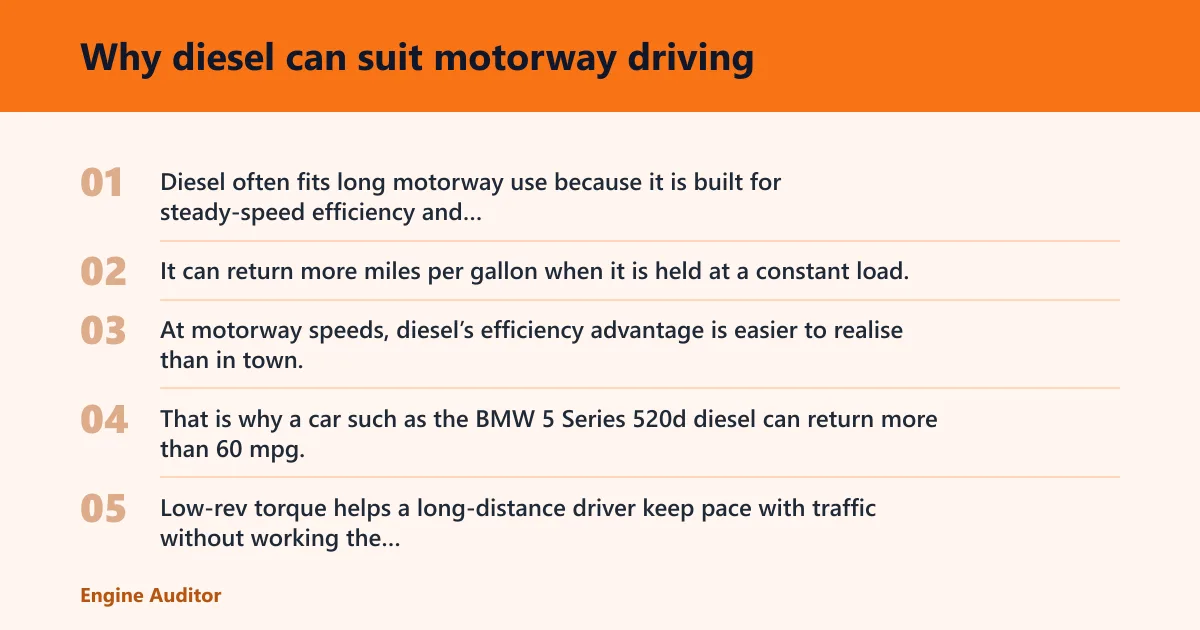
Diesel often fits long motorway use because it is built for steady-speed efficiency and relaxed cruising. It can return more miles per gallon when it is held at a constant load, and diesel engines usually deliver strong low-rev torque that suits overtaking and lane changes without frequent gearshifts.
Steady-speed fuel economy
At motorway speeds, diesel’s efficiency advantage is easier to realise than in town. That is why a car such as the BMW 5 Series 520d diesel can return more than 60 mpg, while many petrol rivals will not match that on the same journey pattern.
Low-rev torque and relaxed cruising
Low-rev torque helps a long-distance driver keep pace with traffic without working the engine hard. The result is often quieter, more relaxed progress. That benefit matters on repeated long runs, where fatigue and comfort are part of the comparison too.
Why those gains shrink in town use
Stop-start traffic narrows the diesel advantage because the engine is no longer spending much time at its most efficient operating point. Short trips can also make diesel emission systems work harder, which is one reason city-heavy use changes the buying decision.
What extra maintenance costs should I expect with a diesel?
Expect diesel ownership to carry more risk around emissions hardware and related repairs. The main extras are DPF maintenance, AdBlue top-ups or faults, and more complex diesel repair costs if a component fails. These items can wipe out fuel savings if the car is used mostly on short trips.
DPF maintenance and regeneration needs
The diesel particulate filter traps soot, and it needs the car to reach the right operating conditions so regeneration can happen. Short, interrupted journeys can leave the DPF unable to complete that process, which raises the risk of warning lights and repair bills.
AdBlue system top-ups and faults
Many newer diesels use AdBlue to help control emissions. That adds another fluid to monitor and another system that can fail. It is usually manageable on long runs, but it is still a maintenance item that petrol buyers generally do not face in the same way.
Repair costs for more complex diesel systems
Diesel engines often include more emissions-control hardware than comparable petrol cars. That extra complexity can make repairs more expensive when something goes wrong. For a buyer comparing total cost, the question is not whether a diesel can be efficient, but whether it can stay efficient without costly intervention.
Will ULEZ or clean air zones change the answer?
Yes. Older diesel cars are more likely to face restrictions or charges in low-emission zones, and that can erase fuel savings quickly. In London’s ULEZ, non-compliant vehicles currently cost £12.50 per day, so even occasional city entry can become expensive.
Older diesel restrictions
Not all diesels are treated the same way, but older models are the most exposed. If your routine includes city centres, school runs, or work parking inside a charge zone, the diesel case weakens because the running cost is no longer just fuel, tax, and servicing.
Why NOx matters in cities
Diesel generally emits less CO2 per mile than many petrol alternatives, but NOx emissions are the problem in urban air-quality policy. That is why a car can look efficient on paper and still be a poor fit for a driver who spends time in regulated city areas.
How mixed driving can erase diesel savings
Say your weekly pattern is five motorway commutes and two short city hops. The motorway miles help diesel, but the city use still raises DPF stress and leaves you exposed to zone charges if the car is not compliant. In that case, the diesel advantage is smaller than the fuel bill alone suggests.
Break-even worksheet: petrol vs diesel by mileage
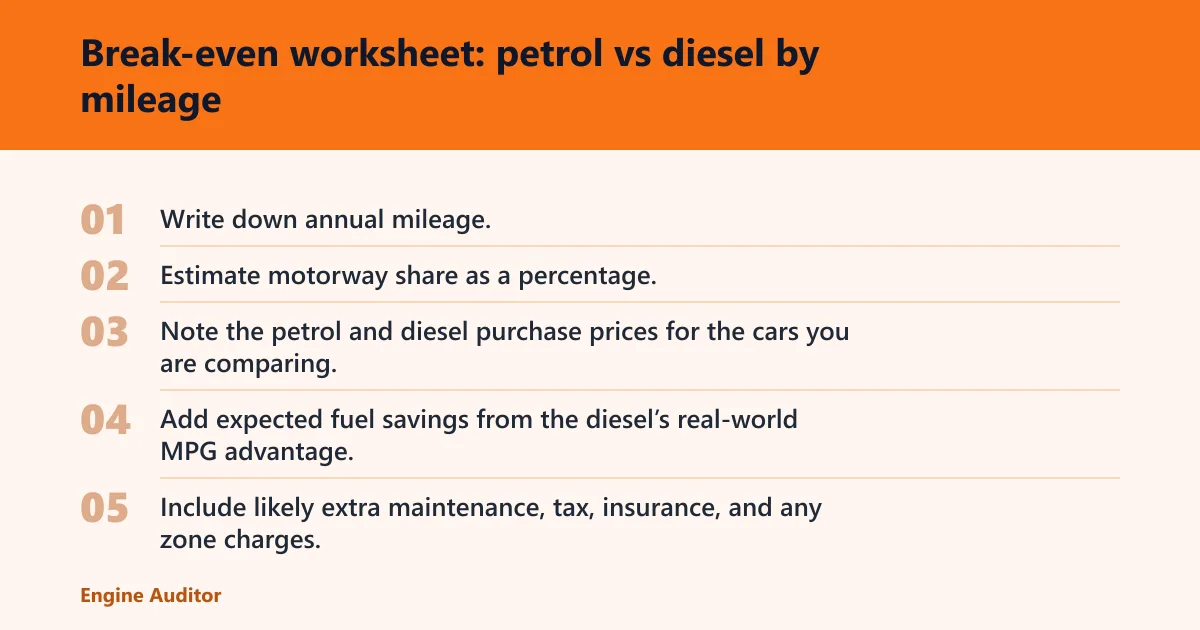
This worksheet turns the decision into a simple payback check. Fill in your mileage, your motorway share, and the car’s actual purchase and running costs, then see whether diesel’s fuel saving is large enough to cover the extra buy-in and upkeep.
How to use the worksheet
- Write down annual mileage.
- Estimate motorway share as a percentage.
- Note the petrol and diesel purchase prices for the cars you are comparing.
- Add expected fuel savings from the diesel’s real-world MPG advantage.
- Include likely extra maintenance, tax, insurance, and any zone charges.
- Choose the option with the lower total yearly ownership cost.
One-page mileage threshold table
| Annual miles | Motorway share | Estimated fuel savings from diesel | Likely maintenance adders | Likely recommendation |
|---|---|---|---|---|
| 8,000 | 30% | Low, because mixed use limits diesel’s efficiency gain | High risk of DPF and AdBlue costs if trips are short | Petrol |
| 10,000 | 50% | Moderate, but payback may still be slow | Possible diesel adders; check service history and zone exposure | Petrol, unless the car is mainly motorway use |
| 12,000 | 70% | Good, if the diesel gets strong real-world motorway MPG | Budget for DPF and AdBlue upkeep | Depends on purchase premium and city access |
| 15,000 | 80% | Strong, and more likely to repay the higher sticker price | Still allow for diesel-specific maintenance | Diesel |
| 20,000 | 90% | Very strong, especially on steady motorway routes | Maintenance matters less than fuel and depreciation here | Diesel |
Final recommendation rule
Choose diesel if your annual mileage is high, most of it is motorway use, and the car will stay outside charge zones. Choose petrol if your mileage is lower, your journeys are mixed, or you want to avoid the extra purchase and emissions-system risks that can come with diesel.
Choose petrol if…
Petrol is the better choice if you do shorter annual mileage, drive a lot in towns or city centres, or want the lower purchase price and simpler ownership picture. It also fits buyers who may face ULEZ or clean air zone exposure and do not want diesel-specific repair risk.
Choose diesel if…
Diesel is the better choice if you cover high annual mileage, spend most of your time on motorways, and plan to keep the car long enough for the fuel savings to repay the extra buy-in. It also suits drivers who want relaxed long-distance cruising and can avoid repeated short trips.
Frequently asked questions
Is a petrol or diesel car better for long-distance driving?
Diesel is usually better for long-distance driving because it tends to use fuel more efficiently at steady speeds. Petrol can still be the better buy if your mileage is lower, your trips are mixed, or you want to avoid diesel-specific maintenance and emissions-zone risks.
How many miles per year make diesel worth it?
A common break-even point is often around the low-to-mid teens in annual miles, but the motorway share matters as much as the total. If a large share of those miles is steady-speed driving, diesel is more likely to repay its higher purchase price and upkeep.
Are diesel cars still cheaper on motorways?
Often, yes. Diesel cars are usually more economical on motorways because they use fuel more efficiently at steady speeds. That said, the saving depends on real-world MPG, fuel price per litre, and whether the extra purchase and maintenance costs stay below the fuel benefit.
What extra maintenance costs should I expect with a diesel?
Plan for DPF maintenance, AdBlue top-ups or faults, and potentially higher repair bills because diesel emissions systems are more complex. Short trips can make these issues more likely, so a diesel that spends too much time in town may cost more than its MPG suggests.
Will a diesel car be affected by ULEZ or clean air zones?
Possibly. Older diesel cars are more likely to face restrictions or charges in low-emission zones, and London’s ULEZ currently charges non-compliant vehicles £12.50 per day. Check the exact model and emissions standard before you assume a diesel will be acceptable everywhere.
Is petrol cheaper to buy and insure than diesel?
Petrol cars are usually cheaper to buy than similar diesel models, and insurance can also be lower depending on the exact car. You still need quotes for the specific model, but petrol often has the lower starting cost and fewer diesel-related ownership risks.
Products related to this article
Sponsored / affiliate links. As an Amazon Associate I earn from qualifying purchases. I may earn additional commission from eligible campaigns.