Hybrid vs Gas Cars for Everyday Driving: Which Wins?
If your driving is mostly stop-and-go city trips, a hybrid usually wins. If you drive mostly long highway miles or keep annual mileage on the lower side, a gas car often costs less overall. Pick wrong and you can pay more upfront, save less on fuel, and end up with a car that misses your routine. This guide looks at city share, trip length, highway speed, annual mileage, and ownership costs for everyday use.
This guide is part of our Car comparison guide series.
| Decision factor | How to compare hybrid | Gas cars for everyday driving | Winner |
|---|---|---|---|
| Fuel use in city traffic | Usually stronger when the route has braking, idling, and low-speed motion. A full hybrid can run on electric power alone in parts of the trip. | Uses fuel every time the engine is running, so slow traffic rarely gives it a break. | How to compare hybrid |
| Upfront price | Often costs more up front, and the trim gap can be wider than people expect. | Usually cheaper to buy in a comparable trim. | Gas cars for everyday driving |
| Maintenance and repair risk | Can be fine, but the system is more complex and battery-related concerns matter over time. | Mechanically simpler, with fewer high-voltage parts in the mix. | Gas cars for everyday driving |
| Best fit for short trips | Strong if the car can warm up and recover energy during frequent stops; weaker if trips are very short and cold. | Fine for short trips, but it gives up the fuel savings a hybrid can capture in stop-and-go use. | How to compare hybrid |
| Highway-heavy driving | The gain often shrinks when the car spends most of its time at steady speed. | Often competitive here because steady cruising narrows the fuel gap. | Gas cars for everyday driving |
How to compare hybrid vs gas cars for your daily drive
Why your commute pattern matters more than the badge
The right comparison starts with how the car spends its day, not the badge on the grille. City share, trip length, highway speed, and annual mileage decide whether a hybrid earns back its higher price or just adds complexity.
I have seen people fixate on power figures and ignore the route. That usually leads them to the wrong trim, the wrong drivetrain, or both.
The three numbers that drive the decision: city share, annual miles, trip length
City share tells you how often the car can recover energy during braking. Annual miles tells you how much fuel savings can add up over a year. Trip length tells you whether the engine and battery ever get into the operating pattern where a hybrid helps most.
Short trips are the trap. If the engine is cold most of the time, the fuel gap can shrink fast, and some hybrid advantage never shows up.
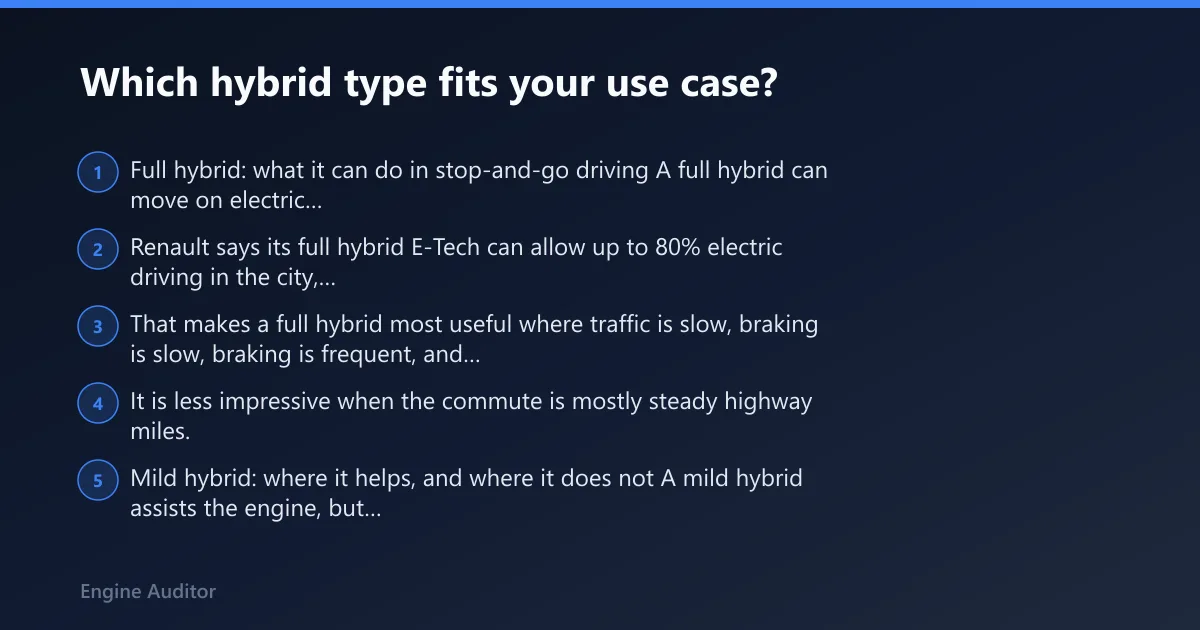
According to Plug-in hybridy Renault – Šetrné k životnímu prostředí — Renault says full hybrid E-Tech can allow up to 80% electric driving in the city.
Which hybrid type fits your use case?
Full hybrid: what it can do in stop-and-go driving
A full hybrid can move on electric power alone for short stretches, then switch between the engine, the motor, or both. Renault says its full hybrid E-Tech can allow up to 80% electric driving in the city, and it says these full hybrid cars do not need to be plugged in.
That makes a full hybrid most useful where traffic is slow, braking is frequent, and daily errands are broken into many short legs. It is less impressive when the commute is mostly steady highway miles.
Mild hybrid: where it helps, and where it does not
A mild hybrid assists the engine, but Renault states it does not allow 100% electric driving. That means it can trim fuel use and smooth stop-start traffic, yet it does not behave like an electric drive car in town.
For drivers who want a little help without changing habits, mild hybrid can be a simple middle path. For buyers chasing the biggest city fuel savings, it usually falls behind a full hybrid.
Plug-in hybrid: when charging access changes the answer
A plug-in hybrid can drive on electricity alone for a meaningful daily segment, but only if it is charged regularly. If parking and charging access are poor, the car spends more time hauling battery mass without using it well.
That is the key split. With home charging and a short commute, plug-in models can make sense. Without charging access, many buyers end up using them like heavier gas cars.

How fuel economy changes by route and trip length
City driving, highway driving, and mixed use
Hybrids usually look best in city driving because they can recover energy during braking and shut the engine down more often. Gas cars often close the gap at steady highway speed, where the hybrid system has fewer chances to help.
Mixed use sits between the two. The result depends on how much time is spent in traffic versus cruising.
Why short cold trips can shrink the hybrid gain
Very short trips can favor neither car. The engine may stay cold, the cabin may demand heat, and the hybrid battery may not get enough useful cycling for the system to pay back its extra cost.
That is one reason a commuter who drives many short errands can see less benefit than a driver with the same mileage spread across longer urban routes.
How real-world conditions change MPG and WLTP claims
Terrain, weather, traffic density, and driving style all change real-world efficiency. Hills, winter temperatures, hard acceleration, and heavy traffic can pull both cars away from brochure figures.
WLTP and other test cycles are useful for comparison, but they are only an estimate. Daily life has more stops, more cold starts, and more bad weather than a lab route.
Is a hybrid worth it for everyday driving?
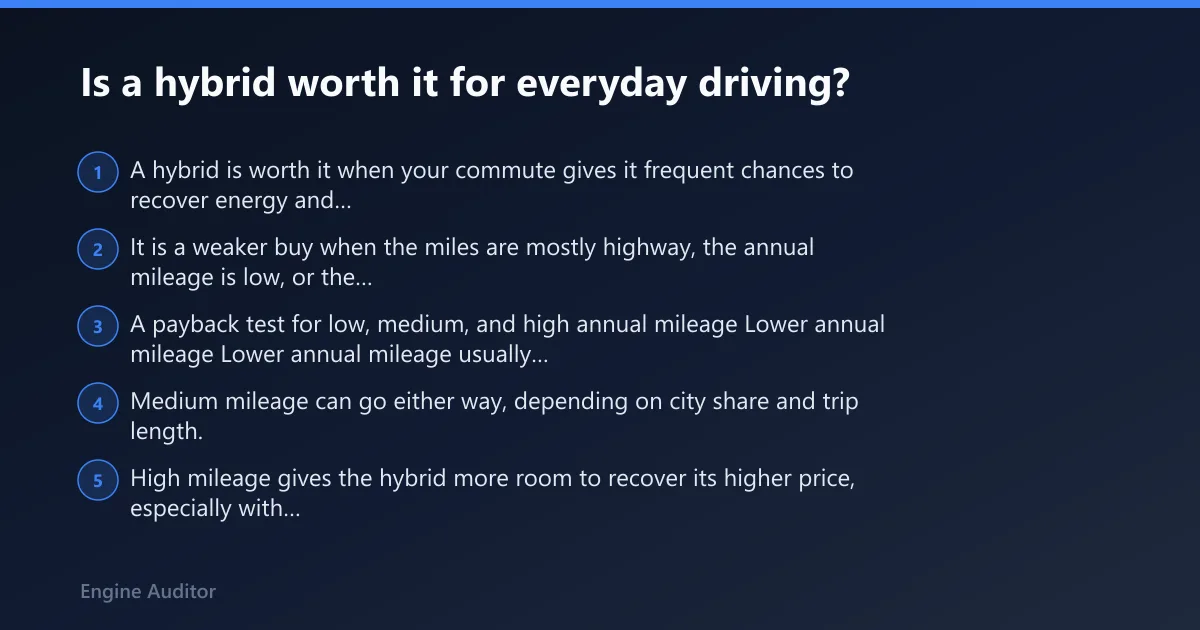
A hybrid is worth it when your commute gives it frequent chances to recover energy and cut engine run time. It is a weaker buy when the miles are mostly highway, the annual mileage is low, or the added purchase price would take too long to recover through fuel savings.
A payback test for low, medium, and high annual mileage
Lower annual mileage usually favors the gas car because the hybrid premium has fewer miles to spread its payback over. Medium mileage can go either way, depending on city share and trip length. High mileage gives the hybrid more room to recover its higher price, especially with heavy stop-and-go use.
When higher purchase price is recovered in fuel savings
The payback period shortens when fuel use is high, traffic is slow, and the car is driven often. A full hybrid in city traffic can make the math work sooner than a gas car, but the same model may struggle to justify itself on a mostly-highway commute.
When a gas car stays the cleaner buy from a budget view
Gas cars often stay ahead for buyers who want the lowest entry price, simple ownership, and predictable service. If the car will not rack up enough urban miles, the lower sticker can matter more than fuel savings that may take longer to add up.
What costs should you compare besides MPG?
MPG is only one line in the budget. Upfront price, maintenance, repair risk, insurance, depreciation, and resale value all change the total cost of ownership, and they can move the answer more than fuel economy does.
Upfront price and trim differences
Hybrid versions often come with a premium, and the comparable gas model may sit in a different trim band. That matters because a buyer is not comparing engines alone; the whole package changes price.
Maintenance, brakes, battery concerns, and repair risk
Hybrids can reduce brake wear through regenerative braking, though the system is also more complex. Battery-related concerns do not mean a bad car, yet they do belong in the risk check, along with the cost of specialized repairs.
Gas cars are simpler mechanically. That simplicity can help when the buyer wants fewer parts and fewer unknowns.
Insurance, depreciation, and resale value
Insurance can differ by model, not just powertrain. Resale value also varies by market, and strong resale can help a hybrid offset its higher purchase price.
Depreciation is the quiet part of the math. It can erase a fuel savings story that looked good on paper.
How much gas can I save with a hybrid in city driving?
City driving is where a hybrid usually saves the most fuel because stop-and-go traffic lets it use electric assist, shut the engine down more often, and recover energy on braking. The size of the gain still depends on trip length, winter weather, traffic density, and how gently the driver accelerates.
Savings in short urban trips
Short urban trips can still favor a hybrid, but the margin is less stable. If the engine stays cold and the car never settles into its most efficient operating pattern, some of the expected savings disappear.
Savings in mixed suburban commuting
Mixed suburban commuting often lands in the middle. A hybrid can help during school-zone crawling, signal-heavy roads, and slow exits, while a gas car can remain close enough on fuel use that the price gap matters more.
Why mostly-highway drivers often see a smaller gap
On the highway, a hybrid has fewer chances to recover energy. The engine is doing most of the work, so the fuel gap narrows and the extra purchase price becomes harder to justify.
Commute-based comparison worksheet: estimate your payback

Use this worksheet to compare fuel cost, service cost, and payback timing for your own routine. The point is not to chase one MPG number. The point is to map the car to the way it will actually be driven.
| Driving profile | Typical use pattern | Hybrid case | Gas car case | Payback read |
|---|---|---|---|---|
| Short urban trips | Frequent cold starts, lots of stops, low-speed errands, parking close to home | Best when the route has repeated braking and the car gets used often in town | Lower buy-in, but more fuel burned in traffic and idling | Hybrid can win if city share is high and annual mileage is not tiny |
| Mixed suburban commuting | School runs, office trips, some arterial roads, some highway, moderate annual mileage | Helpful if the route has enough stop-and-go to let the system work | Often close enough that sticker price and trim become decisive | Payback depends on annual miles and how much of the drive is stop-and-go |
| Mostly-highway driving | Long steady-speed commute, fewer stops, less braking, longer warm-up periods | Fuel gain is smaller, so the premium is harder to recover | Often the better budget pick | Gas car usually wins unless annual mileage is very high |
How to calculate annual fuel cost, service cost, and payback period
- Estimate your yearly miles from your commute and errands.
- Split those miles into city share, mixed driving, and highway share.
- Compare real-world fuel use for each car, not the brochure number.
- Add routine service costs, brake wear, and likely repair risk.
- Compare the purchase price gap against the annual savings.
- Divide the price gap by annual savings to judge payback speed.
How to compare hybrid vs gas cars on a test drive
Drive both cars over the kind of route you actually use. The goal is not to admire spec sheets. It is to see how each car behaves in traffic, in parking lots, and on the road you use most.
What to check beyond specs
- Low-speed throttle response in parking lots and crawl traffic
- Brake feel during gentle stops and repeated stop-and-go use
- Cabin comfort when the engine stops and starts often
- Visibility when merging, parking, and turning in traffic
- How the car behaves on hills, rough pavement, and cold starts
- Whether charging access exists at home or work if a plug-in is on the list
Frequently asked questions
Is a hybrid worth it for everyday driving?
It is often worth it for drivers who spend much of the week in city traffic, face frequent stop-and-go movement, and put enough miles on the car to recover the higher price. It is less convincing for low-mileage drivers or mostly-highway commuters.
What are the main differences between full hybrid and mild hybrid?
A full hybrid can move on electric power alone for short stretches and does not need a plug in some versions, while a mild hybrid only assists the engine and cannot do 100% electric driving. That difference matters most in traffic and short urban errands.
How far can a full hybrid drive on electric power alone?
That varies by model, traffic, speed, and battery charge. In practice, a full hybrid is best thought of as a car that can cover short electric-only segments, not as an electric car with a long zero-emission range.
Are hybrid cars more expensive to maintain than gas cars?
They can be, mainly because the system is more complex and battery-related repairs may cost more. But brake wear can be lower, and actual service cost depends heavily on model choice, mileage, terrain, and how the car is driven.
Do hybrids need to be plugged in?
Full hybrids usually do not need to be plugged in because the battery is charged through braking and the engine. Plug-in hybrids are different; they need charging to deliver their strongest electric-only driving benefits.
EV, hybrid, or gas car: what is best for a road trip?
For long highway trips, a gas car is often the simplest and least awkward choice, while a hybrid can still be a reasonable middle ground if it also sees city use during the week. A plug-in hybrid only makes sense if charging access fits the route and the daily routine.
Verdict
Choose a hybrid if your routine is heavy on city driving, short errands, traffic, and frequent braking, and if you will keep the car long enough for fuel savings to offset the higher price. Choose a gas car if your miles are mostly highway, your annual mileage is low, or you want the simpler and cheaper buy today. For plug-in hybrids, only choose them if charging access is part of the plan, not an afterthought.
Products related to this article
Sponsored / affiliate links. As an Amazon Associate I earn from qualifying purchases. I may earn additional commission from eligible campaigns.