Car Price Comparison India Vs US: Which Country Offers Better Deals?
Buying a car is a big decision, and prices play a major role. If you’ve ever wondered why a car costs so much more in India than in the US—even if it’s the same model—you’re not alone. The reasons are more complex than just currency differences.
In this article, you’ll see a clear, side-by-side comparison of car prices in India and the US. We’ll explore why these price gaps exist, compare real examples, break down taxes and extra costs, and reveal key insights that many first-time car buyers miss.
If you’re thinking about buying a car, or just curious about how global markets work, this guide will help you see the full picture.
How Car Prices Are Set In India And The Us
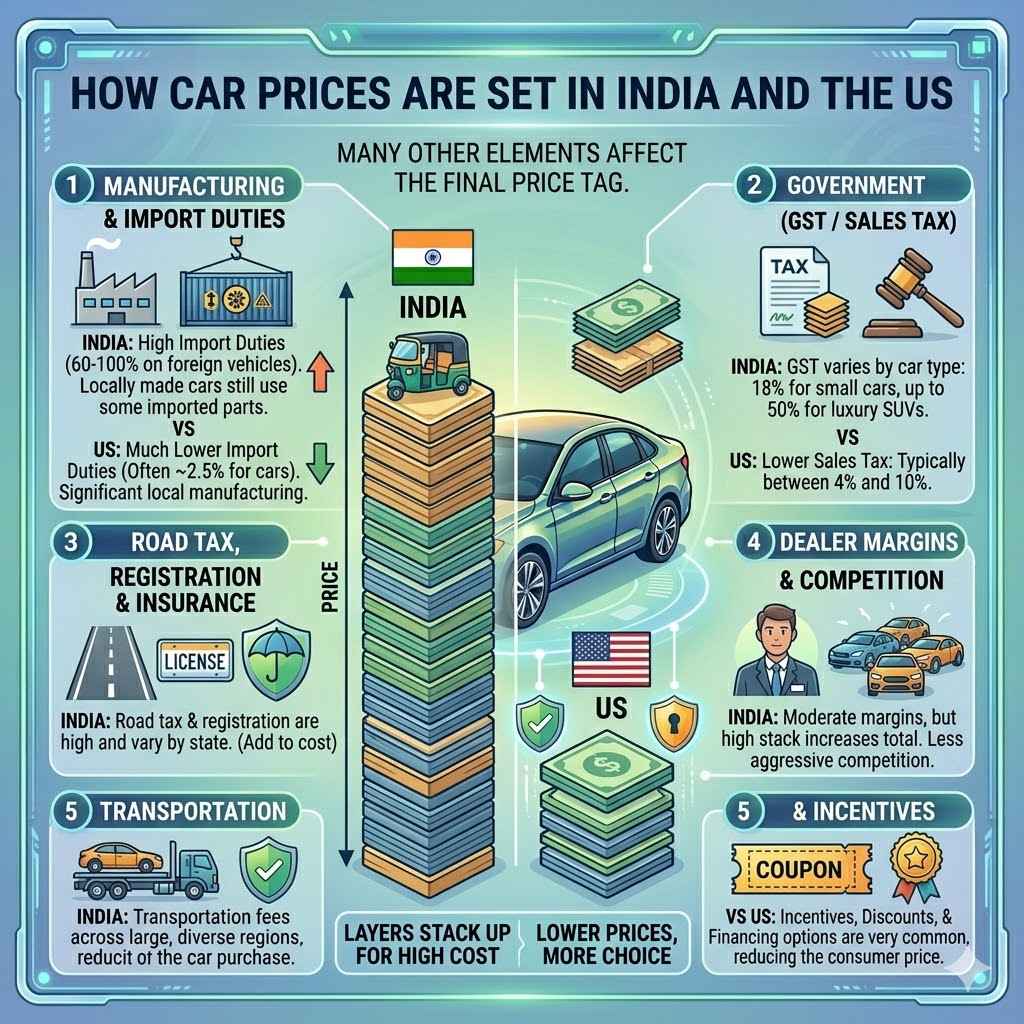
Car pricing is not just about the cost to make the vehicle. Many other elements affect the final price tag. In both India and the US, these include manufacturing costs, import duties, government taxes, dealer margins, and transportation fees. But the weight of each factor is very different in each country.
In India, most cars are either manufactured locally with some imported parts, or are fully imported. The government imposes high import duties on foreign vehicles, which can add 60-100% to the base price. On top of that, GST (Goods and Services Tax) varies by car type, ranging from 18% for small cars to 50% for luxury SUVs. Road tax, registration fees, and insurance also add to the cost. All these layers of cost stack up, making cars more expensive for Indian buyers.
In the US, cars are either made locally or imported, but import duties are usually much lower—often around 2.5% for cars. Sales tax applies, but it’s much lower compared to India, typically between 4% and 10%. The US also has a highly competitive market, which keeps dealer margins low. Incentives, discounts, and financing options are more common. This results in lower prices and more choices for the consumer.
Real Car Price Comparisons: India Vs Us
To see the difference clearly, let’s compare the prices of some popular car models available in both countries. These are on-road prices for India (including taxes, registration, and insurance), and MSRP (Manufacturer’s Suggested Retail Price) plus average sales tax for the US.
| Car Model | India Price (INR) | India Price (USD) | US Price (USD) |
|---|---|---|---|
| Hyundai Creta / Hyundai Tucson | 1,100,000 | 13,500 | 26,900 |
| Honda City / Honda Civic | 1,200,000 | 14,800 | 25,050 |
| Maruti Suzuki Swift / Suzuki Swift | 800,000 | 9,800 | 16,000 |
| Toyota Fortuner / Toyota Highlander | 3,800,000 | 46,900 | 36,420 |
| BMW 3 Series | 5,200,000 | 64,200 | 44,500 |
| Mercedes-Benz C-Class | 5,300,000 | 65,400 | 44,850 |
| Ford Mustang | 7,500,000 | 92,600 | 32,515 |
You can see that for mass-market cars like the Hyundai Creta, India’s price is lower in dollars than the US price for the Hyundai Tucson. But for luxury and imported cars, the difference is huge. The Ford Mustang, for example, is nearly three times more expensive in India.
Why Are Cars Cheaper In The Us?
There are several reasons:
- Lower Taxes and Duties: Import duties in the US are much lower, and sales tax is also less.
- Economies of Scale: The US market is massive. Car companies sell more units, so they can keep prices low.
- Fewer Middlemen: Distribution channels are more direct in the US, leading to lower overhead costs.
- Stronger Currency: The US dollar is stronger, making imports and raw materials cheaper.
- Higher Competition: More players in the market force prices down, and discounts are common.
Why Are Cars More Expensive In India?
- High Import Duties: For imported cars, duties can reach up to 100% of the car’s value.
- GST and Cess: Taxes can be as high as 50% for large SUVs and luxury vehicles.
- Smaller Market: Lower sales volumes mean less room for discounts.
- Expensive Logistics: Poor infrastructure increases transportation costs.
- Dealer Margins: Margins are often higher due to limited competition.
Taxes And Extra Costs: A Deep Dive
Let’s break down the main taxes and fees that add to a car’s price in both countries.
Taxes And Fees In India
- Import Duty: Ranges from 60% to 100% for Completely Built Units (CBUs).
- GST: 18% for small cars, up to 50% for luxury cars/SUVs (including cess).
- Road Tax: 8% to 15%, depends on state and car price.
- Registration Fee: Small, but adds up.
- Insurance: Mandatory, and often expensive.
- Dealer Handling Charges: Not regulated, can be high.
Taxes And Fees In The Us
- Import Duty: Usually 2.5% for cars.
- Sales Tax: Varies by state, between 4% and 10%.
- Registration Fee: Varies, but usually lower than in India.
- Insurance: Also mandatory, but can be lower for most models.
- Dealer Fees: Regulated and usually transparent.
Here’s a quick look at how these costs stack up for a mid-range car:
| Cost Component | India (Approx.) | US (Approx.) |
|---|---|---|
| Base Price | ₹900,000 | $15,000 |
| Import Duty | ₹450,000 (50%) | $375 (2.5%) |
| GST/Sales Tax | ₹180,000 (18%) | $1,200 (8%) |
| Road Tax/Registration | ₹90,000 (10%) | $200 (1.3%) |
| Insurance (1 year) | ₹40,000 | $900 |
| Total (Approx.) | ₹1,660,000 | $17,675 |
The numbers show how taxes and duties in India can double the price compared to the US.
Key Factors Behind Price Differences
Import Rules
India makes it expensive to import cars to protect local manufacturers. Most imported cars come in as CBUs (Completely Built Units), facing high taxes. The US, on the other hand, encourages imports and has free trade agreements with many countries.
Local Manufacturing
Many global brands set up factories in India to avoid import duties. But even then, parts are often imported, which still attracts some taxes. In the US, most cars are either made locally or imported from neighboring countries with low tariffs.
Model Variations
Car models are not always exactly the same. Sometimes, the Indian version has fewer features or smaller engines to keep costs down and fit local rules. The US version might offer more power, better safety features, or advanced tech as standard.
Exchange Rates
When the Indian Rupee weakens against the US Dollar, imported components and cars get more expensive. This adds even more cost to the final price.
Dealer Practices
In India, dealer commissions can be higher due to less competition, while in the US, prices are often advertised clearly, and there’s more pressure to offer discounts.
The Hidden Costs: What Buyers Often Miss
Most first-time buyers focus on the sticker price, but there are hidden costs that make a big difference.
- Maintenance Costs: In India, spare parts for imported or luxury cars are very expensive due to import duties. In the US, parts are cheaper and widely available.
- Fuel Prices: Petrol and diesel are much more expensive in India due to heavy taxes. The US has lower fuel costs, which reduces the overall cost of car ownership.
- Resale Value: Cars in India tend to depreciate faster, especially imported models, because they’re expensive to maintain and repair.
- Finance and Loan Rates: Car loans in India often come with higher interest rates compared to the US, making the total cost of ownership even higher.
Real-world Examples: What A Buyer Experiences
Let’s look at two buyers—one in Mumbai, one in Texas—both buying a Toyota Camry.
In India:
- On-road price: ₹4,500,000 (about $55,500)
- Taxes, registration, and insurance make up 45% of the total cost
- Annual maintenance: ₹50,000 ($615)
- Fuel price: ₹110 per liter ($5.18/gallon)
- Five-year cost of ownership: Over ₹6,000,000 ($74,000)
In the US:
- On-road price: $28,000 (including tax)
- Taxes and fees are about 10% of the total cost
- Annual maintenance: $400
- Fuel price: $3.70 per gallon
- Five-year cost of ownership: About $34,500
The Indian buyer pays more than double for the same car, and ongoing costs are much higher.
Why Do People Still Buy Expensive Cars In India?
Despite higher prices, demand for cars—especially premium ones—is growing in India. Why?
- Status Symbol: Cars are seen as a sign of success.
- Limited Options: People have fewer choices, so they pay more for the brands they want.
- Import Restrictions: Some models are only available as imports, so buyers must pay high duties.
- Urbanization: As more people move to cities, car ownership is becoming more important.
It’s not just about transport; it’s about lifestyle and social image.
Car Price Trends: How The Gap Is Changing
Over the last decade, the price gap between India and the US has grown for premium cars, but narrowed slightly for budget models. This is because more carmakers are building factories in India, reducing import duties on some models. But for high-end cars, the taxes remain high.
There is discussion about reducing import duties to make cars more affordable. However, local manufacturers oppose this, as it could hurt their sales. For now, the price gap is likely to remain.
Tips For Indian Buyers: How To Get The Best Deal
- Choose Locally Made Models: Avoid fully imported cars unless necessary.
- Compare State Taxes: Prices can change a lot between states due to road tax differences.
- Negotiate: Dealers often have some flexibility, especially at the end of the month.
- Consider Total Ownership Cost: Look beyond the sticker price to maintenance, insurance, and resale value.
- Check for Offers: Festive seasons and year-end sales can bring good discounts.
- Research Loan Options: Shop around for the best interest rates.
Tips For Us Buyers: Maximizing Value
- Look for Incentives: Cashbacks and financing offers are common.
- Compare Across States: Some states have lower taxes.
- Don’t Overbuy: Many buyers choose bigger engines and trims than they need.
- Consider Certified Pre-Owned: These offer good value and warranty.
- Factor in Insurance: Premiums can be high for certain models.
Two Insights Most Buyers Overlook
- Long-Term Cost Difference: In India, a car’s sticker price is only the start. Over 5–7 years, you may pay 1.5–2x the original price in taxes, maintenance, and fuel. In the US, the ongoing costs are much lower, and resale values are stronger.
- Feature Differences by Region: The same car model may have different safety features, emissions ratings, or engines in India and the US. Sometimes, US models offer more for a lower price.
Will Prices Ever Equalize?
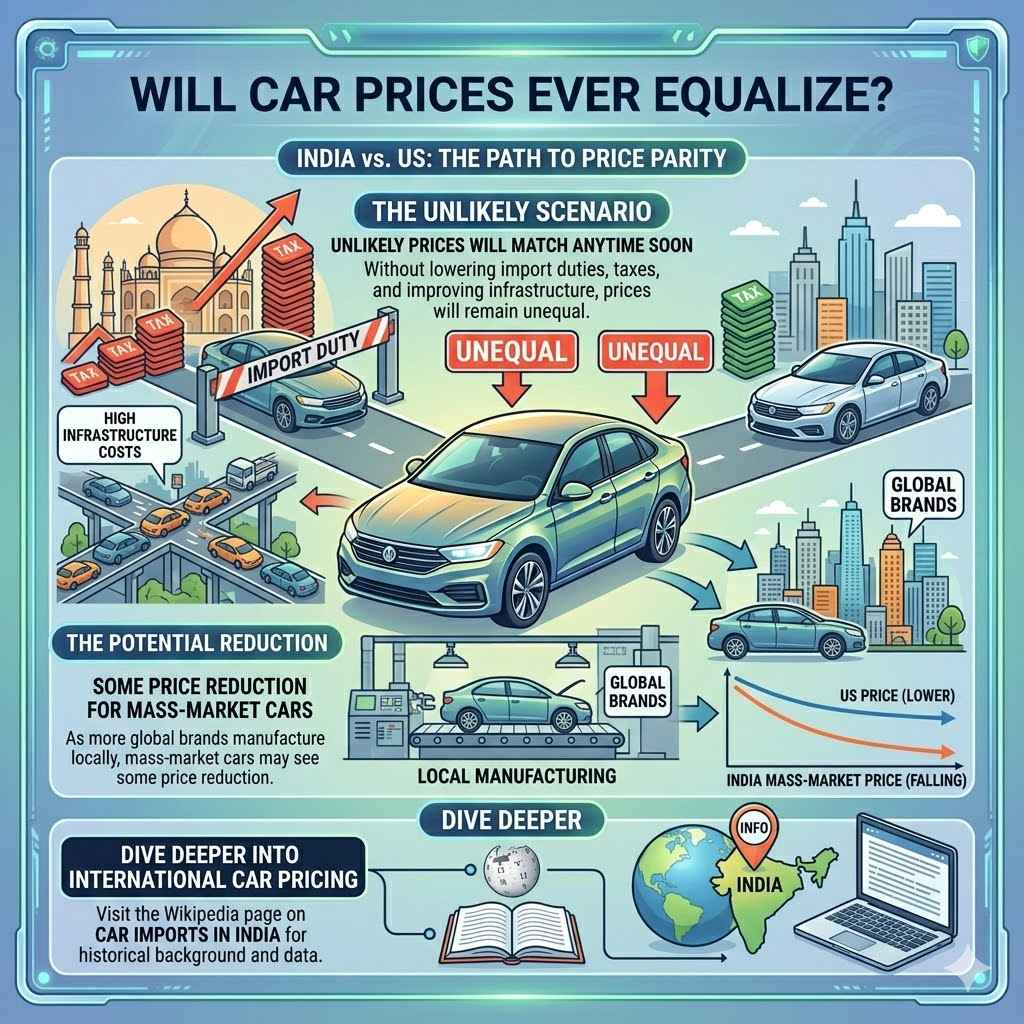
It’s unlikely that prices will match anytime soon. Unless India lowers import duties, taxes, and improves infrastructure, cars will remain more expensive than in the US. However, as more global brands manufacture locally, some price reduction for mass-market cars may happen.
If you want to dive deeper into international car pricing, the Wikipedia page on Car Imports in India offers a lot of background.
Frequently Asked Questions
Why Are Luxury Cars Much More Expensive In India Than In The Us?
Luxury cars in India face high import duties (up to 100%), GST, and cess. These taxes can double or triple the price compared to the US, where import duties and taxes are much lower.
Do Indian Cars Have Fewer Features Than Us Versions?
Often, yes. To keep costs down and meet local regulations, Indian versions may have smaller engines, fewer airbags, and less advanced tech compared to the US models.
Can I Import A Car From The Us To India To Save Money?
It is rarely economical. Import duties, taxes, and shipping costs can make the final price even higher than buying locally in India. Plus, you may face issues with servicing and getting spare parts.
Which Is Cheaper To Own: An Indian Or A Us Car?
Owning a car is generally much cheaper in the US due to lower taxes, cheaper fuel, lower maintenance costs, and higher resale value. In India, all these costs add up quickly.
Are There Any Signs That The Price Gap Will Shrink Soon?
Unless the Indian government reduces import duties and taxes, or more global brands manufacture locally, the price gap is unlikely to shrink for imported or luxury cars. For budget cars, local production is helping narrow the gap slightly.
Car price comparison between India and the US is about more than just numbers. It’s about policy, market size, and the real costs of car ownership. If you’re planning to buy, understanding these factors can help you make the smartest choice for your needs and your wallet.
Products related to this article
Sponsored / affiliate links. As an Amazon Associate I earn from qualifying purchases. I may earn additional commission from eligible campaigns.