How to Compare Acceleration and Power in Two Cars
Compare acceleration by power-to-weight ratio, gearing, tyre grip, and test figures. Horsepower alone does not decide which car gets to speed quicker. Get this wrong, and you can overpay for a car that feels slower in real driving. This guide shows how to compare launch, in-gear pull, and high-speed acceleration from specs and road tests.
How to compare two cars step by step
Start with the same test type. Compare launch figures with launch figures, rolling figures with rolling figures, and high-speed pull with high-speed pull. Then line up curb weight, peak power, peak torque, RPM range, gear ratios, tyre size, drivetrain type, and the road-test result before you call a winner.
Start with the same test type
Do not mix a 0-60 mph claim from one car with a 50-70 mph roll from another and call that a full comparison. Acceleration changes with road speed, so each metric answers a different question. A car can launch better, yet lose in the midrange or at motorway speeds.
List the specs you need before you judge anything
Use the same sheet for both cars: curb weight, peak power, peak torque, RPM range, gear ratios, tyre size, drivetrain, 0-60 or 0-100 time, and 50-70 mph time. If a brochure gives only crank output, note that wheel power will be lower because the drivetrain consumes some power.
A common first-timer mistake is to compare a 300 hp rear-drive sedan on summer tyres with a 300 hp front-drive hatch on narrow all-seasons, then blame the horsepower gap for the result. The tyres and drivetrain explain a lot of that difference before power even enters the picture.
Compare launch, rolling pull, and high-speed pull separately
Launch acceleration is the off-the-line result. Rolling pull is the punch from one road speed to another, such as 50-70 mph. High-speed pull is what happens when aerodynamic drag starts to matter more. A car can win one category and lose another.
Are speed and acceleration the same?
No. Speed is how fast the car is moving at a moment in time. Acceleration is how quickly that speed changes. Two cars can travel at the same 60 mph, yet one can still be accelerating hard while the other is holding steady speed on level ground.
Why speed is a state and acceleration is a rate of change
Speed has a value at a given moment. Acceleration measures the change in that value over time. That is why a car at 70 mph on cruise control is not accelerating much, while a car climbing from 50 to 70 mph in a few seconds is.
Why two cars can have the same top speed but very different acceleration
Top speed depends on power balance against drag and gearing, while acceleration depends on how much force reaches the road at lower and middle speeds. Two cars can both reach 155 mph, yet one reaches 60 mph much sooner because it has better gearing, more wheel power, or better grip.
Horsepower, torque, and RPM explained
Horsepower and torque are different measurements. Torque is twisting force, measured in N·m or lb-ft. Horsepower is a power output measure. RPM matters because it links the two: power equals torque multiplied by angular speed in a rotating system.
What horsepower measures
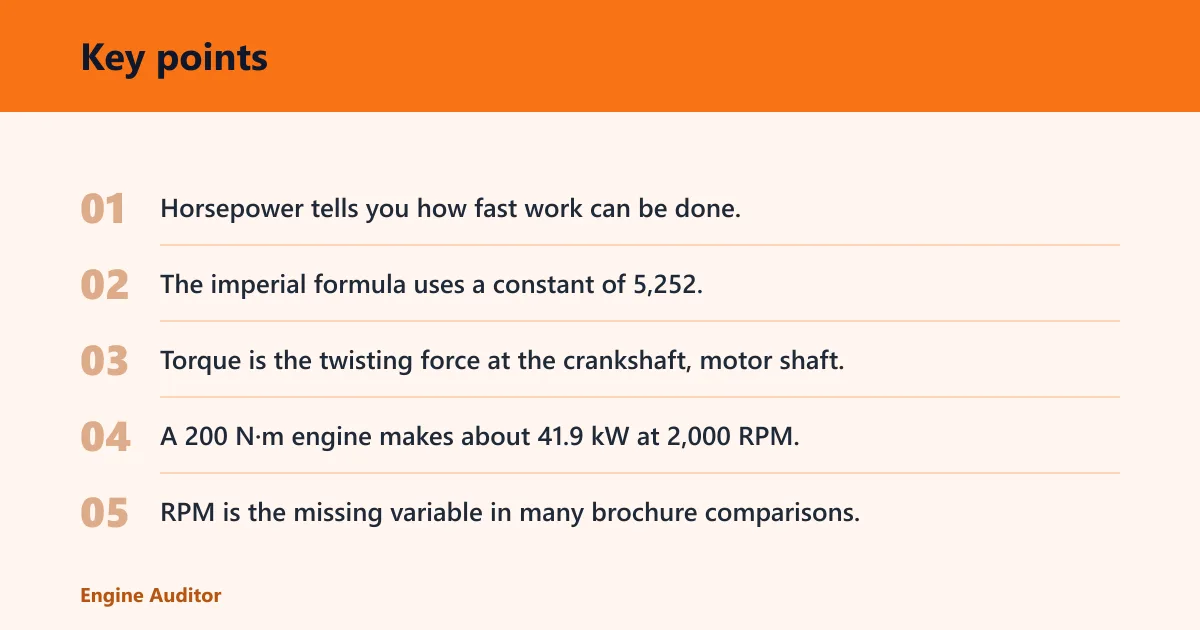
Horsepower tells you how fast work can be done. The imperial formula uses a constant of 5,252, which is why torque and horsepower curves cross there in common unit charts. Metric horsepower is about 735.5 watts. Mechanical horsepower is about 745.7 watts.
What torque measures
Torque is the twisting force at the crankshaft, motor shaft, or wheels depending on where it is measured. It does not equal wheel force by itself. A 200 N·m engine makes about 41.9 kW at 2,000 RPM, but the same 200 N·m at 6,000 RPM is about 125.7 kW.
Why RPM changes the link between torque and power
RPM is the missing variable in many brochure comparisons. The same torque at different engine speeds produces different power. That matters because acceleration is not about peak torque alone; it is about how much power the car can deliver over the speed range you care about.
How to convert between hp, PS, CV, hk, and kW
Use kW as the common base if the figures come from different markets. hp usually means mechanical horsepower, PS and CV are metric horsepower terms, and hk is another metric horsepower label used in some markets. If a listing gives only one of those units, compare like for like before you rank the cars.
Power units can hide the same output behind different labels. A 250 hp car may not be directly comparable to a 250 PS car unless you convert both to the same unit. The safest habit is to write the unit beside every number on your worksheet.
Why gear ratios matter
Gear ratio multiplies wheel torque. That is why a lower-powered car can beat a stronger one at one road speed if its gearing puts more force at the tyres. Gear selection also changes where in the RPM range the engine sits, which affects power at that moment.
How gear ratio multiplies wheel force
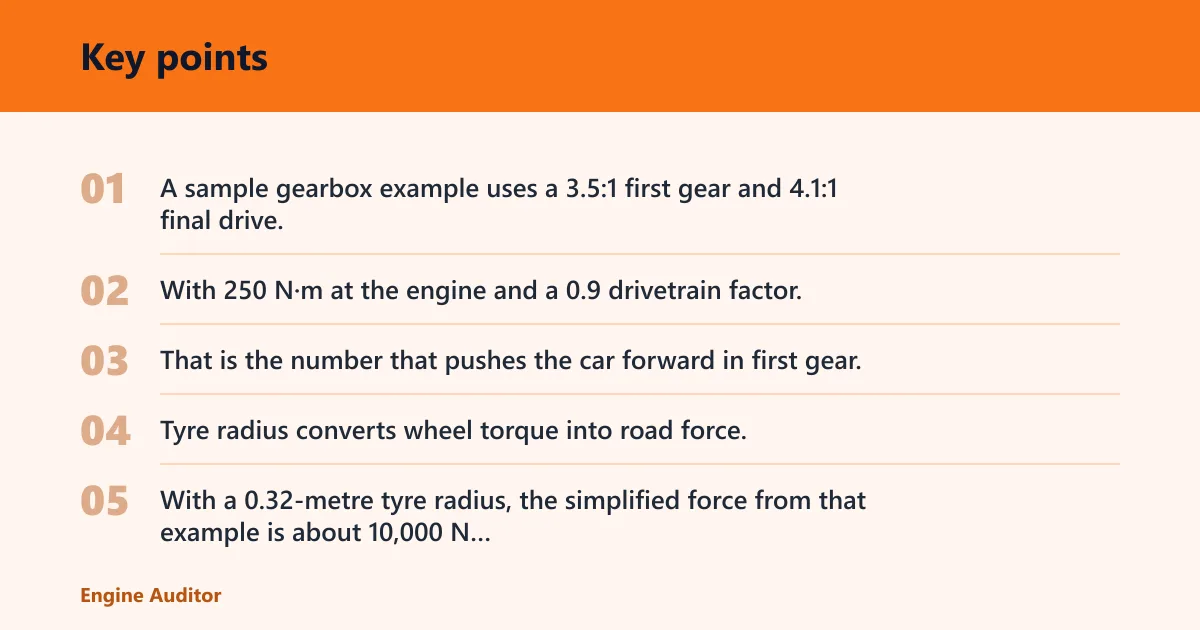
A sample gearbox example uses a 3.5:1 first gear and 4.1:1 final drive. With 250 N·m at the engine and a 0.9 drivetrain factor, wheel torque is about 250 × 3.5 × 4.1 × 0.9 = 3,228.75 N·m. That is the number that pushes the car forward in first gear.
How tyre radius changes the force at the road
Tyre radius converts wheel torque into road force. With a 0.32-metre tyre radius, the simplified force from that example is about 10,000 N at the contact patch. A larger tyre radius lowers road force for the same wheel torque.
Why two cars with similar engine output can accelerate differently at the same speed
Suppose Car A has modest peak power but short gearing, while Car B has more power and taller gearing. At 40 mph in the same gear, Car A may sit closer to its power band and deliver more wheel force than the brochure figure suggests. At 80 mph, the result can flip.
| Comparison item | Manual example | Automatic example | DCT example |
|---|---|---|---|
| First gear | 3.5:1 | 4.6:1 | 3.8:1 |
| Final drive | 4.1:1 | 3.3:1 | 3.9:1 |
| Engine torque | 250 N·m | 250 N·m | 250 N·m |
| Assumed drivetrain factor | 0.90 | 0.85 | 0.92 |
| Estimated wheel torque | 3,228.75 N·m | 3,196.50 N·m | 3,400.20 N·m |
Power-to-weight and wheel power
Power-to-weight ratio belongs in every comparison because curb weight changes how far each kilowatt has to move the car. It is more informative than peak power alone for broad acceleration checks. If two cars have similar power, the lighter one usually has the edge unless traction or gearing gets in the way.
Why curb weight belongs in every comparison
Use curb weight, not just a marketing claim about output. A heavier car needs more force to change speed at the same rate. That is why a 20 kW gap can be small if one car carries much more mass.
How drivetrain losses change crank power into wheel power
Wheel power is lower than source power because the drivetrain uses some of it. Losses vary by drivetrain. Front-drive, rear-drive, all-wheel drive, and different transmission types do not waste the same amount, so crank figures are only part of the picture.
When wheel power is the better number to trust
If you have independent road-test data or chassis dyno data, wheel power gives a cleaner comparison than brochure output. It reflects drivetrain losses and often lines up better with real acceleration. If you only have crank figures, treat them as a starting point, not the final answer.
Acceleration comparison worksheet
Fill this out for both cars, then compare launch, rolling acceleration, and high-speed pull on the same page. If a figure is not published, write “not listed” rather than guessing. The point is consistency, not perfect data.
| Spec | Car A | Car B | What it tells you |
|---|---|---|---|
| Curb weight | 1,420 kg | 1,560 kg | Power-to-weight comparison |
| Peak power | 220 hp | 250 hp | Source output |
| Peak torque | 340 N·m | 320 N·m | Low-speed force potential |
| RPM range | 1,800-6,500 RPM | 2,500-6,000 RPM | Where power arrives |
| Gear ratios | 3.6 first, 4.0 final | 3.2 first, 3.4 final | Wheel force at road speed |
| Tyre size | 225/45R18 | 245/40R19 | Tyre radius and grip clues |
| Drivetrain | Front-wheel drive | All-wheel drive | Traction and loss profile |
| 0-60 mph / 0-100 km/h | 5.8 s | 5.4 s | Launch result |
| 50-70 mph | 3.1 s | 2.8 s | Rolling pull |
| Launch winner | Lose | Win | Best off the line |
| Rolling winner | Lose | Win | Best in-gear pull |
| High-speed winner | Win at lower speeds only | Win | Best at higher road speed |
- Write down curb weight, power, torque, RPM range, gearing, tyre size, and drivetrain for both cars.
- Convert power into one unit if the cars use different markets or labels.
- Check power-to-weight using curb weight, not an empty or guessed figure.
- Estimate wheel torque in the gear that matters for the road speed you care about.
- Compare 0-60 or 0-100 times for launch, then 50-70 mph for rolling pull.
- Decide whether traction, gearing, or drag explains the result before you rank the cars.
What changes the result in real driving?
Traction limits launch acceleration. Aerodynamic drag matters more as speed rises. Turbo lag, hybrid assist, EV motor delivery, and automatic shift logic can all change the result compared with a brochure number. That is why claimed figures and road-test figures should be checked against each other.
How traction limits launch acceleration
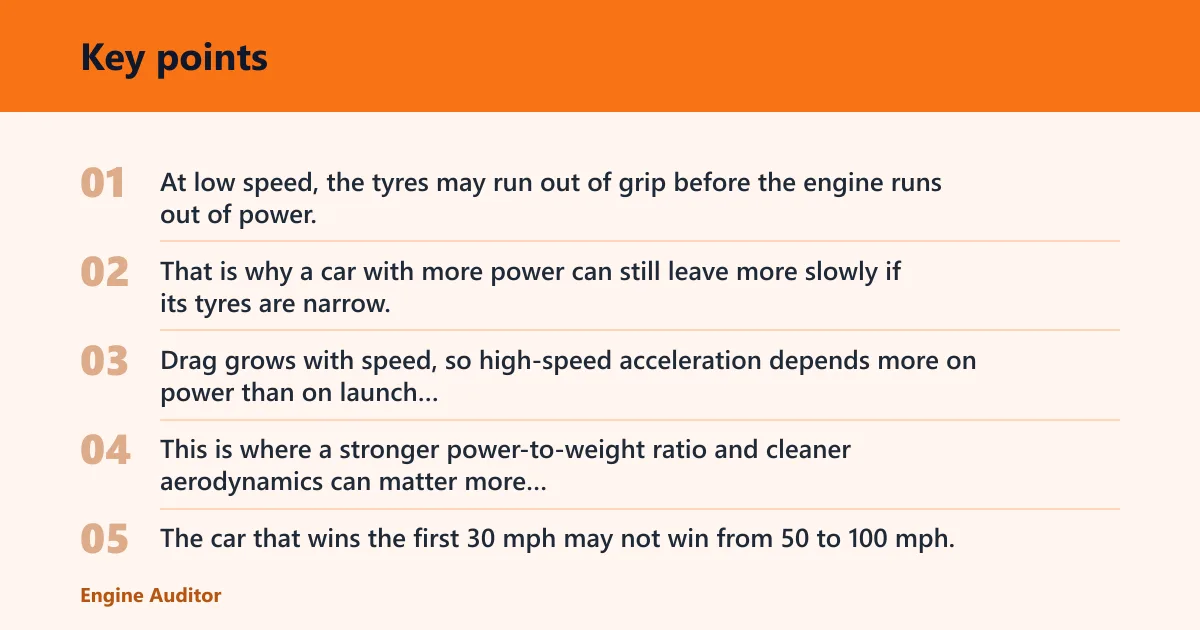
At low speed, the tyres may run out of grip before the engine runs out of power. That is why a car with more power can still leave more slowly if its tyres are narrow, cold, or mounted on a front-drive layout that gets light under hard throttle.
How aerodynamics matter more as speed rises
Drag grows with speed, so high-speed acceleration depends more on power than on launch grip. This is where a stronger power-to-weight ratio and cleaner aerodynamics can matter more than a sharp 0-60 time. The car that wins the first 30 mph may not win from 50 to 100 mph.
Say your 250 hp hatch is on all-season tyres and your 220 hp coupe is on wide summer tyres. The coupe can leave harder from a stop if grip is the limit, even though the hatch has more peak power. The launch result changes because traction, not power, is the bottleneck.
How turbo lag, hybrids, EVs, and shift logic can change the outcome
Turbo lag can delay boost, so a turbocharged car may feel softer just off idle. Hybrids can fill that gap with electric assist. EVs often deliver strong low-speed pull because motor torque arrives immediately, but they can still be limited by tyre grip and by power fade at higher speed. Automatic shift logic also matters because the wrong shift point can drop the engine out of its best RPM range.
How to compare claimed figures with independent road tests
Match the test conditions as closely as possible: same metric, same road type, similar surface, similar tyres, and a fair fuel or charge state. If the brochure says 0-100 km/h but a road test shows a slower result, the test usually reflects real weight, grip, temperature, and shift behaviour more honestly.
Frequently asked questions
Does more horsepower mean faster acceleration?
Not by itself. More horsepower helps, but weight, gearing, traction, and drag all change the result. A lighter car with better gearing can beat a heavier car with more peak power. That is why power-to-weight and road-test figures matter more than a single brochure number.
How does acceleration differ from speed?
Speed is a momentary rate of travel. Acceleration is the change in that rate over time. Two cars can have the same speed and very different acceleration if one is still building pace while the other is cruising steadily.
Which matters more in a car comparison: horsepower, torque, or weight?
Weight is often the first filter, because it sets the load that power has to move. Horsepower matters more as speed rises, while torque matters through gearing and RPM. For a fair comparison, use power-to-weight, then check gearing and traction before deciding.
How do I compare two cars if one has more horsepower but weighs more?
Calculate power-to-weight using curb weight, then compare launch and rolling times. If the heavier car has a much better gearbox or stronger traction, it can still win some tests. If not, the lighter car may feel quicker even with less peak power.
How do gearing and RPM change acceleration between two cars?
Gearing multiplies wheel force, and RPM decides where in the power curve the engine sits at a given road speed. A shorter gear keeps the engine in a stronger part of the band, which can make a lower-powered car faster in one speed range. The result can flip after an upshift.
Products related to this article
Sponsored / affiliate links. As an Amazon Associate I earn from qualifying purchases. I may earn additional commission from eligible campaigns.