Ford maintenance plan worth it? Costs and coverage guide
Ford Protect Premium Maintenance only makes sense when scheduled dealer service costs more than the contract price. I’ve seen low-mileage owners pay extra for coverage they never use, while high-mileage, towing, and EV owners can reach break-even sooner. Skip the math and you can overpay by hundreds, or miss covered services that would have paid back the plan.
Verdict: is Ford Premium Maintenance worth it?
The answer depends on mileage, service interval count, and wear-item coverage. If the vehicle will rack up enough scheduled visits for covered oil changes, tire rotations, inspections, and wear items to exceed the contract price, the plan can pay off. If the owner does basic upkeep, drives lightly, or skips dealer service, it is usually a poor deal.
The buying rule to use
Use a simple rule: estimate the number of scheduled service visits over the contract term, multiply by what a Ford dealer would likely charge for those visits, then compare that total with the plan price. If the gap is small, the plan is a maybe. If the out-of-pocket total is clearly higher, the plan deserves a hard look.
How Ford Premium Maintenance works

Ford Protect Premium Maintenance follows the vehicle’s own service schedule. Ford says coverage is based on the Owner’s Scheduled Maintenance Guide, so the guide controls what counts as covered maintenance and when it is due. That matters, because the value changes with the engine, powertrain, use pattern, and interval count.
How the Owner’s Scheduled Maintenance Guide controls coverage
The guide sets the service intervals, and the plan follows those intervals. A vehicle with short intervals will usually create more covered visits than one with long intervals. The plan also does not cover every repair need on the car; it tracks scheduled maintenance only.
Where service can be done
Service may be performed at a Ford dealership, depending on the program or location. That helps owners who keep dealer records for resale or fleet paperwork. It does not change the math by itself. A nearby dealer only matters if the scheduled work is actually covered.
Which vehicle types are eligible
The company says it offers Premium Maintenance for a range of vehicle types, including gas, diesel, hybrid, and electric models. Ford also offers Premium Maintenance EV. That matters because service content is not identical across powertrains, and the break-even point shifts with how much scheduled maintenance the vehicle actually needs.

What does Ford Premium Maintenance cover?
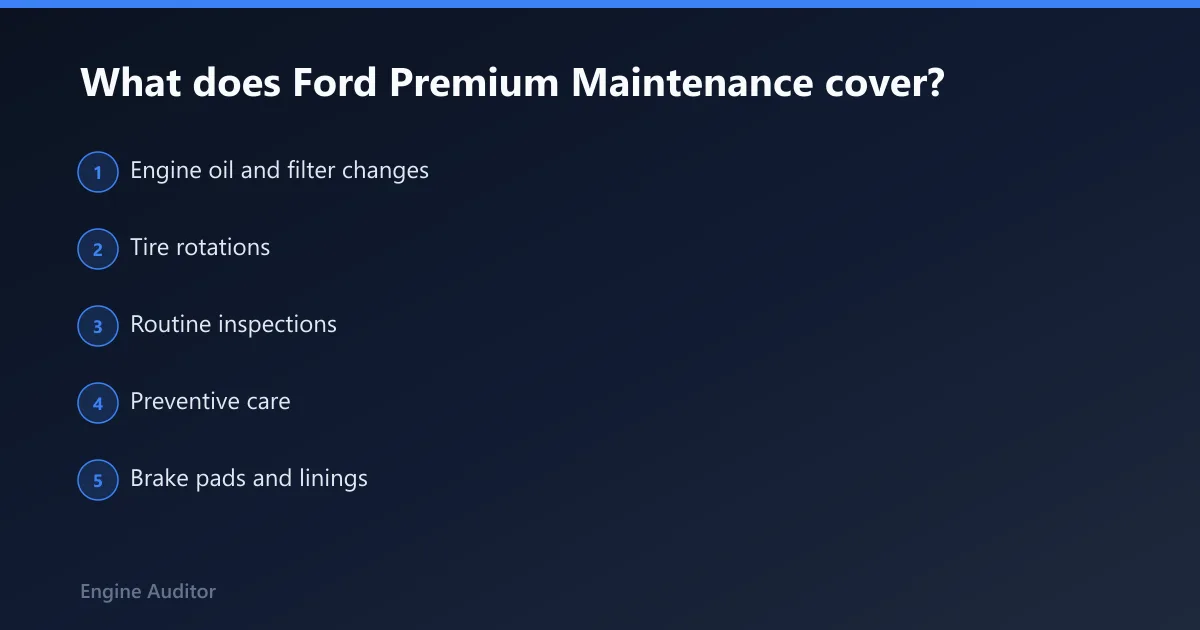
Ford Premium Maintenance covers routine inspections and preventive care, plus replacement of normal wear and tear items that fall within the maintenance schedule. The most useful items for most owners are engine oil and filter changes, tire rotations, brake pads and linings, spark plugs, shock absorbers or struts, engine belts, and wiper blades.
Routine service items
- Engine oil and filter changes
- Tire rotations
- Routine inspections
- Preventive care
These are the services that decide the value test. Oil and filter changes and tire rotations repeat on the schedule, so they do most of the work in the break-even check.
Wear items and periodic replacements
- Brake pads and linings
- Spark plugs
- Shock absorbers and struts
- Engine belts
- Wiper blades
These items matter because they are not one-time perks. They are the parts that can turn a plan from average to useful if the owner keeps the vehicle long enough and drives enough miles for them to come due within the contract term.
Diesel exhaust fluid and schedule-linked items
Diesel exhaust fluid fill is covered when scheduled maintenance is performed at the dealership. That helps diesel owners who already follow the dealer schedule, but it should not be treated as a free-standing fuel or repair benefit. It sits inside the maintenance context.
What is not included?
Common misses can include alignments, cabin filters, damage-related repairs, and items outside the vehicle’s maintenance schedule. A dealer may still recommend those items, but recommendation is not the same as coverage. The plan follows the schedule, and anything off-schedule can create extra charges.
Common exclusions and gray areas
Alignments are a frequent example. Cabin filters are another. Both are often confused with routine upkeep, but buyers should check the actual schedule and plan terms before assuming they are covered. Damage-related repairs also sit outside this plan; wear coverage is not collision coverage.
When dealer work can still trigger extra charges
Extra charges can show up when the vehicle needs work outside the scheduled maintenance list, when a dealer finds damage, or when an owner asks for a service item that the guide does not include. That is where prepaid maintenance can disappoint owners who expect broader coverage than Ford actually lists.
Break-even worksheet: what you pay versus what you use
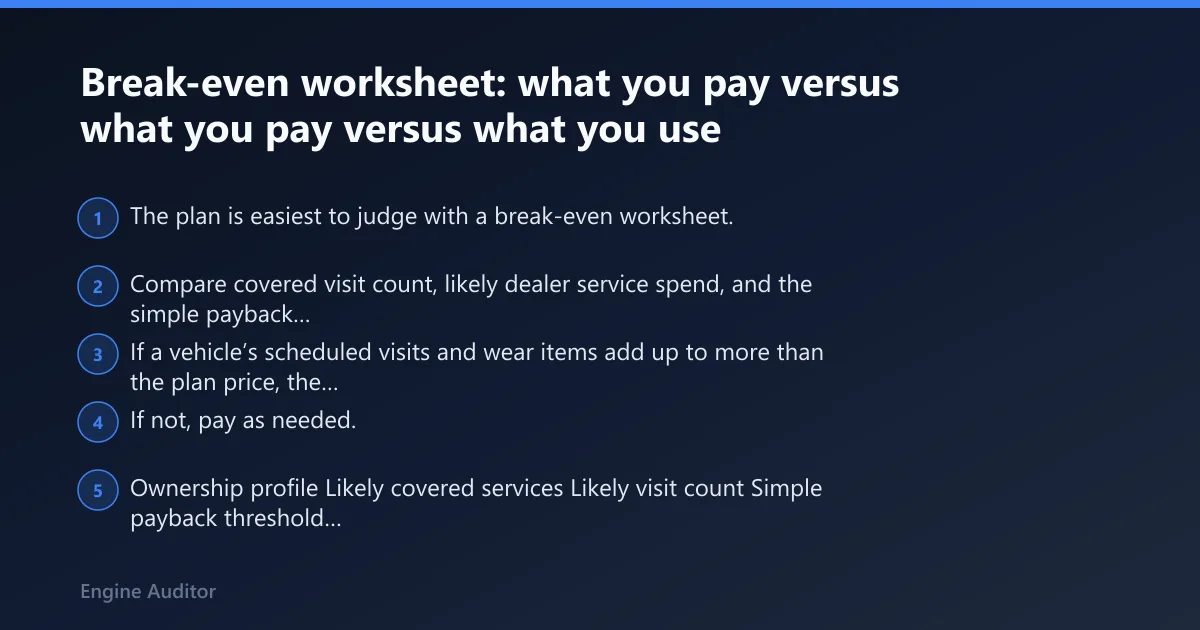
The plan is easiest to judge with a break-even worksheet. Compare covered visit count, likely dealer service spend, and the simple payback threshold. If a vehicle’s scheduled visits and wear items add up to more than the plan price, the plan has a case. If not, pay as needed.
| Ownership profile | Likely covered services | Likely visit count | Simple payback threshold | Value read |
|---|---|---|---|---|
| Low-mileage commuter | Oil and filter changes, tire rotations, inspections, wiper blades | Low | Plan is worth it only if the contract price is below the total of those visits plus any wear-item replacements that land inside the term | Often skip |
| Average driver | Oil and filter changes, tire rotations, inspections, possible spark plugs or belts if the term is long enough | Moderate | Buy only if dealer-priced service over the term is clearly above the plan price, with enough margin to cover exclusions | Maybe |
| High-mileage or tow-use driver | Oil and filter changes, tire rotations, inspections, brake wear, wiper blades, possible shocks or struts, belts, diesel exhaust fluid for diesel use | High | Worth it when the vehicle’s schedule generates repeated visits and one or two wear-item replacements would put out-of-pocket spending well above the contract price | Often buy |
Low-mileage commuter
This owner often has the weakest case. The vehicle may need only a few covered services in the contract window, so the plan can cost more than paying for a couple of dealer visits. If the owner also does basics like wipers or rotations elsewhere, the value drops further.
Average driver
This profile sits in the middle. The plan can work if the vehicle’s schedule is tight or the owner expects wear items to land within the term. If the car is driven gently and the owner is willing to shop service prices, this profile often ends up near the fence.
High-mileage or tow-use driver
This is where prepaid maintenance starts to make sense. More miles mean more scheduled visits, more rotations, more oil and filter changes, and a higher chance of wear items being due. Towing and heavy use can also shorten intervals and push the owner toward the break-even line faster.
Pros and cons of buying the plan
Pros
- Covers routine inspections and preventive care
- Includes oil and filter changes and tire rotations
- Includes wear items such as brake pads and linings, spark plugs, shocks or struts, belts, and wiper blades
- Can simplify dealer scheduling and service records
- May help with reliability and safety when maintenance is kept on schedule
- May improve trade-in or resale value when service history is documented
Cons
- Can cost more than paying as needed, especially for low-mileage drivers
- Does not cover every item people assume is maintenance, such as alignments or cabin filters
- Can be a bad fit for DIY owners who handle basic upkeep themselves
- Dealer work outside the schedule can still add charges
- Value depends heavily on vehicle type and service interval count
Who should buy Ford maintenance coverage?
It fits lease-minded drivers, high-mileage drivers, towing users, and owners who already plan to use Ford dealership service. It is weaker for DIY owners, low-mileage drivers, and people who rarely visit the dealer unless something breaks. The tighter the match to the schedule, the better the case.
Best fit
Lease-minded drivers often like predictable service history. High-mileage and tow-use owners can also benefit because the schedule stacks up quickly. Diesel owners who want dealership service for diesel exhaust fluid fills and scheduled maintenance may also find a cleaner value case.
Poor fit
DIY owners are the clearest skip. If basic maintenance is handled at home or through a cheaper independent shop, the plan can become expensive padding. Low-mileage drivers can also lose money if the vehicle never reaches enough scheduled visits to justify the contract.
How to decide before you buy
Start with the service interval count in the Owner’s Scheduled Maintenance Guide. Then compare the number of covered visits you expect with the plan price and with dealer retail pricing. If the plan price is above your likely out-of-pocket total, the answer is no. If it is below, the plan deserves a closer look.
Questions to ask before signing
- How many scheduled visits will this vehicle need during the contract term?
- Which covered items will actually come due in that window?
- Will the vehicle need wear items such as brake pads, spark plugs, belts, shocks, or wiper blades?
- Do I plan to use Ford dealership service, or do I usually go elsewhere?
- Am I the kind of owner who does basic upkeep myself?
- Are cabin filters, alignments, or other add-ons likely to create extra cost?
Simple payback threshold
A practical threshold is straightforward: if the estimated dealer cost of covered maintenance over the term is not clearly higher than the plan price, do not buy. That threshold gets easier to hit as mileage rises, intervals shrink, and wear items become more likely to be replaced during the contract.
Can I use Ford dealership service if I buy the plan?
Yes. Ford says service can be performed at any Ford dealership. That helps owners who want dealer records or who already prefer factory-trained service. It does not make the plan a win by itself. The value still comes from the number of covered visits and the items that actually fall due.
Does the plan work for electric vehicles too?
Yes. Ford also offers Premium Maintenance EV. The value test is still the same: compare the plan price against likely scheduled service spend, then check the EV maintenance guide for what is covered and how often it appears. EV coverage should not be treated as identical to gas coverage.
Frequently asked questions
Is the Ford maintenance plan worth it for my car?
It is worth it when your scheduled dealer service total is likely to exceed the contract price. That usually happens with higher mileage, more frequent intervals, or ownership patterns that bring wear items into the term. For low-mileage or DIY owners, paying as needed is often cheaper.
What does Ford Premium Maintenance cover?
Ford says Premium Maintenance covers routine inspections and preventive care, plus replacement of normal wear and tear items. The covered items called out by Ford include engine oil and filter changes, tire rotations, brake pads and linings, shock absorbers and struts, spark plugs, engine belts, and wiper blades.
How much does a Ford maintenance plan cost?
Price depends on the vehicle’s maintenance needs and usage pattern. Ford does not publish one price that fits every car, because the schedule, engine type, and expected service count all affect the plan. That is why a break-even check matters before buying.
Does the plan cover oil changes and tire rotations?
Yes. Engine oil and filter changes are included, and tire rotations are included. Those are the core services most owners use to test whether the plan pays for itself, because they recur on the maintenance schedule and show up repeatedly over the contract term.
What wear items are included in Ford’s maintenance plan?
Ford lists brake pads and linings, shock absorbers and struts, spark plugs, engine belts, and wiper blades as covered wear items. Those are valuable only if they come due during the coverage period. If the vehicle is lightly driven, some of them may never be used.
What maintenance is not included in the Ford plan?
Common misses are alignments, cabin filters, and damage-related repairs. Anything outside the vehicle’s scheduled maintenance guide is also a likely exclusion. That is the part buyers often miss when they assume every dealer recommendation will be paid for under the plan.
Products related to this article
Sponsored / affiliate links. As an Amazon Associate I earn from qualifying purchases. I may earn additional commission from eligible campaigns.