Ford Service Intervals: What to Do at 5k, 10k, 20k
At around 5,000 miles, Ford service typically includes inspections, tire pressure checks, and fluid top-off checks; at around 10,000 miles, many Ford models add the Ford-specified oil change and tire rotation; at around 20,000 miles, service may repeat those items and include checks of filters, brakes, and scheduled fluids. Skip the correct interval and you can shorten tire life, miss leaks, and turn cheap maintenance into repairs. This guide separates universal checks from model-specific Ford schedule items at 5k, 10k, and 20k.
This guide is part of our Ford car maintenance guide series.
Ford service intervals by mileage
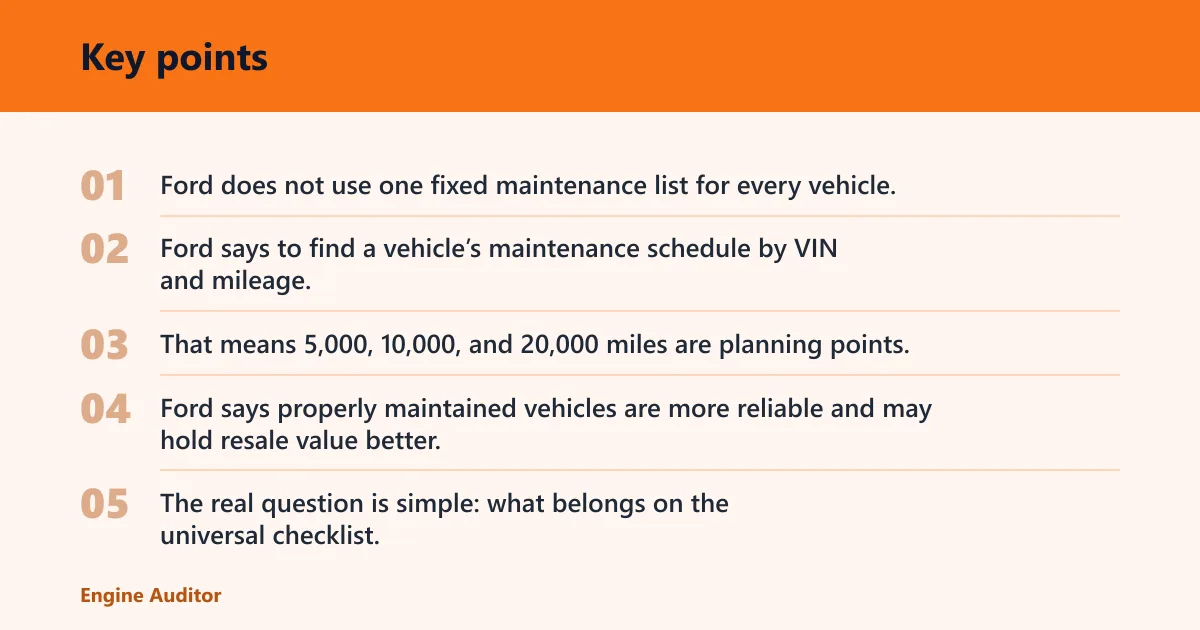

Ford does not use one fixed maintenance list for every vehicle. Ford says to find a vehicle’s maintenance schedule by VIN and mileage, and that schedule can be checked on its support page anytime. That means 5,000, 10,000, and 20,000 miles are planning points, not automatic proof that every item is due.
The same source says properly maintained vehicles are more reliable and may hold resale value better. The real question is simple: what belongs on the universal checklist, and what belongs only on your specific schedule?
What 5k, 10k, and 20k mean on a Ford schedule
Use 5,000 miles for basic checks, 10,000 miles for routine service items that often include rotation and scheduled fluid or filter checks, and 20,000 miles for deeper inspection points and wear-item review. The exact list depends on engine, model year, duty cycle, and climate notes in the Ford schedule.
That is why mileage alone is not enough. A truck used for towing in hot weather may call for different timing than a commuter sedan in mild conditions, even at the same odometer reading.
Why the VIN matters before you book service
The same source says the VIN is the key to identifying the vehicle-specific schedule. The VIN is a 17-digit alphanumeric code, and Ford says it is commonly found on the driver’s side doorframe and at the lower driver’s side windshield corner. Use it before you assume a universal mileage chart fits your vehicle.
Where mileage fits in Ford owner support
The same source says you can check maintenance schedules on its support page, and mileage is part of that lookup. Enter the mileage the car has now, then compare the result with the schedule tied to the VIN. If the page points to an interval farther out, do not force a service early just because a generic list says “10k.”
5,000-mile service: what usually applies

At 5,000 miles, the safe baseline is inspection work, tire pressure checks, and fluid level checks, plus any oil-life-based service your Ford schedule calls for. Some models may also list an oil change, but Ford schedule guidance should decide that, not a blanket mileage rule.
Oil-life timing and inspection checks
Many Ford schedules tie oil service to mileage and oil-life monitoring together. That means 5,000 miles can be due on one vehicle and early on another. At this point, the common universal items are underbody and safety checks, fluid condition checks, lights, tires, and a look for leaks or obvious damage.
Say your SUV has mostly short trips and cold starts. The mileage may read 5,000, but the owner schedule may call for service sooner or later depending on the oil-life monitor and duty cycle. Match the schedule, not the odometer alone.
What may be model-specific at 5k?
Some Ford schedules add oil change timing, cabin or engine filter checks, or severe-duty notes at this point. Other vehicles do not. If the schedule does not list a part or procedure, do not assume it belongs at 5,000 miles just because another Ford model has it.
When to wait for the schedule instead of guessing
If the schedule does not call for a replacement, wait. A premature filter swap or fluid service adds cost without solving a stated need. At 5,000 miles, the main goal is to catch wear, low fluids, tire issues, and early signs of leaks before they become bigger repairs.
- Check the VIN-based Ford schedule.
- Confirm current mileage.
- Review oil-life status if your model uses it.
- Inspect tires, brakes, lights, and visible fluid levels.
- Book only the items the schedule lists.

10,000-mile service: the routine set

At 10,000 miles, many Ford schedules add a tire rotation and a fuller routine inspection, along with fluid and filter checks where listed. This is the point where owners often combine basic checks with the first standard maintenance visit, but again the VIN-based schedule decides what is actually due.
Tire rotation and wheel inspection
Tire rotation is one of the most common 10,000-mile items, but it is not universal. Ford schedules may place it earlier, later, or on a different pattern depending on the vehicle. Wheel inspection should also include tread wear, visible damage, and signs of uneven wear that could point to alignment or inflation problems.
Is a tire rotation included in Ford maintenance intervals? Often, yes, but not always at the same mileage on every model. Use the schedule tied to your VIN, then pair rotation with wheel inspection so tread wear is checked while the tires are already off the ground.
Fluid checks and filter checks where listed
At 10,000 miles, routine fluid checks usually include engine oil, coolant, brake fluid, washer fluid, and other model-specific reservoirs. Filter checks may include the engine air filter or cabin filter if the schedule lists inspection or replacement. Do not replace a filter just because the odometer crossed 10,000 miles if Ford has not called for it.
Items that commonly pair with this visit
A common first-timer mistake is scheduling only the oil change and skipping the tire rotation and brake inspection that could have been done during the same stop. Pairing tasks saves downtime. It also keeps a technician from repeating the same disassembly later.
Expect this visit to be routine rather than repair-heavy. If the schedule is standard, the appointment is usually short. If the vehicle has a warning light, uneven tire wear, or a fluid concern, the visit may take longer because the technician has to diagnose instead of simply check boxes.
20,000-mile service: what gets checked next
At around 20,000 miles, Ford schedules often move beyond basic checks into deeper inspection points and wear-item review. Many vehicles still need the same core tasks, but the list may also add replacements or inspections that are specific to engine, climate, or driving duty.
Wear items and deeper inspection points
At this interval, expect a closer look at brakes, tires, suspension components, belts, hoses, and fluid condition where the schedule lists them. The point is to catch parts that are moving from routine wear into serviceable wear, before they cause noise, vibration, or a warning message.
Suppose a crossover comes in with 20,000 miles and a faint pull to one side. If the schedule includes wheel inspection and tire rotation, that is the right moment to look for uneven wear, a dragging brake, or inflation mismatch before the problem spreads across the tire set.
Parts that may be due only on some models
Air filters, cabin filters, brake fluid checks, spark-related service, and transmission-related items are model-dependent in Ford schedules. Some vehicles list them early. Others do not. The schedule should tell you whether a part is due now, only inspected, or left for a later interval.
How to group 20k tasks with earlier intervals
When 20,000-mile service is due, combine it with any missed 10,000-mile items only if the schedule and current condition support it. That may mean one visit for rotation, inspection, and a listed fluid service. It does not mean stacking every item from earlier intervals if Ford never called for them together.
Ford service matrix
This matrix separates common mileage work from items that belong only when your Ford schedule says so. Use it as a planning tool, then verify against the VIN-specific maintenance page before you book.
| Service item | 5k | 10k | 20k | Only if your Ford schedule calls for it |
|---|---|---|---|---|
| Oil | Check oil-life timing | Oil change for many models | Repeat if due by schedule | Oil change timing varies by model and oil-life monitor |
| Tire rotation | Inspect tires and wear pattern | Common interval for rotation | Repeat rotation if listed | Rotation interval may differ by drivetrain and tire setup |
| Brake inspection | Basic visual check | Routine inspection | Deeper wear-item check | Brake service or replacement only when wear or schedule says so |
| Fluid checks | Top-off and leak check | Routine fluid review | Check scheduled fluids again | Some fluids are inspected; others are replaced later |
| Filter replacement | Usually inspect only | Check where listed | May be due on some models | Engine air filter, cabin filter, or other filters per schedule |
| Battery test | Check condition if needed | Test if starting is slow | Good time for a load test | Battery service if voltage or cranking performance calls for it |
| Wheel inspection | Check pressure and damage | Inspect with rotation | Inspect for wear and alignment clues | Alignment, balancing, or repair only if symptoms or schedule point there |
How to use the matrix before scheduling
Read across one row at a time. If an item appears in the 5k or 10k column, you can treat it as a common planning item. If it sits in the last column, book it only when the Ford schedule lists it or the car shows a problem that needs diagnosis.
Can you use VIN to find the schedule?
Yes. The same source says to find a vehicle’s maintenance schedule by VIN and mileage, and that makes VIN lookup safer than a generic mileage chart. The 17-digit VIN ties the schedule to the right engine, model, and build details, which is exactly what changes the service list.
What the 17-digit VIN does
The VIN identifies the vehicle in a way a trim name cannot. Two vehicles with the same badge may have different service timing because of engine type, drivetrain, towing package, or market-specific hardware. The VIN is the cleanest way to avoid over-servicing one truck and under-servicing another.
Where to find the VIN on the vehicle and paperwork
The same source says the VIN is commonly found on the driver’s side doorframe and at the lower driver’s side windshield corner. It also appears on registration and insurance paperwork. If one location is hard to read, use another rather than guessing from the model badge alone.
Why VIN-based lookup is safer than a generic mileage chart
Generic charts are useful only as a starting point. VIN-based schedules are better because they reflect your actual vehicle. That matters for climate-based notes, severe-duty service, and models that do not follow the same interval pattern as the rest of the lineup.
What Ford service options can handle these jobs?
Ford offers more than one way to complete common maintenance. Ford Mobile Service can handle oil and filter changes, brakes, batteries, and tire rotation. Ford Pickup & Delivery can bring the vehicle from home or work to the dealership and back. Ford Rewards may let eligible owners earn points on service, parts, and accessories.
Ford Mobile Service for common maintenance tasks
Ford Mobile Service can perform oil and filter changes, brakes, batteries, and tire rotation. That makes it useful for the 5k and 10k visits that are mostly routine, provided your location and vehicle qualify. It is not a claim that every repair can be done remotely.
Dealer service with Pickup & Delivery
Ford Pickup & Delivery includes dealer pickup from home or work, service at the dealership, and return afterward. That is helpful when the service call is wider than a mobile visit, or when you want dealer tools for a diagnosis tied to a warning light, drivetrain issue, or other scheduled inspection.
Ford Rewards for eligible visits and purchases
Ford Rewards lets owners earn points on Ford service, parts, and accessories, with enrollment handled through the app. If you already need a scheduled visit, it is worth checking whether the appointment and any eligible parts purchase can be tied to the rewards account before you book.
Frequently asked questions
What should I do at 5,000 miles on a Ford?
At 5,000 miles, start with the VIN-based Ford schedule, then do basic inspections, tire pressure checks, and fluid level checks. Some models also call for oil-service timing at this point, but not all do. Use oil-life status and the owner schedule before you book anything beyond the basics.
What service is due at 10,000 miles on a Ford?
At 10,000 miles, many Ford schedules call for a tire rotation, routine inspection, and fluid or filter checks where listed. Some models also add an oil change here. The exact package depends on the VIN-specific schedule, so mileage alone should not decide the work order.
What gets checked at 20,000 miles on a Ford?
At 20,000 miles, expect deeper inspection points, wear-item checks, and any model-specific replacements Ford lists for your vehicle. This often includes brakes, tires, fluids, belts, hoses, and filters where applicable. If you missed earlier interval items, combine them only when the schedule and condition support it.
Do Ford service intervals change by model or engine?
Yes. Ford service intervals can change by model, engine, drivetrain, climate notes, and duty cycle. That is why Ford points owners to VIN and mileage rather than a one-size chart. Two vehicles with the same odometer reading may not need the same service.
Can I use Ford’s maintenance schedule by VIN?
Yes. The same source says to find the maintenance schedule by VIN and mileage. The VIN is a 17-digit alphanumeric code that identifies the specific vehicle, which makes the service list more accurate than a generic mileage estimate. Use it before you schedule any interval service.
Do I need to sign in to see my Ford maintenance schedule?
The same source says maintenance schedules can be checked anytime on its support page, and owner account tools are also useful for managing vehicles. In practice, sign-in may help with saved vehicle details, but the key point is that the schedule should be matched to the vehicle and current mileage, not guessed from memory.
What services can Ford Mobile Service perform?
Ford Mobile Service can perform oil and filter changes, brakes, batteries, and tire rotation. That covers many routine maintenance items at 5,000 and 10,000 miles, as long as the vehicle and location qualify. It is not meant to replace every dealer repair or every schedule item.
Products related to this article
Sponsored / affiliate links. As an Amazon Associate I earn from qualifying purchases. I may earn additional commission from eligible campaigns.