Ford maintenance cost by model: what owners should expect
Ford maintenance costs can vary by model: a smaller Ford like a Fiesta or Escape may be in a lower annual range, while a larger one like an F-150 or Explorer may be somewhat higher; hybrids or EVs may cost less for routine service but more if specialized parts fail. I see owners get surprised most often by brake, tire, cooling, and battery costs before high mileage. This guide compares Ford maintenance by model class, mileage, and use case so you can budget what owners usually spend.
How much does Ford maintenance cost by model?
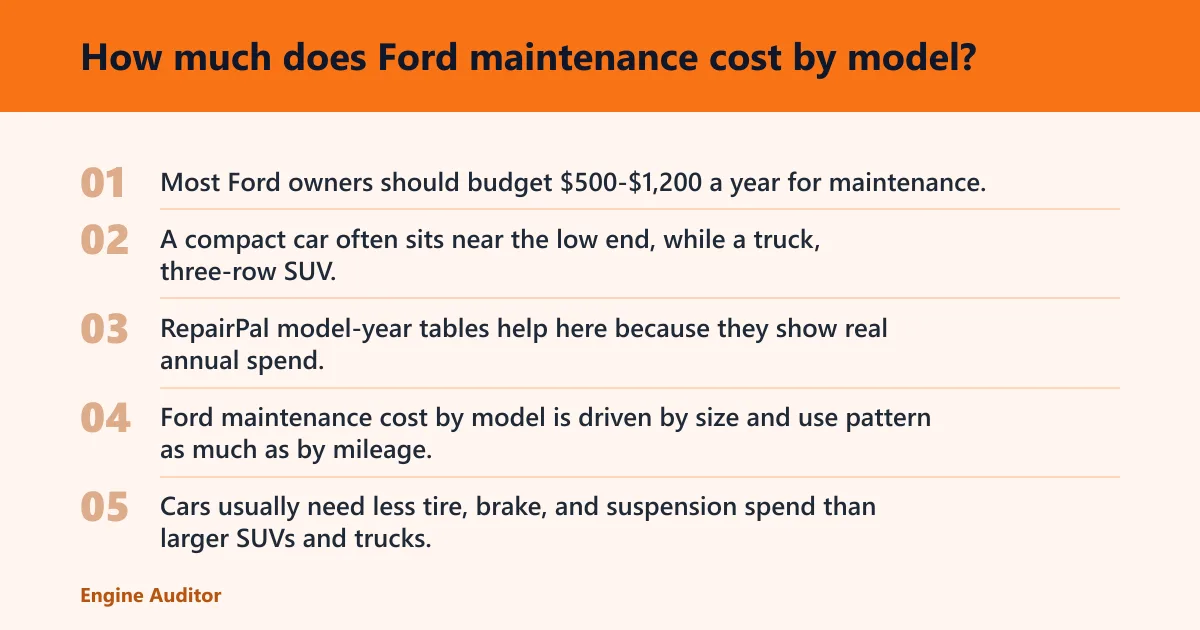
Most Ford owners should budget $500-$1,200 a year for maintenance, then adjust for body style and duty cycle. A compact car often sits near the low end, while a truck, three-row SUV, or hard-work van can move to the upper end fast. RepairPal model-year tables help here because they show real annual spend, not sticker price guesses.
How model class changes the budget
Ford maintenance cost by model is driven by size and use pattern as much as by mileage. Cars usually need less tire, brake, and suspension spend than larger SUVs and trucks. Hybrids can save on scheduled service, and EVs usually have lower routine maintenance than gas models, though tires and other wear items still matter.
What goes into a Ford maintenance budget?
A practical budget has three buckets: routine service, wear items, and repairs after warranty ends. Routine service includes oil changes, tire rotations, inspections, and filters, with synthetic oil on most modern Ford versions. Wear items are tires, brake pads, batteries, and wipers. Post-warranty repairs can push costs far above the usual annual range, especially on heavier Ford models with more expensive parts.
📊 Ford maintenance tables in the source include the F-150, Focus, Mustang, Taurus, Explorer, Fusion, Edge, Flex, Fiesta, Escape, and Expedition. Source: The Complete Cost Of Maintaining A Ford.
Which Ford models cost the most to maintain?

The largest Ford models usually sit at the top of the budget list because they use bigger tires, larger brakes, more fluid, and pricier suspension parts. In the source tables, the Expedition is the highest-cost example, while the Explorer and F-150 also land well above smaller cars. The Focus remains a lower-cost benchmark by comparison.
Ford Expedition: why it can reach $1,014
The 2013 Expedition in the source table is listed at $1,010 annual maintenance, and the larger Expedition line can cross the $1,000 annual mark. That makes sense. A full-size SUV has more weight to stop, more tire to replace, and costlier wear items than a compact car. If it tows, the budget rises again.
Ford Explorer: why older model-year costs can reach $820
The 2012 Explorer in the source table is listed at $820 annual maintenance. That number is not surprising for a midsize SUV with larger tires and brakes than a sedan. Family hauling, short-trip use, and stop-and-go school runs tend to wear brakes and tires faster than highway commuting does.
Ford F-150: why older model-year costs can reach $893
The 2012 F-150 in the source table is listed at $893 annual maintenance. That is a clear example of how a popular truck can cost more than a car long before major repairs appear. Payload, towing, brake wear, tire size, and heavier driveline loading all push the budget up.
Ford Focus: why smaller cars usually set the lower benchmark
The Focus is a useful lower-cost reference point because smaller cars usually need less expensive tires, brakes, and suspension work. Ford’s maintenance tables include the Focus, and that matters for comparison shopping. When owners move from a compact car to a truck or three-row SUV, the service bill usually follows.

Why do Ford trucks and SUVs cost more than cars?
Ford’s maintenance costs track with vehicle size, and that shows up in parts pricing. Bigger vehicles need larger tires, larger brake assemblies, and more fluid in several systems. They also tend to place more load on suspension pieces, especially when they carry families, cargo, trailers, or roof loads on a regular basis.
Tire size and brake size
Larger tires cost more to replace, and larger brake hardware usually costs more per axle. That is why the same kind of service feels different across Ford models. A Focus owner often sees smaller bills than an F-150 or Expedition owner, even when both vehicles are getting the same maintenance item.
Weight, towing, and heavy loads
Towing is a direct cost driver. So is carrying tools, gear, or a trailer all week. The more weight a Ford moves, the harder the brakes and tires work, and the faster fluids and suspension parts can age. That is why truck and full-size SUV budgets should assume more wear, not just more miles.
Stop-and-go driving, idling, and short trips
Short trips are expensive in a quiet way. The engine may never warm fully, oil changes may come sooner by duty cycle, and brakes can rust or glaze from frequent light use. Heavy idling and city traffic do the same thing to many Ford models, especially trucks and SUVs that are used like commuter cars.
How much should you budget monthly for Ford maintenance?
Monthly reserve budgeting is the cleanest way to handle Ford ownership. A $600 annual plan is about $50 per month. A $1,200 annual plan is about $100 per month. That reserve should cover routine service, predictable wear items, and part of the repair risk that appears after the warranty ends.
Turning annual spend into a monthly reserve
- Pick the model class first: car, SUV, truck, hybrid, or EV.
- Start with a realistic annual maintenance range for that class.
- Divide that number by 12 and set it aside every month.
- Add more if the Ford tows, idles, or runs mostly in traffic.
- Increase the reserve again if the vehicle is out of warranty.
What to save for wear items and post-warranty repairs
Wear items do not wait for a convenient month. Tires wear out, brake pads thin, batteries weaken, and wipers streak at the worst time. Once warranty coverage ends, cooling, electrical, and suspension repairs can turn a normal Ford budget into a much larger one. That is where the $2,000-plus year becomes realistic.
What do common Ford maintenance items cost?
Oil changes on a Ford will generally cost $110-$139, and the source says most modern versions require synthetic oil. Brake pads cost $175-$222 per axle. Those two items alone explain why Ford service is not a tiny line item, especially on larger models that use pricier parts and burn through wear items faster.
Oil changes at about $110-$139
Oil-change interval depends on engine design and duty cycle, not only mileage. A truck that idles, tows, or takes short trips can need attention sooner than a highway commuter. Synthetic oil is often required, which is one reason Ford oil changes sit above what some owners expect from a routine service visit.
Brake pads at about $175-$222 per axle
Brake pad pricing matters because trucks and SUVs often need larger, costlier hardware. Stop-and-go driving, trailers, and heavy loads shorten pad life quickly. On a Ford that sees city traffic, the brake budget should be treated as a recurring annual line item, not an occasional surprise.
Why skipping rotations shortens tire life
Skipping rotations shortens tire life. That is especially costly on larger Ford vehicles because their tires already cost more to replace. Uneven wear also shows up faster on trucks and SUVs that tow, carry heavy cargo, or spend much of their lives in tight urban driving.
How do costs change as a Ford gets older?
Maintenance cost usually rises as a Ford ages, and the jump often becomes sharper after warranty coverage ends. Routine service does not disappear, but wear items start arriving closer together, and repairs become more likely. For many owners, the $500-$1,200 range stops being enough once age, load, and repair history stack up.
Warranty period versus out-of-warranty ownership
During warranty, many owners only feel the cost of service items and wear parts. After warranty, the budget needs room for cooling systems, sensors, electrical repairs, suspension pieces, and driveline work. This is where model class matters again, because the same failure often costs more on a larger Ford.
When the annual budget crosses $2,000
Maintenance can jump to a $2,000-plus year when wear items and post-warranty repairs are included. That does not mean every older Ford will land there. It means the owner should be ready for a year that includes tires, brakes, batteries, and one or two repairs that were easy to ignore while the vehicle was newer.
Model-class maintenance budget matrix
| Ford model class | Typical annual spend | Common wear items | Main cost drivers |
|---|---|---|---|
| Cars | $500-$800 | Tires, brake pads, batteries, wipers, filters | Short trips, stop-and-go use, older belts and fluids |
| Compact SUVs and midsize SUVs | $700-$1,100 | Tires, brake pads, fluids, suspension wear | Larger tires, heavier body weight, family hauling |
| Full-size SUVs | $900-$1,200+ | Large tires, brake pads, batteries, suspension parts | Towing, cargo load, brake size, heavier wear |
| Trucks and vans | $800-$1,200+ | Tires, brake pads, fluids, driveline service, suspension parts | Towing, payload, idle time, work use, bigger hardware |
| Hybrids and EVs | $500-$1,000 | Tires, cabin filters, brake service, 12-volt battery, coolant on some models | Lower scheduled maintenance, but tire and specialized repair costs still apply |
Frequently asked questions
How much does Ford maintenance cost by model?
Most Ford owners should plan on $500-$1,200 a year, then move higher or lower by model class. A smaller car usually sits near the bottom of the range. A truck, full-size SUV, or heavily used vehicle often needs a bigger reserve because tires, brakes, and suspension parts cost more.
Which Ford models cost the most to maintain?
The Ford Expedition is the strongest example among the listed models because its annual maintenance can reach $1,014 and cross the $1,000 mark. The F-150 and Explorer also sit above many smaller Fords. Their size, load capacity, and wear-item costs make them pricier to keep on the road.
Are Ford trucks more expensive to maintain than Ford cars?
Yes, in most real ownership cases they are. Trucks usually use larger tires and brakes, carry more weight, and may tow or idle more often. A Ford Focus or similar car usually has a lighter maintenance footprint than an F-150 used for work, towing, or daily stop-and-go driving.
How much should I budget monthly for Ford maintenance?
Use a monthly reserve, not a vague guess. A $600 annual plan is about $50 per month, while a $1,200 annual plan is about $100 per month. Larger Fords, older vehicles, and hard-duty use should add a cushion for tires, brakes, and post-warranty repairs.
Does Ford maintenance cost more after warranty?
Usually yes. Warranty coverage can hide a lot of the pain, but once it ends the owner pays for repairs, wear items, and the service interval work that keeps piling up. That is when a Ford that once fit a normal budget can start pushing into $2,000-plus years.
What maintenance items make Ford ownership expensive?
Tires, brake pads, batteries, oil changes, and suspension parts are the common budget killers. On larger Ford models, each of those items can cost more than owners expect. Add towing, idling, and short trips, and the same vehicle can need service much sooner than mileage alone suggests.
Products related to this article
Sponsored / affiliate links. As an Amazon Associate I earn from qualifying purchases. I may earn additional commission from eligible campaigns.